Feeds:
Posts
Comments

Archive for February, 2012

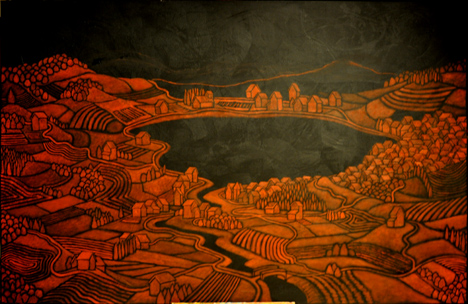
I’ve been documenting the progress  that has been made over the past two weeks on a large canvas on which I’ve been been working.  It’s been a roller coaster of emotion for me as I’ve been working on the 54″ high by 84″ wide painting.  Sometimes I am completely satisfied, thrilled with what is unfurling before me, and at other times I am worried that it may not pop in the way I envisioned in earlier stages.  At the moment, I am closer to happy as the piece has started to come into full sight.

After beginning to bring more light to the sky, I have started adding color to the lake that dominates the center of this piece.  As I do so, I can better see tweaks that need to be made in some of the colors of the landscape around it.  Nothing big but small adjustments that bring it closer to completion. 

After coming to the still dark blue color as shown above, I decided that I wanted the color to be more dominant and added a light teal that really emboldened the whole composition.  I have to better photograph this so there is a bit of glare on the image below.  I also noticed that the sun is showing a bit harsher here, less warm than it actually is.  But this gives you an idea of what is there at the moment.

This painting pretty much dominates everything in the studio at the moment.  It’s big in size and visual impact and my eyes immediately fix on it.  There is still a ways to go but it’s coming closer to being the internal landscape that I envision.


Read Full Post »

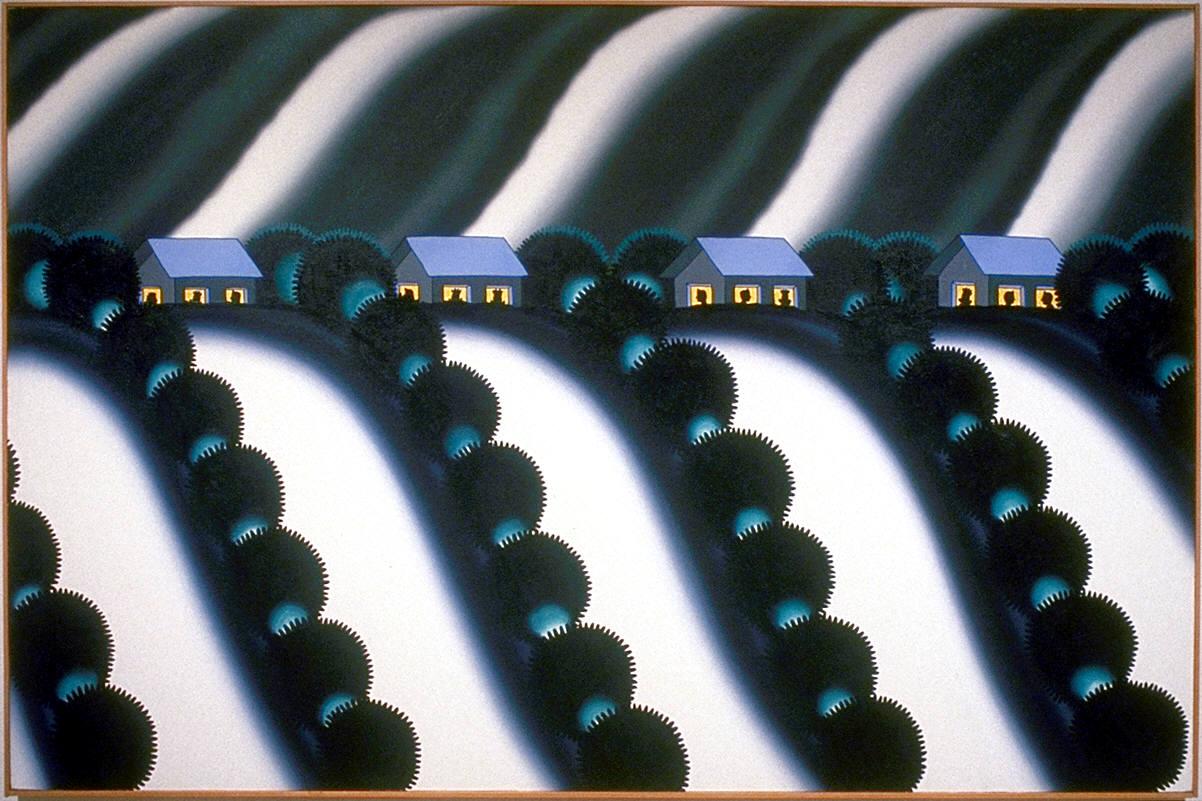
I was looking up something totally unrelated to his work when I stumbled across the paintings of Roger Brown, a painter who was one of the group of Chicago Imagists, an informal school of art in the late 1960’s that had it roots in comic book art, Surrealism and  Primitivism.  The work was highly individual and always bold in style and statement.  When I saw Brown’s images, I wondered how I had missed him before.  Strong work with big rhythmic patterns.  Just plain good stuff that turns my wheels.

Brown was born in Alabama in 1941 and came to Chicago in 1962 to study at the Art Institute of Chicago and remained a resident of the Windy City until his death in 1997 from liver disease at the age of 55.  I can’t give a lot of info here about his biography as I am still learning about his life and work myself.  I will let his images tell the story here .

Read Full Post »

Valentine’s Day

It’s Valentine’s Day.

I’m busy today but I will stop to listen to this song from Steve Earle.  Says it all.

Have a great day.

Read Full Post »

I thought I  would show a bit more of the large canvas I’m working on at the moment.  As I’ve described in previous posts, it’s a 54″ tall by 84″ wide canvas that has been biding its time for nearly 10 months in my studio, waiting for me to finally give it some life.  Well, it’s beginning to take shape and I can see better its final stages, if things work out as I hope.

I’m always a little hesitant to show these pieces in progress because sometimes they lack the life that the final stages of the process bring.  But even though there is still a lot of depth to be added, this piece is gaining animation quickly.  It’s been interesting seeing how the colors of the fields have changed as other colors are added in the process, some of the reds and oranges that seemed to jump off the canvas modulated in intensity by adding varied shades of green and yellows.

I’ve brought the sky to a certain point where it creates enough ambiance that I can be influenced by it  but is not yet at its final intensity.  I see a certain blue in my mind that will be a challenge to pull off here but at least it is there now, pulling at my mind. 

The same goes for the great black void that is a lake in the center of the canvas.  I see a certain color and depth ahead for this critical part of the composition,  which is the focal point for the whole thing, everything else revolving around and reacting to it.  The overall strength of this painting  is dependent on my ability to recreate the color that I see in my mind for this section.  If I don’t reach that visualized color, what could be a very good painting could become a ho-hum piece.  As a result, my mind is always running through methods of achieving that color even while I am at work on other parts of the painting.

Today should be a pivotal day for the bigger part of the composition, as I finish up this layer of color on the landscape and begin adding what may be the final layer for some parts of it.  The composition should really come together at this point,  just waiting for that color in the lake.

We shall see.

Read Full Post »

The Sprout and the Bean

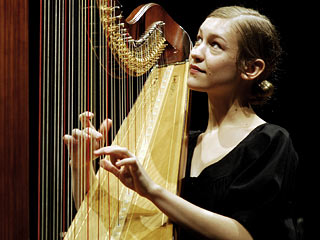
I don’t know a lot about famous harpists except for possibly Harpo Marx, who I have featured here before playing an ethereal Take Me Out to the Ballgame.  To tell the truth I can’t think of another harpist at the moment except for Joanna Newsom.  My nephew introduced me to her music a few years ago and I have to admit it has taken some time for me to warm to it.  It has not been the harp playing, the sound of which I really love. 

 No, it was getting past her voice.

It’s a high, flat voice that some have called childlike, a term to which I understand Newsom objects.  Others have said it is reminiscent of the voices of  the Appalachian hill folk and their traditional songs.  I kind of find it in somewhere in between and had a tough time hearing it set in contrast  against the beautiful tones of the harp.  But I keep listening and there are now many moments when I really see the beauty in her truly unique talent.  The Sprout and the Bean is such a moment.

Have a great Saturday.


Read Full Post »

I’ve been working on my large painting, as I have noted in the past few posts here.  I decided to take a few moments this morning to explore one of my favorites sites at the Foundation for Self-Taught Artists, just to browse for a bit to maybe clear my mind before jumping into today’s work.  I always love browsing the work here, feeling a real affinity with the artists here who often followed a circuitous route to their artistic lives and their personal visions .

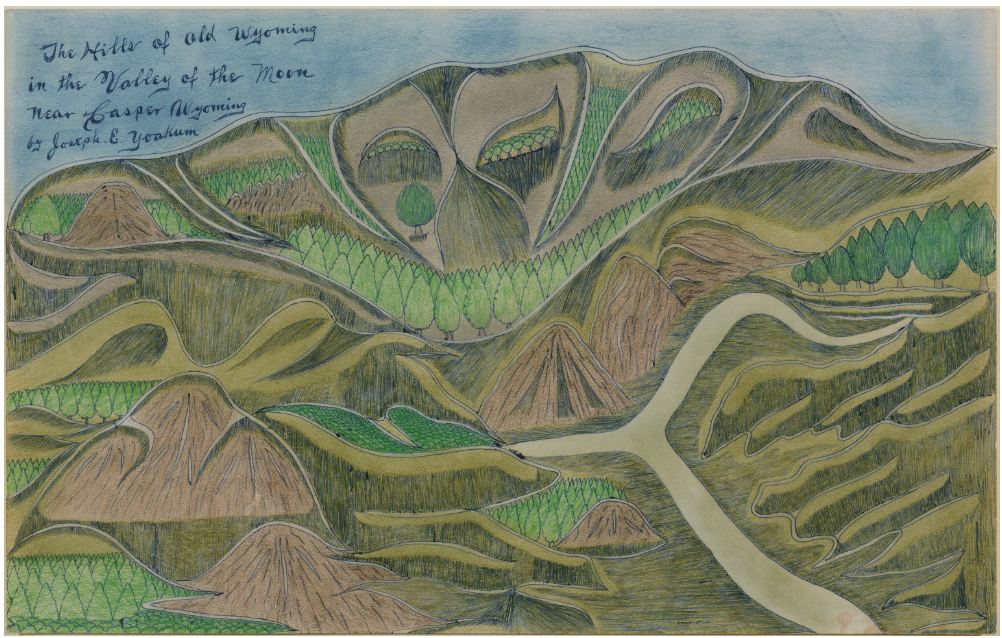
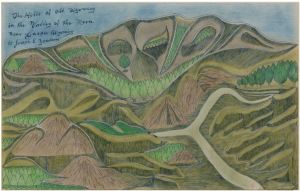
As I clicked through the work, a greenish colored landscape caught my eye.  Called The Hills of Old Wyoming, it immediately reminded me of the piece on which I was working.  I mean, there are obvious differences in the composition and the manner in which it was rendered, but there was something familiar in the manner, the rhythm, in which the artist portrayed the landscape– the hills, the trees and the roads.  I understood his vision in much the same way I understand and see my own.  Makes me feel that there is a commonality of perception in the rhythm of the landscape that compells some, like this artist, Joseph Yoakum, and others, such as myself,  to put down how they perceive the world around them.

Here is a little biographical background from the Foundation’s site:

1890–1972, lived and worked in Chicago, Illinois

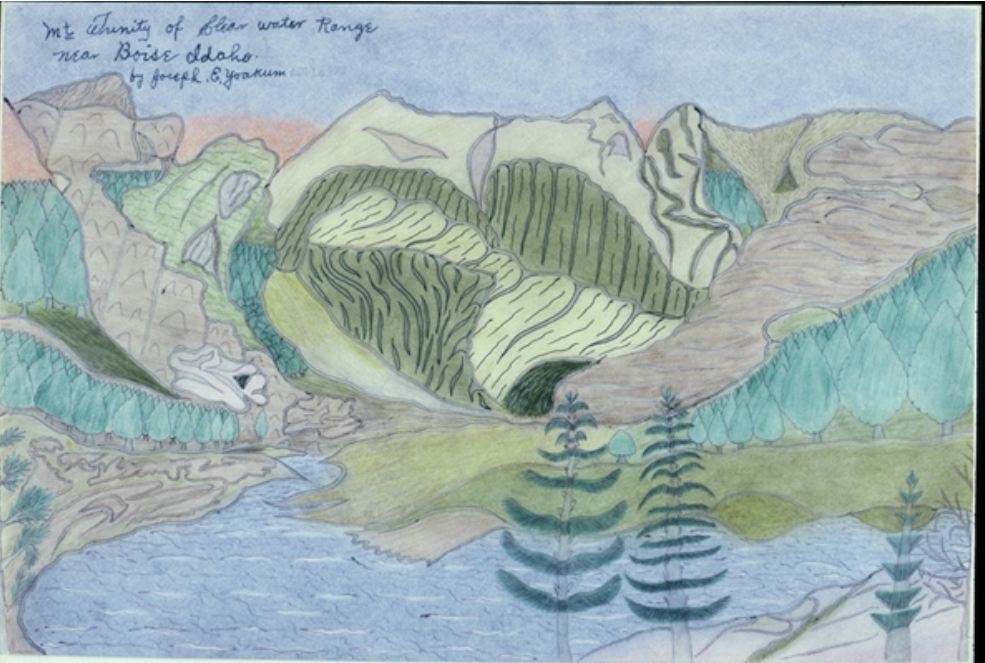
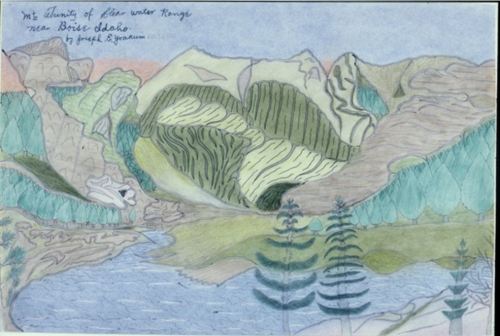
Joseph Yoakum arrived at art in his later years, making approximately 2,000 small-scale drawn landscapes in the last decade of his life. Unlike many self-taught artists, he enjoyed at least a modest amount of appreciation and remuneration from the art world before he died in 1972. While much of Yoakum’s biographical information cannot be verified, he was likely born in 1890 in Missouri to parents of African, French, and Cherokee descent (although he claimed he was born in 1888, in Arizona, to a Navajo family). The artist said that, at age nine, he ran away to join the circus and later traveled the world as a billposter. Upon his return as to the United States, he settled first in Missouri and finally in Chicago. He began drawing in the 1950s, and in 1967 his imaginary landscapes came to the attention of the Hairy Who and Imagist circle of the Art Institute of Chicago. Artists Ray Yoshida, Jim Nutt, and Whitney Halstead praised and promoted Yoakum, who was granted a solo show at the Whitney Museum shortly before his death in 1972. 

A proud world traveler and a deeply spiritual man whose beliefs embraced both Christianity and Navajo animism, Yoakum instilled in his work elements of travelogue and revelation. Usually rendered in ballpoint pen and colored pencil, and then buffed to a shine with toilet paper, these evocative drawings feature a refined color sensitivity, a sublime sense of compositional balance and symmetry, and a sinuous organic line. Most of his drawings include inscriptions indicating the location of the drawn scenes, though the depicted landscapes bear no resemblance to the actual named locations.
 

Read Full Post »

I debated over showing the  progress of the large painting on which I am currently working.  I know that I have done it it the past , especially with this style of work, but I almost felt like I wanted to keep this one more guarded.  It feels kind of like pulling the curtain back on the little man working the controls which make him appear as a much more magnificent Wizard of Oz.  Or maybe it’s like showing how the sausage is made– tasty but nobody wants to see it.

But whatever I thinking, in the end, I decided that I would show how this piece is moving.  If the final product is not worthy, knowing how it came to be so won’t taint it and if it ends up being a good piece, nobody will care or remember.

Again, this is a 54″ high by 84″  (4 1/2′ by 7′) canvas that I have finally decided to start after 10 or so months of pondering it in the studio.  Well, pondering is overstating it.  Avoiding is probably closer to the mark. 

 This is the progress after about three days of roughing in the composition with red oxide paint and I am  finally nearing the end of this this part of the progress.  As I near the terminus where the landscape ends and the sky will begin, I have started roughing in with a piece of rouge chalk, trying to find that final silhouette that will stand out in the final product.  I am hoping to finish this phase today.

So far, I am pleased.  The elements all seem to work well together and the whole composition has a unity that I am looking for.  This is vital especially in a piece of this scale where any element that lacks that sense of rightness will be magnified by the sheer size of the comsposition.  I am really beginning to see how I think the painting will finally emerge and I am getting antsy, wanting to get beyond this initial phase.  But as I said earlier, the key is to not jump ahead, not speed up at any point.  If I make a shortcut now, it will change that final version dramatically.

So, I will be patient.  But I must go.  Gotta paint.

Read Full Post »

I’ve shown pieces with  multiple panels and images here in the past and they often are very regimented, with each panel measured and uniform in size.  There is sense of order in these paintings.  But I’ve been doing a few multiple pieces lately that are less precise, with individual panels that bulge and expand in a fashion that creates a sense of the organic.  I find these pieces very naturally engaging, meaning that the organice nature of the lines create a sense of rightness that lets you take it in easily, without questioning its validity or accuracy.

I think this piece is a good example of what I’m trying to describe here.  It’s a small 12″ square canvas that I’m calling On a Cellular Level.  The raw but right nature of the lines and the interaction between the  individual panels here gives me the sense of each panel being a living cell.  Living and moving, affected by each surrounding even though it is complete within itself.  The RedTree here is part of a group of cells that bulges up and downward, almost like mutated cells.

I don’t know if there’s any meaning in that observation but it makes the piece more alive for me. Less static.

There is just something that I really like about these multiple paintings.  Perhaps it is the power of a simple image presented in an amplified sense.  Kind  of  like tap-dancing.  One person doing a very simple tap step is not that compelling.  But put a hundred people doing the same simple  step together and it becomes a powerful entity.  Or maybe it’s like singing.  One average voice singing a simple tune, while it may be lovely, may not come across as powerful.  But add a hundred voices, none extraordinary, and you have a magnificent chorus. 

Maybe that’s how I will start viewing these multiples, as choruses.  But for now, I see this painting on a cellular level.

Read Full Post »

Tuesday morning and now that I’ve started on the big canvas I showed in yesterday’s post  I find myself obsessed with getting at it.  It’s moving slower than I want but the size makes every decision have more variables to weigh and more angles to inspect.  I’m at the part of the process where I am roughing in the structure of the painting in red oxide paint and even though I am about a quarter of the way through this segment, I can see it starting to take shape and can now see several steps ahead.  Although I don’t yet know where it will finally come to rest, I now have at least an inkling. 

 As I said yesterday, the difficulty is in not trying to hurry the process,  letting it grow slowly and not rushing for my own instant gratification.  And as we all know, that can be a difficult thing to rein in.  But so far, so good and I’m liking what I’m seeing on the canvas and in the forward looking part of my mind.

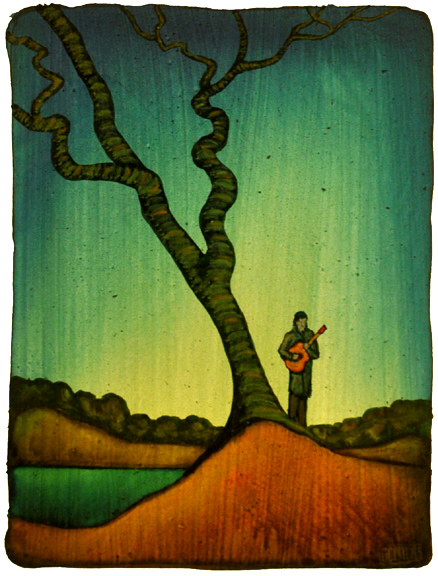
That being said, I’m going to work now.  I think I need some music today and I think I’ll listen to some Gillian Welch, one of my favorites.  This is a beautiful song with a Neil Young feel called Throw Me a Rope that she’s performing with her husband, David Rawlings.  Oh, and the painting at the top is called Audience, which I will now become.

Read Full Post »

Sometimes you find yourself out little bits of advice to other people, never realizing the irony behind the act.  Take yesterday’s post, where I passed on some advice from Chuck Close about getting to work and not waiting for inspiration.  Well, after reading what I had read yesterday morning, I looked across the studio at a large canvas that I had prepared last year, knowing that the time to take Close’s words to heart was at hand.

The canvas is 4 1/2′ by 7′  and has been haunting me for almost a year.  I had written about this canvas in a post last March called Daunting and I guess it must have been just that because I have found excuse after excuse to not start working on it over the past 10 or so months.  Too busy doing other things and the sort.  But in reality I was just plain scared of facing such a large challenge.

But thinking about Close and his words as well as his work and the challenges he has faced in his life made me feel a bit embarassed.  You shouldn’t run away from big challenges.  You should embrace them as an opportunity to simply overcome in a bigger way. I know that and have passed on that advice to others over the years.  Yet, here I was, not heeding my own words.  This was a challenge and to put it off only created other problems of avoidance.

So, I finally put it on the easel and started at it. 

It was difficult to start but it slowly is beginning to take form.  It will be a long process, much longer than I am accustomed to in my work, and I know that this will a challenge.  I will have to fight my urge to shorten the process, to take shortcuts that might not be too noticeable to the outside observer but would nag at me in the aftermath of completion. 

But the battle has been engaged and I am on the way to whatever this canvas holds for me.  We shall see…

Read Full Post »

« Newer Posts - Older Posts »