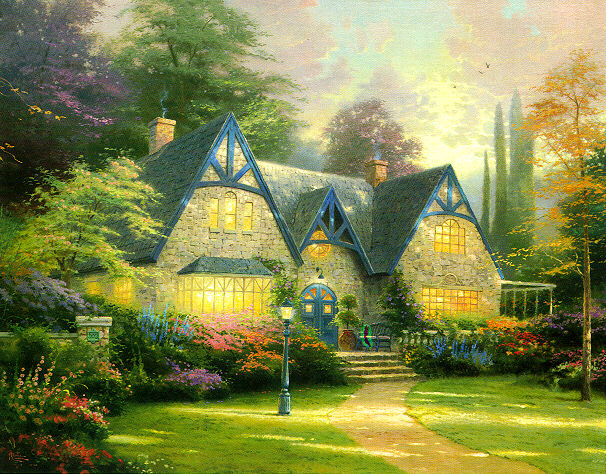
 The death of Thomas Kinkade was announced yesterday. The self=proclaimed Painter of Light was only 54 and his death is attributed to natural causes with an autopsy upcoming to determine what actually caused his early demise.
I am not really sure what to say here. I was not a fan of his work but never really wanted to join those who openly jeered at his often saccharine paintings of thatched cottages with windows that looked like the inhabitants were reading by huge floodlights. To rail against these paintings was to rail against those people who did connect with that sort of art, be it good or bad. And that is not a good thing.
Art is a personal taste and can’t be dictated. You like what you like. And that is as it should be.
And, whether you liked Kinkade’s paintings or despised them, there were those who had a taste for them. A great many of them. His paintings obviously filled a niche. He had legions of fans who bought his prints and paintings and books and mousepads and plates and figurines and on and on. Even homes in communities based on his paintings.
Ubiquitous.
To me, his gauzy paintings always reminded me of walking into our local Loblaw’s grocery store as a child where near the entrance they had inexpensive copies of highly sentimental paintings, undistinguished for the most part, printed on thick gray cardboard stapled into cheap wooden frames. I believe that you could buy them for a few dollars with a certain amount of groceries purchased. That was the artwork of my childhood, the sugary farmsteads and watery city street scenes that adorned seemingly every home I entered as a kid.
I had no judgment of them then but noticed them and their ubiquitity in my world. They aroused no emotion in me. Nothing. I neither liked them nor disliked them. They served a purpose for the folks who had them hanging on their walls and even the tritest piece of this work was preferable to not having anything on the walls of these lower middle- class homes. When I think about Kinkade’s work, that is pretty much how it comes across to me– it arouses no emotion in me and I find myself having no feelings one way or the other. It’s there to cover bare walls and that was okay to me. His mass market approach to art, while a bit distasteful, didn’t offend me. He was simply filling a niche. He took a market that was once filled by my Loblaws supermarket and today is often littered with factory produced works sold in starving artist sales in every Holiday Inn across the country and made it his personal kingdom. He became the face and signature of mass produced work.
And that’s okay, for what it’s worth.
Will it have lasting value to future generations? Now that’s a different story. It will, in the short run, over the next ten or twenty years, probably hold its appeal, and value, for some people. But as the next generations comes along, I have a feeling that Kinkade’s work will be little more than a footnote in the history of art. It’s happened to the great mass artists of most every generation. The popularity they held fades to anonymity over the generations. I could be wrong here but I sincerely doubt it.
Unfortunately, I fear that the people who bought into Kinkade’s sales pitch and paid dearly for his mass produced pieces thinking they would continue to grow in value will be forced to face this reality. And that’s the distasteful part here. Not the in the artistic merit of the work itself, but in the way it was marketed, manipulating people with Christian themes that never seemed to quite jibe with the reality of the artist’s life. There is a marked lack of taste in this.
Oh, well. I feel badly for the human tragedy of his family’s loss. There’s something sad in the premature death of anyone. But I don’t feel the tragedy in not seeing what great works he might have someday produced. His work is all here now. For some, that is enough. For others, too much. For me, it’s just there, like those cardboard paintings at Loblaws.
 Redtree Times
Well stated Gary.
Thanks, Cybthia.
It’s slightly ironic that I knew nothing personal about Kinkade until this morning. His work never interested me, so I never went looking for more information.
I do have an aunt who makes gift-giving easy because she’s such a fan. A little Kinkade address book here, a Kincade jigsaw puzzle there, and she’s happy. I suspect she knows nothing of his personal or business difficulties, and I won’t be telling her.
I remember her saying once that she liked his work because it portrays the kind of peaceful, beautiful world she imagined as a child during the Depression. As she says, “It makes me feel good to look at it.” Whatever you call what he produced, that’s not a bad legacy to leave.
Your aunt is precisely the reason that scorn for his owrk should be set aside. It served a purpose.
As Cynthia said, very well put, Gary. You summed up what I felt yesterday, but I didn’t have the thoughtful words that you have here…
Thanks, LuAnne.
When I was first exposed to Kinkade’s work, it was by a friend who considered his work an assault on civilization. I took your more tolerant view that art is subjective and some people find joy in a Precious Moments knick knack while others get a kick out of pre-Colombian clay figures.
By coincidence, we walked by a Kinkade Gallery that same day and we went inside. Afterwards, I apologized to my friend. He was right. Kinkade’s paintings were an assault. On taste, if not civilization. As Ellington said about music: there are two kinds – good music and bad music.
Kinkade’s paintings were bad. Very bad. Even in something as subjective as art, one has standards.
I’m not going to argue anything that you’ve said here, David. I never went into any of his “galleries” probably partly because I knew my head would probably explode but mainly because I just never gave what he did any weight or thought. His work was mere product to me. Nothing more. When I did take notice it was for the manipulative nature of his marketing which was, as you say, an assault. The words he used to shill his product reeked of insincerity and that bothered me because so many people apparently did not see what seemed so obvious to me. I just hated to see anyone take such advantage of gullible people.
Seems as if one could apply one of your amiel journal intime quotes to kinkade: “Learn to… be what you are, and learn to resign with a good grace all that you are not.” He painted what was right for him. i didnt like his art personally, but it did have a good fantasy / instant gratification / visual warmth sorta thing goin’ on.