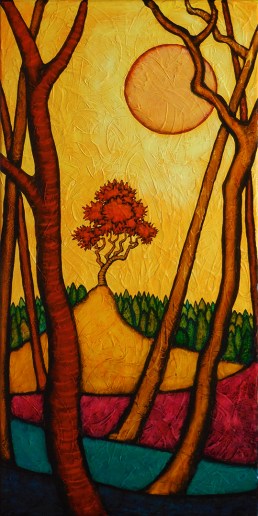
Narrow Passage– At West End Gallery
I have said many times here that I am not a religious person. Oh, I have my own personal beliefs that are both vague and concrete in their formulation.
They may not align with other organized belief systems, especially not to the dogmatic and politicized forms of most religions that abound at the moment.
My beliefs are mine alone. They may not line up with yours. Or anyone, for that matter. And that’s okay–I am not asking you to understand or share them. So long as I am not hurting you or telling you that you must live your life based on my beliefs, that should be acceptable to anyone. In much the same way that you should not expect me to live my life based according to only your beliefs.
But I do respect theology in its purer form, where there is a study and comparison of the multitude of religions, striving to reveal the many commonalities that exist between the belief systems of peoples.
I mention this today because I wanted to share a short essay from C.S. Lewis. Most of you no doubt know him from his wildly popular Narnia books and films. He was also a lay theologian of the Anglican Church who wrote numerous books and essays dealing with his faith, often in a way that was accessible to those whose belief systems might be outside his Christian faith.
The essay below is from his 1940 book The Problem of Pain. It is titled The Signature of the Soul and deals with the uniqueness of each individual and how each of us often seek something we can only define in the vaguest of terms. It very much speaks to aspects of that which I seek for myself in my work.
It’s a lovely piece of writing, even for one as irreligious as myself. I may not completely share his belief system, but he makes clear the point that we– all of us, not just me– share much more than that.
There have been times when I think we do not desire heaven; but more often I find myself wondering whether, in our heart of hearts, we have ever desired anything else. You may have noticed that the books you really love are bound together by a secret thread. You know very well what is the common quality that makes you love them, though you cannot put it into words: but most of your friends do not see it at all, and often wonder why, liking this, you should also like that…
Are not all lifelong friendships born at the moment when at last you meet another human being who has some inkling (but faint and uncertain even in the best) of that something which you were born desiring, and which, beneath the flux of other desires and in all the momentary silences between the louder passions, night and day, year by year, from childhood to old age, you are looking for, watching for, listening for? You have never had it. All the things that have ever deeply possessed your soul have been but hints of it — tantalising glimpses, promises never quite fulfilled, echoes that died away just as they caught your ear. But if it should really become manifest — if there ever came an echo that did not die away but swelled into the sound itself — you would know it. Beyond all possibility of doubt you would say ‘Here at last is the thing I was made for.’ We cannot tell each other about it. It is the secret signature of each soul, the incommunicable and unappeasable want, the thing we desired before we met our wives or made our friends or chose our work, and which we shall still desire on our deathbeds….
This signature on each soul may be a product of heredity and environment, but that only means that heredity and environment are among the instruments whereby God creates a soul. I am considering not how, but why, He makes each soul unique. If He had no use for all these differences, I do not see why He should have created more souls than one. Be sure that the ins and outs of your individuality are no mystery to Him; and one day they will no longer be a mystery to you. The mould in which a key is made would be a strange thing, if you had never seen a key: and the key itself a strange thing if you had never seen a lock. Your soul has a curious shape because it is a hollow made to fit a particular swelling in the infinite contours of the Divine substance, or a key to unlock one of the doors in the house with many mansions. For it is not humanity in the abstract that is to be saved, but you — you, the individual reader, John Stubbs or Janet Smith. Blessed and fortunate creature, your eyes shall behold Him and not another’s. All that you are, sins apart, is destined, if you will let God have His good way, to utter satisfaction… Your place in heaven will seem to be made for you and you alone, because you were made for it — made for it stitch by stitch as a glove is made for a hand.
Let us be thankful that God loves us as individuals and that we can have a personal relationship with Him.
— C.S. Lewis, The Signature of the Soul, 1940
 Redtree Times