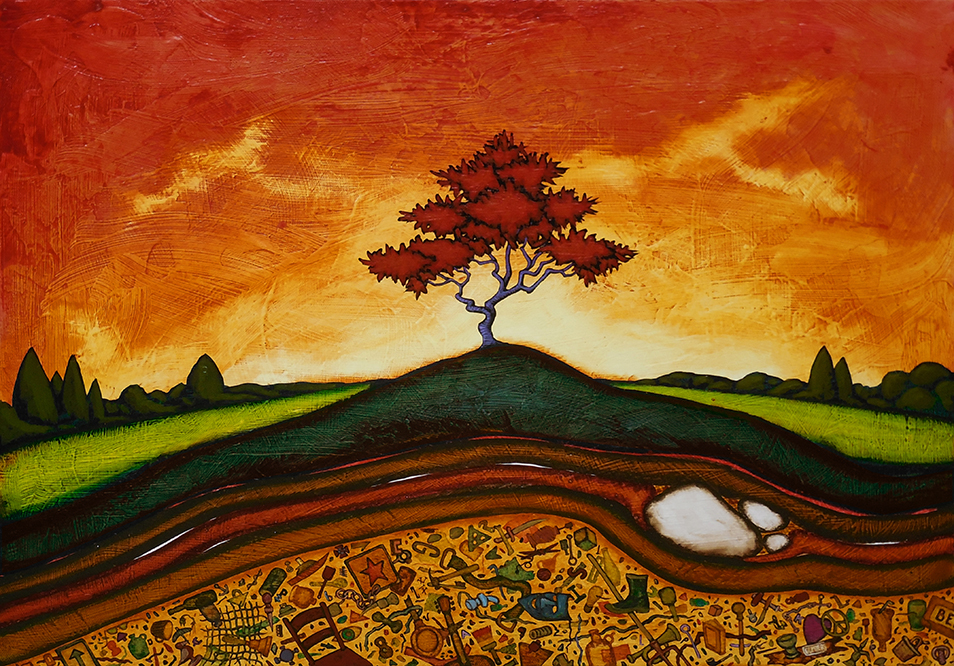
Archaeology: The Golden Age Beyond — At Principle Gallery
At Saturday’s Gallery Talk at the Principle Gallery, I started by speaking about how my painting came about as a result of a lifelong search to identify my own belief system. I feel that everyone has some sort of belief system– even atheism is a belief system– and had always wanted to understand why we were here and what our purpose truly was.
Eventually, the talk turned to the Red Tree. That was fortuitous since it has become an icon for me of some sort of the sort of cobbled together belief system I have come to hold. I went on to read a passage from Hermann Hesse on his own feelings on the meaning and importance of trees.
Hesse holds a place in the formulation of my belief system, something I didn’t mention this during the talk. At a dark low point in my life, I had come across a book, Demian, by Hermann Hesse that I believe saved my life. I have read many of his other works and have gleaned bits here and there but that one resonated most with me and the turmoil I was experiencing at the time.
But I was equally affected when I came across the passage from Hesse below on what we can learn from listening to trees from Hermann Hesse. The late Nobel Prize winning writer included this in his 1920 book, Wandering: Notes and Sketches. It well describes much of what I have received from the Red Tree, things that have contributed to my belief system.
There is a lot to like here but I was most struck by the line: Home is neither here nor there. Home is within you, or home is nowhere at all.
That line would be included in the Proverbs section of my belief system.
I thought it would be fitting to include his essay here once again. I have also included a reading of this selection at the bottom. I have listened to several and they often miss the mark for me. This one is fairly good, in my opinion. But perhaps you should just read it in your own voice. Here it is, if you choose that route:
For me, trees have always been the most penetrating preachers. I revere them when they live in tribes and families, in forests and groves. And even more I revere them when they stand alone. They are like lonely persons. Not like hermits who have stolen away out of some weakness, but like great, solitary men, like Beethoven and Nietzsche. In their highest boughs the world rustles, their roots rest in infinity; but they do not lose themselves there, they struggle with all the force of their lives for one thing only: to fulfill themselves according to their own laws, to build up their own form, to represent themselves. Nothing is holier, nothing is more exemplary than a beautiful, strong tree. When a tree is cut down and reveals its naked death-wound to the sun, one can read its whole history in the luminous, inscribed disk of its trunk: in the rings of its years, its scars, all the struggle, all the suffering, all the sickness, all the happiness and prosperity stand truly written, the narrow years and the luxurious years, the attacks withstood, the storms endured. And every young farmboy knows that the hardest and noblest wood has the narrowest rings, that high on the mountains and in continuing danger the most indestructible, the strongest, the ideal trees grow.
Trees are sanctuaries. Whoever knows how to speak to them, whoever knows how to listen to them, can learn the truth. They do not preach learning and precepts, they preach, undeterred by particulars, the ancient law of life.
A tree says: A kernel is hidden in me, a spark, a thought, I am life from eternal life. The attempt and the risk that the eternal mother took with me is unique, unique the form and veins of my skin, unique the smallest play of leaves in my branches and the smallest scar on my bark. I was made to form and reveal the eternal in my smallest special detail.
A tree says: My strength is trust. I know nothing about my fathers, I know nothing about the thousand children that every year spring out of me. I live out the secret of my seed to the very end, and I care for nothing else. I trust that God is in me. I trust that my labor is holy. Out of this trust I live.
When we are stricken and cannot bear our lives any longer, then a tree has something to say to us: Be still! Be still! Look at me! Life is not easy, life is not difficult. Those are childish thoughts. . . . Home is neither here nor there. Home is within you, or home is nowhere at all.
A longing to wander tears my heart when I hear trees rustling in the wind at evening. If one listens to them silently for a long time, this longing reveals its kernel, its meaning. It is not so much a matter of escaping from one’s suffering, though it may seem to be so. It is a longing for home, for a memory of the mother, for new metaphors for life. It leads home. Every path leads homeward, every step is birth, every step is death, every grave is mother.
So the tree rustles in the evening, when we stand uneasy before our own childish thoughts: Trees have long thoughts, long-breathing and restful, just as they have longer lives than ours. They are wiser than we are, as long as we do not listen to them. But when we have learned how to listen to trees, then the brevity and the quickness and the childlike hastiness of our thoughts achieve an incomparable joy. Whoever has learned how to listen to trees no longer wants to be a tree. He wants to be nothing except what he is. That is home. That is happiness.
 Redtree Times
Gary, thanks for the Hesse passage today. I liked it a lot and it will be spinning around in my thoughts for a while now. I think that I might print it out and put it on my office wall.
Regards, Cliff