Feeds:
Posts
Comments

Archive for December, 2024

Peanuts Dec 31 1974Peanuts Dec 31 1983Peanuts Dec 31 1980


And now let us believe in a long year that is given to us, new, untouched, full of things that have never been, full of work that has never been done, full of tasks, claims, and demands; and let us see that we learn to take it without letting fall too much of what it has to bestow upon those who demand of it necessary, serious, and great things.

― Rainer Maria Rilke, Letters of Rainer Maria Rilke, 1892-1910


I felt that the last day of the year deserved a post. But I am not feeling very peppy this morning, if peppy is even a real term, and my brain didn’t feel like serving up anything new.  As a result, I am kind of turning to the archives for today’s post. It’s from four years back but it holds up because of a great song. some minor editing, and the addition of three Peanuts strips in place of the big bloodshot eye that adorned the original. Each of the three strips ran on this date in their respective years. I think the center one with Lucy and Linus best fits my feeling today.

Just glad to still be here today. And tomorrow, if the lord’s willin’ and the creek don’t rise, as the old saying goes. See you on the other side, in the year 2025.

Sounds kind of science-fiction-y, doesn’t it? I don’t know if that’s good or bad but it doesn’t sound good at first blush. We shall see,


Gosh, I wish Rilke was sending me letters. I always seem to find something in his collected letters that speaks directly to me, something that helps me better understand my own place in the world.

Give me his letters and a Peanuts comic strip and I am all set for perspective and advice on how to live my life.

Rilke’s words above on the New Year speak loudly this year. Let us look at the coming new year as a clean slate, a tabula rasa, that that is filled with new potential. The time ahead may be filled with hard work and stressful times but we should use every available minute of it in attempting to make this new year far better than its predecessor.

I know that these words can sound like empty platitudes but I truly hope they ring true this year and that we don’t waste the gift of time we are given.

Have a happy and quiet New Year’s Eve. Stay safe and perhaps next year at this time, we can truly celebrate the end of a wonderful year.

For those of you who don’t buy into my hopeful look forward and plan on partying your brains out tonight, here’s a song from Wynonie Harris, the great blues shouter who many consider the father of rock and roll. His style and his stage moves, including provocative hip gyrations, were swiped and adapted by Elvis, who some thought was the G-rated version of Wynonie Harris. His stuff really rocks and this song, Don’t Roll Those Bloodshot Eyes at Me, reminds me of the best work of Louis Prima, which is pretty high praise.

So, enjoy and bid goodbye to 2024 tonight in whatever way you see fit. May we do the necessary work so we all have a happy New Year in 2025.


Read Full Post »

Character

Watchful-Presence-GC Myers

Watchful Presence-– At Principle Gallery


Perhaps a man’s character is like a tree and his reputation like its shadow. The shadow is what we think of it; the tree is the real thing.

Abraham Lincoln, Washington in Lincoln’s Time (1896)


Sadly, Jimmy Carter passed away yesterday at the age of 100

He was indisputably a man of character.

Honest, principled, compassionate, unselfish, and highly intelligent. I could probably add any number of other positive attributes here, but that would be like pointing out high limbs on an already towering tree.

We probably didn’t deserve him. Our character seldom matched his and it sometimes felt as though we almost resented the strength and goodness of his character, even though he never preached at us. It was as though our own lacking character was somehow shamed by his. 

We shunned honesty and accountability, instead repeatedly displaying our preference for flattery, meaningless slogans, unfulfilled promises, and empty reassurances that there were easy answers to all our problems.

It has come to the point where we almost beg to be told lies so the smallness of our own character is not revealed.

As a result, character such as that of Jimmy Carter has become an almost disqualifying quality in our elected officials. We may never see the likes of Jimmy Carter again in public life. The current environment of manipulated information and media makes such tall trees susceptible and too easily felled.

Where tall trees should stand, we now place tiny, twisted shrubs, whose shadows are equally short and twisted.

Jimmy Carter may have been the last of the tall trees.

We still stand in your shadow. Good travels to you in the afterlife, Mr. President. 


The quote at the top comes from an 1896 book, Washington in Lincoln’s Time, from Noah Brooks, who had first encountered Lincoln during Brooks’ time as young journalist in Illinois. Brooks became a close friend of the Lincoln family and wrote this book based on his conversations and travels with Lincoln, This quote about trees came in a conversation a day after Brooks had spent the day with Lincoln in Virginia where the President stood on a tree stump and talked about how he loved the shape of the silhouettes that leafless made against the sky and the fineness of the shadows they and their branches cast upon the ground.

Lincoln was another towering tree of character.

A little additional info:  Noah Brooks also wrote the first novel exclusively about baseball, Our Base Ball Club and How It Won the Championship, in 1884.

Read Full Post »

To the Main Road
At West End Gallery

I have been thinking about the difference between our highs and lows, between those times when we feel on top of the world and those times when we feel as though we are in an abyss. It’s a typical holiday theme for me, when such contrasts seem to stand out among so many people, including myself.

I wonder what it is in an individual that makes them swing one way or the other, high or low. Is it a massive difference in circumstance and perception between these people?

Or is it just matter of degrees? Could it be that there are times when we only feel 51% positive about everything but that is enough to swing us to what feels like a high point?  And could there be other times when we are only feeling 51% gloomy but that tips the scales enough so that we feel as though the bottom has dropped out on one’s life? 

It seems plausible, given how quickly these swings can shift. But maybe that’s just me. I don’t know, of course. Just thinking out loud. Actually, this thought came after coming across the post below from four years back where the poet Maggie Smith (not the wonderful British actress who we lost this past year) described life as at least fifty percent terrible. Made me think of things in matter of degrees and what is entailed in shifting those the balance one way or the other. I would really like to know.

At the very bottom, I have added this week’s Sunday Morning Music. It’s Superstar from the Carpenters, the brother-sister duo that I never shared here before. Probably because I wasn’t a fan when I was kid and they were everywhere, constantly on the radio and TV. You couldn’t flip on a variety show back then without seeing the two. But over the years, I came to truly appreciate them, especially the glorious tone of Karen Carpenter‘s voice. Her voice seldom fails to provoke a response within me. That would have been a shock to the 12-year-old me back in the day.

But I made the choice of this song not only because it is beautifully written (Leon Russell wrote it with singer Bonnie Bramlett of Delaney & Bonnie), arranged, and performed, but because Karen Carpenter knew more than a little about living a life of shifting degrees. Give a listen and be thankful if you’re seeing the world at least 51% positive today.


GOOD BONES/ by Maggie Smith

Life is short, though I keep this from my children.
Life is short, and I’ve shortened mine
in a thousand delicious, ill-advised ways,
a thousand deliciously ill-advised ways
I’ll keep from my children. The world is at least
fifty percent terrible, and that’s a conservative
estimate, though I keep this from my children.
For every bird there is a stone thrown at a bird.
For every loved child, a child broken, bagged,
sunk in a lake. Life is short and the world
is at least half terrible, and for every kind
stranger, there is one who would break you,
though I keep this from my children. I am trying
to sell them the world. Any decent realtor,
walking you through a real shithole, chirps on
about good bones: This place could be beautiful,
right? You could make this place beautiful.


I came across this 2016 poem from American poet Maggie Smith very early this morning and it really struck a chord. 

We all want things right now, want them to be complete and perfect. Move in ready. But things are seldom that way. It requires imagination and desire to see the potential that things hold. And hard work and determination to reach that potential.

“This place could be beautiful, right? You could make this place beautiful.”

Indeed.

I had never seen or heard this poem but it is quite well known. It has been read and published around the world and Maggie Smith is often asked to read it at events. She calls it her Freebird, which is quite a funny line.

It was written in the aftermath of the 2016 shooting at the Pulse nightclub that killed 49 people. Its popularity was maintained through the momentous 2016 elections here and in the UK –it was called “Official Poem of 2016” by the BBC/Public Radio International— and has continuously popped up throughout the past four years as folks to try to maintain optimism in the dark atmosphere that has marked this era.

I somehow missed it until about 5:30 this morning. Always late to the dance.

But I imagine that this poem will remain popular because, as she points out, the world is at least fifty percent terrible and will no doubt remain so. It will always require plenty of imagination, desire, determination — and throw in loads of blood, sweat and tears– to overcome the awfulness that resides side-by-side with us in this world so that we can make it into that perfect home we all dream of for ourselves.

“This place could be beautiful, right? You could make this place beautiful.”

Indeed.


Read Full Post »

Too Many Moons
At Principle Gallery


We may never never meet again, on that bumpy road to love
Still I’ll always, always keep the memory of

The way you hold your knife
The way we danced until three
The way you changed my life
No, no they can’t take that away from me
No, they can’t take that away from me

–George and Ira Gershwin, They Can’t Take That Away From Me, 1937


Coming to the end of the year. As with most every year, there are some things that beg to be forgotten– it seems like there are more of these than normal this year. Not my favorite year in many ways.

But even so, there are always things that I want to remember, things that I want to hold onto that mark this year. Some are bigger memories and some are tiny but everlasting– an impression of a smile or glance from another. A kind word from a stranger or a friend.

Things that remain with you through thick and thin. Things that stay when all else is lost.

Things that can’t be taken away.

Like the old Gershwin song says.

The song, They Can’t Take That Away From Me, was written by the George and Ira Gershwin and first performed by Fred Astaire in the 1937 movie Shall We Dance. George Gershwin died two months after the film’s release. Since that time the song has become one of the great entries to the American songbook, performed by a seemingly endless list of jazz and pop singers. There are so many great versions of this song by some of the greatest vocalists of all time that it’s hard to pick one that might stand out for everybody.

For myself, I always come back to the Billie Holiday versions of the song which she started performing in 1937. I like her early performances but the one below from 1957 is a favorite. It’s a great version that is a clean and bright production with top notch players–Ben Webster on sax and Barney Kessel on guitar– backing her.

Give a listen. And pay heed to those deep memories that no one can take away from you.


Read Full Post »

Amor Fati

9924132 Passing Through Blue sm

Passing Through Blue– At West End Gallery


“I want to learn more and more to see as beautiful what is necessary in things; then I shall be one of those who make things beautiful. Amor fati: let that be my love henceforth! I do not want to wage war against what is ugly. I do not want to accuse; I do not even want to accuse those who accuse. Looking away shall be my only negation. And all in all and on the whole: some day I wish to be only a Yes-sayer.”

― Friedrich Nietzsche, The Gay Science: With a Prelude in Rhymes and an Appendix of Songs (1882)


Amor fati. The love of fate and everything it brings– good and bad.

It is an idea, as proposed by Nietzsche, of having to accept, along with the highs of one’s life, all the lows that tag along with the inevitable suffering that comes with being a human. Loss, grief, sadness, illness, aging– all these things can never be fully avoided. They come to us all in time.

Amor fati stresses that such unavoidable suffering is simply part of who and what we are. It is therefore necessary for our experience as humans to embrace this suffering, to take comfort in knowing that our suffering is not limited to ourselves alone. That it is universal and that there is beauty and grace to be found within it. 

Of course, nobody wants to hear that. we all want a life free of suffering of any sort. That desire, too, is only human. My belief is that by knowing we are always susceptible to the inherent suffering of this life, we begin to understand that we have the ability to control our reaction to our suffering, that we do not have to be overwhelmed by it. 

I have carried this idea with me for quite some time, long before I heard of amor fati, that recognizing that we have a choice in how we react allows us to persevere through our down times. That comes in handy this time of the year for me when I always feel a little more glum or stressed. I know I have a choice in how I cope to what I have come to see as a natural cycle, that I don’t have to react rashly or impulsively.

As I have said before, knowing that the black birds of sadness can come to my trees at any time makes them tolerable. They are just part of the deal in being human. Not too high a price to pay in my opinion.

Amor fati.

Here’s a longtime favorite song, How Blue Can You Get?, from the late great B.B. King. This is from his classic 1964 album Live at the Regal. I first came across it when I was going through the used bin at a local record shop in the late 1970’s and found a beat-up copy of the recording of the fabled show from the Chicago theater. The album was well worn as though whoever had owned it before had played the hell out of it.  

From the second the needle on my turntable snapped into the groove, I understood why that was so. Pure electric, a perfect storm of time, place and people made every moment of that record crackle. One listen and you knew it was about as good as it gets. I still get shivers when I hear it.

Gets me through my own blues.


Read Full Post »

Edward Gorey Great Veiled Bear Christmas


May the Great Veiled Bear bless your holiday with cookies this year.


I am looking out my studio windows into the darkness with the hope that the Great Veiled Bear shows up with a cookie for me. I like cookies…

A favorite from Edward Gorey. Merry Christmas.

Read Full Post »

Holiday Touchstones

gc-myers-archaeology-happy-holidays-2011-sm


We’re so caught up in our everyday lives that events of the past, like ancient stars that have burned out, are no longer in orbit around our minds. There are just too many things we have to think about every day, too many new things we have to learn. New styles, new information, new technology, new terminology … But still, no matter how much time passes, no matter what takes place in the interim, there are some things we can never assign to oblivion, memories we can never rub away. They remain with us forever, like a touchstone.

― Haruki Murakami, Kafka on the Shore


I certainly agree with the paragraph above from Murakami’s acclaimed novel. Over the years my ability to learn– or at least remember what I have attempted to learn– has diminished. I often read or see something new now and consciously try to register it into my memory. But once done, it seems to dilute and run into all the other factoids and processes and thises and thats that have been put there in recent times. It all becomes a dull blob from which I can discern barely anything.

Maybe that blob is the oblivion to which Murakami refers. Data goes in, nothing comes out.

But ask me about a Christmas 50 or 60 years ago and I can recall it well, often with details of aroma and sound and texture. The taste of a holiday goodie. The smell of the tree and the warm feeling from its light in the evening.

Maybe the occasion or the underlying feeling made it a touchstone for me. I don’t know. Memory is a funny thing. You can never tell what will imprint deeply on it, what will remain vivid many years later.

It is sometimes a gift, sometimes a curse. I tend to view those deep memories from holiday season past as a gift.

I hope you do as well. Or will make new memories that press themselves deep into your memory bank. New touchstones.

Have a good holiday. Here’s song that I played ten or eleven years back. It is a holiday song but one most likely not played on your local radio station this time of the year. It’s a beautiful version of the traditional A Child is Born done by the late jazz trumpet player Thad Jones with the Mel Lewis Jazz Orchestra.

A lovely and sumptuous song to slow down the moment so that maybe you can remember it later. Let that be a gift to you.


Read Full Post »

GC Myers- Archaeology- Déjà Vu sm

Archaeology: Déjà Vu— At Principle Gallery, Alexandria, VA


The fields are fair in autumn yet, and the sun’s still shining there,
But we bow our heads and we brood and fret, because of the masks we wear;
Or we nod and smile the social while, and we say we’re doing well,
But we break our hearts, oh, we break our hearts! for the things we must not tell

The Things We Dare Not Tell, Henry Lawson (1867-1922)


A video for this poem popped up in my YouTube feed for some algorithmic reason I can’t comprehend. I am glad it did.

I first encountered the Australian writer Henry Lawson (1867-1922) a few years back when I stumbled across a poem of his, The Wander-Light, that I shared here. It has been a pretty popular post, receiving a number of views on a daily basis. Doing some research back then, I found that Lawson is an Australian icon, considered to be perhaps the country’s greatest poet and short story writer.  He was a brilliant writer and storyteller but struggled with alcoholism and mental illness for much of his life until dying at the relatively young age of 55 from a cerebral hemorrhage.

Watching the reading of the poem below, I began to think about the secrets we all carry. Oh, we may claim or attempt to be transparent, but we all maintain words and deeds and beliefs that we share with no one. Some we don’t share because, to be honest, they are things nobody would care to hear. Some are too shameful or painful or embarrassing to release from our grip.

I probably share too much here and in my talks. More than most. Mainly because I believe that transparency has a liberating effect. But even so, there are things that will no doubt go unshared to my grave. Well, that is, if I ever decide to die. If I don’t, I might break my silence in a couple of hundred years or so.

It makes me wonder what secret things others will carry to their graves, the good and the bad. Will they ever reveal themselves to some future archaeologist or researcher? Are they hidden somewhere, like one of the artifacts in the Archaeology piece at the top, waiting to be unearthed then put together like a strange and wonderful jigsaw puzzle? Small bits that together tell a bigger story?

The other thing that comes to mind is the one line in Lawson’s poem that resonated most with me:

Oh, the world would be such a kindly world if all men’s hearts lay bare!

I believe it but wonder if that is true. Do secrets keep us apart? Would revelation of all things hidden somehow bring us together?

I don’t know the answer. My lack of answers is no secret, that’s for sure.

Maybe we need those secret things just to maintain that feeling of mystery that comes with not knowing everything about everyone. 

Might that mystery be the thing that drives all types of creativity?

Could be. I don’t really know.

Okay, got to run. I have secrets waiting to be buried as well as some to be shared. It’s the sorting out that counts.

Here’s the poem from Henry Lawson along with the whole poem below it.


The Things We Dare Not Tell

The fields are fair in autumn yet, and the sun’s still shining there,
But we bow our heads and we brood and fret, because of the masks we wear;
Or we nod and smile the social while, and we say we’re doing well,
But we break our hearts, oh, we break our hearts! for the things we must not tell.

There’s the old love wronged ere the new was won, there’s the light of long ago;
There’s the cruel lie that we suffer for, and the public must not know.
So we go through life with a ghastly mask, and we’re doing fairly well,
While they break our hearts, oh, they kill our hearts! do the things we must not tell.

We see but pride in a selfish breast, while a heart is breaking there;
Oh, the world would be such a kindly world if all men’s hearts lay bare!
We live and share the living lie, we are doing very well,
While they eat our hearts as the years go by, do the things we dare not tell.

We bow us down to a dusty shrine, or a temple in the East,
Or we stand and drink to the world-old creed, with the coffins at the feast;
We fight it down, and we live it down, or we bear it bravely well,
But the best men die of a broken heart for the things they cannot tell.

— Henry Lawson

Read Full Post »


GC Myers- Affirmation  2024

Affirmation— Now at Principle Gallery

Take refuge in silence. You can be here or there or anywhere. Fixed in silence, established in the inner ‘I’, you can be as you are. The world will never perturb you if you are well founded upon the tranquility within. Gather your thoughts within. Find out the thought centre and discover your Self-equipoise. In storm and turmoil be calm and silent. Watch the events around as a witness. The world is a drama. Be a witness, inturned and introspective.

– Ramana Maharshi


This time of year is one of stress for many, especially for those who are a bit withdrawn. There’s a lot of motion and sound surrounding the tension that comes with the obligation in trying to please others. The calming effect of silence is absent. Thinking about this brought me to the post below from back in 2013, one that I have never revisited. It seems to speak, in a way, to the need for that bit of quiet that might be missing in the season. 

Since this is the time for Sunday Morning Music and since it is the holiday season, I thought I’d share a Christmas song that is as calming as they come. It’s the late great Vince Guaraldi and his Christmastime is Here. This is the instrumental version without the chorus of kids. It’s a good listen anytime of the year.


[From 2013]

I often speak of seeking quiet, even absolute silence. I all too often come up short in my search, usually the victim of my own fears and shortcomings which cause me to fill the void around me with sound and chaos.

Silence is pushed aside.

It is only in those times when I allow myself to be pulled completely into my work that I feel the silence slowly creeping back in, stilling the fears and doubts that seem to wail around me like sirens at times. It is at these moments while painting that I feel in a small way as though I am like a witness that the great guru Ramana Maharsi advises us to be in the passage above.

I am then calm and silent. I watch and gather my inner thoughts as I feel myself melding with the colors and forms before me. It is absolute peace as I go deeper into this inner realm.

That’s as close as I can describe in words the feeling I have when I lose myself to painting. The painting shown here is an example of this feeling. It is a different painting than the one shown in the 2013 post. But like that painting, the one shown, Affirmation, is simple and quiet yet richly harmonious and full.

It feels outside of time, always in the present. It is both inward and outward looking, a silent witness that is not fearful of the future or regretful of the past. It is just as it is– quiet and placid.

All that I seek.


Read Full Post »

GC Myers- Absorbing Quiet

Absorbing Quiet— At West End Gallery


A world where beauty and logic, painting and analytic geometry, had become one.

–Aldous Huxley, After Many a Summer Dies the Swan, 1939


I am relatively sure that my use and interpretation of this passage from a novel by Aldous Huxley is a departure from its original context. The novel, which is considered by some to be the inspiration for Orson Welles’ Citizen Kane script, concerns an ultrawealthy movie mogul who lives with a Hollywood starlet in a vast estate where he displays the products– rare art, for example– of his unquenchable acquisitiveness.

The novel is mainly concerned with his desire to acquire the one thing he can’t have–immortality. The title of the novel is a line from Tithonus, a poem from Alfred Tennyson. which is about a king who asks the gods for immortality.  It is granted but the king has overlooked asking for eternal youth. As he ages, he grows ever physically older and frailer. His immortality becomes a horrible and never-ending burden.

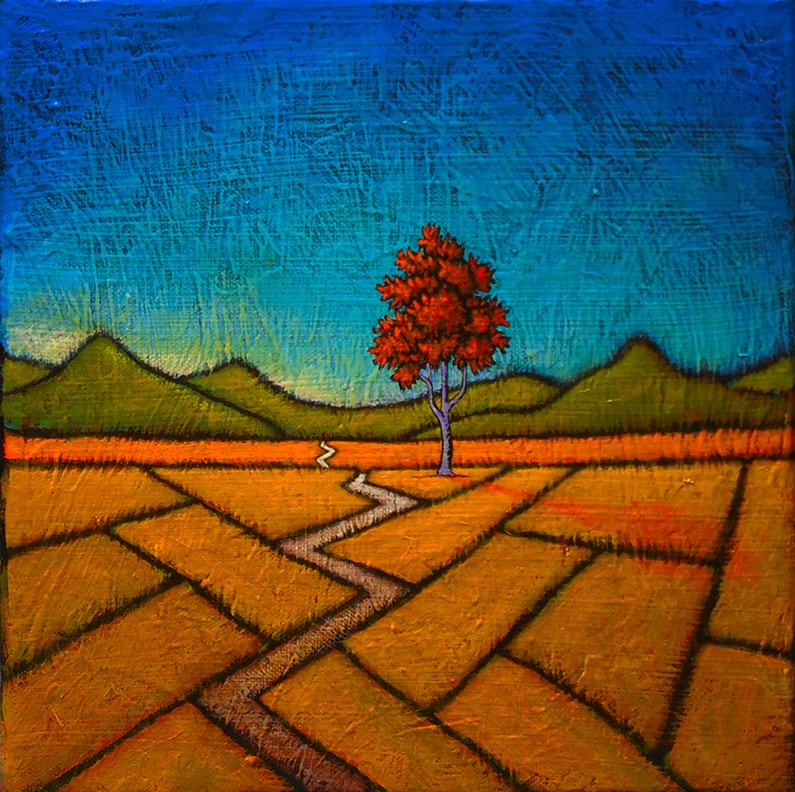
The painting here, Absorbing Quiet, obviously has nothing to do with either novel or the poem. However, I felt that the line from Huxley above captured what I was seeing in this piece– beauty and geometry and maybe a little logic all coming together to create a moment of stillness. And the Red Tree at the center of this stillness, contentedly taking it all in.

Satisfied with what ii contained in that moment, not craving more. Not immortality nor youth. Not fame nor fortune.

Just content in its place in the geometry and beauty of the moment.

An immortal moment.

True wealth. 

You’ve probably had enough Christmas music at this point of the season so here’s a song to go along with the thought. It’s Baby You’re a Rich Man from the Beatles. It beats hearing Last Christmas for the umpteenth time from Wham! or the seemingly endless string of singers who have covered it.


Read Full Post »

Older Posts »