Feeds:
Posts
Comments

Archive for February, 2025

Heart’s Fortress– At West End Gallery


Fortify yourself with contentment, for this is an impregnable fortress.

–Epictetus


Epictetus probably personally knew a thing or two about building a fortress out of contentment. He was a Greek Stoic philosopher born into slavery in the middle of the first century AD. In Rome, he served as a slave to a powerful and wealthy man who was secretary to Emperor Nero. His owner recognized that Epictetus, who also had a disability caused in his childhood which required him to use a crutch, possessed a passion for philosophy and allowed him to study under a Stoic master.

Eventually the owner released Epictetus from servitude, and he began teaching philosophy in Rome. Around 93 AD, Emperor Domitian banished all philosophers from Rome and Epictetus left for Greece where he established his school of philosophy which became well known and revered.

Having survived slavery, disability, and banishment, Epictetus was someone who knew hardship and loss. Even so, it seems as though he was able to find his own fortress of contentment that was beyond the reach– the influence, opinion, and injury– of the outside world.  

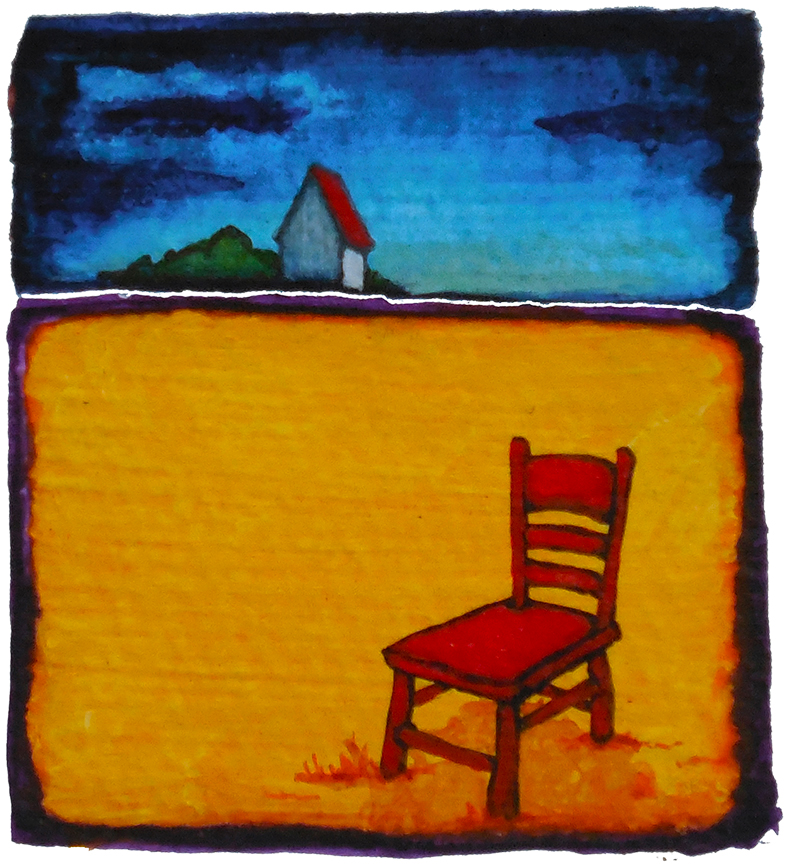
I think that idea applies to the new painting from the Little Gems show (opening today at the West End Gallery) shown at the top, Heart’s Fortress. I know that it is just an idealized condition, that no one can fully isolate from the world. But we all need a place of our own, even if it exists only for short periods of time in our inner landscape, where we can be free from the world. A safe island of quiet where we can examine all that we are and find some degree of satisfaction in that.

I try.

Occasionally, I succeed.

And sometimes the world comes in the form of tidal waves that crash on the cliffs of my fortress, shaking away much of my contentment.

Still, my fortress remains. Perhaps a little disheveled and in need of some maintenance. But it stands.

And in that alone, there is some satisfaction, some contentment. 

Heart’s Fortress is a small painting, 3″ by 4″ on paper that is now at the West End Gallery in Corning as part of the annual Little Gems show. There is an opening reception for the show today from 5-7 PM. Hope you can make it.

Here’s a lovely song that, while it may not be about the specific island of my heart’s fortress, is about the love of an island. This is Island in the Sun from the late great Harry Belafonte.


 

Read Full Post »


Height of Achievement– At West End Gallery


“All who are not lunatics are agreed about certain things. That it is better to be alive than dead, better to be adequately fed than starved, better to be free than a slave. Many people desire those things only for themselves and their friends; they are quite content that their enemies should suffer. These people can only be refuted by science: Humankind has become so much one family that we cannot ensure our own prosperity except by ensuring that of everyone else. If you wish to be happy yourself, you must resign yourself to seeing others also happy.”

— Bertrand Russell, The Science to Save Us from Science, NY Times (19 March 1950)


The final sentence above from Bertrand Russell from 75 years ago seems almost quaint in the selfish and cynical times in which we find ourselves. The idea of making others happy as a measure of our success or our satisfaction with our lives is not particularly popular these days.

It raises many questions for me.

How does anyone define success? Or happiness?

Can anyone be successful and happy while denying the same to others? 

That would be the old climb-to-the-top-and pull-up-the-ladder-behind-you trick that’s so popular these days. We have sadly come to believe that our own success and happiness is somehow diminished or devalued by the success and happiness of others. Many see it as some sort of reality show competition and not only pull the ladder up behind them but roll boulders down at those attempting to climb a bit higher.

This all came from thinking about what I was seeing in this new small painting, Height of Achievement, that is part of the Little Gems show now hanging at the West End Gallery. I see it as being about defining your success and happiness on your own terms, about claiming your own small pinnacle and laying a path that gives others the opportunity to climb as well. I see the Red Tree here as not a ruler over a domain but as an explorer or guide showing the way.

I also saw a slightly different interpretation, one where the Red Tree has climbed to the top, achieving the success it sought, and found it a lonely place. And happiness was in short supply, as well, since it was forever preoccupied about keeping its place up there. It never was able to enjoy the view or share it with others.

I guess both translations say much the same– strive for yourself but for others, as well.

That works for me this morning.

Here’s a song that is well-worn, both in airplay and on multiple film soundtracks, for good reason. Just a great song. This is the 1967 hit, Ain’t No Mountain High Enough, written by Ashford & Simpson and performed by Marvin Gaye and Tammi Terrell, who both died tragically young. Diana Ross did a great version of the song as well in 1970 but I thought I’d go with this one.


Read Full Post »


Twilight Time–AT West End Gallery

And even if you were in some prison the walls of which let none of the sounds of the world come to your senses—would you not then still have your childhood, that precious, kingly possession, that treasure-house of memories? Turn your attention thither. Try to raise the submerged sensations of that ample past; your personality will grow more firm, your solitude will expand and become a place where you can live in the twilight, where the noise of other people passes, far in the distance.

–Rainer Maria Rilke, Letters to a Young Poet


Little time this morning as I have some maintenance issues around here that demand immediate attention. Before I get to those issues, I thought I would share a triad of image, word, and song to serve as a reminder that the annual Little Gems exhibit of small works is now hanging at the West End Gallery and that the opening reception takes place this Friday, February 7, from 5-7 PM.

Above is a new painting, Twilight Time, 6″ by 12″ on canvas, that is included in the show. The words at the top are from the always relevant Letters to a Young Poet from Rainer Maria Rilke.  This passage is from a letter where he was instructing a struggling young poet to stop trying to satisfy the critics or publishers and focus on creating an inner world where his work can grow and prosper.  It then takes on its own life based on the poet’s unique self, instead of an imagined criteria set by other people. It then takes on a reality that others will recognize.

For the music, I am selecting the obvious song, Twilight Time. I probably should share the old beautiful Platters hit that most will recognize but I am going with a version from Willie Nelson. I enjoy his takes on the American songbook of standards. It always gives the work a somewhat different dimension, an easiness that is comforting to my ears. 

Okay, got to run. There are things to do that cannot wait.


Read Full Post »


On the Lake Road

What if culture itself is nothing but a halt, a break, a respite, in the pursuit of barbarity?

–Slavoj Žižek, Living in the End Times


This is another new small painting (only 2″ by 4″!) that is included in the Little Gems show now hanging at the West End Gallery. It’s called On the Lake Road. The first thing that came to mind for me was that it reminded me of the feel of the some of the roads that run around the edges of the lakes here in the Finger Lakes region of NY, especially in the summer when the roads are filled with summer residents and vacationers all seeking a pastoral break from their regular lives. There’s an almost palpable feeling of ease as you drive on those roads with the lake right there with you amid the quaint summer cottages.

I saw that feeling in this piece and named it accordingly.

While looking for a literary bit to pair with it, I came across this quote from Slovenian philosopher Slavoj Žižek and it stopped me in my tracks. It made me wonder if our natural instinct as a species was one of barbarity and if art was one of the few things that kept from fully following that instinct.

Were all forms of art just a means to stifle our barbaric impulse? Is it meant to remind us that we have another option beyond our inborn tendency toward cruelty, selfishness, and tribalism? Does it exist to let us know that, though it is naturally within us, we have ability to reject that instinct and instead choose compassionate kindness? 

I don’t know. I am sure there all sorts of examples and differing definitions of art that contradict this but sitting in the dark in the computer screens glow at 5 AM, it sounds plausible. After all, so much great art in all forms has come from times when we were battling our own barbarity, often offering us another vision of what might be. And I believe we might find that the barbarians among us, those who are without empathy and compassion, also have no room in their life for art.

I might expand the old saying music has charms to sooth the savage breast (which, by the way, goes back to the first line from the 1697 play The Mourning Bride by William Congreve) to include all forms of art. 

Can even a small painting like On the Lake Road serve as a levee against our potential floods of barbarity?

Maybe. I would like to think so.

Here’s a song I’ve loved for many years now from the legendary bluegrass duo of Flatt & Scruggs. This is their cover of a Bob Dylan song, Down in the Flood.


Read Full Post »


Daytripper– At West End Gallery

The best kept secret in America today is that people would rather work hard for something they believe in than live a life of aimless diversion.

–John W. Gardner, Living, Leading, and the American Dream, 2003


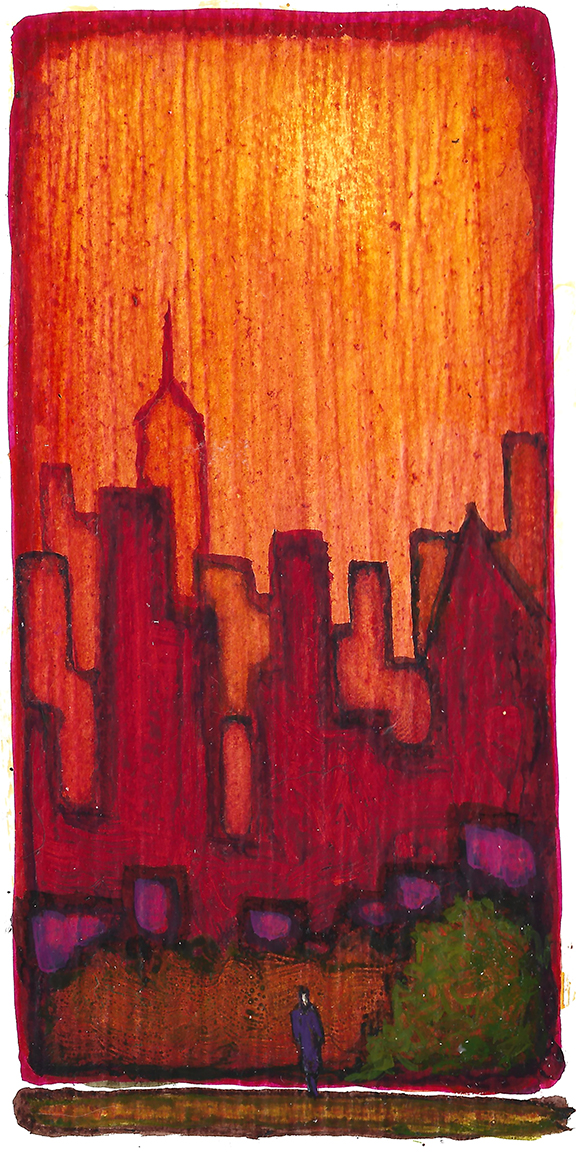
This is another new Little Gem that is now at the West End Gallery for their annual exhibit of small works. This piece really hit me in a visceral way when it was done. It exuded a lot of different things that all hit the mark for me. The color was right on with its mood, tone, and temperature harmonizing perfectly. The shapes and forms felt right in relation to each another and the small figure in the foreground added great depth to the scene.

There was a lot packed into this very small painting. Yet, I struggled with what it was saying to me. The wildfires in LA were burning at the time and I thought that with its extra warm coloration it might be saying something about fleeing the heat and flames.

But that didn’t feel right. The nature of the tiny figure was a nagging question for me. Was it fleeing the city’s hustle and bustle? Or was it returning from the city to its home in a cooler, calmer remote place? I couldn’t answer that definitively, but I loved the ambiguity. It didn’t really matter whether the figure was  seeking diversion in the heat of the city or in the cool of the country. The point I saw was that it was seeking something different, if only to provide a contrast to what it experienced every other day.

The daytripper, of course. 

I looked for a short quote or passage that somewhat summed up what I was seeing here and came across this short passage from a posthumously published book the late John W. Gardner (1912-2002) who had served as the U.S. Secretary of Heath, Education, and Welfare under LBJ. I wasn’t sure it spoke directly to this painting, but it spoke to something that had been on my mind, something that seemed to manifest itself in recent times.

It was this idea that we have become a country that leans into constant diversion, that we seek easy, instant, and short-lived gratification in lieu of working or sacrificing for something that would more deeply satisfy our needs and desires. Something that would benefit us in a lasting manner. It’s a tendency that has been exploited by the powerful and influential for their own benefit

It is a hard offer to resist. We all want things to come easy., with little thought or effort. on pour part. And after being exposed to easy diversion for so long, we expect and demand it. We no longer value the day trip– we expect it each and every day.

It’s all an illusion. And a dangerous one at that. We have lost that muscle memory of the need for work and sacrifice for something greater, something more lasting.  We have exchanged that ability for shiny trinkets. 

I know that sounds much like the rants of an old codger at the local diner crowing about how things were so much better back in the day. To be honest, it wasn’t any better. We still wanted everything to be easy and thoughtless. That desire just wasn’t being as fully exploited as it is now. 

I’m going to stop now because I can’t fully link that thought to the painting outside of saying that we need diversion and the occasional day trip. But it should remain that– a day trip. Not a life filled with diversion that keeps us from attending to the real needs of ourselves and others. We need to pay attention, to look away from the shiny and easy a little more often. 

Divert ourselves not with the meaningless, but with things that feel our souls. 

And I think John W. Gardner was correct in believing that most people today would be willing to shuck constant diversion in order to have something worth working or fighting for. 

Maybe that tiny figure is turning its back on the diversions presented to it in order to seek its purpose? Or maybe the painting itself is a diversion?

I don’t know.

But like I wrote earlier, this little painting has a lot of things packed into it. 

Here’s the song that gave the title to this little guy, Daytripper. I am sharing both the Beatles’ original along with a wonderful version from fingerpicking wiz Tommy Emmanuelle that also includes Lady Madonna from the Beatles. If you like watching a master guitarist play, this is a must see.

A little diversion, yes, but it feeds the soul. Or so I think.


Read Full Post »

Lost in Memory

Lost in Memory— At West End Gallery


Every man has some reminiscences which he would not tell to everyone, but only to his friends. He has others which he would not reveal even to his friends, but only to himself, and that in secret. But finally there are still others which a man is even afraid to tell himself, and every decent man has a considerable number of such things stored away. That is, one can even say that the more decent he is, the greater the number of such things in his mind.

–Fyodor Dostoyevsky, Notes from Underground (1864)


This very small piece, Lost in Memory, is another included in the annual Little Gems show opening this coming Friday at the West End Gallery.

This painting may be little and simply constructed but it packs a potent punch, at least for me. It has its own atmosphere, one that reminds me of deeply hidden memory that sometimes pokes its head out when you least expect it. The kind of sharply felt reminiscences that are more like suddenly revealed secrets about yourself. The kind where a memory of a past moment suddenly takes on a new shape and form, one that you had either missed or denied at the time.

And its disconcerting because it changes your understanding of much of what came after that moment. In some cases, it brings new understanding. In others, it only raises further questions that may never be answered. It remains hanging there in the void of your memory, occasionally bumping against your consciousness to remind you that it still lingers with you.

You may or may not understand what I am saying here. It’s not something one can fully clarify without releasing parts of themself that beg to remain packed away in their secret store of memories.

That is what I see in this little piece. Something in it– perhaps the saturation of the colors or the placement of the sparse elements– adds a quality that is hard to put a pin in.

To go with this Little Gem, this week’s Sunday Morning Musical selection is a jazz standard that seems to possess that same sort of atmosphere that I am getting from this painting. It’s Goodbye Pork Pie Hat from legendary jazzman Charles Mingus in 1959.

It’s a song written as an elegy for saxophonist Lester Young who had died several months before and was known for always wearing that particular style of hat. This song has been reinterpreted in multiple ways by a wide variety of artists and had a couple of differing sets of lyrics added to it but the original stands alone for me with its depth and moodiness.


Read Full Post »

Eye of the Trickster

Eye of the Trickster— At West End Gallery


You have but little more to do than throw up your cap for entertainment these American days…. Farmers’ sons will stare by the hour to see a juggler draw ribbons from his throat, though he tells them it is all deception. Surely, men love darkness rather than light.

–Henry David Thoreau. The Succession of Forest Trees speech, 1860


This is another Little Gem that like King of the Night Forest, which I featured here several days back, is a bit of a departure from my normal landscapes. Like that painting, this one, The Eye of the Trickster, is based on a mythology not yet fully formed. Not sure it ever will be completely fleshed out.

Maybe it doesn’t need to be. I think we all understand and recognize the role of the trickster, the charlatan, in our world, though it is seldom, if ever, a necessary or beneficial role. Maybe the purpose of the trickster in myths around the world is to warn us about being deceived by diversion or sleight of hand or of being too trusting of those who promise us magical results. 

I hadn’t thought of this until just now but perhaps that is what the eye in the upper right-hand quarter of this piece represents– an appeal to us to keep our eyes sharply focused on the trickster, to not fall prey to his attempts to divert our attention away from the true nature of his actions. 

As I said when writing about King of the Night Forest, I enjoyed working on these unusual pieces as well as how they emerged in the end. Going into each piece, I never know who or what is going to emerge. Or why. Maybe that uncertainty is what makes it a very satisfying process, along with the fact that it takes a lot of focus to maintain a constant balancing of color and shape and marks.

I end up feel a little like the juggler Thoreau referenced in the passage above. A lot of balls in the air and when done, I will pull a seemingly endless multicolored ribbon from my throat.

Maybe the Trickster here is me? 

Could be. I never said I wasn’t. A true Trickster would never admit to that.

But then again, maybe the trick is on me and everything that seems real to me is just illusion. I end up not being the trickster, only a pretender. 

Hmm…

Here’s a song that kind of ties into this. It’s a song to which I have always responded strongly but for some reason often falls out of my listening rotation for many years. This is The Pretender from Jackson Browne.  


Read Full Post »

« Newer Posts