Feeds:
Posts
Comments

Archive for August, 2025

Lux Templi-At the West End Gallery


I dream’d in a dream, I saw a city invincible to the attacks of the
whole of the rest of the earth;
I dream’d that was the new City of Friends;
Nothing was greater there than the quality of robust love—it led the
rest;
It was seen every hour in the actions of the men of that city,
And in all their looks and words.

— Walt Whitman, I Dream’d in a Dream (1855)


Keeping it simple this morning since it is a Labor Day weekend. The theme today is dreaming of a better world and though it might seem that has little to do with the work or labor that is celebrated by this holiday, there is a connection.

After all, why do we work?

To provide a better life for ourselves.

Though it might seem like we toil simply to survive at times, we all still maintain a dream of a better world for ourselves in some form.

I would like to think that it is not asking too much that we extend that dream of betterment to all others. Wouldn’t our personal world be enriched and made better by the fulfillment of such a dream?

That’s all I have to say this morning. I have work to do. It might not better my life or anyone else’s in any way, but I am still going to make the effort. It’s all we can do– make an effort.

Here’s a bit of Sunday Morning Music. I went with two biggies today, two American icons– Walt Whitman and Elvis Presley. The song is If I Can Dream from Elvis’ legendary Comeback Special in 1968. I remember watching this as a kid with my dad and even then, being impressed with how hard this guy was working for our approval. You may or not be an Elvis fan, but there is no denying that the man is working hard here.

Dreams take that kind of effort.


Read Full Post »


If hard work were such a wonderful thing, surely the rich would have kept it all to themselves.

——Lane Kirkland, AFL–CIO President, 1979-1995


Ralph Fasanella- Bread and Roses

Ralph Fasanella- Bread and Roses


[From 2014]

I caught the end of a Bill Moyers interview yesterday with Nobel Prize-winning economist Joseph Stiglitz in which he described how our current level of income inequality was surpassing the levels of the prior two times when they reached a level of crisis here in this country– the Gilded Age of the late 19th century and the Roaring 20’s.  In each case, we were at the brink of total collapse but were able to come through and bring wages back into levels of greater equilibrium which always leads to greater prosperity across the board.  He wasn’t too positive about our ability to avoid the consequences of our current inequality, given the ability of the wealthiest to buy political clout with impunity. 

It’s a scary situation and, on this Labor Day weekend, it made me think of what the labor movement has done for this country in battling for greater wage equality.  I went back in the archive to a Labor Day post from back in 2009 that I thought fit the bill.  Here it is:


[From 2009]

On this day, Labor Day, I am showing a painting from the great American folk primitive painter Ralph Fasanella, depicting the famed Bread and Roses strike that took place at the textile plants in Lawrence, Massachusetts in 1912. I thought it fitting that something be shown that is closer to the spirit of this holiday which has faded from the public’s knowledge in recent years.

I was a union member in my first on-the-books job at a Loblaw’s grocery store when I was sixteen years old and a few years later I was a member of the Teamsters Union at the A&P factory where I was employed for several years. Barely 20 years old, I was the union steward, as well as a skilled Candy Cook, in the Cooking & Casting Department, for the last few years of the factory’s existence.

It was a position that I initially took because for some reason nobody else wanted the hassle of it. By taking it, I was protected from being laid off so long as my department was operating so I thought it might be worth a try. Most days had some sort of small trouble and on a few some major problems. There was always an argument to be had, either with company supervisors who tried to circumvent or twist the rules to their advantage or with co-workers who felt the union didn’t go far enough or went too far.

It was a very educational experience. I particularly enjoyed working with the WWII vets in the department. It felt pretty good when I was able to do something for them in my role as shop steward and when management sometimes made things tough for us in retribution for being held accountable, those guys stood tough and didn’t whine. They understood the idea of sacrifice for a greater good.

Unfortunately, the most telling observation from my time as steward was the general apathy from many of the workers, especially the younger works. They wanted the benefits and protections of the union without having to do anything and asking for any effort or sacrifice caused an outbreak of constant grousing.

Their attitude was the same as that which has led to the apathy that has allowed the solidarity of the union to erode and crumble over the years. This parallels the general image of labor unions, which has crumbled, perceived now as mainly corrupt and self-serving.

In many ways, it is a well-deserved image. But the failings of these unions are the failings of men, the same failings that the company owners possessed that the early unions organized against– greed and a total lack of empathy for their workers. It doesn’t take much research to discover that the working conditions of the last 130 or 140 years were deplorable. Long hours. Low pay. Incredibly unsafe conditions. Dismissal for any reason. No rights whatsoever.

Today, many view industry as this amiable, father-like figure but don’t realize how much blood was spilled by early union organizers and members to obtain the things we now take for granted as our rights.

The fact is that industry did not willingly give up anything to the worker without being forced.

I can only imagine what our world would look like without the efforts of our unions.

This very holiday would not exist nor would several others, as far as being paid holidays for the worker. Vacations would only exist for the company owners. Most people don’t realize that vacations for the working man are a 20th century invention.

The pay scale would be similar to those places on the Earth where many of our jobs have migrated, places that allow the avarice of the companies to override the rights and safety of the workers. Places where sweatshops still operate, as they once did here. Places where unschooled children toil in dirty, dank conditions, as they once did here. Places where the health and safety of the workers is secondary to the profit they provide, as it once was here.

You may despise the unions now for their corruption but make no mistake about it- without them our country would look much different. And not in a good way.

Read Full Post »

The Call of Wonder– At Principle Gallery


Three Rules of Work:

Out of clutter find simplicity; From discord find harmony; In the middle of difficulty lies opportunity.

–Albert Einstein


This Einstein fellow is a pretty smart guy.

Simplification, harmony and opportunity could be ingredients for any recipe to success in any field, but I think they apply particularly well to the creative arts. I know that I can easily apply these three rules to my own work.

For me, its strength lies in its ability to transmit through simplification and harmony. The forms are often simplified versions of reality, shedding details that don’t factor into what it is trying to express.

There is often an underlying texture in the work that is chaotic and discordant. The harmonies in color and form painted over these create a tension, a feeling of wholeness in the work. A feeling of finding a pattern in the chaos that makes it all seem sensible.

And the final rule–opportunity lying in the midst of difficulty– is perhaps the easiest to apply. The best work always seems to rise from the greatest depths, those times when the mind has to move from its normal trench of thought. Times when one has to expand beyond the known ways of doing things and find new solutions and methods to move the message ahead.

The difficulties of life are often great but there is almost always an opportunity or lesson to be found within them if only we are able to take a deep breath and see them. These lessons always find their way into the work in some way.

Thanks for the thought, Mr. Einstein. I hear good things about the work you’re doing.


I run theses Three Rules from Einstein every couple of years and it felt like the right time since I think we are all looking for simplicity, harmony, and opportunity in our own lives. Plus, I am short on time this morning. I am going to embellish a bit with two other favorite quotes from Mr. Einstein and a newer version of the wizened wisdom of Oh What a Beautiful World from the ageless Willie Nelson and Rodney Crowell, who wrote and first recorded the song in 2014.

Here are those words from Einstein:

The world as we have created it is a process of our thinking. It cannot be changed without changing our thinking.

———–

“People like you and I, though mortal of course like everyone else, do not grow old no matter how long we live. What I mean is we never cease to stand like curious children before the great Mystery into which we were born.”

Albert Einstein, Letter to Otto Juliusburger, September 29, 1942

And what a mystery it is…


Read Full Post »

Exurgency

The Regeneration— At Principle Gallery, Alexandria, VA


exurgency – Noun (obsolete)- The state or quality of rising up, emerging, or coming to light, often with a sense of urgency and importance.


According to the OED, the word exurgency was only used for a short time in England in the mid-1600’s. It’s first known appearance was in the writings of minister/theologian John Owen.

Probably more than you need to know about this word. I only know it because I came across a piece of music titled Exurgency from Canadian cellist/composer Zoë Keating, now based in Vermont.

I liked the piece enough that I bothered to look up the word. I also liked the definition I found. It felt like this state of coming to light or rising up was a quality easily applied to many forms of art.

I think any artist would want their work to have this sort of revelatory quality.

To be filled with exurgency.

I certainly desire that in my work. Sometimes it’s there and that’s a good day.

Hoping for some more of that exurgency today.

Here’s that piece of music, Exurgency, from Zoë Keating.


Read Full Post »

Bound in Time— At Principle Gallery


Chaos is the first condition.

Order is the first law.

Continuity is the first reflection.

Quietude is the first happiness.

— James Stephens / The Crock of Gold (1912)


The lines above are from a novel, The Crock of Gold, from Irish author James Stephens. The form above is not how they were presented in the book originally. They were actually dialogue spoken by the main character, the Philosopher, in the comic/fantasy novel that deals with philosophy, murder, love and marriage, and Irish folklore, including Leprechauns and a stolen crock of gold.

From the bits of it I have read on Internet Archive where it is available, it seems like a wild ride. It has had continuing influence, too. The late Shane McGowan, leader of the Irish band The Pogues, used the title for his last studio album before his death.

But it is the bit of dialogue that caught my eye. It seemed to capture much of what I have been seeing in my work in recent times. Or. at least, hoping to see. You’re never quite sure what will emerge when you’re pulling things out of the ether.

This procedural list seems to match with what I am trying to depict. We try to identify order within the chaos in which we find ourselves. Having revealed whatever bit of order there is to be found, we try to maintain it through repetition of conditions and behaviors. Having done so, we find a bit of tranquility in whatever small patch of order we are able to maintain. Therein lies happiness.

That might be all you need to know about life.

I don’t know, that’s for damn sure. But it sounds like a decent recipe.

Maybe that is the gold in the Leprechaun’s crock?

Here’s a song that probably has nothing to do with post. Maybe that’s the chaos part of it?

Anyway, it came on the station I often listen to just a few minutes ago. I hear it every couple of days, and it always catches my attention, even if I am really focused on painting at that time. It’s One of Those Days from singer/songwriter Eilen Jewell.

Maybe the appeal for me is that I’ve had a lot of those days. Bet a lot of you have, as well.


Read Full Post »

We Know the Breed…


Over all things certain, this is sure indeed,
Suffer not the old King: for we know the breed.

–Rudyard Kipling, The Old Issue 1899


I recently came across a poem, The Old Issue, from Rudyard Kipling. It was written in 1899 before the outbreak of the Boer War between Great Britain and the two states of South Africa. I am not getting into the issues of that war or how this poem applies to them.

Instead, I am going to point out how the poem warns of a nation allowing any one person to rise to the level of king or dictator.  Famed Supreme Court Justice Robert Jackson, best known for overseeing the Nuremberg Trials in the aftermath of WWII, invoked the passage below in his opening statement at those proceedings:

All we have of freedom, all we use or know–
This our fathers bought for us long and long ago.

Ancient Right unnoticed as the breath we draw–
Leave to live by no man’s leave, underneath the Law.

Lance and torch and tumult, steel and grey-goose wing
Wrenched it, inch and ell and all, slowly from the king.

Till our fathers ‘stablished,, after bloody years,
How our King is one with us, first among his peers.

So they bought us freedom-not at little cost–
Wherefore must we watch the King, lest our gain be lost.

Over all things certain, this is sure indeed,
Suffer not the old King: for we know the breed.

Leave to live by no man’s leave, underneath the Law— Do not allow yourself to be ruled by any person who makes their word alone the law while placing themself above all laws. 

Wise words.

 I was struck by how this poem, in laying out the inherent dangers of a king or dictator, echoes what we are seeing in this nation. There are certain traits that anyone aspiring to total control of any nations will possess that will spur them to engage in similar patterns of behavior. You might call it the Despots’ Playbook.

Below is Kipling’s warning: 

Howso’ great their clamour, whatsoe’er their claim,
Suffer not the old King under any name!

Here is naught unproven—here is naught to learn.
It is written what shall fall if the King return.

He shall mark our goings, question whence we came,
Set his guards about us, as in Freedom’s name.

He shall take a tribute, toll of all our ware;
He shall change our gold for arms—arms we may not bear.

He shall break his judges if they cross his word;
He shall rule above the Law calling on the Lord.

He shall peep and mutter; and the night shall bring
Watchers ’neath our window, lest we mock the King—

Hate and all division; hosts of hurrying spies;
Money poured in secret, carrion breeding flies.

Strangers of his counsel, hirelings of his pay,
These shall deal our Justice: sell—deny—delay.

We shall drink dishonour, we shall eat abuse
For the Land we look to—for the Tongue we use.

We shall take our station, dirt beneath his feet,
While his hired captains jeer us in the street.

Cruel in the shadow, crafty in the sun,
Far beyond his borders shall his teachings run.

Sloven, sullen, savage, secret, uncontrolled,
Laying on a new land evil of the old—

Long-forgotten bondage, dwarfing heart and brain—
All our fathers died to loose he shall bind again.

It’s all there: the surveillance state; tariffs for us and corrupt tributes paid to him; a huge rise in militarization; the intimidation of judges; retribution against any and all who criticize or mock him; the sowing of hate and division; secret money pouring in; teams of lawyers intent on distorting, denying, and delaying justice; our reputation as a nation destroyed with longtime allies turning their backs on us; hired guns on our streets, harassing and belittling the citizens; constant deceit and lying and new alliances with other foreign despots; and all that was gained in the long struggle  for this country– the freedoms and rights we took for granted– lost.

It’s a haunting poem given where we are now. It’s like an echo from the past that has been slowly and imperceptibly rumbling through the deep dark canyons of time and now thunders out into the open, new to us now but just as ugly and dangerous as it was when it has sounded in its past incarnations.

The question is: What are we willing to do to still the blare of this echo of awfulness?

Read Full Post »



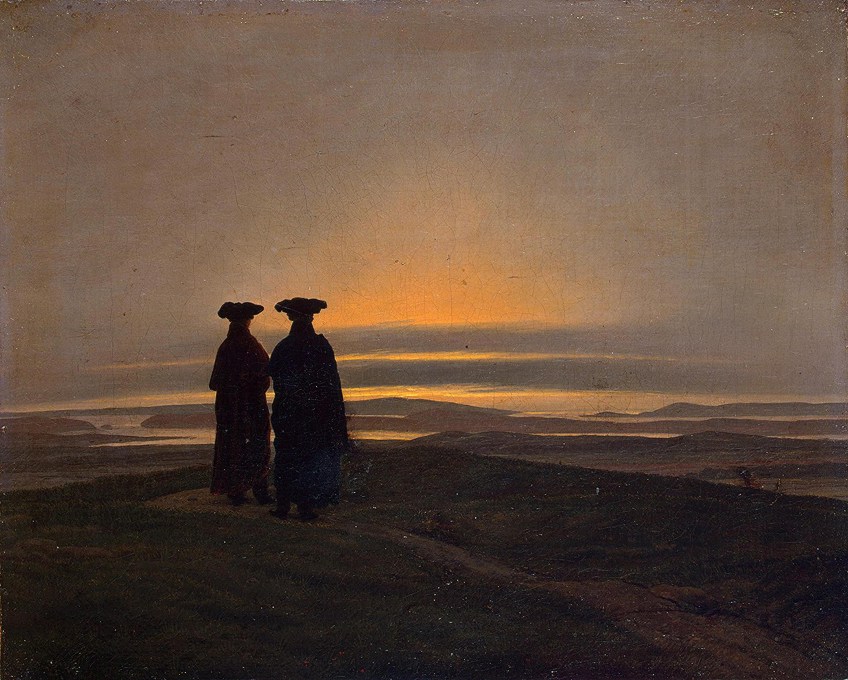
You call me a misanthrope because I avoid society. You err; I love society. Yet in order not to hate people, I must avoid their company.


I have cited the quote above from 19th century artist Caspar David Frederich a number of times when speaking before groups as an explanation for my reclusiveness.

It is said in a tongue-in-cheek manner but there is some truth in it. Actually, a lot of truth.

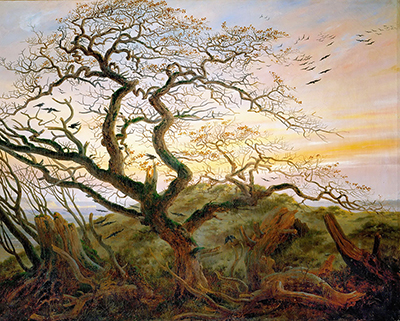
But we’re not going into that today. Instead, I thought I would share a blog entry from ten years ago featuring Frederich’s work. I have added a few more images to the original post. This is only a tiny sampling from his impressive body of work. 


A picture must not be devised but perceived. Close your bodily eye, that you may see your picture first with the eye of the spirit. Then bring to light what you have seen in the darkness, that its effect may work back,  from without to within.

–Caspar David Frederich


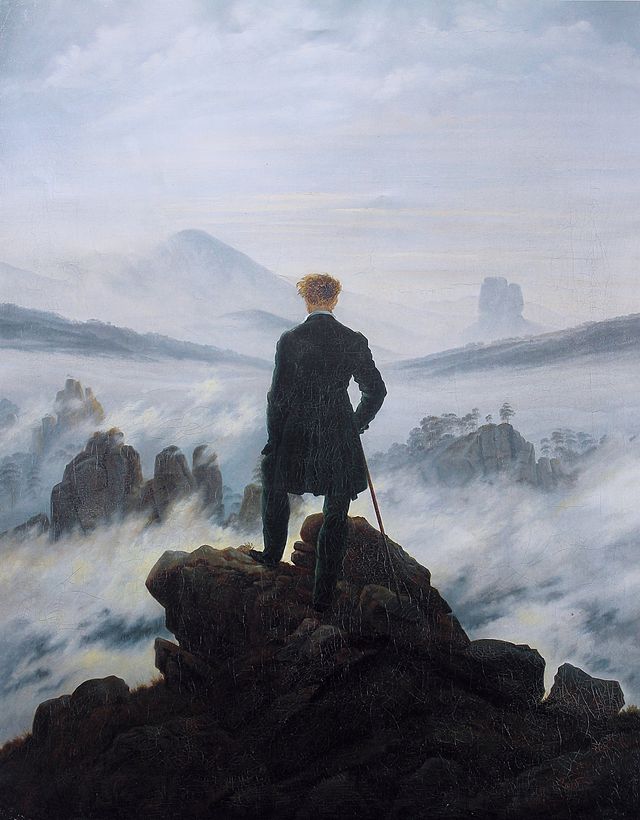
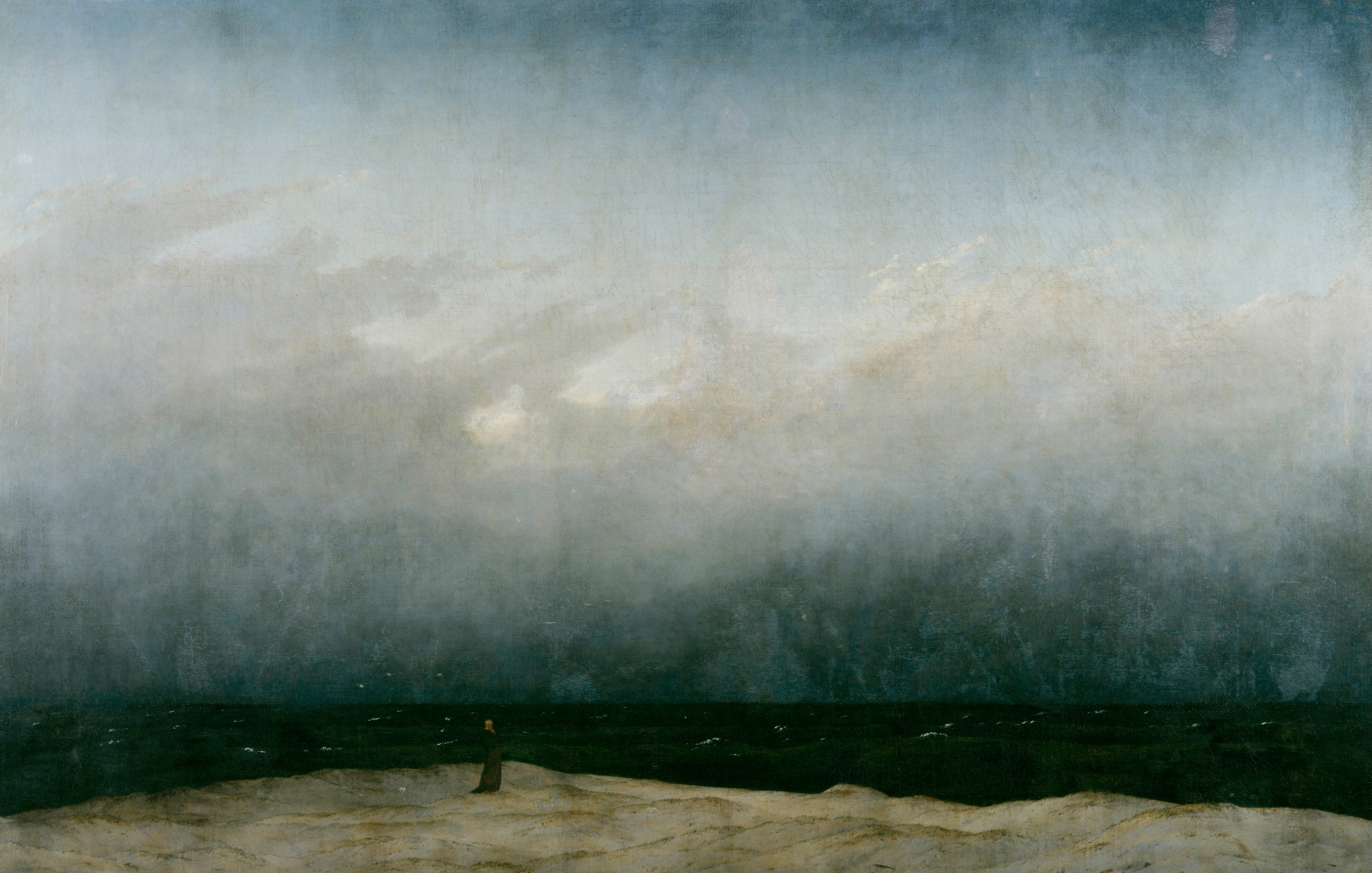
I often find myself identifying strongly with the words and work of the 19th century German painter Caspar David Frederich (1774-1840).  His work often takes a symbolic stance with expansive landscapes that overwhelm the human presence in them and much of it moves toward the metaphysical. He, along with his British contemporary JMW Turner, were at the forefront of the movement from Classicism to paintings that reflected the inner emotional reaction of the individual to the world around them.

It was said of Frederich that he was “a man who has discovered the tragedy of Landscape.” I see this in his often moody and contemplative work. It is not painting of only a place or scene– it is more a painting of emotion, of some inner vibration triggered by what is before the painter. His brilliance is in capturing that inner element and revealing it to the viewer. It’s a rare thing, one that I think most painters aspire to obtain in their own work. I know that I do.

Caspar_David_Friedrich_-_Wanderer_above_the_sea_of_fogFrederich’s work fell from favor in the latter stages of his life but the coming of modern art movements, comprised of many painters were greatly influenced by Frederich, brought him back to greater recognition through the first few decades of the 20th century. Unfortunately for Frederich, in the 1930’s his work was associated with the Nazis who mistakenly saw his work as being nationalistic in its symbolism. I know that the piece shown here on the right, Wanderer Above the Sea of Fog, is often associated with Friedrich Nietzsche’s idea of the Übermensch or Superman. Even though Frederich died years before Nietzsche was born and almost a century before the Nazis usurped his art, it took several decades before his work regained the stature it lost due to this association.

But the inner message of his landscapes persevered, and his paintings still resonate with the potency of their timeless qualities today. As they should.

Caspar David Friedrich- Monk by the Sea

Caspar David Friedrich- Monk by the Sea


Read Full Post »

Asking Questions

Harmony in Blue and Green— At Principle Gallery


What did the tree learn from the earth
to be able to talk with the sky?

Pablo Neruda, The Book of Questions


Since we’re asking questions:

Does the tree know it is a tree when it talks to the sky?

Does the sky see any difference between the tree and you or me?

When animals– other than us– talk with the sky, do they speak with words? For that matter, do we speak to the sky with words? 

When the sky and the tree talk, do they discuss ponderous subjects like eternity and the meaning of life or do they just chit-chat about things like the weather?

Do the tree and the sky ever sing together, rather than talk?

I don’t know the answer to any of these questions, of course. I would like to think that the tree and sky do harmonize in song together. That actually seems plausible.

Is the sound of leaves rustling in the breeze part of the chorus of their song?

That brings me to this week’s Sunday Morning Music. I have picked Sky Full of Song from Florence + The Machine. Seems to fit.

Before I go, another question: Why doesn’t the sky return my calls?

Does it have a problem with me? Did it say anything to you? Does it think I’m asking too many questions?


Read Full Post »

Hold On

The Durable Will– GC Myers


Not only during the ascent, but also during the descent my willpower is dulled. The longer I climb the less important the goal seems to me, the more indifferent I become to myself. My attention has diminished, my memory is weakened. My mental fatigue is now greater than the bodily. It is so pleasant to sit doing nothing–and therefore so dangerous. Death through exhaustion is like death through freezing–a pleasant one.

–Reinhold Messner, Moving Mountains: Lessons on Life and Leadership (2001)


I was going to write about the painting at the top, The Durable Will. It’s another orphan that lives here in the studio. The fact that it still lives here is a bit of a headscratcher for me since it has such a strong presence in the spaces where it now hangs. It’s a dynamic piece in both color and stance which combined with its size, 28″ by 28″, seems to make it practically demand attention when I enter the room.

While looking for some words to accompany this painting I came across the words from famed mountaineer Reinhold Messner. He describes how the exhaustion that occurs during a long and rugged climb slowly saps his willpower, bringing on the mental fatigue that begs him to stop moving, to just sit and rest for a spell. 

That might not sound too bad a suggestion under normal circumstances. After all, we all need to rest at some point. But when you’re climbing a mountain where conditions are dire, a lapse of focus might cause a misstep which could send you plummeting to your death. Or the fatigue might convince you that you can stop to take a short break which ends up being the ultimate snooze as some future mountaineer comes across your icy corpse with a peaceful look on its frozen face.

I feel like we’re at that point in this country. We’re on some frozen, windswept mountain, struggling to move upward and, more importantly, to simply survive.  The conditions are horrible and continue to worsen without end. The winds rage endlessly. The snow mounts up and ice coats the trail ahead, which steepens more and more as it rises.

It feels as though we’ve been battling this bastard of a mountain for years and years. Exhaustion is setting in while the mountain is most treacherous for us. Our minds are telling us to take a break, to tune it all out, to step off the trail for a quick catnap. 

That is a recipe for death, pleasant as it might feel in the moment.

We’re on that mountain now, standing on the edge of the precipice of a totalitarian future and a police state that will oversee our every move.  So many who backed this regime did so in the name of freedom, fearing an intrusive and overreaching government. That is ironic because that is exactly what they have enabled in this administration– a government that demands Big Brother-like control over its citizens. 

What do we choose? Do we sleep a peaceful death?  Or do we struggle upward, fighting back against our exhaustion and fatigue and trying to hold on against all odds?

As tired as I am, I choose to keep moving. I believe I have the will to endure. My belief in my ability to hold on might be my only belief at this point.

You have to make that choice for yourself. And remember, it’s not just for yourself.

Here’s Tom Wait with his song Hold On.


Read Full Post »

Under the Compass– Now at Principle Gallery


“I have no right to call myself one who knows. I was one who seeks, and I still am, but I no longer seek in the stars or in books; I’m beginning to hear the teachings of my blood pulsing within me. My story isn’t pleasant, it’s not sweet and harmonious like the invented stories; it tastes of folly and bewilderment, of madness and dream, like the life of all people who no longer want to lie to themselves.”

― Hermann Hesse, Demian


I have a new painting on the easel waiting for me this morning. I thought it was complete when I finished up yesterday but just as I was leaving, I saw that it needed a small but critical adjustment. I didn’t have the time then to complete it, so it’s been nagging at me all night.  Therefore, I will be short this morning even though the subject deserves much more time and effort than I can give it at the moment.

Today is a triad of word, image, and song centering around the seeker. By that I mean the seeker of inner discovery, of the self. I am including a passage from a Hermann Hesse book, Demian, that was very influential in my life. It came to me at a time when I was struggling mightily and it helped me rethink what my life was and could be. It allowed me to recognize that I was exhausted from the lies I told not only to others but mainly to myself.

Without coming across this book, I doubt I would be painting or writing at this moment. God only knows what, if anything, I might be doing.

I am accompanying the passage with a painting that is very much about seeking, Under the Compass. For me, I see it as being about the inner search though it might also apply to the seeker who still looks for outer validation of their existence. I a also sharing a performance from The Who of their song The Seeker. It first came out in 1970 and this is how Pete Townshend described it in a Rolling Stone interview at the time:

Quite loosely, “The Seeker” was just a thing about what I call Divine Desperation, or just Desperation. And what it does to people. It just kind of covers a whole area where the guy’s being fantastically tough and ruthlessly nasty and he’s being incredibly selfish and he’s hurting people, wrecking people’s homes, abusing his heroes, he’s accusing everyone of doing nothing for him and yet at the same time he’s making a fairly valid statement, he’s getting nowhere, he’s doing nothing and the only thing he really can’t be sure of is his death, and that at least dead, he’s going to get what he wants. He thinks!.

Divine desperation. Maybe that is the unifying bond here, the driving force behind the Seeker.


Read Full Post »

Older Posts »