Feeds:
Posts
Comments

Archive for August, 2025

Natural Selection

 The Heights, circa 1994


Evolution advances, not by a priori design, but by the selection of what works best out of whatever choices offer. We are the products of editing, rather than of authorship.

–George Wald,The Origin of Optical Activity  (1957)


I came across the quote above from George Wald (1906-1997) who was a Nobel Prize winning a scientist whose work focused on retinal pigmentation. I don’t know much about that, but his words made me think about how evolution occurs in whatever we do, how we try new things in order to hopefully make our lives better. We keep those that work best for whatever reason and discard those that don’t, mirroring the process of Natural Selection.

This thought made me think of how this has worked in the evolution of my own work. It has been a constant trial of new techniques and materials. There have been small and large changes, some that have stuck with me and are now built into my artistic DNA. Others lingered for but a short time and were soon took their place in my personal annals as examples of a failed past, like looking in a book of natural history describing species like the Dodo that lost out to Natural Selection.

Thought I’d take this opportunity to share a post on some of my earliest work, sort of like pages from my book of extinct species. Some are gone forever as a result of the editing of natural selection, but some live on in certain traits that have been passed down from them. And as I point out in the post below from 2014, the styles and techniques shown below, unlike the Dodo, can always be reborn by me in some manner in the future. 


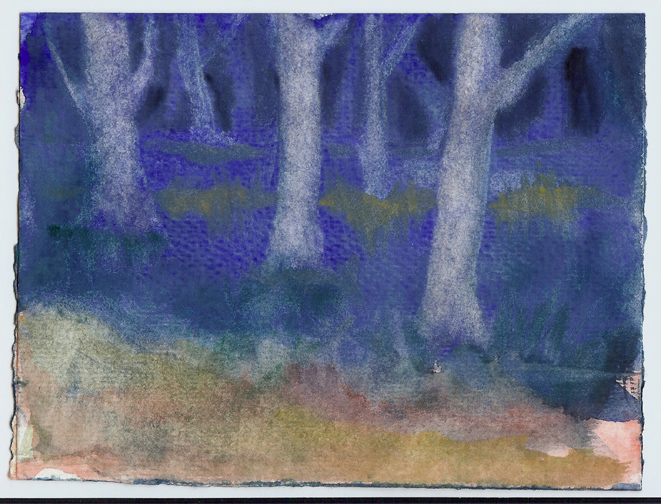
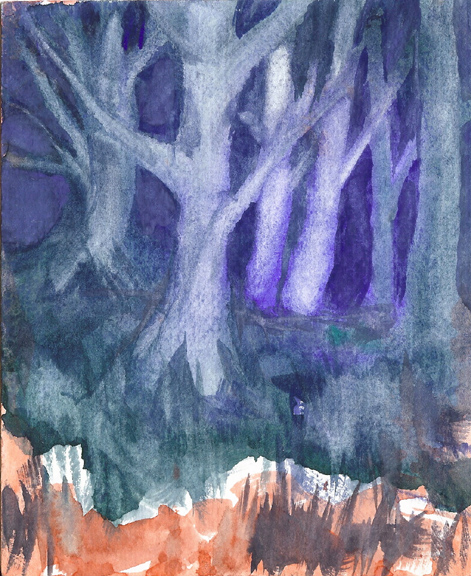
GC Myers 1994 Early ReductiveWork6I have been spending a lot of time in the studio in the last few weeks painting in a more traditional manner, what I call an additive style, meaning that layers of paint are continually added, normally building from dark to light. I’ve painted this way for many years and most likely that’s the style you know. But much of my work through the years, especially in the early years of my career, has been painted in a much different manner, one where a lot of very wet paint is applied to a surface, usually paper. I then take off much of this paint, revealing the lightness of the underlying surface. That’s a very simplified explanation of the process, one that has evolved and refined over the years. I refer to it as being my reductive style.

When you’re self-taught, you can call things whatever you please. I’m thinking of calling my paint brushes hairsticks from now on. Or maybe twizzlers. Maybe I will call my paints something like colory goop?

This reductive process is what continually prodded me ahead early on when I was just learning to express myself visually. I went back recently and came across a very early group of these pieces, among the very first where I employed this process. I am still attracted to these pieces, partly because of the nostalgia of once again seeing those things that opened other doors for me. Pieces that set me on a continuing journey. 

But there was also a unity and continuity in the work that I found very appealing. Each piece, while not very refined or tremendously strong alone, strengthened the group as a whole. I would have been hesitant to show most of these alone but together they feel so much more unified and complete.

This has made me look at these pieces in a different light, one where I found new respect for them. I think they are really symbolic of some of what I consider strengths in my work, this sense of continuum and relativity from piece to piece. It also brings me back to that early path and makes me consider if I should backtrack and walk that path again, now armed with twenty years of experience. Something to consider.


GC Myers 1994 Early ReductiveWork 1GC Myers 1994 Early ReductiveWork 5GC Myers 1994 Early ReductiveWork 2GC Myers 1994 Early ReductiveWork 4

Read Full Post »

Can’t Complain


This is the true joy in life, the being used for a purpose recognized by yourself as a mighty one ; the being thoroughly worn out before you are thrown on the scrap heap ; the being a force of Nature instead of a feverish selfish little clod of ailments and grievances complaining that the world will not devote itself to making you happy. And also the only real tragedy in life is the being used by personally minded men for purposes which you recognize to be base. All the rest is at worst mere misfortune or mortality: this alone is misery, slavery, hell on earth.

–George Bernard Shaw, dedication to Man and Superman (1903)


I’d like to think that I don’t complain much. I bet most people who complain all the time feel they don’t complain much so I might be wrong about that. I’ve been wrong so many times when I thought I was right that I am never surprised when I say something that is immediately proven wrong.

All I can do is take the loss and move on. No complaints.

I’d also like to think that all my losses are mine, caused by me alone. And here I don’t think I am wrong. Any losses or misfortunes I’ve suffered were the result of poor decisions and actions.  

And again, all I can do is take the loss and move on. No complaints.

For me, the only acceptable complaining is when it is on behalf of others when trying to correct injustices or imbalances.  

I guess then I would be called a complainer. We should all be complainers so that we might right the real wrongs of this world that are overwhelmingly being caused by people of incredible privilege parading as victims, endlessly complaining and blaming others for the imagined offenses they have suffered.  

Was that complaint? Could be. I might be a complainer or maybe not. Could be both. Like Uncle Walt Whitman says in Song of Myself:

Do I contradict myself?
Very well then I contradict myself,
(I am large, I contain multitudes.)

In the end, we are probably more of everything we think we’re not and less of what we think we are.

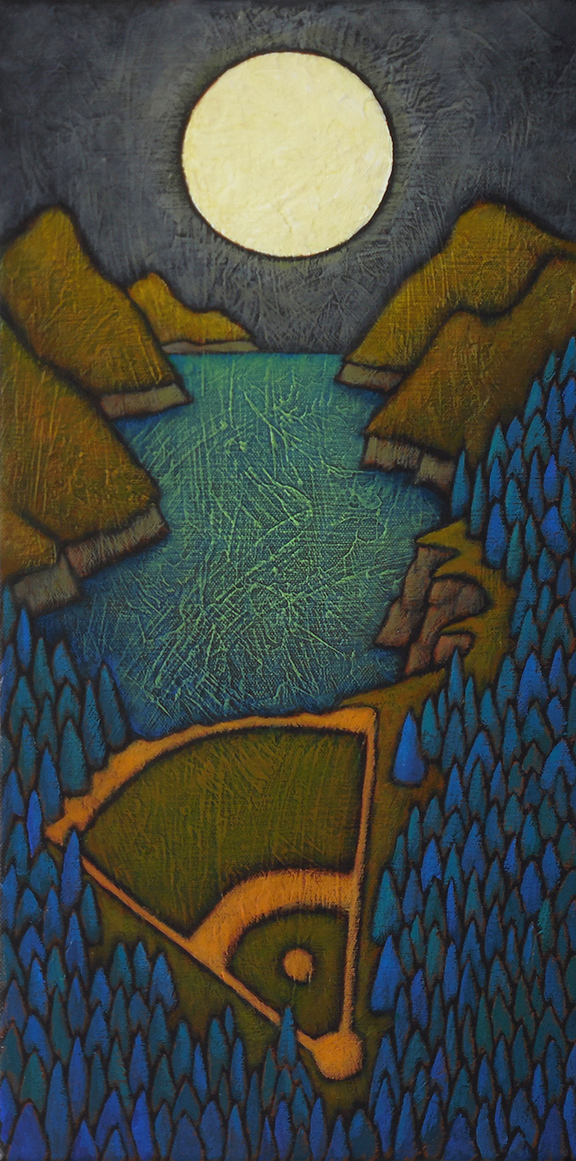
Here’s a couple of songs from singer/songwriter Todd Snider. The first is a song Can’t Complain which pertains here for obvious reasons. Snider is a wonderful storyteller with a droll and goofy delivery that appears in both his lyrics and the monologues that often accompany them. The second, If Tomorrow Never Comes, is great example of this. The painting above, Deep Right Field, actually has some relevance if you listen to the second song.  I found myself laughing at the second song because his don’t-bug-me-and-just-let-me-do-my-own-thing attitude was so familiar to me. Both songs were recorded at a House Concert in Boulder, CO.


Read Full Post »

Wherever the Wind Takes Me – At Principle Gallery


The worst sin that can be committed against the artist is to take him at his word, to see in his work a fulfillment instead of a horizon.

–Henry Miller, The Cosmological Eye (1939)


Love these words from Henry Miller. I think most people, artists included, look at a piece of art and see it as an endpoint rather than a jumping off point. I would like to think that my work serves both as an invitation and starting point for the viewer. My hope is that my little world as I present it is welcoming enough that they easily enter and feel comfortable. Once there, my wish is that they begin to explore both the space in which they are and the self they see in it. To start an inner journey of some sort, one that might last only for a few moments or for a lifetime.

That’s asking a lot, I know. And it’s not fully in my mind when I am at work because at that point I am fully engaged in my own inner journey. It’s only after I step back and try to view a piece with a more dispassionate eye that I begin to recognize if a piece has that potential in it.

A horizon to pursue.

A starting point of a journey.

Some do. Some don’t. And maybe some that I think do, don’t. And vice versa.

One never knows for sure. And that is the beauty of art. Some see totality and some see endless potentiality.

That’s all the time I have this morning. I see a horizon forming and need to get moving towards it.

Here’s a song from Michael Nesmith, best known as one of the Monkees. This is his take on Beyond the Blue Horizon, a song that was first performed by Jeanette MacDonald in 1930. It’s quirky but still works for me this morning.


Read Full Post »

Advice: Hard Work

gc-myers-1994

GC Myers- Early Work, 1994


He was justifying his existence, than which life can do no greater; for life achieves its summit when it does to the uttermost that which it was equipped to do.

–Jack London, White Fang


From 2011:

I had a nice email from a gentleman who sent me the image of painting done by his 16-year-old daughter, telling me about a prize it had been recently awarded in a scholastic competition.

I took a look at the piece, and it was indeed a very well-done painting, nicely composed with strong lines and color. It was certainly far ahead of anything I was doing at that age, especially by the virtue that it was complete. It was obvious that this young person had talent, and I could see this young person doing more with it in the future. I wrote him back and told him this but with my standard warning, one that I have written about here before: Potential must be actively pursued with constant efforts and a consistent pushing of one’s abilities.

In other words: Talent is great but doesn’t mean much if it’s not constantly practiced

I wrote him to tell him this, to let him know about some of the young talents I have seen come and go because they felt their talent was something that was innately within them and could be turned on and off with the flip of a switch.

I told him to tell her to look at the work required in the way a musician looks at rehearsals. Perhaps even look at their talents as being like those of a musician, talents that need constant exercise in order to stay sharp and strong. For instance, even if you have great innate talent, you can’t expect to play the violin like Itzhak Perlman if you don’t devote your talents in the same way as he does. As it is with many great musicians, the greater part of his life is spent in nurturing his abilities.

I always feel like a sourpuss when I’m giving this advice. Nobody wants to hear that in order to reach their potential they need to work harder or that they might have to sacrifice time that might be spent elsewhere doing other things. Everyone wants to think that they have this great talent born within them and it will flow like a spigot whenever they so desire.

If only that were true.

I think you will find that those who succeed at the highest levels in any field are those who understand this need to constantly push and work their talents. I’m sure there are exceptions, but none come immediately to mind. I wrote about this in a blog post when I first started this, two years back, in 2009. I wrote about something author John Irving had said about his work habits.

He saw himself competing as a writer in the same way as he did in his time competing as a wrestler. Irving felt that reaching one’s fullest potential as writer required putting in the same levels of intense effort as those needed to compete as a wrestler or any other athlete on the Olympic level. 

Hard work– it’s not glamorous especially in this world of instant gratification but it is a proven entity.

I’m showing the piece above to highlight this. It’s a small painting that I did before I was showing in any galleries, in 1994. At the time, it pleased me very much, though I am not sure I felt it was the best thing I had done to that point. However, it felt complete and self-contained. I could have very easily kept painting in that style and been satisfied in some ways without much effort.

But I also recognized that it was limited in many ways. It began to say what I was feeling but didn’t fully express it. There was more beyond this. I just knew there had to be. A little voice kept urging me to push ahead and work harder, to dig deeper to uncover what I could accomplish with greater effort.

This little painting soon was not an endpoint but a steppingstone on a much longer path.

 I hope this man’s daughter also sees her painting as a steppingstone. She may think now that it is the best thing she has ever done. She might be right– to this point. But if she is willing to push ahead and put in the effort, she will look at it someday as a very fine first step in a journey to reach her true potential.


I think the last time I shared this was ten years ago. Nothing has really changed. Around the time I painted the piece at the top, I read about John Irving comparing his work schedule to that of an Olympic athlete. That really connected with me. By then, I knew that I possessed an ability to work hard. It might even be my only true talent. If for once I was to apply this talent towards doing something that truly excited me, who knew where it might lead? And even if it was short path to nowhere, the time was well spent since I was doing something that had meaning and fulfillment for myself.

I don’t regret taking that path or a single minute spent toiling at whatever hard work there is in doing what I do. Like they say, it’s not hard work if you’re doing that which you enjoy. The hardest work I ever did was working at jobs I hated, jobs where was little pay, fulfillment, or joy. 

My worst day in the studio is better than most of the best days at those other jobs. But making that happen took a lot of time, effort and blood, sweat and tearsthe definition of hard work.

Maybe it is also, as Jack London put it at the top, the justification for our existence.

Maybe…


Read Full Post »

NightFlare– At Principle Gallery


I say in speeches that a plausible mission of artists is to make people appreciate being alive at least a little bit. I am then asked if I know of any artists who pulled that off. I reply, ‘The Beatles did’.

— Kurt Vonnegut, Timequake (1997)


To make someone else appreciate the fact that they are alive is an admirable goal for any artist– or any person, for that matter.

I can’t say that it was my mission when I first began painting. I don’t know that I actually had a mission other than trying to find something that would release the pent-up feelings within me. It began as a selfish act, for me alone.

There was never a consideration of its effect on other people. Actually, I doubted that it would have any effect on others. At the time, I didn’t have a lot of faith in my ability to do much of anything, let alone make others appreciate the fact they were alive. I wasn’t sure that I was that thrilled about being alive so who was I to make others feel that way?

But as time passed, the work I was doing, after first being an expression of self for myself alone, became a way of reaching out to people, many who recognized their own feelings in that work. I have been blessed to have heard from so many people over the years that tell me how the work has affected them. 

The effect this has had on me is immeasurable. I can’t say that it measures up to Vonnegut’s mission aim of making people appreciate being alive.  But I can unequivocally say that the reactions these folks pass on to me make me glad I am alive.

Maybe that should be a corollary to Vonnegut’s words, that the mission for the artist should also be to find a gladness for their own life in making others realize their appreciation for being alive.

If so, mission accomplished.

Here’s a favorite song and performance by those very same Beatles. This is from their legendary concert that took place in January of 1969 from the rooftop of their Apple Corps headquarters in London. It was their last public performance. I am not going to try to explain the effect that the Beatles had on everything in their short lifespan, not just on music. There are no contemporary comparisons, nor have there been any since, to make someone who came of age after they were around understand their influence and reach since the world had already changed by then. The shortest way I can describe it as the world was in black-and-white before the Beatles and in full, vivid color afterwards.

I love this performance of I Got a Feeling, particularly that of Paul McCartney, though everyone shines, including Billy Preston on keyboards, though you only get brief glimpses of him.

Makes me glad to be alive. 

Mission accomplished.


Read Full Post »


Freedom’s just another word for nothing left to lose…

— Me and Bobby McGee, Kris Kristofferson


That line from Me and Bobby McGee has echoed in my head for almost 55 years. One Christmas back then, Santa left me a new cassette player/recorder. It was a cheap plastic one, a Ross if my sometime spotty memory is correct. But more importantly, he also left me a Janis Joplin tape.

It was her album, Pearl. I played the hell out of that tape for years. Songs like Cry Baby, Get It While You Can, Mercedes Benz and the others left a deep impression on my 12-year-old mind, but none more than this song and that line. 

A few years later one of my English teachers asked the class the question, “What is freedom?

I answered, ” Just another word for nothing left to lose.” I then had to duck as one of his Clark Wallabee shoes soared past my head.

As I said, it made an impression.

Even though I didn’t have enough world experience to understand it at the time, maybe it was the fact that those words held a kernel of a universal truth that made it such a potent line.

A little over a decade later, I learned that truth for myself. I found myself bankrupted and broke, my home foreclosed on, I had just endured a mental health crisis, and I was scrambling to find some sort of job to make a few dollars for food and gas.

It felt like I was at rock bottom. It would be hard to go much deeper. The only direction to go was up.

It was a nerve-wracking time, to say the least. But, oddly enough, it was also an exhilarating time. In many ways, I never felt freer. I was only constrained by my lack of education, opportunity, and money.

But I firmly believed that these shortcomings could be overcome with a little energy, imagination, and creativity. I had a lot of energy then and enough imagination to be creative.

I might have been in a deep dark hole at that time but there was bright light coming from above.

I only had to figure out how to climb out of that hole so that I might stand in the light and grow like a plant nourished by the sun.

With nothing left to lose, I was absolutely free. I was living that line from Me and Bobby McGee.

Long story made short, I got out of that pit and into the light. 

I feel less free these days.

While I still have some imagination and creativity, I don’t have the same levels of energy or stamina as I did 30 years ago.  As a result, I worry more about things and money and how to endure old age If I make it to there. All that kind of stuff. 

I am not saying that I want to return to that earlier state of freedom but, having experienced it once before, I can better appreciate it for what it was. I now know that should push come to shove and I am somehow toppled back into that deep hole, I will still be able to figure a way out.

And, with nothing left to lose, be free once more.

Unfortunately, I fear that many more of us here in this country will find themselves with that same nothing-left-to-lose freedom in the coming years. The powerful people responsible for this should be forewarned that that a population with the freedom brought about by having nothing left to lose is an unstoppable force. 

This was not the post I meant to write today. Certainly not one so personally revealing. I was going to write about our president’s reprisal of his role as The Gimp from Pulp Fiction during his obsequious meeting with the war criminal president of Russia yesterday as well as his striving to become king of this nation. I was going to remind you to revisit the grievances our Founding Fathers laid out against King George III in the Declaration of Independence.  I think most of you will see many immediate parallels between the actions of George that they so protested to those of our wannabe king. 

We know what happened in the first case with George III when he ran up against citizens who felt they had nothing left to lose. We’ll soon find out what happens in the present time.

Here’s that song from Janis.


Read Full Post »

Placidarium (2017)


I long for scenes where man hath never trod
A place where woman never smiled or wept
There to abide with my Creator, God,
And sleep as I in childhood sweetly slept,
Untroubling and untroubled where I lie
The grass below—above the vaulted sky.

–I Am, John Clare, ca 1845


I came across the post below from several years ago and was reminded of the painting shown above, Placidarium. It was painted in 2017 and instantly became a favorite of mine. The title was a conjured word that described a self-contained environment much like a terrarium or aquarium. I saw this as a self-contained ecosystem of tranquility. Over the years this painting has traveled far and wide in attempt to find a home that needs a placidarium of its own. And time and again, it has always returned to me like a boomerang.

Though I was pleased to have it with me once more, it was always a little disappointing when it would come back. Was there something in it that only I could see, a voice that only I could hear? That was certainly a possibility. Some work speaks so loudly to me that it feels like it must be audible to many others and sometimes that’s just not the case.

Some voices speak to only one person. Kind of like the many voices in my head that tell me to do terrible things. I am just kidding, of course– there’s not many voices, just one.

All kidding aside, the fact that this painting’s voice seemed to go unheard and the tranquil world it portrayed reminded me of this poem and the life experience of poet John Clare. I could see him lying untroubled as he slept among the flowers under this sky.

Sounds pretty damn good to me, as well.


[From 2021]

John Clare was an interesting case. He led a troubled existence for much of his 70 years on this planet. Born in Northampton in England to a family of rural farm laborers, Clare bounced from job to job and place to place, living a life of poverty. In an attempt to raise money to prevent his parent’s eviction from their home, Clare, through a local bookseller, submitted his poetry to the publisher who had published the works of John Keats. His book of verse, as well as a second soon after, was published and praised.

But even then, recognized as he was as a poetic genius in farmer’s garb, he struggled with his own mental demons. Much of the rest of his life was spent in English asylums. His most famous poem, I Am, whose final verse is shown above, was written in one such asylum, Northampton General Lunatic Asylum, around 1844 or 1845.

His work was somewhat overlooked after his death in 1864 at the Northampton Asylum, where he had spent his final 23 years. But in the 20th century his worked received new attention and Clare’s work was elevated and he has been deemed a major poet of the 19th century.

It’s a sad life, indeed. It reminds me of those times when I have been going through genealogy records, following an ancestor’s life as it progresses, and come upon a record from some sort of institution. It might be an almshouse– a poorhouse– or a county home, a place where they gathered the paupers, the handicapped and those with mental problems so that they would be out of sight.

Coming across these records always makes me very sad. I can imagine myself in these ancestors’ places, the feelings that I would no doubt be experiencing– the loss, the alienation, the confusion that must have plagued their minds.

But even more than that, my sadness comes from knowing that their voices were no doubt unheard by the time these records were registered. They had, by that time, become problems to be swept aside.

And they, no doubt, wanted little more than the peace of mind that Clare describes in that final verse– the untroubled sleep of a child in the grass beneath a high, clear sky.

I find my own desires for this life dwindling down to those same simple wants. And in this, I find a bond with these poor, troubled relations. And with Clare in that English asylum.

And that in turn makes me grateful for the small graces that allow me to live the life I live and to find expression for my own small I Am.

Sigh.

Here’s a fine reading of I Am from Tom O’Bedlam:


Read Full Post »

Stop Thinking!


Lend your ears to music, open your eyes to painting, and… stop thinking! Just ask yourself whether the work has enabled you to ‘walk about’ into a hitherto unknown world. If the answer is yes, what more do you want?

Wassily Kandinsky, Concerning the Spiritual in Art (1911)


I am running late this morning but came across this short post concerning a favorite artist, Wassily Kandinsky, whose work and words always inspire me. I like this because his advice to stop thinking is much the same thought that I often share in gallery talks. I say that my best work comes when I stop thinking and react instinctively. Too much thought moves the work towards stilted contrivance and an unnatural stiffness while work that comes intuitively tends more toward an organic feeling with rhythm and harmony.

A case of intuition over intellect or as I often put it in these talks, we’re just not that smart.

Some days the brain just gets in the way.

Several years ago in a short post here, I shared the quote above and a great little film from Alfred Imageworks that features an animation of the elements from some of Kandinsky’s great paintings as well a film from 1926 of Kandinsky creating a drawing with these same elements.

These always seem to help me in some way that I can’t quantify. Maybe I should take Kandinsky’s advice and stop thinking on this.

Anyway, thought they’d be worth revisiting today before I get down to real work.

Take a look if you are so inclined and then have yourself a good day, again, if you are so inclined.


Read Full Post »

Happiness or happiness?

In the Free World— At Principle Gallery, Alexandria


Men can only be happy when they do not assume that the object of life is happiness.

–George Orwell, Critical Essays  (1946)


I wonder how our perception of the word happiness has changed over the ages, from the 4th century BC when Aristotle first described it as an activity of the soul that expresses virtue to the time of the American Revolution when the phrase Life, liberty and the pursuit of happiness was forever enshrined in the Declaration of Independence until now.

Is the definition of happiness from our Declaration stating that citizens should be free to live a life without oppression that would lead them to some sort of fulfillment the same as it is today?  Is the fulfillment that brought happiness to the ordinary citizen then the same as today?

I don’t know.

It seems like the word happiness has become somewhat trivial these days, that it is happiness with a lower-case h rather than the capitalized Happiness.

Maybe there is a difference in  those two, happiness and Happiness. Maybe the happiness we feel laughing at a joke with friends or playing with a pet is vastly different than the Happiness of going to bed without worries or fears?

I don’t know.

I do know that we are living in a time when moments of lower-case happiness are easier to find than that larger feeling of upper-case Happiness we are supposedly free to pursue. With American troops prowling the streets of American cities under false pretenses and growing legions of masked government agents on our streets who are free to whisk anyone away without due process or accountability, with a kakistocracy in place led by a maniacal billionaire that seeks to severely punish political opponents and strip away many of the rights we have come to expect, it is hard to see how anyone could find true Happiness at the present.

Maybe for now, we have to lean on that lower-case happiness to get us through to the time when Happiness can again be freely pursued by all.

Hoping you find some bits of happiness today. Here’s a song that always makes me happy. It’s Oh Happy Day from the Edwin Hawkins Singers from back in 1969. The fact that it is basically a religious song and I am not a religious person does lessen my happiness in hearing this song. Maybe that is because this is a song about Happiness and not happiness?

I don’t know…


Read Full Post »

The Choice— GC Myers 2017


There is nothing in this world that does not have a decisive moment.

–Cardinal de Retz  (1613-1679)


Photographer Henri Cartier-Bresson , a favorite of mine, took that phrase from the quote above and used it to describe that moment in searching for an image when the photographer makes the creative decision to snap the photo. But I see the term at play in everything we do, everything we are. Who, what, and where we are is all the result of random moments of decision. Every day offers us new choices for moving ahead and very seldom do we ponder where these often simple and mundane decisions might ultimately lead our lives.

I think about this all the time when I consider the course my life and career has taken. Several of the galleries in which I show came about as the result of a series of random decisions– and a few moments of serendipity!– and if any of those choices leading up to the final result had differed in any way, my life as it is now might be completely different.

Even the beginning of my painting career might not have occurred if I had decided that working off a ladder on that September day twenty years ago was not a great idea. I would not have fallen and would not have found the time or inspiration to begin painting. Maybe it would have come anyway at some other point but who knows? And would that decision to follow painting at that later date yield the same results?

I see it in genealogy as well. When I look at the charts that show one’s whole ancestry laid out in an ever-widening mesh of connections all I can think is how we are all built on a huge set of random choices and pure chance. If any single one of those many thousands of connections had not been made the whole mesh that brought us here would fall away and our very existence would most likely not have occurred.

Our existence relies on so many ifs: If one ancestor had not returned from the many wars, if one ancestor had not been the lucky child that survived the many diseases that took so many children from most families in the earlier days of our country, if one ancestor had turned left instead of right and not met that person who became their other half.

It’s a delicate dance of decisive moments that leads us all to the here and now.

We can try to consider what each conscious decision we make might someday yield but there are so many decisions made on a daily that seem so inconsequential that they easily escape our notice. We often don’t realize the magnitude of a decision until much later and are either enjoying or suffering the result of a decision from our past.

Only then do we recognize it as the decisive moment.

I guess the best we can do is to use our best judgement in those decisions we truly consider and hope that who we are at our core allows us to make wise choices on those that we fail to consider fully.

I am reworking an old blog post from about 12 years ago to highlight the painting at the top from 2017, The Choice. It’s one of those pieces that jumped at me when I painted it, becoming an instant favorite of mine, but never clicked for anyone else. Over the years, as much as I liked it from the start, my appreciation for it has only grown. Maybe it’s because I see it as a representation of the choices and decisive moments that brought me to this here and now.

Or maybe not. I can’t decide…

Read Full Post »

« Newer Posts - Older Posts »