Feeds:
Posts
Comments

Archive for October, 2025


The Devil holds the strings which move us!
In repugnant things we discover charms;
Every day we descend a step further toward Hell,
Without horror, through gloom that stinks.

— Charles Baudelaire, To the Reader in Les Fleurs du Mal (The Flowers of Evil) (1861)


Is today Halloween? It’s hard to tell these days since every day sees our streets filled with masked goblins swooping in and whisking kids away. It sometimes feels like every day is Halloween now, only darker and much more dangerous.

But still wanting to recognize the holiday as it once was, I went looking for something a bit Halloween-ish. I dipped into French author Charles Baudelaire‘s controversial 1861 book of poetry The Flowers of Evil and found something of interest on the first page.

The verse both struck my fancy and was topical, as well. It basically describes how the Devil tempts us with things ugly and loathsome, pulling us deeper and deeper into the depths of Hell and all the while we barely notice though the sight and stench of death and horror is all around us.

In our glee for the awful we begin to normalize the aberrant and indecent while at the same time demonize that which was once the accepted normal. 

Sounds familiar, right? 

It might not be totally in the spirit of today’s holiday that we recognize, but it is scary. I guess every day in Hell is Halloween, only with the emphasis on the trick part rather than the treat.

Could that be right? You tell me.

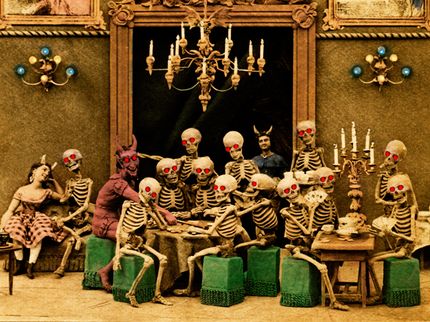
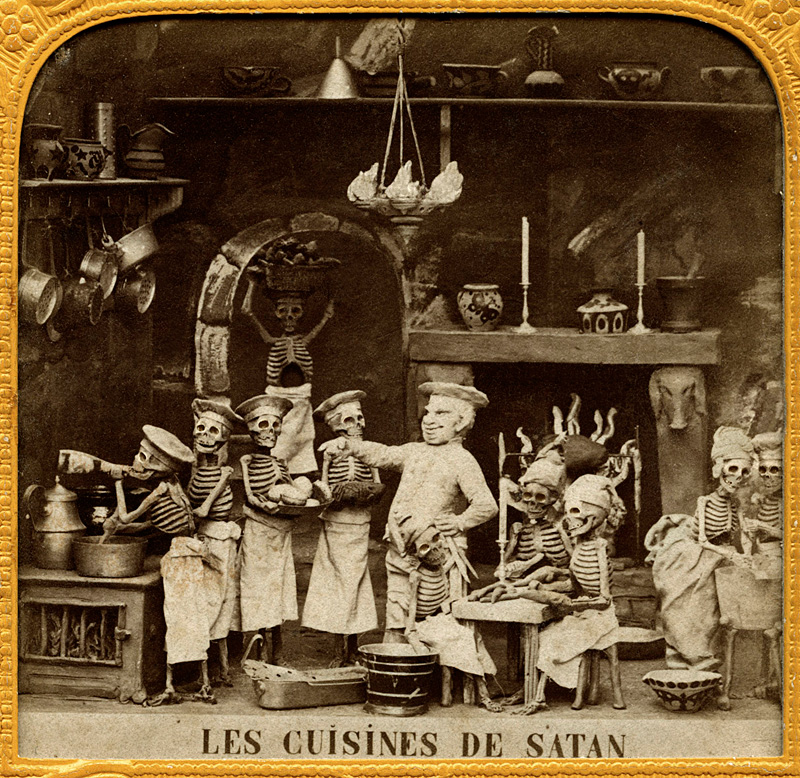
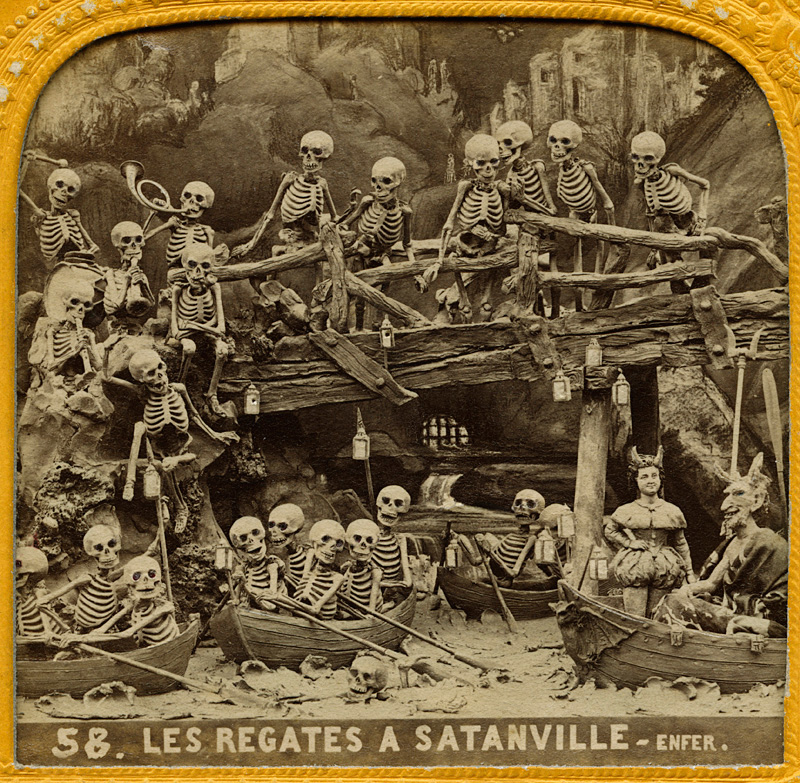
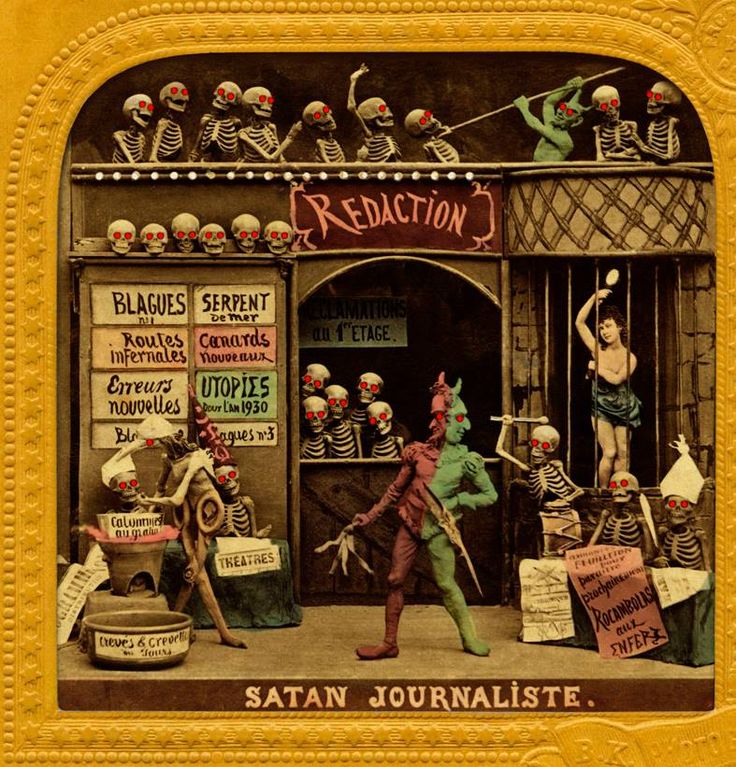
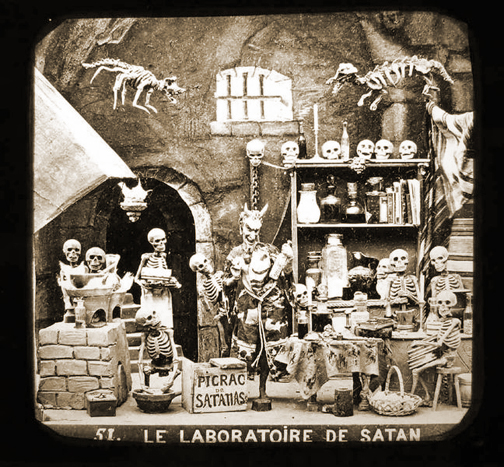
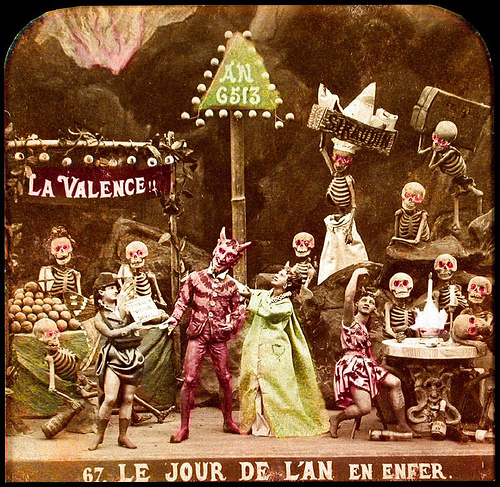
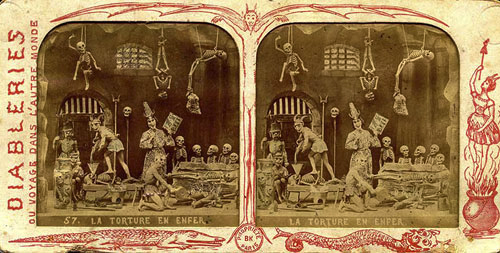
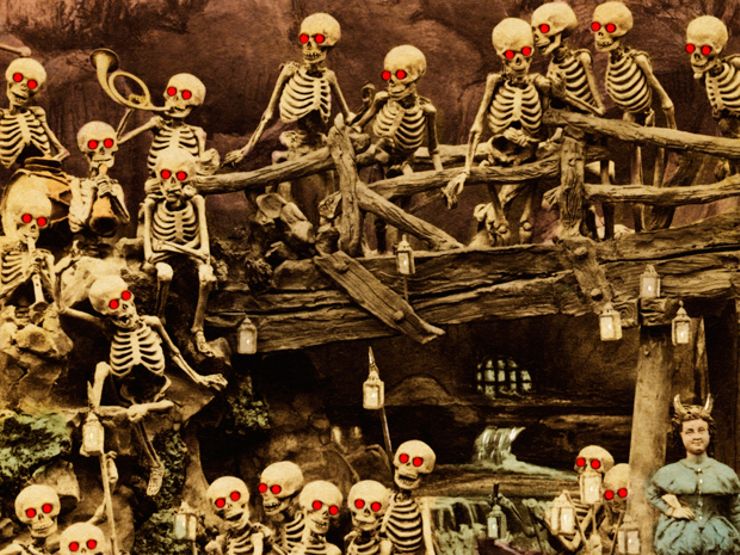
In my research I came across a post from several years back that featured these photographic oddities. I thought they would be fitting companions for Baudelaire’s words. These images are intended for the stereoscope which was invented in Paris in 1850 and became a worldwide sensation over the next decade with its three-dimensional imagery. In 1861, a series of 72 of these stereoscopic photos were printed anonymously in Paris that consisted of macabre scenes of Satan and various aspects of Hell.  Called Les Diableries, these plates were a drastic turn away from the often-mundane photos seen in early stereoscopes and were quite the hit in 1860’s Paris.

The photos remained anonymous in that time because they were viewed as politically satiric of the French government of the time, the Second Empire under Napoleon III. To openly chide the emperor at that time could bring swift retribution (this also sounds familiar, huh?) but the images circulated freely, nonetheless. I think they are a remarkable set of images from that time, and I can imagine how they must have resonated in the minds of people who weren’t exposed to the mind-boggling array of imagery that we often experience in a single day in our time on social media.

When I look at them closely, I can recognize satiric parallels to our current time. Unfortunately, it doesn’t feel as humorous as I had thought it might. Not a lot of laughs in Hell, I guess.

Keeping in the theme of a devilish Halloween, here’s a song from Chris McDermott called Even the Devil Gets Right Someday. Let’s hope the song is correct. 

Hoping you have a good and Hell-free Halloween.

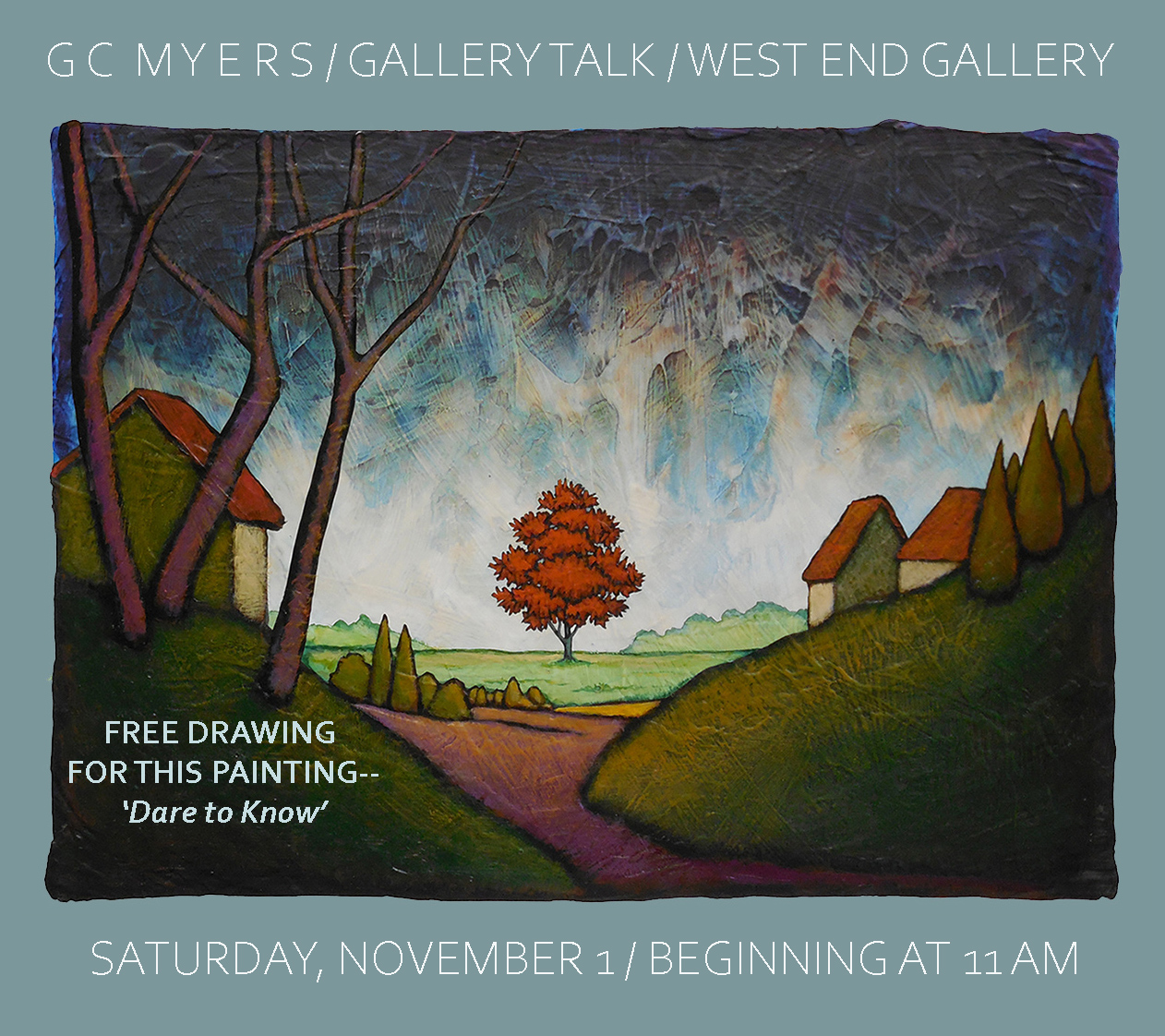
Finally, here’s a reminder that I will be giving my annual Gallery Talk at the West End Gallery tomorrow, Saturday, November 1. The talk begins at 11 AM and lasts about an hour, ending with the drawing for the paintingDare to Know, shown at the bottom of this page. The Gallery Talk and the drawing for the painting are free and open to all. You must be in attendance to win prize. Seating is limited so I would suggest you arrive early to claim your seat and settle in. We can chat or you can take in the exhibit. Doors Open at 10:30 AM.


Read Full Post »

First Peace— At West End Gallery


The great quality of true art is that it rediscovers, grasps and reveals to us that reality far from where we live, from which we get farther and farther away as the conventional knowledge we substitute for it becomes thicker and more impermeable.

–Marcel Proust, The Maxims of Marcel Proust (ed. 1948)


Proust certainly knew what he was talking about when it comes to the reality of one’s inner landscape. In his case, it is a place populated with layers of memory. The memories described in his monumental seven-volume Remembrance of Things Past are both voluntary and involuntary, those triggered and animated in his inner world by a sensory prompt– a taste, smell, sight, or sound– occurring in the outer real world.

His maxim above clearly states what I have been trying to say with my work for years now. And that is that art reveals realities that we often fail to observe. As he points out, it is a reality that has been barricaded from us by the common perceptions of what makes up reality that have been built up over the years. We have become so entrenched in only dwelling in that reality that we have lost the ability to sense and appreciate the other, that being one’s inner reality and its connection to an even greater outer reality.

My hope as an artist is that my work serves as a device or a prompt for the viewer to find their way to their own inner world, to see things from a viewpoint inside themselves rather than from their usual position in the outer world. And maybe that is what true art is, a device or tool that exists beyond its surface.

Proust mentioned this in the final volume of Remembrance of Things Past, writing how the reader (or in my case, the viewer) uses the work as instrument in which they can better see themselves.:

In reality every reader is, while he is reading, the reader of his own self. The writer’s work is merely a kind of optical instrument which he offers to the reader to enable him to discern what, without this book, he would perhaps never have perceived in himself.

In that way, a piece of art becomes something more than mere wall coverings or ear or mind candy. It becomes a portal to another reality, another dimension, in which we are inhabitants whether we know it or not. It’s kind of miraculous to see this in action, to see someone engage with a piece of art that instantly reveals something of themselves of which they were either unaware or were blindly seeking.

I’ve been fortunate to witness this several times over the years and it may well be the primary motivator for my work now. 

Well, that was not expected when I started this post this morning. Hope it makes sense in an hour or a day from now. Maybe we will talk about this on Saturday at the Gallery Talk at the West End Gallery.

Maybe not. Who knows which way the wind will blow on Saturday?

The Gallery Talk at the West End Gallery begins at 11 AM and lasts about an hour, ending with the drawing for the paintingDare to Know, shown at the bottom of this page. The Gallery Talk and the drawing for the painting are free and open to all. You must be in attendance to win prize. Seating is limited so I would suggest you arrive early to claim your seat and settle in. We can chat or you can take in the exhibit. Doors Open at 10:30 AM.
Here’s a favorite song, Killing the Blues. It is best known as performed by John Prine which to me is the gold standard. I hesitated in playing this version that I like very much from Alison Krauss and Robert Plant since I have played it here before. I thought it was recently but, after checking, discovered that I had shared it last in 2011. I guess a 14-year gap between plays is acceptable.


Read Full Post »

Dusk of Time- At West End Gallery


In my solitude I sing to myself a sweet lullaby, as sweet as my mother used to sing to me.

–Albert Cohen, The Book of My Mother (1954)


Today’s post is kind of like a poker hand. I have a pair of Cohens and a wild card in the form of a new painting. The first of the two Cohens is Albert Cohen who is noted as “a Greek-born Romaniote Jewish Swiss novelist who wrote in French.” Born in 1895, he is considered a French writer though he lived most of his life in Switzerland, dying in 1981.

The other Cohen here is the late great Leonard Cohen. I am sharing a song from late in his long career, Lullaby, from 2012. His deep voice and the song’s easy pace and rhythm have a most soothing feeling for me. 

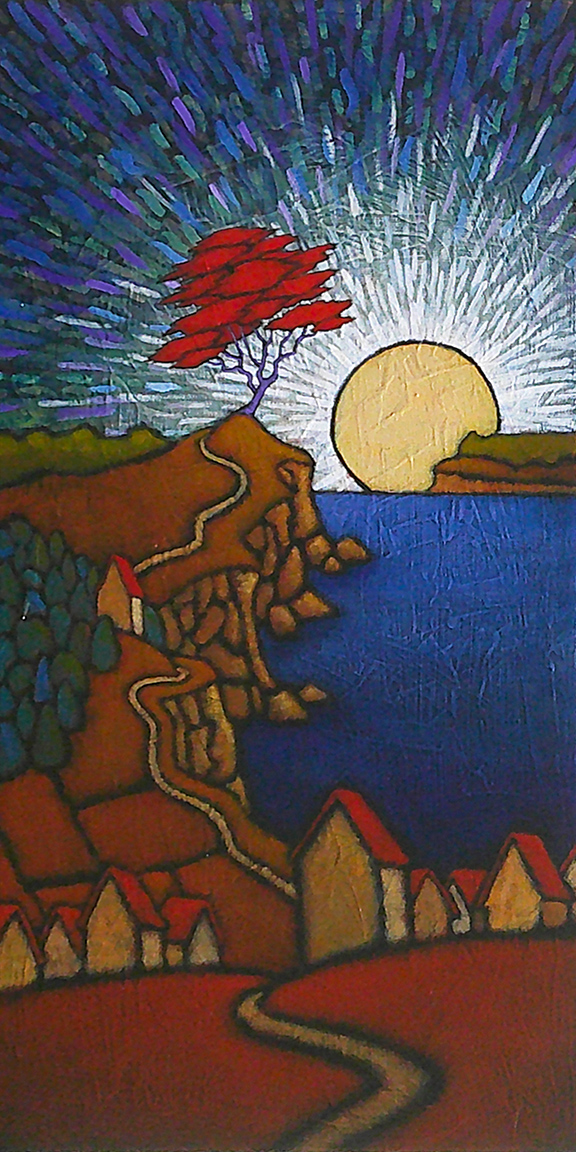
The painting is Dusk of Time from my current solo show hanging at the West End Gallery. I find a soothing feeling in this piece that matches up well with the Cohen song.

Hey, I just fell asleep while looking and listening. I guess they do work well as a lullaby. 

There you are. Three of a kind. That’s usually a winning hand. If I had only come up with a fourth Cohen–that would have been unbeatable! I was going to try to slip in something from the theatrical giant George M. Cohan and maybe slur over the fact it is Cohan with an A rather than Cohen with an E but decided against it. That might be viewed as being a bit underhanded.

Oh, what the hell. Here’s something from George M. Cohen. Oops. That should be Cohan:

Whatever you do, kid—always serve it with a little dressing.

I will use that slightly deceitful fourth Cohen as the transition into the Gallery Talk that will be taking place on Saturday at the West End Gallery. It begins at 11 AM and lasts about an hour, ending with the drawing for the painting, Dare to Know, shown at the bottom of this page. And that’s not all. Taking the advice from that fourth Cohen, er, Cohan, it will be served with a little dressing.

Hope you can make it to the West End Gallery on Saturday for the Gallery Talk. I have plenty of dressing all ready to go…


Read Full Post »

The Wisdom Beyond Words– At West End Gallery


But the Wise Perceive Things About to Happen

“For the gods perceive future things,
ordinary people things in the present, but
the wise perceive things about to happen.”

–Philostratos, Life of Apollonios of Tyana, viii, 7.

Ordinary people know what’s happening now,
the gods know future things
because they alone are totally enlightened.
Of what’s to come the wise perceive
things about to happen.

Sometimes during moments of intense study
their hearing’s troubled: the hidden sound
of things approaching reaches them,
and they listen reverently, while in the street outside
the people hear nothing whatsoever.

–C.P. Cavafy (1915)


I have mentioned C.P. Cavafy a few times here in the past. In 2021 I wrote the following in a post about one of his more famous poems, Waiting For the Barbarians:

Been reading some verse lately from Constantine P. Cavafy, the great Greek poet who lived from 1863 until 1933. He lived his entire life in Alexandria, Egypt and his work often captured the sensual and exotic cosmopolitan feel of that time and place. Readers of Lawrence Durrell and his Alexandria Quartet, in which Cavafy appears as a character, will know what I mean.

Though Cavafy was known for his poetry among the Greek community in Alexandria he spent most of his life working as civil servant. He didn’t actively seek widespread acclaim, turning down opportunities to have his work published while often opting to print broadsheets of his poetry that were distributed to only a few friends. His work didn’t realize wider acclaim until later in his life (and afterwards) when his friend, novelist E.M.Forster, wrote about his work, describing him as a Greek gentleman in a straw hat, standing absolutely motionless at a slight angle to the universe.

I love that description from Forster: standing absolutely motionless at a slight angle to the universe. I am not exactly sure what Forster meant but part of me thinks I know exactly what he is saying.

He sees Cavafy as both part and apart from the world around him. Seen and unseen. Engaged and disengaged.

My perception could well be the result of my own experience of having often felt both part and apart from all things. Not knowing anything but my own experience, I assumed that many others felt exactly the same. But over time, I realized that while there were many others, it wasn’t as many as I had thought.

I don’t know why this was the case. Maybe it’s simply easier to choose one or the other. Choosing and seeing oneself as part of things allows one to be absorbed into the crowd, to take on the voice and thought of the crowd. It requires so much less effort than thinking or speaking in your own voice. And it feels safer in the protection of the crowd.

When you stand apart, you are vulnerable and dependent upon your own wits, senses, and perceptions. There is a sense of danger in this, knowing that whether you stand or fall depends on your own choices and actions.

But with that comes a sense of freedom. You speak your own words and hear clearly beyond the din of the crowd. You think and decide on your own. 

You become the tree, still part of the forest yet standing apart.

And maybe that is what Forster was implying with his slight angle to the universe

I don’t know and I am not sure that this makes one whit of sense to anyone. Probably doesn’t. I don’t mind though. I have often not made sense in many things. Maybe I am standing a little off level myself.

Hey, here’s a lovely piece from Yo-Yo Ma. It’s Gabriel’s Oboe by Ennio Morricone from his soundtrack to the film, The Mission.


REMINDER

MY ANNUAL GALLERY TALK

AT THE WEST END GALLERY

TAKES PLACE

THIS COMING SATURDAY, NOVEMBER 1, 2025. BEGINNING AT 11 AM

SEATING IS LIMITED. THE DOORS OPEN AT 10:30 AM. IT IS SUGEESTED THAT YOU ARRIVE EARLY.

YOU COULD WIN A PAINTING!


Read Full Post »

Land of Amity— At West End Gallery


“Art is such a relief to us because, actually, it’s the real world — it’s the reality that we understand on a deeper level… Life has an inside as well as an outside, and at the present, the outside of life is very well catered for, and the inside of life not at all… We can go back to books or pictures or music, film, theater, and we can find there both some release and some relief for our inner life, the place where we actually live, the place where we spend so much time.”

–Jeanne Winterson, speaking at 2010 Edinburgh Book Festival


I have long referred to my inner and outer worlds as places of equal reality. In fact, my 2012 exhibit at the Fenimore Museum featured just that in its title, The Internal Landscape. I really like this explanation from British author Jeanne Winterson, pointing out that while our inner life is the place where we actually live and spend so much of our time, it is often neglected in favor of care bestowed on our outer life.

This is not to say that we should not take great care of our outer world. It is, after all, one of the realities in which we exist. Rather, there should be more balance in our treatment of both.

Actually, I am probably the opposite, catering to my inner life more than most. This has most likely led to an imbalance that is a bit unhealthy. But that might be the only way I can navigate the outer landscape.

The inner world, inner life, inner landscape– whatever you want to call it– is indeed a relief for me from the outer world. It is a kinder and gentler place, open and friendly to all. I have more control there (or here, depending on from where you’re standing) and can add or subtract to suit my perception of the landscape.

Of course, this inner world is not immune from the reach of the outer world. There are shadows and underlying darknesses that seep through, enough to let me know that it is still out there waiting for me. But I never allow it to fully infiltrate my inner refuge. That’s part of the control I mentioned.

Sometimes when I find myself stranded in the outer world for an extended period of time that tests my endurance, I can quickly find my way back to my inner landscape by seeing, hearing, or reading something that moves me.

Maybe that is movement that is meant when people say they are moved?

Maybe. All I can say definitively is that it instantly transports me back to that inner space of color and rhythm and harmony. It makes my time in the outer world somewhat bearable.

Relief and Refuge.

The other thing that I like about my inner world is that I can do what I do, painting and speaking and writing in ways that might be called crazy by some in the outer world, unabashedly and without a second thought.

My place, my rules. You have your own inner place to tend to so, unless you want to join me in a bit kinder and gentler place, keep your hands off of mine.


REMINDER

I WILL BE GIVING A GALLERY TALK

AT THE WEST END GALLERY

THIS COMING SATURDAY, NOVEMBER 1, 2025. BEGINNING AT 11 AM

SEATING IS LIMITED. THE DOORS OPEN AT 10:30 AM. IT IS SUGEESTED THAT YOU ARRIVE EARLY AND THAT YOU BRING A QUESTION OR TWO WITH YOU. THERE WILL BE A QUIZ. WELL, MAYBE NOT THAT BUT SOMETHING’S GOING TO HAPPEN. I PROMISE.


Read Full Post »

Dare to Know— The Prize at Next Saturday’s Gallery Talk


Enlightenment is man’s release from his self-incurred tutelage. Tutelage is man’s inability to make use of his understanding without direction from another. Self-incurred is this tutelage when its cause lies not in lack of reason but in lack of resolution and courage to use it without direction from another. Sapere Aude!- ‘Have courage to use your own reason!’- that is the motto of enlightenment.

― Immanuel Kant, What Is Enlightenment?


I have written in the past about the difficulty and pain that comes in choosing the paintings that are sometimes given away at my Gallery Talks. I have often said that it must be a painting that creates pain for me in giving it away. 

Well, I’ve made my choice for next Saturday’s Gallery Talk at the West End Gallery and, boy, does it hurt.

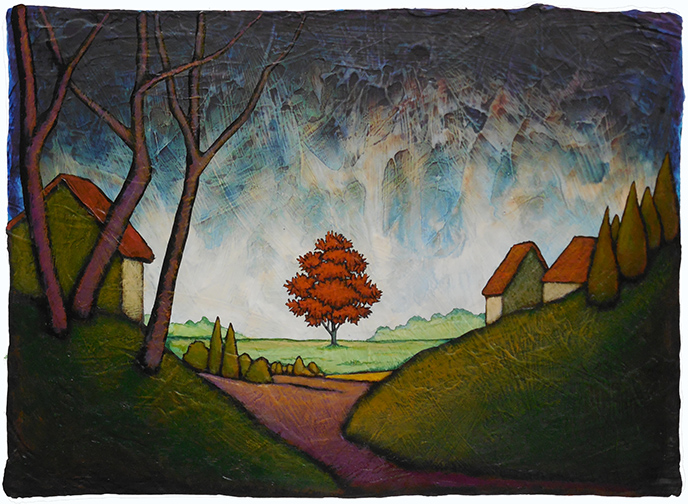
The painting is shown above and is titled Dare to Know. It is 11″ by 15″ on paper and is framed and matted at 16″ by 20″. It’s a piece that attached itself to me immediately, both visually and in its personal meaning which strongly adhered to the words of Kant above. To put it simply, it has always been a very special piece for me.

Here is an essay on this painting that has ran a couple of times here in the past:


Sapere Aude!

From the Latin, meaning Dare to Know.

I came across the passage above from the 18th century philosopher Immanuel Kant and felt immediately that it was a great match for this new painting. In fact, I am calling this piece, 11′ by 15″ on paper, Dare to Know (Sapere Aude!).

The Red Tree here is removed away from the influence and shading of the other trees and houses in the foreground, out of darkness and into the light. There is a light about the Red Tree and a sense of freedom in the openness of the space around it. It is free to examine the world, free to seek the knowledge it craves, and free to simply think for itself.

The concept of self-enlightenment is truly a great idea and one that we definitely could use today. Too many of us construct our own base of knowledge by relying on the thoughts and opinions of others, often without giving much consideration as to their truthfulness, motives, or origins. Or we shade our base of knowledge with our own desires for how reality should appear, holding onto false beliefs that suit us even when they obviously contradict reality.

In short, there is no enlightenment based on falsehoods, no way to spin darkness into light. There is no way to make a right based on wrongs.

  Enlightenment comes in stepping away from the darkness of lies and deceptions to see the world as it is, with clarity. It means stripping away our own self defenses and admitting our own shortcomings, prejudices, and predispositions. 

To have the courage to know and face truths.

It may not always be the desired outcome one hoped for, but it is an honest reality. And maybe that is enlightenment, the willingness to face all truths with honesty.

To dare to know.

Sapere Aude!


Dare to Know will be given away at my Gallery Talk this coming Saturday, November 1 at the West End Gallery, beginning at 11 AM. Seating is limited so I suggest getting there as close to 10:30 AM when the gallery doors will be opened. That will give you time to register for the drawing, claim your seat, and maybe chat for a few minutes beforehand.

The Gallery Talk and the drawing for the painting(s?) is free and open to everyone. Yeah, even you. So, what have you got to lose? Get yourself into the West End on Saturday and maybe take home a favorite painting of mine.

But be forewarned that this is an interactive event. Its success or failure– it can happen!— depends on your participation. So, you better have a good question or two in mind when you enter the gallery. If you leave me hanging up there all alone, there will be hell to pay! 

Okay, that’s that. This week’s Sunday Morning Music is kind of last second choice. I had another song in mind but when I went to get its link this song was a suggestion. It was an immediate hit thematically and also favorite Beatles song. As if that could be a thing out of so many! This is Think For Yourself from their 1965 Rubber Soul album.


Read Full Post »

Beheld— Now at West End Gallery


… I said to my soul, be still, and wait without hope

For hope would be hope for the wrong thing; wait without love

For love would be love of the wrong thing; there is yet faith

But the faith and the love and the hope are all in the waiting.

Wait without thought, for you are not ready for thought:

So the darkness shall be the light, and the stillness the dancing.

-T.S. Eliot, East Coker, The Four Quartets (1940)


Whenever I read this passage from T.S. Eliot, I am inevitably moved by his words. The interesting thing is that while my response is always strong, my personal interpretation of it, how I relate it to my own experience and knowledge, sometimes varies wildly.

And I suppose that is much like looking at a work of art. The day, the moment, the circumstance and context in which we see it– these things and more often dictate our response and our relationship to art.

I have been spending the morning looking at paintings that would satisfy the requirements for the painting to be given away at the Gallery Talk I will be giving at the West End Gallery next Saturday, November 1.

You wouldn’t think there would be requirements or rules for such a thing but there are.

First, it has to be a real painting, something I would proudly show. Not something that makes me go “Yikes!” when I come across it now like some experiment from the distant past that makes me wonder what I was thinking when I did that.

I have plenty of those and wouldn’t push them off on anyone.

The selected painting must also have to be substantial, not a tiny little piece. That means it has real value, yes. But more than that, it means that I dedicated a lot of time, effort, and maybe even a little thought in creating it. I say maybe for the thought part because sometimes thinking less works better for me when I am working.

The painting I choose also has to have meaning for me personally. It has to hurt to see it go. These are usually paintings that have spent a little more time with me here in the studio and, as a result, my relationship with them has evolved and changed a bit since they were created.

I found that especially true while going through a group of paintings that have been narrowed down to as the finalists for my choice. I wrote the two short paragraphs at the top that accompanied the beautiful words of T.S. Eliot several years ago, writing about how our perception of some art is not static and always the same. It changes because we change, the time changes, our mfood changes, our experience changes, etc.

Something we thought of in one way then can often strike us in a different way now. The feeling that was once so near the surface deepens as layers of personal meaning are added over time.

I still have to make the final choice. Maybe I’ll let you know tomorrow. Maybe not. Who knows? But rest assured it will meet my requirements, and it will be painting that will make me both happy and sad to give away.

The painting at the top, Beheld, is 12″ by 12″ on canvas. Note that it is not the painting to be given away. It is included in my current exhibit, Guiding Light, at the West End Gallery. The show is hanging until November 13.

A week from today, on Saturday, November 1 I will be giving away the aforementioned and still unchosen painting at my Gallery Talk at the West End Gallery, beginning at 11 AMAs always, the Gallery Talk is free and open to everyone.

Here’s a song that has been stuck in my head in recent days. It’s Out With the Crow from a group called the Haunted Windchimes. Kind of Halloween-y, right?


Read Full Post »

Follow the River— At West End Gallery


Look down the long valley and there stands a mountain
That someone has said is the end of the world.
Then what of this river that having arisen
Must find where to pour itself into and empty?
I never saw so much swift water run cloudless.
Oh, I have been often too anxious for rivers
To leave it to them to get out of their valleys.
The truth is the river flows into the canyon
Of Ceasing-to-Question-What-Doesn’t-Concern-Us,
As sooner or later we have to cease somewhere.
No place to get lost like too far in the distance.
It may be a mercy the dark closes round us
So broodingly soon in every direction.

–Robert Frost, Too Anxious for Rivers (1947)


The canyon of Ceasing-to-Question-What-Doesn’t-Concern-Us…

This line (and the title) caught my eye when I first came across this Robert Frost poem, Too Anxious for Rivers. I thought the first half the poem shown above (the full poem is included at the bottom of the page) was a fine companion to the painting at the top, Follow the River.  Both have an existential theme and feel.

I could see this river flowing into that particular canyon. There is something about that slash of that particular blue cutting through the center of the painting that speaks to me, something that calms me. I guess that is a good thing, as I, much like the title states, am sometimes too anxious for rivers. Too anxious to simply float along with the current.

So much energy wasted struggling against the rhythm and force of the river when I should be letting it guide me, rather than trying to make it deliver me where it refuses to go. 

The river will deliver you on its own terms and schedule.

This painting, Follow the River, is 30″ by 15″ on canvas. It is included in my current exhibit, Guiding Light, at the West End Gallery. The show is hanging until November 13.

Next Saturday, November 1 I will be giving a Gallery Talk at the West End Gallery, beginning at 11 AM. Today or tomorrow, I will be choosing the painting that will be given away in a drawing at the end of the talk to someone in attendance. As always, the Gallery Talk is free and open to everyone. I will be announcing the prize painting in the next few days so keep an eye out here.

Here’s a song, River Man, from Nick Drake. Nick Drake recorded three albums from 1969 to 1972 that never really found an audience at the time. Tragically, he died from an overdose of antidepressants in 1974 at the age of 26. In the years since, his work has gained that audience that eluded him during his short lifetime and has a cult following. I find this song particularly haunting.

And soothing like the flow of a river.


Look down the long valley and there stands a mountain
That someone has said is the end of the world.
Then what of this river that having arisen
Must find where to pour itself into and empty?
I never saw so much swift water run cloudless.
Oh, I have been often too anxious for rivers
To leave it to them to get out of their valleys.
The truth is the river flows into the canyon
Of Ceasing-to-Question-What-Doesn’t-Concern-Us,
As sooner or later we have to cease somewhere.
No place to get lost like too far in the distance.
It may be a mercy the dark closes round us
So broodingly soon in every direction.
The world as we know is an elephant’s howdah;
The elephant stands on the back of a turtle;
The turtle in turn on a rock in the ocean.
And how much longer a story has science
Before she must put out the light on the children
And tell them the rest of the story is dreaming?
“You children may dream it and tell it tomorrow.”
Time was we were molten, time was we were vapor.
What set us on fire and what set us revolving,
Lucretius the Epicurean might tell us
‘Twas something we knew all about to begin with
And needn’t have fared into space like his master
To find ‘twas the effort, the essay of love.

Read Full Post »

Winter Wonder Moons

Winter Wonder Moons— At West End Gallery


When the moon shines very brilliantly, a solitude and stillness seem to proceed from her that influence even crowded places full of life.

–Charles Dickens, Bleak House (1853)


If one moon can do that, can you imagine the effect of seven moons?

Maybe we need seven moons now more than ever?


This painting is titled Winter Wonder Moons and is 8″ by 10″ on canvas. It is included in my solo show, Guiding Light, which hangs at the West End Gallery until November 13.

And mark your calendars for next Saturday, November 1 when I will be giving a Gallery Talk at the West End Gallery, beginning at 11 AM. I am in the process of choosing a painting that will begiven away to someone in attendance at the end of the talk. It could be you! I will be announcing the prize painting in the next few days so keep an eye out here.

Read Full Post »

Witness to the Dawn

Witness to the Dawn– At West End Gallery


Human history can be viewed as a slowly dawning awareness that we are members of a larger group.

–Carl Sagan, Cosmos


Maybe the way we view ourselves as being part of a group is the dividing line that separates us these days.

Some of us adhere to Carl Sagan’s view that throughout our history we have moved away from seeing ourselves as part of a single small group based on race, religion, occupation, wealth, or any number of other factors that are used to define us. It focuses on the commonalities that we share with others, both here on Earth and beyond.

This is an expansive and inclusive viewpoint.

On the other hand, there are those who deny this view of history and our humanity. They desire to become even more singular and narrow in their definitions.

It is exclusionary and limiting in its scope.

Those are seemingly pretty big differences to overcome. It can be frustrating, even depressing, to contemplate this division. But history shows that we do continue to progress forward. Perhaps slower than we would like and periodically with setbacks to this progress that will take time and effort to repair.

History also shows that the exclusionary factions may have their day in the sun but eventually succumb to the sheer numbers that make up the march of progress. 

I am still feeling poorly and wasn’t going to write anything this morning. However, I thought I might feel a bit better if I were to remind myself that history will usually self-correct, that darkness cannot last forever. I thought this painting, Witness to the Dawn, sort of summed up what I was thinking.

Hopeful and forward looking.  

This new painting is 10″ by20″ on canvas on canvas and is included in my solo exhibit, Guiding Light, now hanging at the West End Gallery in Corning, NY. The exhibit end Thursday, November 13.

Plus, on Saturday, November 1, there is also a GALLERY TALK taking place, beginning at 11 AM. Watch this space in the coming days for further details.

Here’s a song from Pearl Jam that also sums up a bit of what I am pulling from this painting. It’s called Just Breathe. I am also throwing in Willie Nelson’s take in the song from a number of years back, assisted by his son, Lukas.


Read Full Post »

Older Posts »