Feeds:
Posts
Comments

Archive for October, 2025

…agape with wonder…

Something Beyond— At West End Gallery


But We Had Music

Right this minute
across time zones and opinions
people are
making plans
making meals
making promises and poems

while

at the center of our galaxy
a black hole with the mass of
four billion suns
screams its open-mouth kiss
     of oblivion.

Someday it will swallow
Euclid’s postulates and the Goldberg Variations,
swallow calculus and Leaves of Grass.

I know this.

And still
when the constellation of starlings
flickers across the evening sky,
it is     enough

to stand here
for an irrevocable minute
     agape with wonder.

It is     eternity.

— Maria Popova


This poem, But We Had Music, is from Maria Popova, who has written the wonderful blog The Marginalian (formerly Brain Pickings) since 2006. I have gleaned so much from her insights and sharing of the writings and thoughts of so many great thinkers. I seldom come away after reading her blog without a wealth of new perceptions.

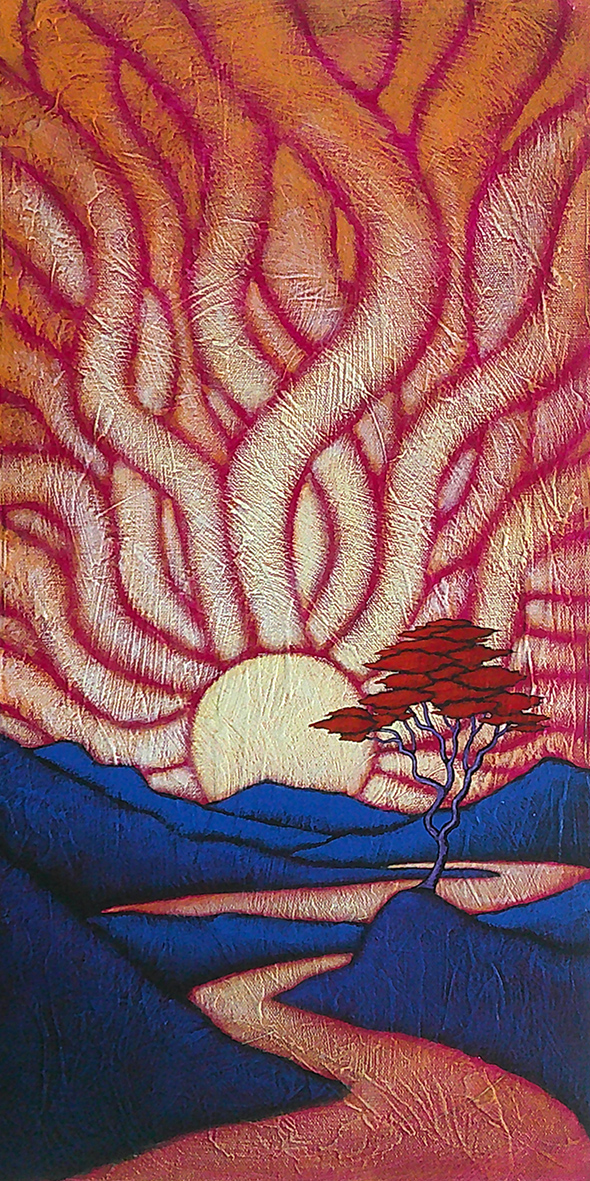
But this time her own poem instantly hit me as a fitting companion to the painting at the top, Something Beyond. It is, of course, one of the paintings featured in my new solo exhibit of work, Guiding Light, that opens next Friday, October 17, at the West End Gallery.

For me, this piece speaks to the same realization that comes in Popova’s poem– that though our lives here are so often filled with busyness, worries, sorrows, joys, opinions, and accusations, there sometimes come moments that remind us of the temporary nature of our time here. We are so often lost in the boiling, roiling, and turmoiling of the minute details of everyday life that we lose sight of the miracle and wonder of it all.

I had such a moment as the one described in the poem just yesterday when I had to run into town early in the morning. It was cold, our first freeze of the season, and there was an icy fog hanging on the road. After a few miles there was a break in the fog and the morning sky softly broke through. There was a lovely and delicate salmon pink color created by the sunrise on the low cloud above. A group of eight or nine geese was rising out of the field off to my right and flew in line across that pale pink sky. They were flying perpendicular to me, both of us moving toward the same point ahead, so that I was able to watch them for more than mere glance. It was a lovely few moments, so tranquil and natural that it felt like a small bit of grace from somewhere beyond, a simple reminder of the wonders that surround us. 

It’s easy to lose sight of that. We live our lives in what could and should be a simple and wonderful world. Unfortunately, it all too often seems tangled up with the stupidity, anger, hatred, and confusion usually brought about by those who forget that we are ephemeral beings living on borrowed time and that no amount of money or power will change that fact. 

A handful of geese in the sky on a cold October morning can sometimes feel like a remedy to all that. 

Below is a reading of Maria Popova’s poem from singer/songwriter Nick Cave with visualizations from filmmaker Daniel Bruson. I have also included a piano piece, Spanish Waltz, from Spanish pianist Nel Aique. It came on while I was writing this and it mirrored the feel of the flight of those geese yesterday morning. Lovely.





Read Full Post »

This Beautiful World— At West End Gallery


To romanticize the world is to make us aware of the magic, mystery and wonder of the world; it is to educate the senses to see the ordinary as extraordinary, the familiar as strange, the mundane as sacred, the finite as infinite.

— Novalis 


I don’t plan on saying much today. Just going to let the spirit of the words, painting, and song do their thing. With a quick glance at these three, you can see that the theme for today is a recognition of the beauty of our world. Or as Novalis put it: the magic, mystery and wonder of the world.

Or maybe it is about how we often don’t fully recognize those things? I can’t decide.

The words are from the 18th century German poet/philosopher Novalis (Georg Philipp Friedrich Freiherr von Hardenberg 1772-1801) who was amazingly productive with work that has had lasting influence in the many generations since his death in 1801, at the youthful age of 28. He is thought to have died from tuberculosis or cystic fibrosis.

His words coincide with the hopes of many artists in wanting others to see in their work the potential for the extraordinary in the ordinary. To see that beauty is at hand at all times.

The painting above, This Beautiful World, is 10″ by 15″ on canvas and is from my West End Gallery show that opens next Friday, October 17. The exhibit is being hung today so you can see it early for a preview, if you so desire. I think this piece falls nicely in line with the words of Novalis as a symbol of the sacred mundane.

The song is the title track from the great Mavis Staples’ new album, Sad and Beautiful World. It’s her cover of a 1995 song from indie rock band Sparklehorse. It is a simple song with spare lyrics but it beautifully lays out the depth of the sadness that often comes with beauty as part of the deal.

We need the contrast of sadness to allow us to fully see how beautiful this world can be and how fortunate we are to experience its love, beauty, and wonder. And how fortunate we are to be able to feel deep emotion or to cry in both suffering and joy. To know life and death.

To be human…


Read Full Post »

The Awakening— At West End Gallery


Life always bursts the boundaries of formulas. Defeat may prove to have been the only path to resurrection, despite its ugliness. I take it for granted that to create a tree I condemn a seed to rot. If the first act of resistance comes too late it is doomed to defeat. But it is, nevertheless, the awakening of resistance. Life may grow from it as from a seed.

–Antoine de Saint-Exupéry, Flight to Arras (1942)


What awakens us?

What are the sacrifices that created us and brought us to this point in our existence?

What seeds have been condemned to rot so that we might stand on this rock?

So many questions.

Few, if any, answers.

It sometimes like we have evolved enough to ask the questions but not enough to recognize the answers.

We are left standing on this rock with only a vague sense of what that answer might be. 

A nebulous feeling of what is and what is not.

And sometimes that feeling is enough in the moment to sooth whatever it is within us that asks such questions.

It is enough to allow us to feel as though we have been given an answer.

The real question is: What do we do with that answer?


I don’t know if any of this makes sense to you this morning. It just felt right for what I was feeling from the combined stimulus from the passage along with the painting at the top and the song below. There seemed to be some thread of sense running between the three, containing some sort of answer to whatever question I was asking.

But then again, I could be delusional. I wouldn’t be at all surprised– I hear there’s a lot of that going around. 

The painting shown here is The Awakening, 24″ by 12″ on canvas, that is included in my solo show, Guiding Light, that opens at the West End Gallery next Friday, October 17. The Red Tree in it represents, for me, the growth from that sacrificed seed, the newly formed consciousness that feels the wonder of the world into which it has emerged. It seeks to understand the answers it feels it is being given.

The song below is a new song from the new album from Robert Plant called Saving Grace.  It features the vocals of singer Suzi Dian and the group Plant. I really like this recent performance on Jools Holland’s show and felt it fit well with some of my work, including this new painting.

Feels like there’s an answer in there somewhere if I could just make it out…


Read Full Post »

Far and Away

Far and Away– At West End Gallery


To persons standing alone on a hill during a clear midnight such as this, the roll of the world is almost a palpable movement. To enjoy the epic form of that gratification it is necessary to stand on a hill at a small hour of the night, and, having first expanded with a sense of difference from the mass of civilized mankind, who are disregardful of all such proceedings at this time, long and quietly watch your stately progress through the stars.

Thomas Hardy, Far From the Madding Crowd


There’s often a dichotomy in art that illustrates our connection to all of humanity– our commonality with all things– while at the same time pointing out our own uniqueness and sense of difference. 

It’s a delicate dance that requires a cooperative balance between the two, with neither dominating and each strengthening the other.

Having a sense of our value as individuals brings a depth of understanding and an acceptance of others that enhances our connection with our humanity.

And recognizing that connection brings a sense of humility that keeps us from thinking that, even though we perceive our own uniqueness, we are any more special than the next person in line at the grocery store. 

I think art can do this; make you feel both common and special at once.

Both part and apart.

And I think that is something that we need. It’s easy to see what happens when people feel too much of one or the other, when people begin to believe that they are unimportant– faceless and voiceless– while others believe they are above all others in every way.

It is hopelessness and hubris. The delicate dance falls apart.

That’s a lot to see in a what seems like a quiet and peaceful painting on its surface. But that is how I read this new painting, Far and Away. For me, it is about that delicate dance of connection and apartness. About finding the balance and rhythm between the two and losing yourself in the dance.

You might not see it that way. That’s okay. Some dances aren’t for everybody. 

Far and Away is 18″ tall and 6″ wide on canvas. It is currently at the West End Gallery where it is waiting to be hung on the gallery walls later this week as part of my solo show, Guiding Light. The exhibit opens next Friday, October 17 with an Opening Reception that runs from 5-7 PM.

Here’s an obvious choice for a song to go with the painting and the words at the top from Thomas Hardy. This is Moondance from Van Morrison from 1970, a mere 55 years ago.


Read Full Post »

Howl– Now at West End Gallery


All hatred driven hence,
The soul recovers radical innocence
And learns at last that it is self-delighting,
Self-appeasing, self-affrighting,
And that its own sweet will is Heaven’s will;
She can, though every face should scowl
And every windy quarter howl
Or every bellows burst, be happy still.

–William Butler Yeats, A Prayer for My Daughter (1919)


I can see this new painting, Howl, as having two distinctly different interpretations.  Probably more when the experience and perceptions of others are considered. But from my personal perspective, the first, which is how I initially viewed it, is as a howl of indignation and defiant resistance against the prevailing winds of injustice, cruelty, and indecency.

Obviously, that interpretation takes current events into account. However, such a howl is certainly applicable in all times and places. There’s never a shortage of injustice, cruelty, or indecency.

The other way of reading it comes from a poem, A Prayer for My Daughter, William Butler Yeats wrote days after his daughter was born in 1919 during the early days of the Irish War for Independence. It, too, takes the current events of its time into account. It is written with the hope that as his daughter can resist the winds of hatred and anger and that she is not pulled along with them. And with the hope that she recognizes that she will always have the choice to find strength and contentment within herself even as the winds of hatred and anger swirl around her.

That though times are ugly, the world surrounding us can still be beautiful and wondrous.

I can easily see both of these views in this painting.  Both takes are really about resistance, about staying intact against the force that want to tear us apart. About staying true to ourselves and our humanity. About denying hatred and cruelty a place in ourselves.

It’s about holding our ground and issuing a howl. a bellow, a yawp borrowed from Whitman, that comes from the core of our being that says we will remain as we are and will not become that which we stand against.

Well, that’s what I see in it…

Howl is 8″ by 16″ on canvas and is part of my solo exhibit, Guiding Light, that opens next Friday, October 17 at the West End Gallery in Corning, NY. The show’s Opening Reception, which is free and open to all, runs from 5-7 PM on the 17th. The work for the show has been delivered and will be available for previews in the coming few days.

Gallery Talk is also scheduled at the West End Gallery for Saturday, November 1, beginning at 11 AM. Keep an eye out here for more details.

Not sure if this song applies at all to the painting or words above. I just felt like hearing it this morning. This is Stand from REM.


Read Full Post »

RedTree: Continuum— Coming to West End Gallery


“We’re only here for a short while. And I think it’s such a lucky accident, having been born, that we’re almost obliged to pay attention. In some ways, this is getting far afield. I mean, we are — as far as we know — the only part of the universe that’s self-conscious. We could even be the universe’s form of consciousness. We might have come along so that the universe could look at itself. I don’t know that, but we’re made of the same stuff that stars are made of, or that floats around in space. But we’re combined in such a way that we can describe what it’s like to be alive, to be witnesses. Most of our experience is that of being a witness. We see and hear and smell other things. I think being alive is responding.”

—Mark Strand, interview with Mihaly Csikszentmihalyi (Flow)


Mark Strand (1934-1914) was a Pulitzer Prize-winning poet and essayist who served as the US Poet Laureate in the early 1990s.

I often wonder what, if any, purpose we have here on this planet. This thought from Mark Strand that we are put here in our present form as an assemblage of the molecules and matter of the universe so that the universe could see and analyze itself intrigues me.

Are we some sort of diagnostic tool? Is this planet a testing ground to reveal what works and what falls short? 

As I said, it’s intriguing. I have dozens of more questions pertaining to it. 

But perhaps Strand is closer to the reality of the matter, whatever the hell that is these days, when he opines that our ultimate purpose might be as witnesses. I guess that might still fall into diagnostic tool category as we would be serving as sensory indicators for the universe, cataloging everything–all the sights, sounds, smells, tastes, textures, emotions, etc.– that we encounter in our time here. 

I like this idea of us as witnesses or observers. I have thought for some time that many artists of all sorts began their lives as observers, as the quiet kid off to the side taking in everything in great detail.

Maybe in those formative years, we are simply new and fresh out-of-the-box sensors that work at full speed and capacity? That makes sense to me since I now often feel that many of my particular sensor’s storage unit is just about full and my operating speed is greatly lagging. 

But beyond that, it is this idea of us being witnesses that speaks to me. We all want to believe that the thoughts, feelings and experiences that make up our existence have served a purpose, that they matter beyond our own small bit of self.

That our voice will be heard somehow as testimony to our existence, as well as to the lives and existence of those around us.

I know that this desire to have my voice heard, to articulate somehow my purpose and experience of living in this world, was the primary reason behind my beginnings as an artist. 

To add my data to the catalog of the universe as fulfill my purpose as part of its continuum.

I will finish by adding the following from Tennessee Williams, in an interview with James Grissom:

All of us require a witness. A witness who will let us–and the world–know that we have lived, that we have contributed. As artists we need to know that our contributions mattered, touched the heart, evoked a thought, led someone else off to their own pale judgment to scribble something out. When we create characters, we are witnesses to ourselves and to those to whom we have reacted, to those we have loved, to those who inspire us.

The greatest artists are, I think, witnesses. They have been, to steal a line, present at the creation….of whatever they have seen.


The painting at the top is RedTree: Continuum, 18″ by 36″ on canvas, that is included in my solo exhibit Guiding Light, that opens next Friday, October 17 at the West End Gallery in Corning, NY. The show’s Opening Reception, which is free and open to all, runs from 5-7 PM.

A Gallery Talk is also scheduled at the West End Gallery for Saturday, November 1, beginning at 11 AM.

Here’s Doctor My Eyes from Jackson Browne. Seemed right this morning.


Read Full Post »

Color and Glide— Coming Soon to West End Gallery


So scanty is our present allowance of happiness that in many situations life could scarcely be supported if hope were not allowed to relieve the present hour by pleasures borrowed from the future.

–Samuel Johnson, The Adventurer No. 69, Idle Hours (1753)


The other day I mentioned not wanting to write about my work when so many wrongs were being spread among us. I didn’t want my focus on art or that of anybody else appear to be a distraction or seem ignorant of what is taking place.

Thinking about it in the days that followed, I realized that I was mistaking the function of art in such times. It is not a distraction at all. It is instead a release, a form of relief that is badly needed if one is aware and stays informed on what is taking place. Anyone who is disturbed by injustice and possessing even an iota of empathy and compassion for their fellow humans can be eaten alive with stress and anxiety in such times.

They need relief of some sort at some point. But not as a distraction nor to make them ignore their fears and cares. No, they need something that calms and gives hope in some way. Something that allows them to step out of the parade and stand hidden in a cool dark shadow for a few moments in order to catch their breath and take in the small details and wonders of this world that may have been overlooked in the hubbub of this moment. To find hope in a small glimpse of beauty, something that reminds them of why they need to continue to care and to stay involved.

No, art is not distraction at such times. It is a needed breath of clean air that keeps us going.

Relief. Release.

It is hope.

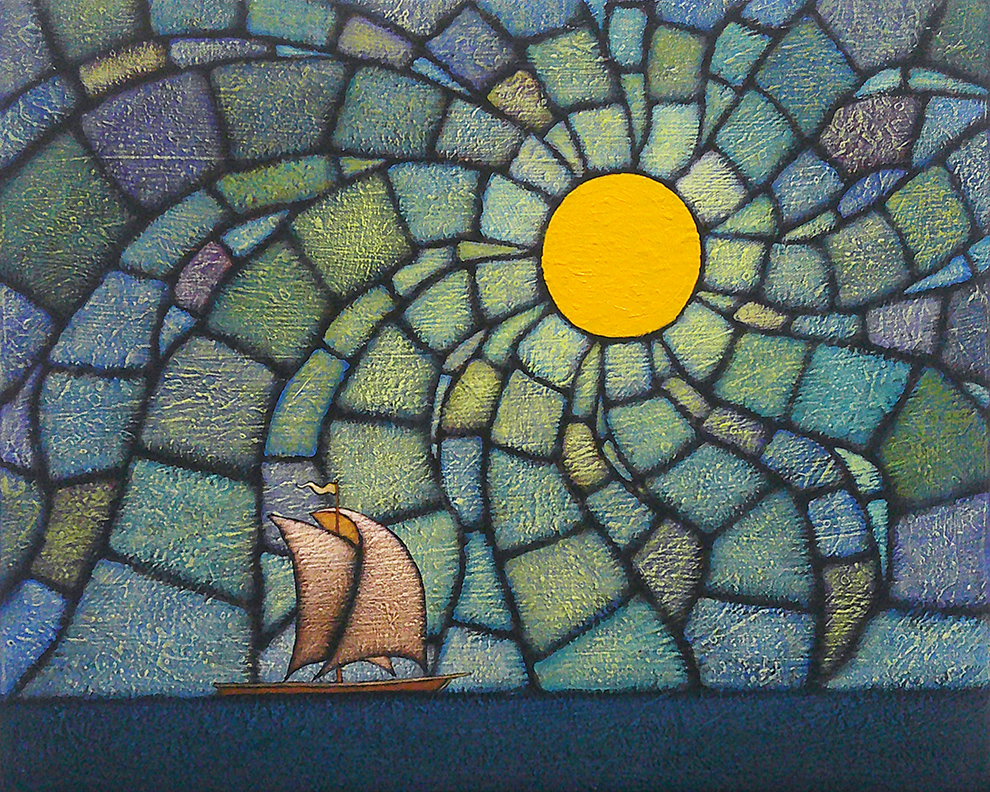
Hope and relief are what I find in this new painting. I had a hard time titling it because it does so many things for me that focusing on one thing seemed to leave out others that seemed as vital for me. But it was the ease of the boat going into the many colors and pattern of the sky that captured me. I feel as though I can get lost in the colors of the sky here, each block of color like a new burst of flavor and feeling.

But more than that, it makes me feel hopeful. it reminds me of the freedom of the mind and feeling, that part of us that can’t be captured, dictated to or governed by others.

It is boat gliding under a sky of wonder.

I call this painting, 16″ by 20″ on canvas, Color and Glide. It is included in Guiding Light, my solo show at the West End Gallery that opens October 17.

For this week’s Sunday Morning Music, I am going with a song whose title, along with its lyrics, might also fit this painting. This is Drift Away by Dobie Gray from 1973. The song was originally recorded by others as a country song, but Dobie Gray’s version far outstrips them in depth of feeling in my opinion.


Read Full Post »

Guiding Light– Coming to West End Gallery


Beauty, Inspiration, Magic, Spellbound, Enchantment, as well as the concepts of Serenity, Silence, Intimacy and Amazement. […] They have never ceased to be my guiding lights.

–Luis Barragán, acceptance speech for the Pritzker Architecture Prize, 1980


Luis Barragán (1902-1988) was an influential Mexican architect whose buildings were a blend of Modernism and traditional Mexican culture. They are marked by his use of bold colors, simple natural forms and materials, the play between light and shadow, and spaces that invited introspection and contemplation. Looking at his work, I was struck by his use of color, particularly his vibrant yellows and pinks that were bold but surprisingly calming. It was easy to see why his work is considered emotional architecture.

I was also struck by the qualities he listed above in his acceptance speech for the Pritzker Prize. We all follow guiding lights of some sort in our lives, attributes that form the paths we follow, the dreams we dream, the beliefs we hold sacred, and the standards– the ethics and morals– to which we personally adhere.

I would like to think that my list is not too far removed from the list of Barragán, especially those final four concepts he mentions: serenity, silence, intimacy, and amazement. I might throw in harmony. They certainly were close to the surface of consciousness while at work for my new exhibit, Guiding Light, that opens two weeks from today, Friday, October 17, at the West End Gallery.

The painting at the top, Guiding Light, 24″ by 30″ on canvas, provided the title for this show. I also believe it perfectly transmits those four concepts, particularly the serenity and silence. And though it depicts a landscape with distance and depth, there is also a sense of intimacy, as though the moon here is communicating directly to the viewer. That might also be the source for amazement, something that often comes with revelation.

This piece also makes me think about what other guiding lights each of us follow. Were they always influencing us from day one or did they one day rise up and become visible to us, like the moon rising in the evening? I think some of my guiding lights were present from childhood, but some have risen in my own sky, becoming more apparent and important to me as I age.

And how closely does each of us follow what we believe to be our guiding lights? I certainly follow mine more than when I was much younger. Well, at least I think I do.

Maybe self-deception is also a guiding light? I sure hope not though I think many folks do see it as one.

I have often employed the simple shape of the sun/moon in my work as a symbol of guidance and of something greater than ourselves.  This show, my 24th solo exhibit at the West End Gallery, is filled with moons and suns. I have come to see the sun/moon as being equal in importance to my work as the Red Tree or any other of the icons that often inhabit it. As an element, it creates a palpable presence in each piece.

The third eye of the painting? I have to think on that.

As stated above, Guiding Light opens at the West End Gallery two weeks from today, on Friday, October 17, with an opening reception that runs from 5-7 PM. Also, on Saturday, November 1, I will be giving a Gallery Talk at the gallery beginning at 11 AM. Keep an eye for more details in the coming weeks.

Here’s a song that has been in my head for a couple of days. I was big fan of the album Pontiac from Lyle Lovett years ago when it first came out, but in the confusion of time and space, it somehow, for no reason, fell off of my playlist. While building frames the other day, I found the CD and played it for the first time in quite a while. It reminded me of why I liked it so much and made me wonder what other music that really hit the mark had fallen to the wayside. This song, Simple Song, has been stuck in my head ever since and seems to fit this painting this morning.


Read Full Post »

Revisiting the Past

Revisiting the Past— Coming to West End Gallery October


The images selected by memory are as arbitrary, as narrow, as elusive as those which the imagination had formed and reality has destroyed. There is no reason why, existing outside ourselves, a real place should conform to the pictures in our memory rather than those in our dreams.

–Marcel Proust, Remembrance of Things Past


The past is a foreign country; they do things differently there.

—L.P. Hartley, The Go-Between (1953)


Just remember that the things you put into your head are there forever, he said. You might want to think about that.
You forget some things, don’t you?
Yes. You forget what you want to remember and you remember what you want to forget.”

― Cormac McCarthy, The Road


I am using three passages above for this new painting, Revisiting the Past, mainly because I simply couldn’t decide between them. Each speaks to feelings I get from this piece, particularly the last line from Cormac McCarthy:

You forget what you want to remember and you remember what you want to forget.

That’s one of those things that is so filled with truth that you don’t question its veracity. While we may remember many of the better moments from our past, it is our lived moments of trauma that hang with us forever, often near the surface of our consciousness and in vivid detail.

It might be said that the kiss and the caress dwell easily in our memory, ready to be pulled up at our prompting whereas the anguish and suffering we have experienced is like a scar over a deep wound, on the surface that sometimes aches in a way we cannot ignore, constantly reminding us of how it came to be there.

There is a dreamlike quality to this painting that reminds of the passage from Proust. I, of course, interpret his words though my own filter. I certainly would not want my reality to consist of my dreams since I have only a few truly good dreams that I can recall, sitting here this morning. The dreams I remember are the ones that still haunt me, the nightmares and night terrors–those that left a scar.

Hardly the stuff on which I would want to build a reality.

The past is a foreign country; they do things differently there, the famous first line from the Hartley novel, fits perfectly with this painting for me. We revisit the past from a point in time beyond it. We are not dealing with the past as the same person or with the same circumstances or dynamics.  Time has passed and things have changed in many ways. What was once the norm has been lost or altered and the future has revealed things that were hidden at the time.

We have changed, hopefully growing in wisdom and understanding. Our perspective is from more distant point now, one that allows us to have a more objective overview. We can now hold it up and turn it to get a better idea of what it was and now means to us, like a scientist examining a specimen.

It might still hurt and haunt but at least we know the what and how of it. Maybe even the why, though sometimes the why of anything can be elusive, living completely hidden in the mind of others.

This is one of those paintings that can say a lot to someone who has ever been haunted by the past or their dreams. I can’t speak for those who haven’t experienced either.

They might be the lucky ones. Or not. Maybe we need some form of haunting in our lives.

I don’t know.

I have to stop now. Time to go to work. The painting, Revisiting the Past is 14″ by 14″ on canvas and will be available as part of Guiding Light, my solo show at the West End Gallery that opens October 17.


Read Full Post »

Gorey Times


There are so many things we’ve been brought up to believe that it takes you an awfully long time to realize that they aren’t you.

–Edward Gorey


I couldn’t write about painting this morning. I think it was the specter of yesterday’s meeting of the Generals, with the president’s spoken threat and desire to pit our military against the citizens of this country. If anyone still had any doubts as to what is happening, yesterday’s little get-together, along with last week’s nightmare address to the UN, should have dispelled them. Throw in the government shutdown along with so many other atrocities that have become everyday occurrences that don’t even raise an eyebrow, and it is obvious that we are treading in deep, dangerous waters.

Writing about my work seemed out of place this morning. So, let me rerun a post from several years about someone else’s work, namely Edward Gorey. Actually, I just wanted to post the clip at the bottom which is tangentially connected with Gorey. I needed to hear the defiant sound of this version of La Marseillaise from Casablanca this morning. It always fills me with hope.


I love the work of the late great illustrator Edward Gorey which very often took matters to dark and quirky places. His Gashlycrumb Tinies, a primer style book with small children being done in in a variety of curious ways, is a prime example. I’ve shown a few here. At face value, it’s awful yet there is a quality to it that still makes you smile at the macabre absurdity of it.

It’s often thought that Gorey, who passed away in 2000 at the age of 75, was English, mainly because much of his work looks very Victorian and Edwardian. Lots of well-appointed gentlemen and gowned matrons brandishing cigarette holders. However, he was from Chicago and lived most of his life there, in NYC and on Cape Cod, where he died. He actually only left the USA once in his lifetime.

One little factoid that interested me was that one of his stepmothers was the actress who played the cabaret musician who sang and played guitar in the movie Casablanca. She was playing the guitar during one of my all-time favorite scenes which featured Resistance fighter Victor Lazlo leading the band in a rousing version of the French anthem, La Marseillaise, that drowned out the singing of the Nazis in Rick’s bar. I guess that doesn’t mean much as far as Edward Gorey’s work but I thought it was a neat little detail.

I also like the quote at the top from Gorey. It’s one of those realizations that come only with the passing of time, after years of trying to fit one’s self into a mode of behavior that is acceptable to others. At a certain point one realizes that they don’t have to satisfy anyone’s expectations or beliefs but their own. It’s the beginning of freedom.

Anyway, have a good and Gorey day.


Read Full Post »

« Newer Posts