Everything has its wonders, even darkness and silence, and I learn, whatever state I may be in, therein to be content.
-Helen Keller, The World I Live In (1908)
Really tired this morning. I think the hormone therapy is finally catching up with me a bit as my fatigue has increased a lot in the past couple of weeks. Still not terrible, not yet up to the fatigue I suffered last summer with the undiagnosed anaplasmosis. That kicked my butt in several different directions.
Even though I am tired, I already wrote a post this morning. However, it felt too personal, too exposing. That may surprise some of you since I seldom hesitate with openness or transparency. But I think my physical weariness made me a little more protective of my private domain this morning.
Made me want to withdraw a bit.
Which coincidentally and fortuitously might pertain to the new painting at the top. It’s called Let Me Be. It’s a 6″ by 8″ painting on canvas that is part of the Little Gems show that opens this coming Friday at the West End Gallery.
Its title and the feel of wanting to be left alone that I take from it suit me this morning. Well, most of the time actually.
There’s a lot more to say about this painting and what I see and feel in it. It has a lot to say. But this morning I am going to let it speak for itself.
If it speaks to you, great. If not, that’s great as well. I am on my little quiet island. I can’t trouble my mind with such concerns this morning.
Here’s song from Rising Appalachia that fits the feel and tone of the morning for me. This is Silver.
Listen but don’t linger. The boat is leaving to take you back to shore. You better catch it now. Otherwise, you’ll be swimming back. Only room for me here this morning.
The tree which moves some to tears of joy is in the eyes of others only a green thing which stands in the way… As a man is, so he sees.
–William Blake (1757–1827), 1799 letter to Dr. John Trusler
Ot it could be a red thing, right?
I would like to think that Blake would be okay with red trees. He was someone who definitely marched to his own drum in his time, never compromising his artistic vision to suit anyone other than himself. He willingly paid the price for choosing to maintain the integrity of his work, dying a pauper.
Such choices are not the sole province of artists. We all face similar choices in our lives about love, family, friends, work, and so on. Our lives are built on the decisions we make when faced with such choices. Some of our choices have huge and obvious consequences but even the smallest decision has some bearing on where we eventually end up and who we become.
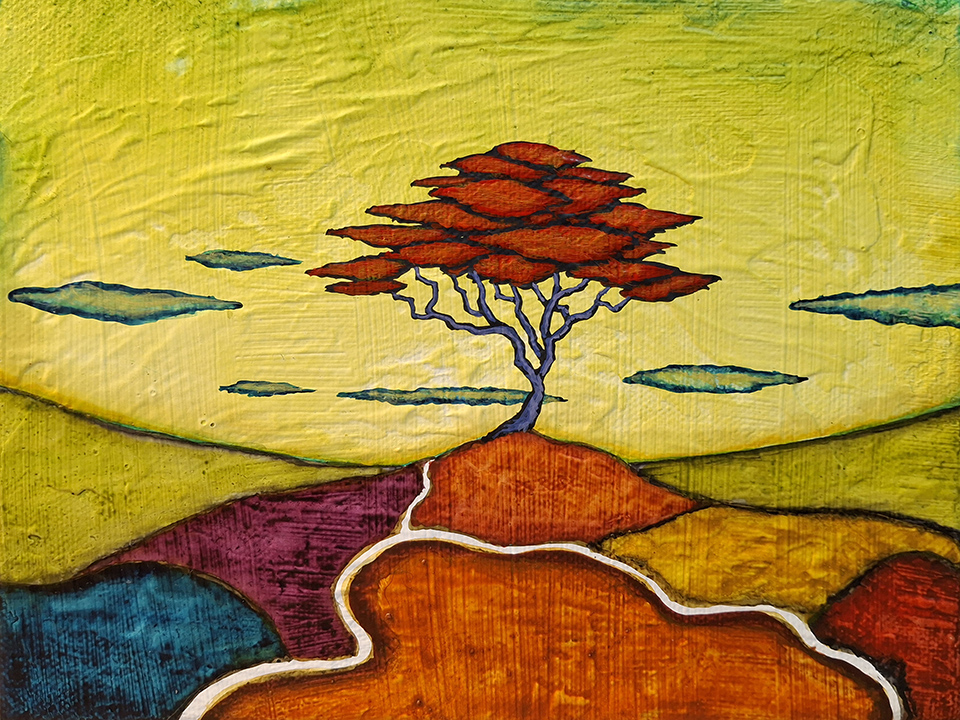
To me, this new small painting, The Juncture, represents such a choice. The path brings us to a fork in the road. We can see a bit ahead where one path will lead us. It seems safer and even bends back towards us. The other veers off and over the mound, giving away few hints to where it might take us. One is safe and one entails the risk of the unknown.
There is no telling if it will end up being a big or small choice. You often don’t know at the time you decide. Choices can sometimes hide or mask their eventual importance and, as a result, we end up taking them too lightly I think that’s why we make so many decisions.
Some may see the Red Tree here as just something to rush by, much like those who according to Blake see trees as something merely standing in the way. In my mind, the Red Tree here is advocating for taking that risk, for pushing ahead to the new unknown. I see it as a knowing guide, letting you know that it can see further ahead than you and that it can be okay– if you commit fully to that path.
That unknown path is not for the squeamish or those require absolute comfort and security. The unknown path has other rewards.
William Blake understood this.
This is a simply constructed painting but its colors the relationship of its forms make it seem bigger and more complex. It makes it feel like makes a statement even though it is smaller and spare in detail.
Well, that’s how I see it but, of course, I am more than a little biased.
This piece, 6″ by 8″ on canvas, is included in the Little Gems exhibit at the West End Gallery, opening one week from today, on Friday February 6.
Here’s a song from Ray LaMontaigne that may or may not mesh with the other part so this post. Actually, it just came up on my playlist as I finished that last paragraph. It’s a song that I have liked for a while and it felt right in the moment. Even its title feels right– Highway to the Sun. And its chorus below could easily be applied to this painting, representing why one might decide to take that unknown path.
I just wanna wake up Underneath that open sky Just wanna feel something real Before I die
Meditation is old and honorable, so why should I not sit, every morning of my life, on the hillside, looking into the shining world? Because, properly attended to, delight, as well as havoc, is suggestion. Can one be passionate about the just, the ideal, the sublime, and the holy, and yet commit to no labor in its cause? I don’t think so.
All summations have a beginning, all effect has a story, all kindness begins with the sown seed. Thought buds toward radiance. The gospel of light is the crossroads of — indolence, or action.
Be ignited, or be gone.
—Mary Oliver, What I Have Learned So Far (1999)
Be ignited, or be gone,,,
For me, this means that our dreams and desires require action. Our wishes and words have the power to manifest themself but only if we follow through and make it so.
The fire might be ignited in our mind, but it must be tended and stoked for it to come to full flame. Otherwise, it flickers and dies eventually.
Tend your fire. Let it burn bright.
The idea of letting your flame burn bright for all to see is easy to say but is a difficult task for most folks. There’s a risk involved that is daunting to most. First and foremost is failure. The fear that your dream’s flame could be forever extinguished keeps most folks from ever lighting it. It seems easier and safer to just keep the possibility of it alive in your mind.
But that is like taking the potential blaze held in a pack of matches and throwing them in a drawer where they will soon be forgotten.
They are your matches, your fire. They want to burn. Let them burn bright.
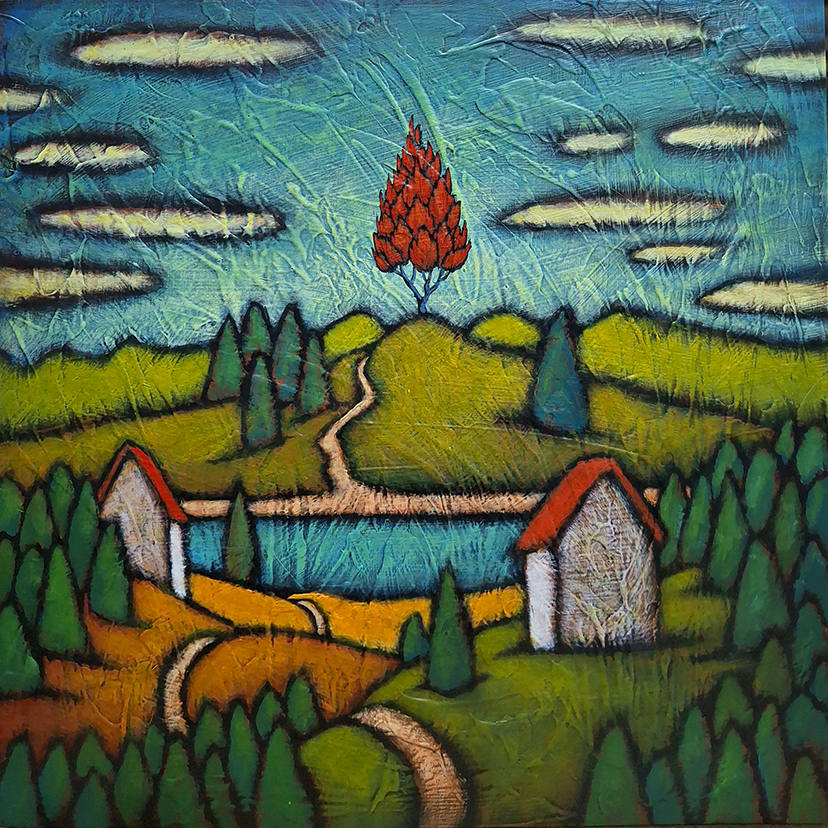
I thought this Mary Oliver poem was a good match for the new painting above, Burning Bright. Though it is slightly bigger than a Little Gemat 10″ by 10″ on wood panel, it made its way to the West End Gallery ahead of their annual Little Gems exhibit opening next Friday, February 6.
This feels somewhat incomplete and I am sure I could edit this better or add more context but, hey, you get what you pay for here. It might not be much, but it keeps my flame alive.
Let’s have a song to fill out the triad. Here’s the great Leonard Cohen with a live performance from 2008 of his Who By Fire. I feel warmer already on this cold morning.
I have been reading the morning paper. I do it every morning-knowing well that I shall find in it the usual depravities and basenesses and hypocrisies and cruelties that make up civilization, and cause me to put in the rest of the day pleading for the damnation of the human race. I cannot seem to get my prayers answered, yet I do not despair.
–Mark Twain, letter to William Dean Howells, April 2, 1899
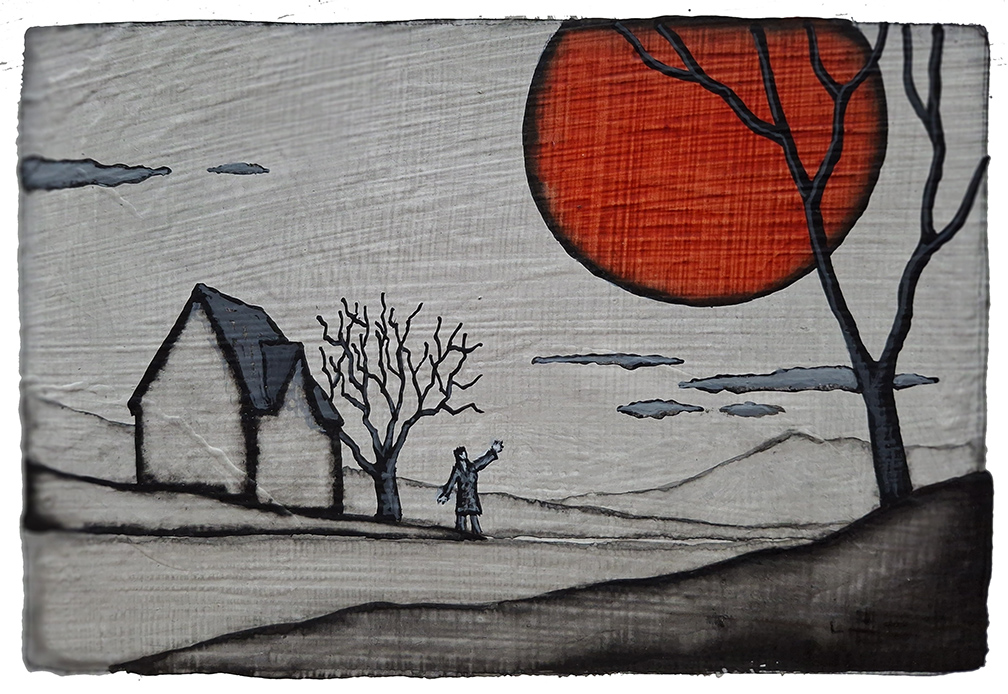
I could see this new small painting as representing someone pleading to the heavens for either the salvation of the human race or its damnation. perhaps it’s Mark Twain after reading his morning paper. I know that I suffer that same feeling when reading of how we mistreat one another on a constant basis.
It’s hard to not come away wishing that the Fat Lady would finally sing and bring this whole damn human opera to an end.
Yet there is always a part inside that recognizes that we also possess a huge capacity for goodness and love.
This love-hate relationship that many of us have with our species is a good example of those contradictions I mentioned here yesterday. From moment to moment, we move from begging for forgiveness for our species’ transgressions to pleading that the whole group be obliterated and returned to dust and ash.
With little to offer and not really knowing what we need, we bargain sometimes for the best and the worst.
And unfortunately for us, our bargain for either is sometimes accepted.
The results never match our hopes or expectations. It might be best for us if our pleadings go unfulfilled, much like Twain wrote: I cannot seem to get my prayers answered, yet I do not despair.
I can see this in this piece called The Bargaining. It is included in the annual Little Gems show opening next Friday, February 6 at the West End Gallery. It has a feeling of someone bargaining to both heal and injure. To live or die.
Whatever it takes to keep us from despairing.
Hmm. This went in a much different way than I had expected. But that’s okay. I can live with that. That seems like a pretty good deal I’ve bargained for this morning.
Here’s a song that you may struggle to see how it connects with the rest of this post. It’s a recent performance by Moby and Jacob Lusk of a 1995 song from Moby, When It”s Cold I’d Like to Die. It’s a powerful and stark performance. Like the image of tree without its foliage in the winter.
Maybe I chose this song because I walked to the studio this morning in -2° temps. There is a solemnity and silence in this kind of cold that makes you ponder the coldness of nonexistence. This song presents one of those human contradictions, feeling the pull of both death and life. Many of us have felt an emptiness within us at times brought on by the coldness and dangers of this world. At such times, we feel hopeless and powerless, too tired to keep going. But though we might think that death would end our suffering, we know that the only way out is to keep moving, to find the hope contained in despair.
Maybe that’s the connection of this song here. I don’t really know. But it is a beautiful song in my opinion.
And that is good enough for me on this frigid morning.
The opinions of men who think are always growing and changing, like living children.
—Philip Gilbert Hamerton, Thoughts about Art (1873)
On Friday I delivered a group of small paintings to the West End Gallery for their 32nd annual Little Gems show. Most of the work is new but there also some of my earliest pieces, a couple that I have featured here in recent weeks, Summerfieldand Isolationboth from 1994.
My opinions of these older pieces have all evolved and changed since I first painted them. I don’t believe any of the five were ever shown in a gallery and at the time I simply just didn’t think they were good enough. ‘
But it’s been a long time, over thirty years now, and I have changed as have my opinions and perspectives on many things, including these paintings. The quote above from an essay on the qualities it takes to be a good art critic written by the 19th century British artist, author, and art critic Philip Gilbert Hamerton stresses just that point. He advises would-be art critics to accept inconsistency and changes of opinions about many things. He says that a writer or art critic (or an artist) must constantly be reviewing what they have done in the past and be willing to change their opinion of it based on the new knowledge and experience they have gained in the time that has passed since it was first done.
Hamerton states that consistency of opinion is the mark of a stupid person. They form an opinion and refuse to change despite all evidence to the contrary coming to light after that opinion has been formed. The intelligent person on the other hand has a more flexible mind, one that can honestly accept that their prior opinions or statements can evolve and change. In the words of Uncle Walt from Song of Myself: Do I contradict myself? / Very well then I contradict myself, / (I am large, I contain multitudes.)
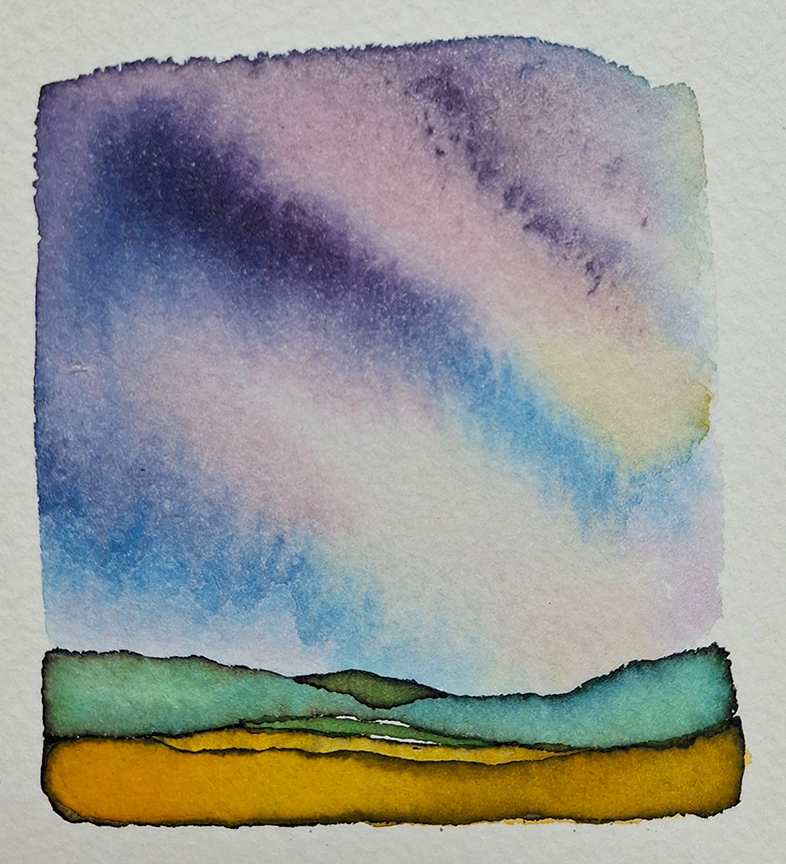
The painting at the top is a perfect example of a change of heart on my part. It was painted it in February of 1996. I had been showing my work at the West End Gallery and within a few weeks would be starting a long relationship with the Kada Gallery in Erie. I was starting to really find my groove as a painter and was at a point where I had some control of the media.
On this particular little piece, I had an idea of how I believed the colors of the sky would merge and blend. It was something I had done many times before over the past year and I had certain expectations. What emerged after I dropped the colors together was completely different than what I had anticipated. It was mélange of pastel colors., pink and yellow and robin’s egg blue. An Easter egg. Not even close to what I wanted or expected which was bold deep colors.
I was not happy with what I was seeing. In fact, I was a little angry. I had high hopes up to that point for the piece. I thought the foreground that made u the bottom quarter of the piece was truly exceptional with strong colors and forms with a real organic feel that pleased me greatly. It deserved a bold strong sky. Instead, it was like an Easter egg with puffy pastel colors that somehow weakened the feel and tone of the piece in my mind then. It just was not the piece I wanted to see. I felt somehow deceived by it.
I decided to just put it aside and move on to the next piece. It never left a crate of old work until now.
It is titled Easter Egg now. That was not its original title that I noted on the bottom of the piece. When first done, in my frustration and anger, I wrote It’s Easter!– So Kiss My Ass. This little painting will always live happily in my mind with that title.
Over the past thirty years, I pull it out at least a few times a year and look at it. It always makes me smile. The anger faded a long time ago, replaced by a growing appreciation. What I initially liked in it was still there and I began to see the sky and its colors much more favorably.
Yes, it was not what I wanted to see all those years ago. It was something different and I needed the time to put aside my disappointment in order to see its true qualities. I have found that when someone or something is not what we want it to be, we fail to see and appreciate what it truly is.
I see this now for what it is. And I like it very much.
It is a great example of an evolving opinion, one of those little contradictions we all hold inside us. I believe that both Hamerton and Whitman would concur. Uncle Walt might even chuckle at the original title.
Here’s a song about things changing. It’s a cover/interpretation of the Bob Dylan song, Things Have Changed, from soul/blues legend Bettye LaVette. She released an album of Dylan covers with the same title as this song in 2018 that received a Grammy nomination. Good stuff.
‘Rise like Lions after slumber In unvanquishable number, Shake your chains to earth like dew Which in sleep had fallen on you – Ye are many – they are few.’
—The Masque of Anarchy, Percy Bysshe Shelley (1819)
I was planning on writing about something other than the current situation in this country but there were a couple of things I felt I needed to add to yesterday’s post. The first are the lines above from an 1819 poem by Percy Bysshe Shelley. It is the final verse from The Masque of Anarchy which was written in response to the 1819 Peterloo Massacre in Manchester, England.
In August of 1819, a huge crowd of around 60,000 had gathered in Manchester to protest for parliamentary reforms which included manhood reform. At the time, only about 11% of adult British males were allowed to vote and that number was even much lower in Manchester and the rest of the industrial north. British forces were sent in to disperse the crowd and capture the protest leaders. The calvary, with sabres drawn, slammed into the crowd, in the process killing an estimated 18 protesters and injuring 400- 700 more.
Disturbed by the event, Shelley composed his poem. It has been called the first statement of the power of nonviolent resistance and has had huge influence over the past two centuries in rousing the oppressed many against the tyrannical few. Its final verse was recited by the students at the Tiananmen Square protests of 1989 and by protesters during the Egyptian revolution of 2011. It has been the rallying cry for many union organizers.
These five lines are pretty powerful, then and now. The imagery of the masses of people who had sleepwalked their way into an intolerable situation suddenly awaking from that deep sleep with an emboldened defiant spirit and the realization that they are the many resonates in any time.
Activist/ historian Howard Zinn has written of the power these lines as well as the power of music, art, poetry, and literature in rousing people to the fact there is power in their numbers. His words make me think of those things that have made America what it has represented for so many people around the world up to this point. It has been our freedom to think and create and openly express ourselves, which is rare in many parts of the world and something we have taken for granted here. Our greatest exports were not products or commodities, not cars or grain or oil.
No, our strength was built on those freedoms which the rest of the world witnessed in our music, our literature, our films, our art. It was our art that created the mythology of America, that ideal that spawned revolutions around the globe by daring others to follow our lead. It was our blues and jazz and rock and roll. It was the Technicolor dreams that came from Hollywood. It was the stories and myths of the Cowboy and the rugged individualists who forged the American West.
Our greatest export was the idea of America.
To the rest of the world, especially those who lived under oppression and poverty, America represented a blank canvas on which anyone could paint their own picture.
And that is being taken away.
Fascists and authoritarian regimes have no tolerance for the inherent freedom of art except that which serves as propaganda. As I pointed out in an earlier post, art provides clarity. It helps us clearly see and understand despite the chaos of the situation at hand.
It is a light that cuts through the dark.
Okay, I’ve had my say for a while.
The other thing I wanted to share was another Chumbawamba song that is very much pertinent to the moment. This is their 2005 version of Bella Ciao which is a song from the Italian Resistance who fought against the Nazis and Fascists in and before WWII. It was originally a folk song from the 19th century sung by workers in the rice paddies of Northern Italy as a protest against the harsh working conditions.
Just keep this in mind: Ye are many – they are few…
Don’t want to write much this morning. Oh, I could. There’s a lot that needs to be said by all of us in light of what is taking place in a number of American cities right now. We’re at a point of becoming which that I have dreaded since I was child of about nine or ten years old when I first encountered a book on the rise and fall of Hitler, becoming aware of the horrors of Naziism. The mass murders and concentration camps. Families hiding in attics or other hidden spaces or fleeing for their lives. The Kafkaesque show trials. There’s a dream I had from that time that still haunts me, not for any explicit violence but for the horror it implied.
I was already aware of this when my 8th grade English teacher, Mrs. Bryant, showed our class the films of the Allied Force’s liberation of the Nazi death camps as well as some of the Nazi footage from these camps. The sight of the emaciated prisoners and the piles of corpses being bulldozed or chucked into mass graves was a lot to take in. My memory of the blank horrified looks on the faces of my classmates and the sobbing of many of the girls in that class still is with me. Mrs. Bryant was a stern, strong, no-nonsense Black woman who wanted to make us aware of what can happen when ignorance and hatred run wild. For what I think might be the bravest thing any of my teachers ever did, she would most likely be fired for that today, unfortunately.
As a result, my radar for Naziism has been up since I was very young. I soon realized that it was not eradicated as when it came to a supposed end at the end of WWII in 1945 nor would not reappear in the same form. As the saying goes, history doesn.t repeat itself but it does rhyme.
No, it went underground, shunned by the world. But as time passed and the surviving witnesses to the rise and fall of the Nazis and Fascists of the 30’s and 40’s began to die off, it began to stir and become more and more active as the horrors of that era faded in our collective memory. And when it full reappeared. it was with the lessons of its history learned. It’s been 80 years now since the end of WWII and during its hibernation it has studied its earlier mistakes so that they would not be repeated.
They would also have the benefit of far greater advanced technology. They now have a greater ability to track, move, and kill people than they did in their earlier form. And for as great as the Nazi propaganda machine was in its time, it did not have the far-flung reach or infiltrative power of the modern nazis’ influence in worldwide mass media and social media.
All they needed was an opening in order to fully reemerge, a favorable situation in which they could take control. Over the past forty-five years they have worked to create this environment, slowly infiltrating and expanding to exert control of boardrooms, law enforcement, and the halls of government.
They know this is their time, perhaps their best opportunity to fulfill their dream of a 1000-year Reich.
What I have feared for well over fifty years seems to be at hand.
I take some consolation in the fact that it is still a deeply flawed movement, one that depends on the ignorance and blind obedience of its followers who it needs to in order carry out its agenda. Having enough minions of capable intelligence is a fatal vulnerability. It has a level of inherent stupidity in its lower ranks (well, there’s lot in its higher ranks as well) that makes it predictable and defeatable, despite its modern technological additions.
Like all past attempts at authoritarianism, it fails to fully consider the intelligence, imagination, and creativity of those who will stand against it. From what I can see, that is a lesson they still have not learned.
Damn it. I didn’t want to write this this morning. It’s not what I want to do or even think about right now. I just felt that I needed to air it if only for myself. A lot of people have seen this coming for decades and have been called crazy and deluded or have been totally ignored. Even though I am not as vocal as I might be, I have been both ignored and have received plenty of emails over the years calling me crazy, deluded, and even hateful because my words offended their brand of hatred.
Maybe they were right, but given what we are now seeing, I don’t think so.
I don’t know where this is going. They have fully reemerged and they are not going back into the ratholes where they have been festering for the past 80 years without a struggle.
They see this as their moment.
We must make it ours.
Here’s this week’s Sunday Morning Music from of all people Chumbawamba. Best known for their infectiousTubthumping in the 1990’s, they have a long history of controversy and antifascist, social justice advocacy. This song,The Day the Nazi Died, was written in 1990, just a few years after Rudolf Hess, the last of the Nazi leadership convicted at the Nuremberg Trials, committed suicide at Spandau Prison in 1987. He had been the sole prisoner at the infamous prison for over 20 years, which was torn down soon after his death. This song points out that though the last vestiges of the Nazis from WWII were gone, the underlying beliefs were still in place and, in fact, growing. This song pointed out how those who held these beliefs were moving up in the corporate world and that of government, just waiting for their moment.
I scare myself and I don’t mean lightly I scare myself it can get frightening I scare myself to think what I could do I scare myself it’s some kind of voodoo
—I Scare Myself, Dan Hicks and his Hot Licks (1972)
Icy cold this morning. -1° with a wind chill of somewhere around -14°.
The big news around here is the coming storm with an expected snowfall of 12 to 18 inches. This has people all in a fearful tizzy. The supermarkets were packed yesterday as people rushed to stock up.
There was a sense of dread in the air so thick that created its own storm front. I would like to think I am immune to it, that I will just shrug it off.
Whatcha gonna do? It is winter, after all, and if memory doesn’t fail me, we have had many bigger storms in the past. Seems like in those times I had a much more take-it-as-it-comes attitude. Today I find myself thinking about what needs to be done so that we are prepared and dreading the hours on the tractor it will take to clear our long driveways (a little over 1/4 mile in all) in supercold temps.
Maybe that is simply a product of aging, of knowing that I am dealing with much more limited energy resources at this moment. Definitely much less than twenty or thirty years ago. I feel tired a lot more since I began taking the meds and the cold seems to bite a bit more.
But I still have a bit of that take-it-as-it-comes in me, thank god, and sometimes still find myself laughing at the worries I feel from things like these storms. It’s a pain in the butt and I would obviously rather be doing something else than plowing or shoveling and shivering, but it’s part of the deal. I remind myself this when I find myself fretting over this kind of stuff, that just being able to do the things needed to survive the little perils that pop up in this world is actually a privilege. A pleasure, in fact. Just part of being alive. Much better than the alternative.
It makes me stop scaring myself.
There are much more awful and dangerous things and people out there to fear than a little snow and subzero temperatures.
Now, I just have to convince myself that facing those other things is also a privilege and a pleasure.
Here’s a song, I Scare Myself, from Dan Hicks and his Hot Licks from his album Striking It Rich. I bought this album soon after it came out in 1972 and sometimes even now find myself absent-mindedly singing bits and pieces of the songs from it. This is one that often pops to mind. Maybe it serves as an unconscious reminder to stop scaring myself?
I don’t know. Why doesn’t really matter. I just enjoy revisiting the song.
In contrast to the flux and muddle of life, art is clarity and enduring presence. In the stream of life, few things are perceived clearly because few things stay put. Every mood or emotion is mixed or diluted by contrary and extraneous elements. The clarity of art—the precise evocation of mood in the novel, or of summer twilight in a painting—is like waking to a bright landscape after a long fitful slumber, or the fragrance of chicken soup after a week of head cold.
–Yi-Fu Tuan, Passing Strange and Wonderful: Aesthetics, Nature, and Culture (1993)
I like this description of the restorative power of art from the late geographer Yi-Fu Tuan. Art has the ability to bring us to a place of clarity and stability that often seems far from, as he puts it, the flux and muddle of life. He also points out that our reactions to events in our everyday life are often conflicted and affected by many outside factors that cloud the moment and cause our feelings for it to sometimes change drastically over a short period of time. We are left with a gnawing sense of uncertainty in what we know and think.
The words from Yi-Fu Tuan pretty much lines up with how I see art. I have probably expressed just those sentiments here before. It was the phrase here, the clarity of art, that caught my attention. We live in such a turbulent world in which there is so much swirling around all the time that it is hard to have a clear vision or thought. There is always something in the way of us seeing or hearing or thinking clearly.
Art on the other hand is a clarifying agent. It often provides a clear and set focal point for our mind and feelings, a time and place apart from the flux and muddle.
A place to restore mind and soul.
Yi-Fu Tuan (1930-1922) knew a little about places. He was a prominent geographer, writer, and professor who was a major figure in the field ofhuman geography, also known as anthropogeography, which is the study of how people interact with place and environment. He was also one of the originators of humanistic or critical geography which studies how geography affects issues such as migration, inequality, injustice, and political and social movements.
He also coined the word topophilia which is “the strong emotional bond, affection, or love people feel for a specific place or environment, encompassing feelings like attachment, fascination, nostalgia, and belonging tied to a location.”
It is that sense of home I often write of and hope to capture with my work.
Nice to know there is word for that.
Here’s a song that is very much about the relationship between humans and place. This is a version of the Woody Guthrie song This Land is Your Land. I’ve played Woody’s original here as well as a couple of other covers of it but was surprised I never played this live performance from Bruce Springsteen. It’s a fine version of the song that effectively captures both love of place and the sometime elegiac melancholy that comes in it not living up to its promise. This video has spectacular imagery of the American landscape that make for fine examples of topophilia.
Here’s a little info on the song from prior posts:
Guthrie wrote the song in the late 1930’s in response to the immense popularity at that time of the Kate Smith version of God Bless America, written by Irving Berlin. Guthrie saw the world coming apart due to the nationalistic extremism that had spread through Europe, producing fascist leaders such as Hitler in Germany, Mussolini in Italy and Franco in Spain.
The original intro to God Bless America had the lines:
While the storm clouds gather far across the sea / Let us swear allegiance to a land that’s free / Let us all be grateful that we’re far from there, / As we raise our voices in a solemn prayer.
That phrase that we’re far from there was later changed to for a land so fair. Guthrie saw it as a call to an isolated form of nationalism, one that cast a blind eye to the perils lurking abroad that were beginning to spread here as well as our own problems at home. Problems like poverty and inequality of both wealth and justice.
Guthrie wanted to address these problems in his retort to Berlin’s song. At first, Guthrie sarcastically called his song God Blessed America For Me before naming it This Land Is Your Land.
Below are the two verses in the original version of This Land Is Your Land that are always omitted from those cheery civic versions speak to the ills of this country as Guthrie saw them, most noticeably the greed which led to the great chasm of inequality between the wealthy and the poor of this land. He questioned how a land with so much wealth and beauty, one based on the equality of man, could tolerate the extreme poverty and injustice he saw in his travels across this land.
There was a big high wall there that tried to stop me. The sign was painted, said ‘Private Property.’ But on the backside, it didn’t say nothing. This land was made for you and me.
One bright sunny morning in the shadow of the steeple, by the relief office I saw my people. As they stood hungry, I stood there wondering if God blessed America for me.
It’s an interesting song that speaks to this perilous time in the world as blind nationalism rises abroad and here in the USA.
Have you also learned that secret from the river; that there is no such thing as time?” That the river is everywhere at the same time, at the source and at the mouth, at the waterfall, at the ferry, at the current, in the ocean and in the mountains, everywhere and that the present only exists for it, not the shadow of the past nor the shadow of the future.
― Hermann Hesse, Siddhartha (1922)
I was going to write about the absolute insanity we and the rest of the world are witnessing in the frantic and unhinged antics of the Mad King over the past few days. I even started writing it with a quote from MahatmaGandhi at its beginning:
The only tyrant I accept in this world is the ‘still small voice’ within me. And even though I have to face the prospect of being a minority of one, I humbly believe I have the courage to be in such a hopeless minority.
I couldn’t go on with it though. I felt that I should spare you — and me, as well– the aggravation this morning. You know it. You see it. Everybody in the world can see it. My words nor those from anyone else, including the minions who attempt to make us disbelieve what we are witnessing, won’t change anything this morning.
I just need to be quiet this morning. I have work that needs to be done and need a clear mind. Need to shut things out for a while. Need to stop time, not fret about the past or worry about the future.
Just be.
Like Siddhartha’s river.
Here’s a cover of what might be my favorite Beatles song, Tomorrow Never Knows. One of the reasons it is a favorite, especially on a morning like this, comes in its first line: Turn off your mind, relax and float downstream…
It puts me instantly on Siddhartha’s river. And that’s where I need to be this morning.
This version is from the late blues singer Junior Parker. He is best known for his version of Mystery Train from the 1950’s that became an early hit for Elvis when he covered it. This is quite a departure from the blues for which he is best known. It appeared on his last album in 1971, the same year in which he died at the age of 39 from a brain tumor. Given the album title and its cover, which has that politically incorrect 1970’s feel, this is a surprisingly effective and restrained performance of the song, one that captures its essence and quietude. I still defer to the Beatles’ original version, but I found myself listening to Parker’s rendition several times this morning.





 Redtree Times