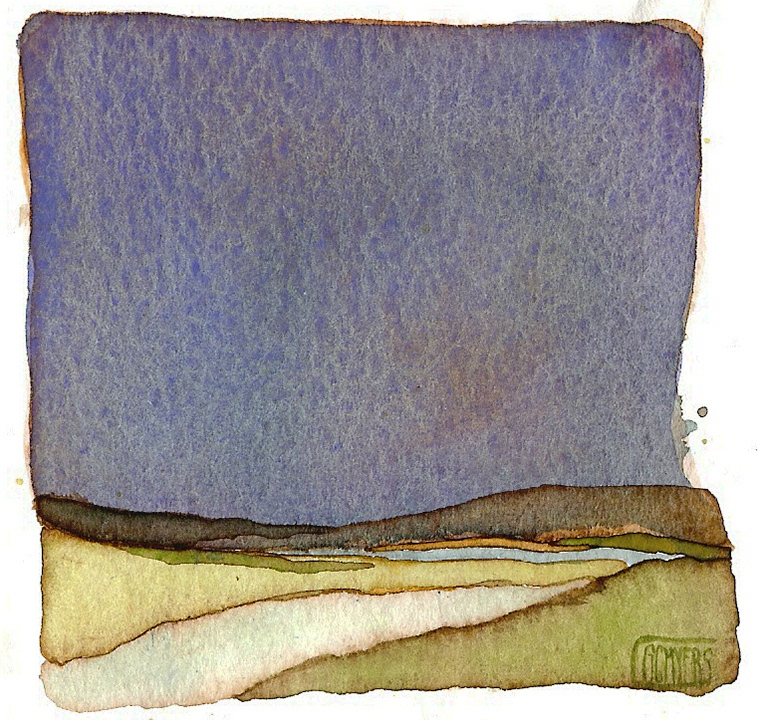
The Sky Is Always the Sky— September1995
Form is emptiness, emptiness is form.
–The Heart Sutra, Ancient Buddhist text
I finally started painting again this past week. I had been on a hiatus brought on by the distraction and uncertainty of dealing with my cancer. I just didn’t have the focus to work. At least effectively work. However, the treatment has gone well and has fallen into a predictable pattern that allows me to begin to focus on something other than the illness and what I can do to minimize its effects. That included getting back to focusing on new work.
So, as 2025 dwindled mercifully down, I finally picked up a brush again. It wasn’t easy. Any kind of break throws off my rhythm and flow. I think it has to do with how I paint. My process is constantly shifting and evolving. It never remains static. That’s one its attractions for me. But it is also daunting after a break since much of what was in my mind when I last worked– color combinations and even how I was applying the paint– has completely fled my mind.
The first weeks are a sort of refresher course. Kind of awkward and out of rhythm. I work small at first which is perfect since I am producing some new pieces for the annual Little Gems show at the West End Gallery in February. I also tend to begin with the transparent watercolor-like process with inks that marked my early work, often beginning with pieces that are rendered in shades of grays and black. Allows me to work with form. Color comes on in its own way later, the form dictating the colors for me.
It’s at this point that I often revisit my boxes of old work here in the studio, looking for something that will spark something– anything– that I can run with. There is a large assortment of small and tiny work from the first year or two years when I began painting after my accident. Most are from 1994 and 1995.
So, at 5 AM this morning I am on my knees going through a box of old work. Some of it not good, maybe even awful, and should be destroyed. I never do that though, feeling that I learned something in doing it and it thus deserved to be spared the trash heap. And some of it jumps out at me, sometimes with an appreciation I didn’t have for it when it was painted. I almost always find something in these boxes that spurs me in a direction or form that I had veered from long ago.
While I was going down memory lane this morning before the sun had even opened its eyes on this part of the world, a thought came to me. Why not feature an early piece of mine each week here on the blog? I’ll call it A Look Back and show and discuss those pieces that hold meaning for me as well as those that frustrated me then and now.
I think I’ll do just that. The first in this series is actually a blog post from four years back about the early piece, The Sky is Always the Sky. It’s a small painting that was very representative of my early work, several years before the Red Tree made its first appearance. It has those qualities of quietness and empty open space that marked my early work. This early always makes me wish to make my work even simpler and sparer in form. The post below speaks of that.
[From 2021]
I’ve been looking at some early pieces lately, trying to differentiate in my mind how the work has changed over the years. I always come back to pieces like the one at the top, The Sky Is Always the Sky from back in September of 1995.
These early pieces focus on the emptiness of open spaces. I use the term emptiness because it seems to be devoid of all matter, save the space between the earth and sky. But I think a better term might be the Buddhist term sunyata which the Encyclopedia Brittanica defines as:
…the voidness that constitutes ultimate reality; sunyata is seen not as a negation of existence but rather as the undifferentiation out of which all apparent entities, distinctions, and dualities arise.
That infers that nothing — including human existence — has ultimate form or substance, which means that nothing is permanent and nothing is totally independent of everything else. Put in simple terms, everything in this world is interconnected and constantly changing, in a state of flux. To fully accept this concept of emptiness thereby saves us from the suffering caused by our egos, our earthly attachments, and our resistance and reaction to change and loss.
I think it was something close to this concept of sunyata that inspired early pieces like the one at the top even though I wasn’t aware to that term at the time. I do know that I felt there was more to the emptiness of vast space than met the eye, that there was meaning in the void.
As the Heart Sutra, the best known of the ancient Buddhist texts, states: Form is emptiness, emptiness is form.
Without knowing it at the time, I think this concept provided the strength in these early pieces. Their emptiness gave them form.
The reason I write about this today– and I have most likely wrote about this before as my memory is not what it once was– is that I was comparing work from back then and now and it has changed. Looking at this early work makes me realize that I was often more confident then than now. I wasn’t afraid to show emptiness with the thought that others would be able to see it as I did.
I don’t feel that I have that same confidence now.
And I wonder why this it is like this. It’s 26 years later [over 30 years here in 2026!] and I have made a career out of my work. Shouldn’t I be even more confident, more assured in my message and how it will be perceived?
I don’t know that there’s an answer. Not sure I want or deserve one.
Things change. That is the natural course for all things. To fight against this change is an attempt to fill the emptiness.
And that can’t be done.
I may be talking through my hat here. I am trying to think out loud about concepts that are far beyond my meager mental skillset. But maybe just wrestling with this idea for a while will spark something that will show itself in some new form that I can explore.
Maybe a new form of emptiness…
 Redtree Times
I remember those pieces! I’m glad that your treatments are going well. In a recent interview John Scofield said that when he doesn’t play for a few days he feels like he has to re learn the guitar. I’m sure you can relate.
Repetition is the key for so many creative endeavors. When I first went out after weeks of not using my camera, I was surprised by my awkwardness with the mechanics and the terrible results in the images.
A first goal for the new year is to visit a local nature spot two or three times a week, if only for half an hour. By the time wildflower season rolls around again, I may have regained some skills — or even improved them.
Aha! Your use of the word “flux” immediately reminded me of a po
Happy New Year Gary!!!It warms my heart to know th