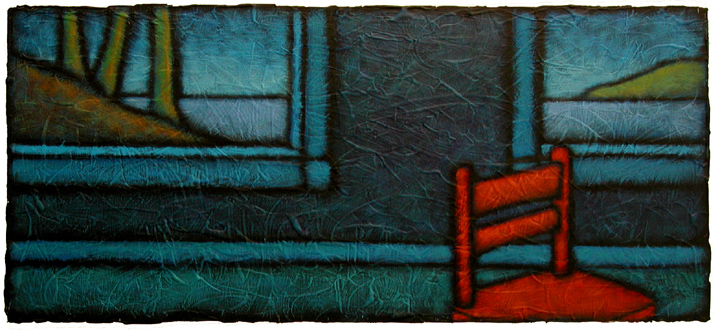
Inner Sanctum (2002)
We tell ourselves stories in order to live. The princess is caged in the consulate. The man with the candy will lead the children into the sea. The naked woman on the ledge outside the window on the sixteenth floor is a victim of accidie, or the naked woman is an exhibitionist, and it would be “interesting” to know which. We tell ourselves that it makes some difference whether the naked woman is about to commit a mortal sin or is about to register a political protest or is about to be, the Aristophanic view, snatched back to the human condition by the fireman in priest’s clothing just visible in the window behind her, the one smiling at the telephoto lens. We look for the sermon in the suicide, for the social or moral lesson in the murder of five. We interpret what we see, select the most workable of the multiple choices. We live entirely, especially if we are writers, by the imposition of a narrative line upon disparate images, by the “ideas” with which we have learned to freeze the shifting phantasmagoria which is our actual experience.
Or at least we do for a while. I am talking here about a time when I began to doubt the premises of all the stories I had ever told myself, a common condition but one I found troubling.
–Joan Didion, The White Album (1979)
We tell ourselves stories in order to live…
This short opening sentence from the Joan Didion essay, The White Album, says so much about how we put together our pasts, our stories and myths, and all our perceptions of it all in a way that brings makes small degree of sense to it all. As she writes, we try to create a narrative out of disparate bits and pieces that somehow makes our life worth living or at least gives a small degree of meaning to it.
It’s what we do to try to make sense of an often-senseless world.
It is a process of synthesis in which we all take part, usually without even recognizing the process. For writers and artists, the process comes closer to the surface of our consciousness. Every work is created out of this synthesization of all we know and experience. It is an internal weighing of all these things, determining what is important and what is trivial. Sifting through a lifetime trying to separate the meaningful from the meaningless. The beautiful from the ugly.
I sometimes think that a good work is that which allows a bit of all of these things through. The good with the bad. The dark with the light.
They are, after all, part of those stories we tell ourselves. The stories that shaped us, that informed how we came to view the world.
I could go on and on. Probably wouldn’t say anything more than what I’ve already said. And I don’t even know why I wrote what I did so far. That sentence, those simple eight words, from Didion spark so many thoughts about how I see the mythology of self that we maintain and present to the world as ourselves and in our creations.
There’s a lot of meat left on that bone which we could keep chewing on but let’s just leave it there for this morning.
Let’s have a tune. It is Sunday Morning and there is always a song on these mornings. Let’s go with a song from the Beatles’ White Album. It only seems right, given Didion’s use of that title for her essay and the book of essays in which it was contained. The album was in heavy rotation when I was 10 or 11 and is now part of those stories which show up in my work. This is a version of Dear Prudence that is an impromptu performance from two powerful vocalists, Haley Reinhart and Morgan James, who both came to prominence with Postmodern Jukebox.
The painting at the top is a piece that has been hanging in my studio for at least 20 years. Inner Sanctum is part of a group of paintings that were created in the immediate aftermath of 9/11. My work at that time took on a much darker tone with deeper blues and more saturation of color over a black base. It was a departure from my prior work and became what I call my Dark Work. It very much reflects the struggle in maintaining those stories we tell ourselves in order to live.
 Redtree Times
All it took was that first sentence, and I knew the author and title. I never get tired of reading that opening paragraph, and only would add: ain’t it the truth? I’d seen the musical selection while browsing, but never stopped to listen. I’m glad I did now.
Yes, that sentence just jumps out and eats you up immediately. And like you, Linda, I had cruised by this video many, many times and never paused to give it a listen until just recently. You never know what gold you’re going to uncover while digging around here.
“You are the storyteller of your own life, and you can create your own legend or not.” — Isabel Allende.
The quote by Isabel Allende has lived at the top of the quotations in my sidebar for years. Everytime I see it I end up getting lost in it’s “rightness”.
Now I think I’ll add this one to the list. Thanks Gary.
That’s a great quote from Allende. I’ve often felt that most people fail to recognize the legends and the mythology present in their own life and in the lives of their ancestors. We tend to underestimate our own experience of life, to feel that it doesn’t measure up to those more well-known lives and legends. You probably read this here before, Gary, but when an exhibit of my work was hung at the Fenimore Museum in 2012, it was in the gallery right next to an exhibit featuring some of the legends of art— Claude Monet, Mary Cassatt, John Singer Sargeant, Wiilliam Merrit Chase and others. When I first saw the show, I was intimidated by having my work hung in such close proximity to those legends. Not sure that I was worthy, I asked myself, “Why me?” But after a while, seeing how folks responded to my work in that exhibit, the question became, “Why not me?” My work was serious and meaningful to me, and I did put less into my work than these legends put into their work. Why was I not worthy of standing on level ground with a legend? We are all legends in the making with stories to share, if we just keep that in mind.
Gary, I’ve always felt that the story of our lives contains not just the stories we tell ourselves but, probably more importantly, the stories others tell about us when talking to us. To me, it’s the reflected stories that do more to build the myth we live by, and try to live up to, than any of the stories we tell ourselves.
I’ve always felt that by living your ideals to the best of your ability will always enhance the myth that others see in their minds… even when you yourself don’t quite agree. And the reflected myth can only make you strive to be a better man.