Feeds:
Posts
Comments

Archive for April, 2026

Good Blues

The Watcher in the Window– At West End Gallery


The word sadness originally meant “fullness,” from the same Latin root, satis, that also gave us sated and satisfaction. Not so long ago, to be sad meant you were filled to the brim with some intensity of experience. It wasn’t just a malfunction in the joy machine. It was a state of awareness– setting the focus to infinity and taking it all in, joy and grief all at once. When we speak of sadness these days, most of the time what we really mean is despair, which is literally defined as the absence of hope. But true sadness is actually the opposite, an exuberant upwelling that reminds you how fleeting and mysterious and open-ended life can be. That’s why you’ll find traces of the blues all over this book, but you might find yourself feeling strangely joyful at the end of it. And if you are lucky enough to feel sad, well, savor it while it lasts– if only because it means that you care about something in this world enough to let it under your skin.

― John Koenig, introduction to The Dictionary of Obscure Sorrows


Came into the studio this morning kind of glum. A bit sad. A long way from the effects I experienced a week or so back caused by the steroids I was taking for my radiation. That filled me with a giddy elation that made me feel supercharged.

Not so this morning. But even as I settled in with this glumness, it didn’t feel bad, didn’t feel despairing. I felt satisfied, oddly enough. As though this was to be expected, that this was simply an indicator that I was alive and feeling life as it is in the moment.

A good sadness. Like a cleansing cry.

It reminded me of a post from about three years ago that talks just a bit about the place and need of sadness in our lives. It also mentions a book of poems that was important to me, There Are Men Too Gentle to Live Among Wolves. Cheri gave it to me when we were going out, and we were talking about it just the other day. It played a big part in the formation of what was to become my life.

I am sharing a section of the preface to that small book of poetry here. As a young man with a sadness I had even then but didn’t yet understand, I felt his words spoke directly to me. Almost fifty years later, it still feels that way.

I am one of the searchers. There are, I believe, millions of us. We are not unhappy, but neither are we really content. We continue to explore life, hoping to uncover its ultimate secret. We continue to explore ourselves, hoping to understand. We like to walk along the beach, we are drawn by the ocean, taken by its power, its unceasing motion, its mystery and unspeakable beauty. We like forests and mountains, deserts and hidden rivers, and the lonely cities as well. Our sadness is as much a part of our lives as is our laughter. To share our sadness with one we love is perhaps as great a joy as we can know – unless it be to share our laughter.

We searchers are ambitious only for life itself, for everything beautiful it can provide. Most of all we love and want to be loved. We want to live in a relationship that will not impede our wandering, nor prevent our search, nor lock us in prison walls; that will take us for what little we have to give. We do not want to prove ourselves to another or compete for love.

For wanderers, dreamers, and lovers, for lonely men and women who dare to ask of life everything good and beautiful. It is for those who are too gentle to live among wolves.

–James Kavanaugh, 1970

Here’s the rest of that post from a few years back.


I recently watched part of a YouTube video of a presentation by the late James Kavanagh. His Wikipedia entry says that Kavanagh (1928-2009) was an American Catholic priest, author, and poet best remembered for his 1967 book, A Modern Priest Looks at His Outdated ChurchIt was a call for the church to move from its antiquated past become a church of compassion and love. It was a controversial bestseller at the time and Kavanagh soon after left the priesthood.

That wasn’t how I knew him. I knew him from the books of poetry he wrote that were not mentioned on his Wikipedia page. One, There Are Men Too Gentle to Live Among Wolves, was first published in 1970 and has gone through 50+ printings and has sold over a million copies, making it one of the most popular books of poetry ever published. I don’t know that it will ever rival the verse or longevity of the immortal poets, but it is effective popular, straightforward poetry that wears its emotion on its sleeve, meant to be easily absorbed. Simple verses for complex feelings. I knew this book and its title poem well in my teens. It served a great purpose for me, helping form a lot of my goals and ideals at the time.

In the aforementioned video Kavanagh spoke about his embrace of the sadness that was always with him, how it was an essential part of who he was as human being. It wasn’t something to be hidden or avoided.

I understood immediately what he meant by this. I often experience a sense of sadness that is far different from despair. Nor is it joy or elation. Hardly.

It is difficult to describe but it almost seems like a form of pleasure that comes in being moved by the extremes of the human condition, as though it validates our own humanity, our own place in the world. A recognition of those common experiences– good and bad– that we all share in our time here.

Reading the words at the top from the introduction to the John Koenig book, The Dictionary of Obscure Sorrows, brought it into better perspective. The sadness that I know is, indeed, a fullness — an exuberant upwelling that reminds you how fleeting and mysterious and open-ended life can be. 

One can’t fully appreciate the human condition without knowing at least a little bit of that sadness.

I no longer try to stifle this sadness in myself and am easily moved by displays of human emotion that involve feelings of empathy, concern, courage, and tenderness.

The true despair I do feel most often comes from witnessing the acts of those who feel little of these same feelings. People without empathy. The selfish and the greedy. The hateful and the spiteful.

The unfeeling and the unloving.

I don’t know what this means this morning or why I am sharing this. Maybe you’ve felt a sadness that you don’t understand. But it somehow makes you feel a bit more human, a bit more alive. Maybe it’s just that you’re aware of the fullness of this human life.

Hmm…

Here’s a version of the Tampa Red song from 1940, It Hurts Me Too, that later became a hit for Elmore James. Sounds right this morning. This is from modern blues musician Susan Tedeschi. Good stuff.

Good blues…


Read Full Post »

Balancing Act— At West End Gallery


A master in the art of living draws no sharp distinction between his work and his play; his labor and his leisure; his mind and his body; his education and his recreation. He hardly knows which is which. He simply pursues his vision of excellence through whatever he is doing, and leaves others to determine whether he is working or playing. To himself, he always appears to be doing both. Enough for him that he does it well.

—L.P. Jacks, Education Through Recreation (1932)


Came into the studio this morning at my usual much too early time. After tending to my studio assistant cats, I sat down to write something here. Wasn’t sure what I had to say or if I wanted to say anything at all. I’ve written an awful lot lately, probably too much, and taking a day off from this might not be a bad idea. I think I’ve posted something every day for close to four months straight. Like I said, probably too much.

But habit is aa hard thing to overcome. I started poking around trying to see if there was anything that sparked a thought. In mere minutes I found myself in a swirl of emotions as I looked at some older posts mentioning my late mom that made me sob and some others about goofy stuff that made me laugh outright.

It’s funny how emotions can sometimes shift and change direction so quickly.

It made me think of the passage above which was one of the drafts I had pulled up when I sat down. I often save quotes and other things that pique my interest as drafts for just such mornings, hoping they spark thought. In this passage, the English minister/philosopher L.P. Jacks extols the virtue of finding playful, joy in one’s work. The master in the art of living finds no distinction between their work and play, seeing them as inseparable parts of themself.

Simply achieving excellence in whatever they do produces a deep and joyful satisfaction.

It made me ponder how there is little distinction between my work and play. But with the flow of emotions I had just experienced fresh in my mind, it made me consider how my work and my emotional responsiveness are completely intertwined.

My work is nothing without my emotion. And to a great extent, my emotions depend on the expression I find in my work.

I have commented a number of times here over the years about how I feel my most powerful work comes when I am on an emotional edge, one that finds me close to tears of both joy and sorrow.

This might be the most valuable asset I possess as an artist, probably far more essential to my work than any innate or attained technical ability or talent. I have often said there many, many painters that are far more talented from the perspective of craftmanship. There are absolutely many more that are better trained and educated than me. And certainly many more that are much more intelligent and knowledgeable than me. And most likely many more ambitious than me.

I can easily admit the superiority of a number of artists in many ways. Except one.

I believe my work is mine alone, my unique emotional response to the world. If you know my work and respond to it, you most likely know me on an emotional level. I think I rival any artist on this point because, as I derived from Jacks words above, there is no distinction between my work and my emotional responsiveness.

My emotional being is fully integrated into my work.

Of course, as always, I could be wrong.

And even If I am right, does that make me a master in the art of living?

No way. But it might be a good start towards getting to that level, if time allows. I think that must be one of those things you don’t fully know until your last minute on this earth.

Well, as has been the case lately, this was all unexpected when I sat down here this morning. Not sure why I even wrote it, to be honest. Probably just a result from a mixture of fatigue and hormones. Thanks for bearing with me.

Shall we have a song? Why not? It’s the least I can give you this morning.

I have played a few Ren songs recently and this is one from several years ago with the band he has played with for quite some time, The Big Push. They basically began as buskers in Brighton, England, playing impromptu sets on the streets for whoever happened along. They quickly developed an avid following and there are some great videos of their street performances where they are surrounded by a couple of hundred people. Though Ren’s popularity as a solo performer has taken off, the Big Push is doing a British tour this year. This early song, It’s Alright, is from back in 2018 or 2019.

It just feels right this morning. It’s alright…


Read Full Post »

My Hill

Bradford County (1994)


Mountains should be climbed with as little effort as possible and without desire. The reality of your own nature should determine the speed. If you become restless, speed up. If you become winded, slow down. You climb the mountain in an equilibrium between restlessness and exhaustion. Then, when you are no longer thinking ahead, each footstep isn’t just a means to an end but a unique event in itself. This leaf has jagged edges. This rock looks loose. From this place the snow is less visible, even though closer. These are things you should notice anyway. To live only for some future goal is shallow. It’s the sides of the mountain that sustain life, not the top. Here’s where things grow.

–Robert M. Pirsig, Zen and the Art of Motorcycle Maintenance (1974)


Finished my last round of radiation yesterday morning. I had been exhausted the day and night before, the steroids having little affect after Monday’s dose. I felt a bit better yesterday as we road down the highway towards the hospital, perhaps brightened a bit by the thought that a critical phase of my treatment was near to an end.

During the drive, we both were silent for most of the drive, more so than usual. Along the way, my gaze moved to the silhouette of the hills to my right. I do this every time we go the hospital.  These hills run east and west parallel to the New York/ Pennsylvania state line, at the south edge of the valley through which the Chemung River travels on its way to feed the Susquehanna, not far from the hospital.

As I always do, I focus on the high ridge of the hill that rises steeply above my childhood home. The PA line is just over the top it. I know that hill pretty well. Well, whether I really do anymore is a point of contention as memory fades.

Even so, I still think of it as mine.

It lives on in my mind in a Proustian manner. Each time I ride by it, the mere sight of it causes lashes of childhood experience to pass through my mind. The days spent alone wandering on it. It had a feel and a mood that often mirrored my own. Or perhaps it was the reverse– that I was its mirror.

I don’t know. It felt like we knew each other then. Now it simply stands there for me like an old friend, a silent repository of a little boy’s thoughts and imagination from many years ago.

Seeing it again reminds me of how children have an innate ability to live in the present, much like attitude Robert Pirsig advocates for us older folks in the passage at the top. The future, with few exceptions such as Christmas, seems like a distant land, out of sight and out of mind. The past is still close at hand but is quickly washed aside by the overwhelming raging river of all that is new and in front of them.

There was only the now for me then on that hillside.

Of course, that changed at some point, as it does for us all. The past accumulates and takes on a larger presence, one that often taps us on the shoulder and holds our attention for far too long. The future is now loudly beckoning us, loudly calling and waving its arms in a way that distracts us from where we are or what is in front of us.

When we are on that hillside now, we are now too often dwelling on how we got there or where we are headed. The past and the future have tight holds on us.

We no longer notice the feel or smell of the slippery soil on the upgrade. The coolness of the blue light shadows cast by the trees or the welcoming lower limbs of a massive hemlock that asks you to climb up on them and imagine things and people in a different time and place.

It’s funny that the past serves up such a dish whenever I see that hillside. You wouldn’t think the past would try to remind you to live in the now, would you? But it knows that you once knew that feeling of only being in the now, as a kid trudging quietly alone on that hillside.

I sometimes find little bits and pieces of that childhood feeling while walking in the forest around my studio. The hill is not as steep and the trees are not as old growth as those behind my childhood home, but it still provides moments where the past and future fade to nothingness. It gives me once more childlike joy in the now, much like that I experienced on that hillside I pass in silence on my way to the hospital.

It’s good to have an old friend like that, one who reminds you of your better self. To remind you that life is on that hillside, not where you’ve been or where you’re going. Where you are at this very moment.

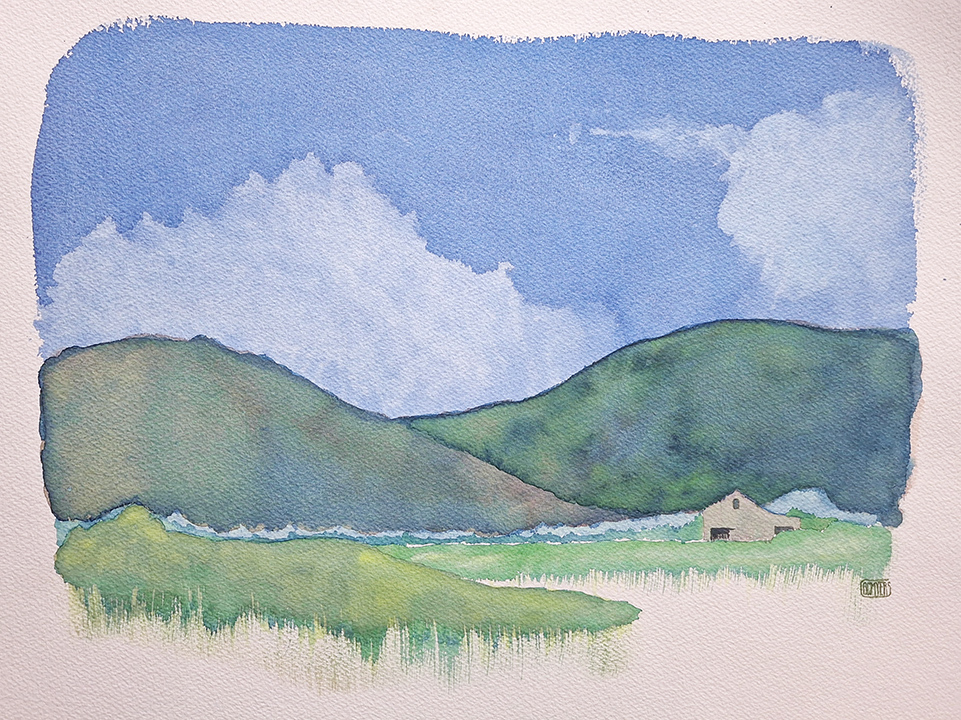
Had no idea what I was going to say this morning. Glad I took the plunge here. It felt good to write this. This is not meant to be a Look Back post but the painting at the top is pertinent here. It is a very early painting that is my impression of an area just a few miles down that same line of hills where they slightly veer into Bradford County, Pennsylvania. I didn’t have that in mind when I painted this early watercolor back in 1994, but it immediately became the only way I saw it then and now.  I called this painting Bradford County.

For a piece of music, I am sharing a song from Grammy Award-winning guitarist Bill Mize. I was honored when he chose a painting of mine for his album Southwind a few years back. This is Lonesome Valley. It felt right for this post even though when I was on that hillside those many years back, I might have been alone but was never lonely.

I had my hill…


Read Full Post »

Out of the Loop 2013


I’m fundamentally, I think, an outsider. I do my best work and feel most braced with my back to the wall. It’s an odd feeling though, writing against the current: difficult entirely to disregard the current. Yet of course I shall.

–Virginia Woolf, 22 November 1938, A Writer’s Diary (1953)


The lines above Virginia Woolf from a 1938 entry in her A Writer’s Diary struck a chord with me. In the entry, Woolf looked back on her career, describing how she had at points received praise and widespread acclaim and at other times fell out of favor with the literati, suffering criticism and personal attacks that marked her as a second-rate talent.

She had certainly known the highs and lows.

She claimed that the attacks did not bother her as much as she might have expected since she had never saw herself as being famous. How can they take away something you never felt you possessed? Actually, she saw their downgrading of her as being a sort of relief, shedding all pretense of her being part of the insider’s club. She could clearly see herself as an outsider now. As she wrote, it put her back to the wall, a place where she felt she did her best work.

Much like the I’ll show them attitude I described here recently.

As I wrote above, this resonated with me. Though I’ve had my fair share of high points and an equally fair share of low points, I have always, like Woolf, viewed myself as an outsider.

I believe this comes from knowing who I am and how I am built. I understand that I don’t have what it takes to be an insider. I don’t play a social game, don’t go to parties and few openings. To be honest, I am uncomfortable at my own events. I don’t schmooze with museum or gallery directors. Don’t seek out people who might specifically help my career. No agent seeking new opportunity nor public relations person trying to spread my name in the media. Outside of this blog and a few little social media entries, I have no mechanism for self-promotion. And even this seems like something more than self-promotion now.

I was never part of an artistic group or school. Well, there was one time, when my work first showed at the Principle Gallery in 1997. I was part of group of five artists from this region, all then showing at the West End Gallery, selected by the Principle Gallery who then labeled us the Finger Lakes School. We did a couple of shows there under that label. But even then, I was the outsider in that group, the only one of the five working outside of traditional representational oil painting.

I also don’t pursue opportunity. Perhaps to a fault.

After my 27-year relationship with Kada Gallery in Erie ended when they closed a couple of years ago and the gallery repping my work in California had changed their business model in a way that greatly lowered my visibility there, I considered looking for new galleries to replace those two. I had a realization then that I had not approached a gallery in nearly 30 years and that every gallery that had represented me approached me first. Approaching galleries now felt so far out of my comfort zone that I soon dropped the idea.

And often, I turn away those opportunities that are offered.  I have often failed to follow-up on commission requests simply because I wanted to do work that pleased me first and then others, not the other way around.

A year or so ago, I was offered a chance to have 13 of my Red Tree paintings grace the covers of a series of Hermann Hesse books published in Mandarin Chinese. The company in China had been following my work for several years and felt that my work was a good match for Hesse’s work. I was flattered but ended up turning down the offer simply because I felt it was too far out of my hands.

Mistake? Maybe. It wouldn’t be the first time. But I find myself being okay with this and those other peccadilloes because I know how I am.

I know I am an outsider, will never be the toast of the art world outside of my little corner of it every once in a while.

The way I see it is that to be in that wider spotlight requires effort and responsibility that goes well beyond the work itself, something I am not comfortable in taking on at this point in my life as an artist.

And I am fine and comfortable with that. To be honest, I never trusted the perception that came with the highs nor the lows. Though the praise is nice to hear sometimes and the rejection always stings, they ultimately are not accurate indicators. The work was generally equal in my eyes at both the high and the low points. Actually, there has been work produced in the low points that went unnoticed that I feel was better than much of the work from the high points.

Time, it turns out, levels out those highs and lows.

So now I just do my work, as Woolf did, with my back against the wall and going forever against the current.

That’s all I can do. That is who and what I am– the outsider.

Here’s a tune from Eddie Vedder that is somewhat, if not wholly, in the same vein. This is Society.

PS: Not that it matters, but this is a remake of the post I accidentally deleted yesterday. I think the original had a bit more gracefulness and flow than this one. Maybe it hit its points more impactfully. But this will have to do for now.  It’s much like trying to recreate a painting where the original just flowed organically from the artist. The copy never has the same ease of being, at least in the eyes of its maker. 

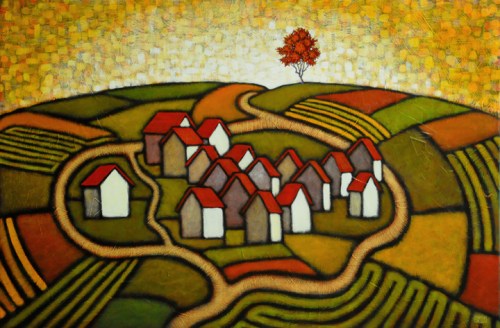
The painting at the top, Out of the Loop, is a piece from 2013 that I am considering for inclusion in my June show at the Principle Gallery. It recently came back to me from California where it had been for over a dozen years. My impression of it had been reduced to the online image of it, such as the one at the top. When I took it from the crate, I was thrilled and surprised at its vibrance and depth, which far exceeded the digital image. Seemed a perfect fit for this post but still deciding if it goes to Alexandria in June. We’ll see…


Read Full Post »