Feeds:
Posts
Comments

Archive for the ‘At the Movies’ Category

Big Eyes Poster Tim BurtonI saw an ad last night for Big Eyes, the new film from director Tim Burton that stars Christopher Waltz and Amy Adams.  It is the story of Walter Keane, the man who built an empire from painting and marketing images of big-eyed waifs in the 1950′ and 60’s.  If you lived in that era, seeing some of Keane’s work was inevitable as it seemed to be everywhere.

I know that for me it is one of the first memories I have from that time of something close to art.  I wasn’t a fan– they made me uneasy, actually– but I couldn’t help notice their presence wherever I would look.

But the true story behind these paintings was the fact that Walter Keane only claimed to have painted the work.  It was actually the work of his second wife, Margaret.  Walter absorbed the accolades and celebrity as the work became more and more popular as it was mass produced and spread worldwide.  But Walter merely added his signature after Margaret had finished each painting in the basement of their home and claimed it as his own.

Eventually, this led to the breakup of their marriage.  Margaret then went public with the truth and for years, the couple had a public dispute over the authenticity and ownership of the work.  After Walter had published an article in the USA Today, this brought about a slander suit against him and the USA Today from Margaret.  The whole thing actually culminated in a proposed paint-off in the courtroom.  Walter declined, saying that his shoulder was injured.  Margaret painted for nearly an hour and won the verdict from the jury and a  4 million  dollar award.

Of course, she never saw a penny as Walter had sq1uandered much of the wealth generated from those sad big eyes.

I think this might be an interesting film.


Read Full Post »

The-Best-Years-of-Our-Lives-  Dana WinterVeteran’s Day is coming up and I thought I might have an image that somewhat represents the experience of some vets on their return home.  In the 1946 movie, The Best Years of Our Lives, Dana Andrews‘ character, Fred, struggles on his return to his hometown and comes across a local airfield where they are junking old war planes from the recently ended World War II.  He crawls into an old B-17 bomber and takes his former seat in the front turret of the plane where he was a nose gunner.  He vividly relives for a brief moment the terror that was still haunting him, tainting every moment of his life.  The haunting image of Andrews appearing ghost-like in the nose of that B-17 is a powerful one in a movie filled with powerful scenes, one that doesn’t sugarcoat the experiences and hardships of the returning vets.  It remains relevant to this very day.

I thought for this Sunday’s musical interlude, I would play something in the spirit of this upcoming holiday.  It would be easy enough to play something patriotic but this isn’t really a holiday of nationalism and a call to arms.   No, this is a holiday that celebrates an end to war , namely World War I when the holiday was originated as Armistice Day, and honors the service of all soldiers with the hope that they will soon return home and resume their lives there.  This holiday honors those who have served and sacrificed so much, not the wars to which they are sent.

The song is Johnny I Hardly Knew Ya which is the original tune on which the Civil War era  song When Johnny Comes Marching Home is based.  While When Johnny Comes Marching Home is more celebratory and martial in tone, Johnny I Hardly Knew Ya is pointedly anti-war and mournful.  It was supposedly written in the 1790′s as a protest to the British imperialist invasion of Ceylon, present day Sri Lanka.  It tells of a young woman seeing her lover , who left her after their illegitimate child was born to join the army,  returning from war.  He is much changed in appearance and she mourns for his loss.

This is a very emotional version of the song from British opera and folk singer Benjamin Luxon accompanied by American Bill Crofut on banjo.  Have a great Sunday and gives some thought to the men and women who have given their time and their selves to serving their countries.  Let’s vow to treat them better.

Read Full Post »

Project Yosemite Night ImageYosemite National Park is an elemental place, one formed from a beautiful union of stone, wood, water and light.  There is a wonderful time-lapse film project, Project Yosemite, filmed by Colin Delehanty and Sheldon Neill,  that  attempts to capture this elemental beauty.  It has stunning vistas showing the changing light of both day and night set against the backdrop of some of the park’s iconic landmarks.

The night scenes with the heavens moving above as shooting stars fire across the starry sky are pretty incredible as are the movements of the climbers on some of the massive rock faces.  They appear as bug-like figures and at night they become fireflies as their lights cast tiny but bright specks of light against the granite monoliths.

There are two great films.  Take a look and definitely check out the Project Yosemite site.  Just beautiful work.

Yosemite HD from Project Yosemite on Vimeo.

Yosemite HD II from Project Yosemite on Vimeo.

Read Full Post »

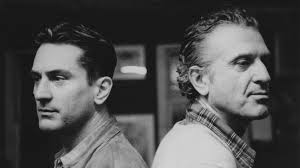
Remembering the Artist-Robert De Niro Sr.The other day I watched the HBO documentary Remembering the Artist: Robert De Niro, Sr., a film produced by actor Robert De Niro to better illuminate the work of his late painter father.  Robert De Niro, Sr. had been a rising star in the New York art world of the 40’s and early 50’s, working in a style that was expressionistic and abstract yet still representational, very much influenced by earlier painters such as George Rouault and Henri Matisse.

He gained some fame early with an acclaimed solo show at the Art of the Century Gallery ran by Peggy Guggenheim who later began the museums bearing the Guggenheim name.  But fame was fleeting as the art world’s flavor of the month changed from the figurative Expressionism which he maintained as the primary vehicle for his artistic voice  to Abstract Expressionism in the 50’s  to the Pop Art of the 60’s.  He was left toiling in a style that was viewed as outdated  while others who he may have viewed as inferior talents or at best equals were lifted in the spotlight, earning the fame and fortune that he sought and  thought his work deserved.  This left him bitter yet to his credit, he remained faithful to his style and his own artistic voice.

It’s an interesting portrayal of the artist in general, touching on many areas that resonate with anyone who works in a creative field and struggles to make their work visible to the world.  His resentment in having his work, which represents everything he understands himself to be,  marginalized is a feeling that many artists will find familiar.  I know that I have felt that same bitterness, that same resentment at times in my career.  But I have come to recognize that it is simply part of the deal I bargained for in becoming an artist, that my work would sometimes find itself as a flavor of the month and at other times simply exist as a possible favorite for a few.

An artist in the film explained this with a great analogy, saying that artists are like characters on a stage in a play.  The spotlight moves around the stage and sometimes falls upon you but soon passes on to the next character and that moment in the spotlight is gone.  But if you persist and stay consistent and in character, eventually the spotlight will cycle around to you again.  He felt that much of De Niro’s life was in between those moments in the spotlight.  And for some, like De Niro, that can be a very difficult thing with which to live.

For me, that was the thing I took from this film, that as an artist you cannot control, the spotlight, cannot control how your work is received or perceived.  You can only do that work that comes from your core– staying consistent and in character, true to your inner voice– and bide your time on the stage, hoping that the spotlight will once again come around.  I fit does, great.  If it doesn’t find you, you have the solace of the work itself, knowing that you have maintained your vision,  and the hope that it will find a champion, as De Niro Jr, is for his father,  in its life after you are gone.

I encourage you to watch the film.  It’s an interesting look at an interesting painter in an interesting era.

Read Full Post »

Peter O'Toole Lion in  WinterI was saddened to discover yesterday that Peter O’Toole had died over the weekend  in London at the age of 81.   He was definitely a favorite of mine.   The Irish-born actor was famous for his partying and brawling alongside his longtime chum Richard Harris, but first and foremost was legend on the stage and on the screen, casting a magnificent presence into all his roles.   And what great roles they were-  the ethereal Lawrence in Lawrence of Arabia,  his comic twist as Allan Swann in My Favorite Year and  my favorites, two times as King Henry II in Beckett and in The Lion In Winter.

O’Toole holds a dubious record , being the most nominated best actor ( 8 times) without ever winning the Oscar.  I can’t fault most of the winning choices in the years that he lost.  Most were incredible performances such as Marlon Brando in 1972’s The Godfather, Gregory Peck in To Kill a Mockingbird in 1962, Rex Harrison in My Fair Lady in 1964, John Wayne in True Grit in 1969, Robert DeNiro in Raging Bull in 1980, and Ben Kingsley in Gandhi in 1982.  All of these are legendary roles.  Even his loss to Forrest Whitaker in 2006’s The Last King of Scotland is understandable.

No, the one where his performance was by far the greatest of that year (and most others in my opinion) was in 1968 when he portrayed  Henry II in The Lion in Winter.  He lost to Cliff Robertson in Charly, which was a great role and a fine movie, the film version of Flowers For Algernon.  I take nothing away from Cliff Robertson but O’Toole’s portrayal was one for the ages, matched as he was with Katherine Hepburn  and a young Anthony Hopkins.  It’s a film that I cannot help but watching whenever it comes on.  O’Toole is mesmerizing in that film, just dominating the screen.  He was truly the Lion in that film.

I think I’ll watch it again today just to see him roar once more.

Here’s a taste:


Read Full Post »

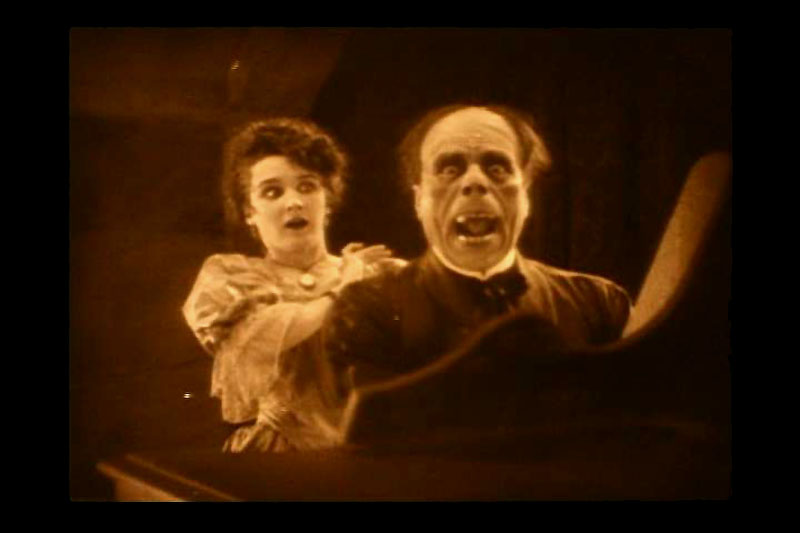
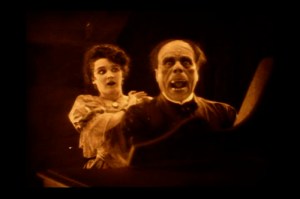
Lon Chaney- Phantom of the Opera 1925We went to see the classic silent film , The Phantom of the Opera, on Sunday at the Clemens Center, a beautifully renovated  theater in my hometown of Elmira.  The film featured accompaniment from organist David Peckham playing the theater’s newly restored Marr and Colton pipe organ.  It was pretty special when the Peckham and the organ rose from the orchestra pit before the film began , Peckham playing  the familiar theme from the theatrical play of the same name.

The organ’s grand sound really added  a wonderful dimension to the film, bringing life to the sometimes exaggerated  pantomime of the actors.  If you’ve seen many silent films, you’re familiar with this style of acting though I believe this film is a little over the top  with its frantic gestures and grasping of the neck in fear.  As you can probably detect, this is not one of my favorite films from the great Lon Chaney who starred as the Phantom who haunts the Paris Opera House, although he delivers a strong and compelling performance here.  I found myself identifying more with his character than the wooden stiffs who played the so-called good guys in the film.  So much so that at the end when the mob captures the Phantom,  beating  and throwing him into the Seine as the audience cheered their approval, I felt a real twinge of sympathy for his character.

Lon Chaney made some of the most interesting and powerful films of the silent era before dying at the relatively young age of 47, after a throat hemorrhage  from an infection caused by inhaling painted corn flakes that served as snow on one of his last films.  His ability to transform himself is legendary and made him one of the first mega-stars of film.  I have a hard time watching some of what I consider his best films as they are often grim and filled with base emotion, a quality that is pretty common for the best silent films of the era.

A few years back I wrote here about a couple of his dark movies that featured Chaney as tragic clowns.  Here is what I wrote at the time:
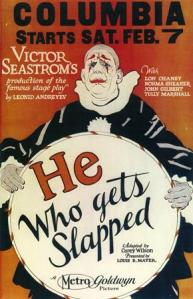
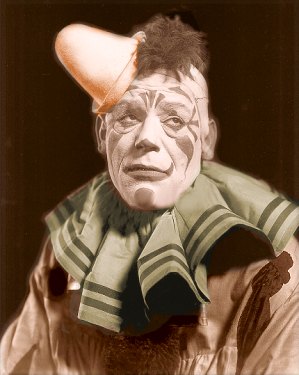
Lon ChaneyI don’t know what made me think of this movie so early this morning.  Something made me think of clowns and how even though their aim is to be comedic and entertaining, they often come across as scary or tragic.

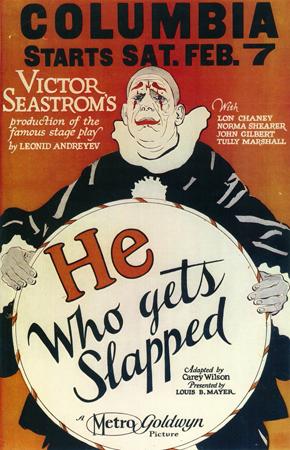
I saw a couple of Lon Chaney silent films a few years back that really reinforce this image.  He Who Gets Slapped and Laugh, Clown, Laugh are anything but laughfests.  Both are grim in nature and filled with tragic circumstances, like many of the films in the post-WW I early 1920’s.

Lon Chaney was a huge star of early films and is pretty much unfamiliar to modern movie fans.  He was known for his ability to transform himself into a wide variety of characters, often contorting his body and altering his face for grotesque effect.  This transformative ability won him the nickname The Man of a Thousand Faces which was also the title of a great film biography of him starring Jimmy Cagney as Chaney.  I recommend this film for those who wishing to learn a little more about an incredible talent.
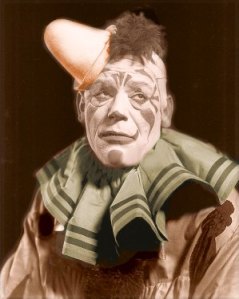
lon-chaney-laugh-clown-laughChaney is probably best remembered for his classic roles as The Phantom of the Opera and The Hunchback of Notre Dame, but for me it’s these roles as clowns that define Chaney for me.  They are dark films filled with grim  melodrama and tragedy.  They’re sometimes hard to watch.  But they are filled with real human emotion and complexity, so dark that it’s hard to believe that these were popular successes of the time.  Hollywood had yet to perfect the happy ending.

Again, I’m not sure why these came to mind today.

Maybe I’ll be painting clowns today.  Brightly painted sad faces.  Like Red Skelton.  That’s probably another too obscure reference.

Anyway, if you get a chance, and don’t really want to have your spirits lifted, check out these classics from the great Lon Chaney or his film biography, The Man of a Thousand Faces.

Read Full Post »

Crazy Rockers- Indorock Band circa 1962One of my favorite movies is The Third Man, which was filmed in post-World War II Vienna and stars Joseph Cotten, Orson Welles and Trevor Howard— three of my favorite actors.  With a screenplay by Graham Greene and great black and white cinematography, it’s just a great film.  But the thing that holds it all together and makes it memorable is the theme song that runs through the whole film, a haunting yet lively tune played on a zither by Anton Karas, who wrote and performed the song.  It was so catchy that it topped music charts around the world in 1950.

A number of people have recorded the song over the years but one of my favorites was from a group called the The Crazy Rockers from the early 60’s.  They were part of the Indorock scene in Holland at the time which was guitar-driven rock music played by Indonesians who were living in Holland.  It’s not a genre that many of us here in the states are familiar with but it was pretty big in that part of the world.   Still is from what I understand– the Crazy Rockers and the Tielman Brothers, who are the best known Indorock band, are still performing with over 50 years in the business.

I loved their version of The Third Man Theme with their choreographed movements and gyrations and matching sparkly costumes.  It was sort of kitschy but in a very authentic way.  I featured it here in a post back in 2008 but unfortunately can  no longer locate that version online.  So I will show a song from the same time frame, Carioca.  I’m also showing the original The Third Man credits  with the theme from Anton Karas playing over it  just to give those who aren’t familiar with it a chance to hear it.  If you get a chance, definitely catch the whole film.

Read Full Post »

GC Myers- Island of Souls  Called Island of Souls, this painting, 16″ by 26″ on paper, uses the isolation of an island as its central theme.  I am not sure if my photography on this particular piece accurately captures the true color and feel of this piece so I may have to re-shoot this.  But this image does get most of what is important so I will get on with it.

The idea of an island has always intrigued me.  I think it comes from the paradox of perception that comes with them.  The isolation offers escape and safe haven from the outer world on one hand but at the same time has a sense of captivity and limitation on the other.  As an artist my working life is spent on such an island, either safely ensconced in the quiet safety of my studio or trapped in a self-made prison, depending on your viewpoint.

A lot of artists have trouble with this isolation but for me it has always been preferable.  I always think of  the film Papillon where inmate Louis Dega, played by Dustin Hoffman, finally accepts and adapts to his fate on Devil’s Island, the penal colony off the coast of French Guiana.  He eventually lives in a little hut away from the others and lives a quiet and simple life until the end of his life there.  I have always thought that , outside it being forced upon him as punishment, it was an existence to which  many  people might aspire, living on a tropical island with little to worry about from the outside world.

Maybe that’s what I see here.  I suppose it could be seen as some sort of a prison with the cluster of huts on a rocky island with a dock and no visible boat.  I tend to see it in more aspirational terms, as a place of peace with a sense of tranquility in the colors of this piece that complements this reading of this picture for me.

One man’s penal colony is another man’s paradise.

Here’s a song of the same name from Sting.  It’s from his 1991 album The Soul Cages and uses the island as a dreamed of place of escape for the boat builders of Newcastle as they toil over the great ships that they will never sail on.

Read Full Post »

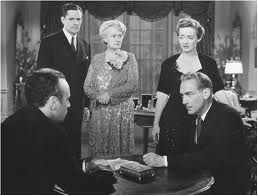
Watch on the Rhine 1943Tonight is night when the Oscars are handed out for the best movies, directors, actors and so on.  I’ve always been a big film fan and I always look forward to seeing who wins even on the years when I have hardly seen a movie.  It also makes me think of many of my favorite movies, films that stick in my mind and, like any other  form of art, define who I am.

A few weeks ago, I saw one of these favorites of mine, Watch on the Rhine.  It was made in 1943, adapted for the screen by Dashiell Hammett from  the prize-winning play written by his wife, the great Lillian Hellman.  It concerns a family in the Northern Virginia area across the Potomac from DC whose daughter ( Bette Davis in a supporting role here) returns home from a war torn Europe for the first time in many years with her husband and children.  It is set, and was written,  in the years before our entry into World War II.

Her husband is a German freedom fighter, Kurt Muller,  who is a wanted leader in the underground movement against the Nazis. He is  played by Paul Lukas in a magnificent performance, one that won him the Academy Award for Best Actor that year over Humphrey Bogart in Casablanca and Gary Cooper in For Whom the Bells Toll.  Yes, it was that good.

His Muller is the common man who finds himself in the role of the selfless hero willing to give up everything– his career, his family, his life– in order to stand against evil.  It’s not a task Muller sought but is one he must shoulder.  His words are simple, direct and powerful.  Lukas, who also originated the part on the Broadway stage, is brilliant and, whenever I see this movie, I am haunted for weeks afterwards by Lukas’ performance.  The power of it thrills me but I find myself questioning my own strength and beliefs as a human.  Thankfully, I have never been put into a situation like that faced by Kurt Muller and hopefully never will.  But would I be able to stand with even a fraction of the grace and courage of Lukas’ character?

I doubt it but I don’t know.

But I know that this movie’s ability to fix that question in my mind for weeks make it a great movie with great acting and world-class writing.  Hopefully, this year’s movies will have a film like Watch on the Rhine that will haunt future generations when they watch it years from now.


Read Full Post »

There is a  group of four small paintings that are part of my current exhibition at the Fenimore Art Museum.  They represent the very earliest pieces that showed the way for all of the work that followed, establishing a format and look that I had been seeking in vain up until the time that these pieces arrived.  This little painting is titled Babette’s Feast and is the first indicator of the Red Roof paintings that were to come in later years as well as one of the first pieces that featured a path that leads into the picture plane, a feature of many of my recent paintings.  It is also one of my wife’s treasured pieces.

The title, which was given to this painting by my wife after the title of  one of her favorite movies, a 1987 Danish film and Academy Award winner for best Foreign Film that is based on a story from Danish writer, Isak Dinesen,  best known for her autobiographical tale Out of Africa.  It is a wonderful tale set in a 19th century village in Denmark and, without getting into all of the details of the film, has great humor, beauty and humanity.    You can read a pretty good synopsis of the film on Wikipedia.

One of the docents at the museum asked me about the title and, knowing the film,  commented that it fit the piece perfectly.  That was a gratifying comment for me even though the painting was not done with any thought of the movie.  And even though I see different significance in this little painting, especially as a precursor for what was to come, it  is a great compliment to have a piece bring to mind a favorable comparison with such an evocative and stirring film.

Read Full Post »

« Newer Posts - Older Posts »