Feeds:
Posts
Comments

Archive for the ‘At the Movies’ Category

We’re in that time of the year when seasonal films extolling the virtues of Christmas usually appear.  Films like Miracle on 34th Street, A Christmas Carol, It’s a Wonderful Life,  and White Christmas are among the many.  But this year there is a new and different take on one of the traditional myths behind the season, Santa Claus.  It’s a film from Finland titled Rare Exports: A Christmas Tale which has a story that concerns itself  with the Nordic traditions of Sinterklaas set in a modern Finnish setting.

San Francisco Examiner movie reviewer Pamela Alexander-Beutler starts her review of the film with this  brief description of the myth behind the premise of the film: “Once upon a time in pre-Christian nordic mythology Sinterklaas is accompanied by ‘Zwarte Pieten’ (Black Petes). During the Middle-ages Zwarte Piet was a name for the devil. Later in Alpine regions of the North, these characters became known as St. Nicholas and Krumpus. Children were told that if they were pure of heart and lived without sin, St. Nicholas would bestow gifts and treats on them in December. But if they were bad the demonic Krampus would punish them. Arcane images often show Krampus with a basket or sack on his back carrying bad children away and dumping them into the pits of Hell.”

Basically, the story has to do with the discovery during an archaelogical dig of sorts and the capture of the real Sinterklaas, who is a darker and more sinister version than the jovial Santas we grew up with.  We might not be too thrilled about this guy shimmying down our chimney.  The film has gotten very good reviews so far and is opening in large cities around the country but, as Alexander-Beutler points out, this no film for children.

Here’s the trailer:

Read Full Post »

There’s a new documentary out (actually a re-edited version of a 2006 film) called Who Is Harry Nilsson? (And Why Is Everybody Talkin’ About Him) which concerns itself with the life, death and influence of the late American singer/songwriter.  His career was both brilliant and tragic, qualities you can often see in many of his songs. 

 He had a genius for composing beautiful ballads yet often had a bitter edge, throwing in lyrics that catch the listener off guard.  For example, in Don’t Forget Me Nilsson takes a tender song that has a wistful air and suddenly drops a line like “and when we’re older and full of cancer, It doesn’t matter now, Come on, get happy” that disarms you completely.  Neil Diamond perfromed that song on a recent album and changed that lyric, which bothers me in that it alters the whole song.   Or you can choose any of the lines from You’re Breaking My Heart with its happy rhythms and the ultimate punch of its chorus.

I’m hoping that more people will learn more about Nilsson and his talent to keep his music alive.  It has been a staple for film-makers since his Evcerybody’s Talkin’ from Midnight Cowboy  in 1969 captured the essence of  film and its memorable characters.  A personal favorite of mine is Martin Scorsese’s use of Jump Into the Fire from Goodfellas.

So, if you get a chance, take in this documentary or least find a Nilsson song and give it a listen.  I guarantee you will find something in there to like.  Here’s the trailer:

Read Full Post »

I usually don’t like remakes of older movies, don’t like taking something that stands up so well over the years and trying to redo it with a slicker look and more technology.  You usually can’t outdo the original actors who made certain parts iconic.  How could you remake Casablanca today and who could replace Bogart in it?  Who could have the sheer charisma of Clark Gable’s Rhett Butler character in Gone With the Wind without appearing to do a lame impersonation of him?  Or Henry Fonda’s Tom Joad  in The Grapes of Wrath?

But after seeing the trailer for True Grit I am willing to make an exception, despite John Wayne’s iconic portrayal of Rooster Cogburn in the 1969 version.  Maybe it’s the trust I have in the Coen Brothers who are doing this remake.  Or maybe it’s the short clips of Jeff Bridges’ version of Cogburn that I’ve seen (this is no Dude here).  I don’t know.  It looks darker and angrier than the original, more about a biblical sort of wrath than the earlier version.  I liked the early Wayne version but this looks like it could have fallen from the pen of Cormac McCarthy, and in the Coen’s hands that’s okay with me.   I know it will be a different interpretation and not a mere retelling with new window dressing.

There are few films I look forward to but this is one.  Look for it around Christmas.  Here’s the trailer:

Read Full Post »

I wrote some time ago about how a series of my paintings from several years back, the Outlaws series, had been influenced heavily by the imagery from a number of silent movies.  One that I mentioned specifically was Sunrise, the 1927 film from the great German Expressionist director FW Murnau of Nosferatu fame.  I mention this today because TCM is showing the film tonight at 9 PM EST.

The film was made at a really interesting time in the history of films.  Just as talking pictures were emerging ,  silent films were reaching their apex of artistic expression.  Within a few years they would be gone completely.

This film is the answer to a trivia question in that it won won the award for Best Picture  at the first Oscars ceremony in 1928.  Trivia fans will be shouting at this point saying that I’m wrong, that Wings won the first Best Picture award.  Well, they’re correct but I so am I, as Sunrise won the award for Best Picture: Unique and Artistic Production. There were originally two awards to honor two separate  aspects of the industry- the popular and the artistic.  This practice ended after this ceremony and  Sunrise became the only winner of the award for a unique and artistic film.

The cinematography in this film is beautiful and there is a long continuous shot from inside a streetcar that shows the city passing by that is breathtaking for its freshness, even by today’s standards.  The story is a fable telling the story of farmer and his wife and his struggles with a big-city temptress who nearly lures him into murdering his wife.  It is beautifully expressed and is a must-see for anyone who has seen more than enough special effects extravaganzas of the Transformers sort.  It is considered by many critics to be the finest silent film ever made and some even rank it up there with Citizen Kane as one of the greatest films ever.

I always hesitate in recommending films because we all have such different and subjective preferences, but if you get a chance and have any interest, take a look tonight on TCM.

Read Full Post »

There was a terrorist threat in Paris yesterday with a bomb scare at the Eiffel Tower.  Any thought of the Eiffel Tower for me always triggers memories of scenes from one of my favorite movies, Ninotchka.  It is a film from that legendary year in moviemaking, 1939, starring Greta Garbo and Melvyn Douglas and a wonderful cast of supporting character actors.

Ninotchka (Garbo) is a Soviet civil servant sent to Paris to expedite the sale of Russian royal jewels confiscated in the Communist Revolution, which has been held up by the three Soviet agents sent there previously who will do anything to slow the process so that they can further enjoy the luxuries and pleasures of Paris.  Ninotchka is a no-nonsense, stern woman who is meticulous in detail.  In Paris, she encounters and falls in love with Douglas before realizing he is the agent for the Russian countess whose jewels they are attempting to sell. 

 That’s all I will say except that it is a charming movie with wonderful lines  and performances.  If you’ve never seen Garbo, this is a great place to start.  She was a mega-star at the time and to see this, one understands why.  She is radiant on the screen.  Melvyn Douglas gives a great comic performance as do  the three actors portraying the bumbling agents (Sig Ruman, Felix Bressart and Alexander Granach.)

Just great moviemaking from director Ernst Lubitsch and writer Billy Wilder.  Technically, several of the scenes are one-shots, meaning that there are no editing cuts in the scenes and that the whole scene is shot with one camera.  It’s a small detail but it adds a lot to the appearance of the film and the feeling of continuity and unity throughout.  It’s one of those films, like Casablanca, that I can watch at anytime from any point in the film.  Good stuff.

Anyway, that is my trigger memory whenever I hear mention of the Eiffel Tower.  Here’s a taste of Ninotchka:

Read Full Post »

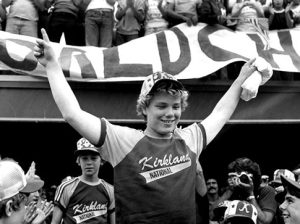
I watched a documentary last night on ESPN, Little Big Men, that tells the tale of the Little League team from Kirkland, Washington as it marched through the 1982 Little League World Series to face  and defeat the mighty Taiwanese team in the final game.  It was considered a huge upset at the time as Taiwan had thoroughly dominated the World Series for the past decade, winning 9 times out of 11 years.  The only time they didn’t win came in a loss to champion Japan one year and in 1975 when foreign teams were temporarily banned from competing.  Apparently, the Little League wasn’t quite committed to the term “world” in World Series in 1975. 

It’s a nice documentary of a group of kids accomplishing big things.  All of the team members carry great memories from their experience but the documentray is not just about the glory of the moment.  No, it’s concerned more with the aftermath and the treatment of one player, Cody Webster, by other parents.

Cody Webster was the big star of the 1982 Kirkland team.  He was a 5′ 7″, 174 pound 12 year-old who threw the baseball hard and hit it even harder.  In the final game, he baffled the Taiwan team with his fastballs and curves  and at the plate hit a tape-measure homerun that sealed their fate.  After he struck out the final Taiwanese batter, his teammates poured onto the mound and he carried his first baseman in one arm like a child.  He certainly seemed larger than life.

But he was simply a 12 year old kid who wanted to just be part of the team, not be the big star.  Even at the time, he expressed concern that his teammates weren’t getting the recognition they deserved, that there was too much focus on him. 

And there was focus on him.  Parades.  Rallies.  Television appearances.  It was pretty heady stuff for a shy 12 year old.

But the worse part came soon after.  His celebrity made him a huge target.  In the years after, as he competed in baseball, other teams wanted to beat the kid who won the World Series.  In their minds, to beat the champ made them the champ, which is all fine and good.  However, the parents of these other  teams took it to another level.  Cody Webster was swore at repeatedly and even spat on by opposing parents.  In the documentary, one of his teammates broke down in tears, recalling all the terrible taunts Cody had to endure as a kid but saying that he was glad that it was Cody, of all the team members, who had to take it because he was the only one of them who could have endured it.

And he did.  Thankfully, this is a cautionary tale that doesn’t have a tragic end.  Cody doesn’t end up dead or living in a cardboard box.  He did give up baseball several times in this teens until throwing it in for good as a college freshman.  As he said, he was a good baseball player at 12 but not at 17.  The fun had left the game with every curse hurled at him as a 12 and 13 year old until the joy that was so apparent in the team’s victory seemed like ancient history. 

But he did endure.  And as he says, it’s okay.  He coaches and instructs elite players in the Seattle area now and I’m sure he has a lot to pass on about handling the pressures put on these kids by parents with grand expectations.  Adults who take the joy out of a little boy’s game.

Read Full Post »

Yesterday, as I was working in the studio, I caught the last few minutes of the film, Tin Men, Barry Levinson’s atmospheric comedy about aluminum siding salesmen in early 1960’s Baltimore.  It’s a great film that I’ve seen dozens of times.  It never fails to make me laugh with Levinson’s always engaging dialogue and great use of deep detail throughout the film that give it rich texture and a real sense of place.

He also makes great use of the background music that adds another layer of texture to the overall feel of the film.  One of my favorites is his use of Nat King Cole’s version of the classic Sweet Lorraine.  It ‘s easy rhythm and pace makes me feel as though I were in Baltimore in the heat of a carefree summer in 1963.

Here’s Nat King Cole with Sweet Lorraine.  It’s always been a favorite of mine and I hope your day goes as smooth and easy as this song…

Read Full Post »

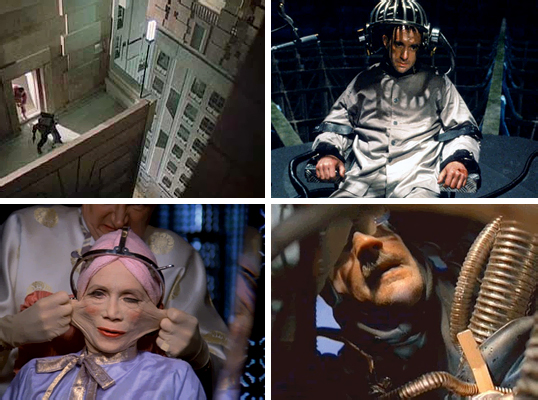
Images from Terry Gilliam's "Brazil"

It’s about 6:30 in the morning and I’m sitting here, stumped and looking at a blank screen.  Nothing to say so I flip on the television.  Don’t really want to watch the news.  Not ready for that just yet.

So I flip around the dial and up comes the opening from the movie Brazil with the music from the old song of the same name blaring, but in a gentle way.  It’s a sort of  1984 storyline that is set in a futuristic nightmare world that vaguely  resembles 1950’s England, only with some slight twists and bends.   I know I can’t watch it and get anything done but keep it on because I know that at any moment I can look up at it and see incredibly interesting imagery.

It’s a Terry Gilliam film after all.

Terry Gilliam was the American member of Monty Python’s Flying Circus, the least visible member but the one responsible for much of their visual look including their trademark opening credits and most of their animations.  In his post-Python life he has become one of the most original film-makers in the world, creating films that are wildly original and always richly visual.  Films like Time Bandits, The Adventures of Baron Munchausen, Jabberwocky, Twelve Monkeys, The Fisher King and  most recently, The Imaginarium of Doctor Parnassus.  All films that march to their own drum and have had degrees of success but hardly movies that have had widespread appeal for the general movie-going public.

I can imagine when film critics in the future, if there are such things then, will look back on Gilliam’s body of work and will recognize him for the creative genius he is for creating richly detailed alternate visions of this world in his films,  with stories that are consistently strong and beautifully conceived, that often deal with the individual trying to make his way through a world in which he is usually out of place in some way.  A theme I think we can all identify with in our own way.   I think that is how his work will be remembered, as highly individualistic visual feasts. 

Each film is definitely recognizable as his work.

So, as I struggle tofinish this post and get back to my own work, Brazil still rolls across the TV screen in my studio and I know I won’t get much done until it’s over.  Thanks, Terry…

Read Full Post »

Harold Russell in “The Best Years of Our Lives”

It’s Memorial Day weekend and every year at this time, TCM shows films with  military themes as a way of honoring the holiday.  I see that tonight they’re showing The Best Years of Our Lives from 1946.  It’s a movie I have watched a number of times and am always reminded of one of its stars, Harold Russell.

Harold Russell was not an actor.  He had been an Army instructor during World War II when he lost both hands in an accident while handling explosives.  Near the war’s end, he was the focus of a film about the rehabilitation of disabled vets which is where director William Wyler first saw him and decided to cast him as Homer Parrish, a sailor who loses both hands in the war.

Though not a trained actor, Russell gives a spectacular performance as Homer.  There are many memorable scenes with Homer that linger with you long after the film ends.  One that stands out for me is one in which Homer is in the garage and his young sister and a friend are watching from outside and Homer, tired and frustrated at the stares and pointed fingers from the curious, smashes his hooks through the window at the girls.  The visual impact of the scene is brilliant.

There are many other scenes  that shine as well and they came together to bring Russell the Best Supporting Actor Oscar for the film.  He holds a unique distinction as the only actor to have two Oscars for the same performance.  You see, the Oscar board thought Russell had no chance at winning and wanted to honor his performance for bringing attention to the plight of disabled vets so they chose to honor him with a special Oscar.

The Best Years of Our Lives is a compelling film.  Sure, there are moments of sentimentality.  How could there not be?  But this is no rosy view of the world in any way.  It has a dark grim tone and shows the damage the war has inflicted on the returning vets, both physically and emotionally.  It has an honesty about the subject of the effects of war that you didn’t often see in contemporary films of the time.  The vets returned to a world that was changed from that which they remembered and they were often forced to deal with indifference and sometimes scorn from a public that soon forgot their sacrifice.   It seems to me to be the jumping off point for the dark realism of  many films from the next decade.

So, if you get a chance tonight take a look.  It’s a great film and you’ll be reminded why we honor the sacrifice of those who served.  Here’s a great scene with Harold Russell as Homer and his girlfriend, who he has felt alienated from because of his disability. He’s trying to show her what she will face in the reality of  a life with him.

Read Full Post »

Once again, it’s the time of the year when the movie, The Ten Commandments, takes to the airwaves, an Easter tradition on ABC.  I’m pretty sure I mentioned in the past how much I enjoy this film on so many levels.  It has a great epic quality from the solemn narration by its director, Cecil B. DeMille, to the huge sets employed.

It also has a great deal of goofiness in the writing and acting, where I sometimes feel like I’m watching an SCTV skit and half expect Eugene Levy to stumble into the scene.  Pure kitsch.

When you throw in the fact that it’s such a great tale, it makes for a great night of viewing.

Here’s something that has very little to do with the movie except for the title.  It’s Desmond Dekker‘s early reggae hit, The Israelites.  When I hear this song I am immediately transformed to being a kid listening to this song in our kitchen on my Dad’s big old plastic AM radio that had its batteries held in place with a piece of wood in its open backside.

Anyway, enjoy…

Read Full Post »

« Newer Posts - Older Posts »