Feeds:
Posts
Comments

Archive for the ‘At the Movies’ Category

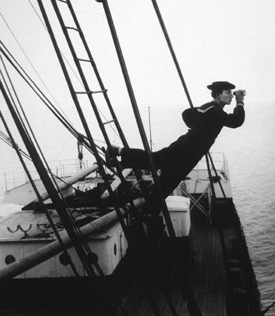
Buster Keaton in "The Navigator"

I’m kind of busy this morning.  I’m getting a group of work ready to be delivered to a couple of my distant galleries so I’m hustling around, finishing the details and things that should have been finished some time ago on a few pieces.

But I did want to comment on another of my favorites, the great comedic film actor, Buster Keaton.  They showed his 1924 classic, The Navigator, late last night on TCM.  Like many of Keaton’s films, one of the main characters in the movie was the main prop in the film, a hulking old steamship that is abandoned and adrift.  Keaton could make incredible use of his prowess as a physical comedian with the physical dimensions of such a ship, as he had done in other films with locomotives and falling houses, among other things.

With his deadpan, melancholic face and ability to find comedy in very a physical manner, his humor is universal and timeless.  I find myself laughing out loud at his work often and marveling at the his daring in performing all the tremendously dangerous stunts that he did without a double.  For what it’s worth, Jackie Chan mentions him as one of his biggest influences.

Here’s a short with several of his bigger stunts from several of his films including a funny underwater bit from The Navigator

Read Full Post »

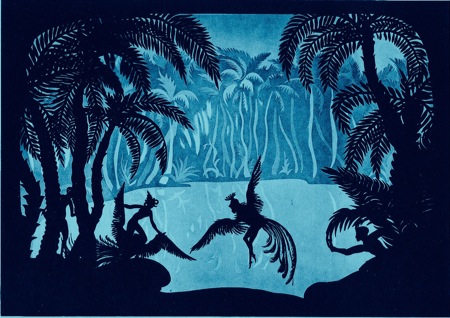
The Adventures of Prince Achmed (1926)

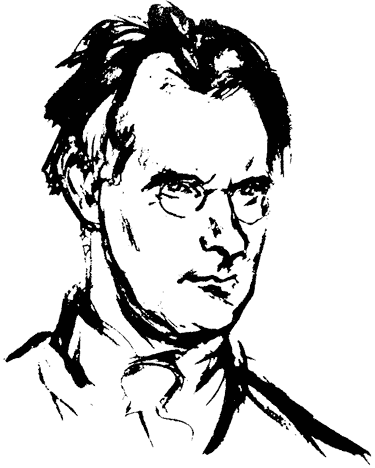
I first saw a film, The Adventures of Prince Achmed,  from Lotte Reiniger several years ago in a series about early silent films.  It was made in 1926 Germany and was one of the first animated films made.  It’s a form of animation that Reiniger pioneered and mastered, based on Eastern shadow theatre.   Using silhouette figures, each is painstakingly cut and hinged then  filmed in small movements with time lapse photography to produce motion in the film.  This film took three years to complete.

Lotte Reiniger At Work

In this telling of the Arabian Nights stories, I was immediately struck by the beauty and movement of the colors in the film.  Each cell was tinted by hand to produce intense bursts of color that gave the film a gorgeous surreal quality.  The movements of the figures in the film are smooth and natural,  very subtle.  I found myself so taken with watching the movements and changes that I found myself not following the story.  But I didn’t care.  It was beautiful to see and sparked the imagination.

Lotte Reiniger (1899-1981), born in Germany and living most of her post-WW II life in Britain,  left quite a body of work from a career that spanned over 50 years, including one of the first film versions of Hugh Lofting’s Doctor Dolittle. She’s pretty much unknown in popular culture which is a great shame.  Her work is marvelous and deserves to be seen.

Here’s a small clip of Prince Achmed:

Read Full Post »

There’s an old piece of film that I have often seen in snippets, usually in a montage about the earliest days of film in the late 1890’s.  It’s a short film of a dancer with swathes of fabric twirling, very modern dance-ish in style, and as she spins the fabric changes color.  It’s a pretty mesmerizing piece of fim, even more so given the infancy of the medium of the time.

Doing a little research I found that this was filmed by the French film pioneers, the Lumiere Brothers, in 1896.  Each film cell is handpainted to achieve the color effects.  The dancer in the film is Loie Fuller, an American-born pioneer of modern dance who was the toast of Paris in the 1890’s, starring often at the Folies-Bergere

I find this film quite enchanting which is pretty amazing considering how many different  moving images, how much computer generated animation and other advances in film-making I, like most people, have witnessed in this time, over 110 years in the future.  Can you imagine how mind-blowing this must have seemed to the average person of the day?

This point is well illustrated in the movie, The Magic Box, a 1951 film in which Robert Donat portrayed British inventor, William Friese-Greene, who had invented and patented the motion picture camera a year before Edison but never received any credit and died in virtual anonymity.  In the film, when he finally is able to fully demonstrate the motion picture with his invention he is alone in his lab, late at night.  He is frantic with excitement and runs out into the London streets to let the world know of his triumph.  The only person he encounters is a London police officer, played by Laurence Olivier.  The bobby suspiciously goes along with Friese-Greene thinking he has a psychotic on his hands.  He hesitantly agrees to look at Friese-Greene’s demonstration and when the film rolls and the images of the London citizens strolling in Hyde Park appear, he is frozen with amazement.  It is as though he is looking on a true miracle.  And perhaps he was– the miracle of invention.

Anyway, take a look to see a beginning point and realize how far we have come…

Read Full Post »

“There was an old man of Madrid
Who ate sixty-five eggs for a quid.
When they asked, ‘Are you faint?’
He replied, ‘No I ain’t,
But I don’t feel as well as I did.”

****************

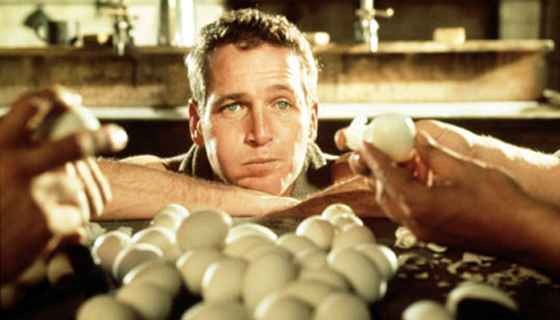
I came across this old limerick and immediately the movie Cool Hand Luke came to mind and the scene where Luke, played to perfection by Paul Newman, bet his fellow inmates that he could eat 50 eggs.  Great scene.  Great movie.

Luke was and is one of my favorite movie characters of all time.  His contrarian nature constantly put him at odds with the world.  He just didn’t seem to fit in with all its rules and was in a never ending rebellious struggle with those in authority.  It was easy to identify with Luke as a young man, especially in the way he channeled his rebellion.

Cool.  Never showing the anger and frustration that was obviously inside him.  He had a sort of stoic acceptance, even a smile, when he appeared to totally defeated by the forces he opposed.

It’s a great film.  It has drama, tragedy, humor and moments of defeat and triumph.  It’s everything a movie should be.  very human.

Funny how a little found limerick can trigger so many memories and feelings.  Something out of nothing.

Or as Luke might say:

Sometimes nothing can be a pretty cool hand…

Read Full Post »

Yesterday, as I was painting in the studio, I had the pleasure of seeing two of my favorite movies, Hangmen Also Die and The Seventh Cross from the WW II era, two films that dealt with the citizens of countries occupied by the Nazis at that time.   Both dealt with underground resistance efforts and how they operated to undermine and hinder the Nazi’s hold on their countries.

I’ve always been intrigued by these movies made during wartime, movies that deal not with the soldiers in the field but with the citizens who struggle to live day to day under a brutal occupier.  The depiction of the resistance fighters in both of these movies is remarkable in that they are portrayed as totally unremarkable people.  Just everyday people who overcome their fears to perform small acts of bravery that collectively become large actions against their oppressors.

In many ways, these people are more inspiring and heroic than the John Wayne style heros of that era’s battlefield films.  When I watch these films, I always find myself wondering how I, or people I know, would react in such situations.  Would we be able to muster the will to put aside our fears and work to oppose our occupiers?  Or would we cave and submit willingly?

I know we would all love to say that we would take the heroic route, that we would fight against the powers that oppressed us.  For me, I can only hope that this is true.  I can’t be sure.   I’ve lived long enough to know that, for most,  the expediency of momentary security often trumps heroic intentions and the very thought of courageous actions.

I hope I never have to know the answer to these questions.

So, if you wish to be inspired by the courage of common folk, take a gander at these two films.  Maybe it will help you be braver in your own lives…

Read Full Post »

The other day I had a post about Lon Chaney and my friend, Dave, commented that he had wanted to be Chaney when he was a kid.  This made me wonder what movie hero I wanted to emulate when I was young.  It’s easy to rattle off stars now, when you’re older and know their full careers and the impact they made.  But when you’re a kid the attraction is more basal, less thought out.  More limited to the scope of your own small world.

I wanted to be Audie Murphy when I was a boy.

Though hardly known today, Audie Murphy lived for me in the B-movie westerns that were shown every Saturday morning at 7:30 AM on our local TV station.  They were pretty predictable stories with Audie as the lawman or the wrongly accused cowhand who ferrets out the bad guys, often played by Dan Duryea, another name that is little known today, and finds justice with his fists or his six-guns, riding off into the western sunset.

His appeal for me was in that, as a kid, he seemed both like the hero and the underdog.  He wasn’t a big  tough guy who physically dominated the screen like John Wayne.  He seemed smaller than the villains who threatened him.  Maybe that was the appeal to a kid.  But he had quiet determination and grit and always upheld the heroic qualities of honesty, courage and justice.  He always persevered.

While most of his films were B-movies, he did have a few higher quality outings.  He starred in the classic The Red Badge of Courage and in The Unforgiven with Audrey Hepburn as well as a starring role as himself in the biographical To Hell and Back.  Did I forget to mention that Audie Murphy was a real-life  war hero?  Audie Murphy was the most decorated soldier of World War II and his exploits in the field are legendary.  He received the Purple Heart  when a German bullet hit and shatter his hip.  He recuperated for all of ten weeks, came back and was wounded within days by a mortar then again some time later  during incredible combat actions which led to him receiving the Medal of Honor.  He received 33 medals, all that were  possible, plus 6 medals from France and Belgium.

Not bad for a guy who was listed upon enlisting as being 5′ 5 1/2″ tall and weighing 110 pounds.

But I didn’t even know about his offscreen heroics then nor did  I know about the emotional struggles that came with such brutal war experiences that haunted him until his death in 1971.  He was just the little guy in the light colored hat with the fast fists and quiet determination, fighting for what was right.

Not a bad guy to want to emulate…

Read Full Post »

I don’t know what made me think of this movie so early this morning.  Something made me think of clowns and how even though their aim is to be comedic and entertaining, they often come across as scary or tragic.

I saw a couple of Lon Chaney silent films a few years back that really reinforce this image.  He Who Gets Slapped and Laugh, Clown, Laugh are anything but laughfests.  Both are grim in nature and filled with tragic circumstances, like many of the films in the post-WW I early 1920’s.

Lon Chaney was a huge star of early films and is pretty much unfamiliar to modern movie fans.  He was known for his ability to transform himself into a wide variety of characters, often contorting his body and altering his face for grotesque effect.  This transformative ability won him the nickname The Man of a Thousand Faces which was also the title of a great film biography of him starring Jimmy Cagney as Chaney.  I recommend this film for those who wishing to learn a little more about an incredible talent.

Chaney is probably best remembered for his classic roles as The Phantom of the Opera and The Hunchback of Notre Dame, but for me it’s these roles as clowns that define Chaney for me.  They are dark films filled with grim  melodrama and tragedy.  They’re sometimes hard to watch.  But they are filled with real human emotion and complexity, so dark that it’s hard to believe that these were popular successes of the time.  Hollywood had yet to perfect the happy ending.

Again, I’m not sure why these came to mind today.

Maybe I’ll be painting clowns today.  Brightly painted sad faces.  Like Red Skelton.  That’s probably another too obscure reference.

Anyway, if you get a chance, and don’t really want to have your spirits lifted, check out these classics from the great Lon Chaney or his film biography.

The Man of a Thousand Faces.

Read Full Post »

Work! labor the asparagus me of life; the one great sacrament of humanity from which all other things flow — security, leisure, joy, art, literature, even divinity itself.

Sean O’Casey

.

.

.

I had the movie Young Cassidy on in the studio yesterday which is a mid-1960’s biopic  starring Rod Taylor as the great Irish playwright Sean O’Casey.   It documents the formative years up to the time when he finally had his first plays produced at the Abbey Theatre , the first being in 1923 when he was 43 years old.  It ends with the production of his play,  The Plough and the Stars , which caused  riots at the time and propelled him into a career as a full-time playwright.  He had worked as a laborer for the many years before this breakthrough and as a result his work often dealt with the inequality of  the classes and other societal ills.

I can’t say that it was a great movie but it was pretty good, good enough that it made me think.  Think about O’Casey’s work and how it was shaped by his early life, living in poverty and oppression.  Think about how such inequalities still rule our world and how we so willingly live with them so long as it doesn’t affect our own little worlds, so long as we don’t have to think about them.

Makes me glad there were men like O’Casey to inflame thought and passion with their work,  because to make us think is to put us on the road to action.  It seems that such thought is a rare commodity today even with the billions of words that spring forward every day on the web, on blogs like this, on Twitter, on text messages and on and on.  We talk and talk, blathering on and on (this is a prime example!) but are these words adding anything to the greater good?  How many of these words make us stop and think or inspire us to action?  Or is action lost in the deluge of words?

Could we even hear the words of an O’Casey today in the din of all these meaningless words?


Read Full Post »

Sometimes when you think about what you might write down on a list of your favorite movies there are some that evade your memory until you see it again and, like a desert flower, blooms again in your mind.

Such is the case with 84 Charing Cross Road.

It was on TCM last night and we flipped it on just to glimpse a few moments and ended up watching the whole thing.  I was immediately reminded of how much I like the film.

From 1987, it’s a movie about books and the written letter.  Hardly an action-filled two hours.  It’s the true story of writer Helene Hanff and her 20 year correspondence with a London bookshop, Marks and Co., located at 84 Charing Cross Road.  In 1949, Hanff an aspiring and struggling NY playwright responded a small classified ad from the bookseller.  She was seeking obscure British literature and was unable to locate her desired works in shops.  The movie follows the correspondence between Hanff over the next 20 years with the staff of the shop and how they effected each other’s lives with small acts of kindness and humor.  Hanff never made the trip to London until after the manager she primarily corresponded with had died and the shop had closed.

It’s a small quiet film that celebrates two things that are racing to obscurity- books and the posted letter.  Just a lovely and charming film.

The great Anne Bancroft stars in the film as Hanff and as usual, is wonderful.  I have had a longtime crush on Anne Bancroft to the point that when I think of Mel Brooks I don’t think of his great movies but instead find myself thinking what a lucky bastard he was to have married Anne Bancroft.   It also stars Anthony Hopkins as Frank Doel, the main man at the bookshop and Judi Dench as his wife.

If you love the feel of an old book and still get excited when you receive a hand-written note,  you most likely will enjoy this film.  It remains one of my sometimes forgotten favorites.

Read Full Post »

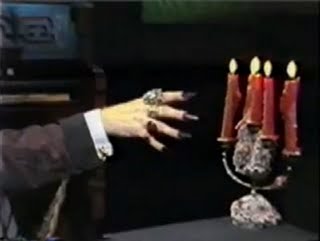
Dr. Witty on Monster Movie MatineeWith Halloween falling on a Saturday this year, my mind switches back to past Halloweens and all the things that go with them.  Part of my normal Saturday routine growing up was to be in front of the TV at 1 o’clock to watch Monster Movie Matinee, a show out of Syracuse that ran for a couple of decades and showed classic ( and not so classic, as the years went by) horror and sci-fi movies.

It was a great kitschy broadcast.  It would start with the camera panning in over an obvious model of an haunted-type mansion on a hill as eerie monster movie music played.  It was hosted by Dr. E. Nick Witty (I think this is supposed to be funny but it eludes me) and his assistant, the wretched Epal. Epal on Monster Movie Matinee You never saw anything of Dr. Witty but his long emotive fingers.  His voice was kind of a bad Bela Lugosi copy that played perfectly for this type of show.  Epal, played by the station’s longtime weatherman who also played other characters (his character, Salty Sam, introduced me to Popeye cartoons) on a number of other shows, was covered in rough-edged scars and wore an eyepatch.  He seemed to constantly erode as the years passed.

They had storylines that they used as they introduced the films, little vignettes that ran from week to week.  Goofy stuff but fun.  They let the movies they showed be the real stars and I saw most of the greats through them.  All the Frankenstein, Dracula and Wolfman movies were in regular rotation in the early years mixed in with a plethora of lower quality, monstery B-movies, which kind of took over in the later years.

215px-Creature_from_the_Black_Lagoon_posterI remember one wet and dark Halloween Saturday back then spending the afternoon watching one of my favorites with Dr. Witty and Epal.  It was The Creature From the Black Lagoon.  It was a movie that was shown at least a few times a year so it became part of the kid memory bank.  It was the story of a group of geological researchers sent to explore a fossilized skeletal claw-like hand found up the Amazon where they encounter the Creature, a rubber-clad Gill-Man who makes repeated attacks on the research vessel, finally abducting the babe girlfriend of the main scientist.

Originally in 3-D in the theaters, was a pretty stylish 50’s monster movie.  Pretty good quality, actually.  The Creature was a great costume, very sleek and somewhat believable- at least to the kid sitting on the couch with the Fig Newtons.  It had nice underwater photography of the Creature gliding after his prey and also had great sound and music that really enhanced the story.  It wasn’t the scariest but it kept you involved with the story.   I always felt more of a connection with the Creature than I did with the crew of researchers and actually felt myself kind of rooting for him at times.  Much like King Kong, he seemed sadly alone.

That wet and dark Saturday many years ago seems to come to life now whenever I think of the Creature or Halloween, for that matter.  I remember the light.  The smell of that living room. Funny how certain things, even the smallest trivialities, imprint on the memory  when coupled with something important, as Halloween was to a kid.

Today I’m thinking of that day and that lonely Gill-Man and Dr. Witty…

Read Full Post »
« Newer Posts - Older Posts »