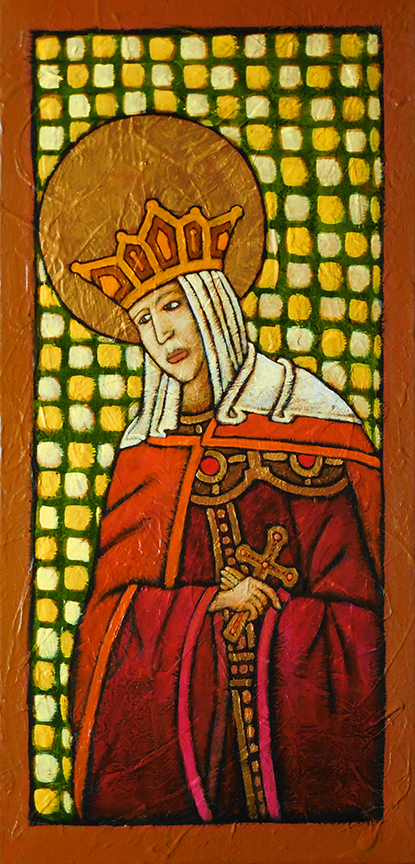
 I don’t know how to start with this newest painting from the Icon series. When I started the series I wanted it to focus on the lives and stories of the everyday ancestors that make up my and many others’ family lines. But there ares some folks in these lines that are definitely not everyday people. Such is the case with this icon– she was already the subject of multiple icons before I even thought of painting her.
Her birth name was Ingegerd Olafsdotter and she was born to the Swedish king Olof Skötkonung right around the year 1001. She is my 32nd great-grandmother.
She received an exceptional education as a young girl of the time, studying the scriptures, literature and history as well as being instructed in the use of military arms. In order to extend his own influence and consolidate power, Olof sent her to Kiev in 1017 to wed the Russian Great Prince Yaroslav the Wise. There she took on the name Greek martyred saint, Irene.
During her time as the Great Princess of Kiev, Irene acted as an ambassador of sorts in maintaining Russia’ influence in the Europe of that age. She offered sanctuary to several outcast princes to protect them from overthrowing forces and arranged marriages for her children that placed them squarely in the middle of continental affairs. Her three daughters became Queens of Hungary, Norway and France ( my 31st gr-grandmother, Anne of Kiev) while her sons all took positions of power within Russia.
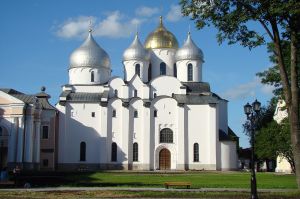
St. Sophia Cathedral in Novgorod
She and Yaroslav also continued the growth of Christianity in that time, building the Saint Sophia Cathedral in Kiev as well as one of the same name in Novgorod. Near the end of her life, Irene established a monastery in Novgorod and, as was the custom of the time, as founder was required to operate it. In doing she was tonsured (which involves the cutting of the hair) and took on the name Anna. She continued in this capacity for several years until her death around the year 1050. She is buried in St, Sophia Cathedral in Novgorod.
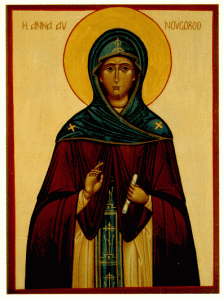 For her works in spreading the beliefs of the church as well, in actually building churches, Anna was made a saint in the Eastern Orthodox church. In fact, one of the feast days of St. Anna is next week on February 10th.
You would think it would be easier to paint this type of ancestor, especially one who is already portrayed in many real icons. But there is such a disconnnect in time and place that with some of these distant illustrious ancestors, while I am pleased to know that I somehow have a blood link to them, I feel less of a bond with them than with a hardworking lumberman in the Adirondacks or a forgotten housemaid who stole from her employer. Or even a Scottish scoundrel and liar who remains a mystery to me.
Maybe I see more of myself in them.
Genealogy often reveals great discoveries. In some cases, you are left wondering how a family rose so far from humble beginnings while in others you wonder what choices and factors along the way brought a descendant so far below the stature of their ancestors.
I guess it’s a great case study in the laws of probability. Over the course of a thousand years and thirty some generations winding their way into a new country, some bad choices and bad luck will inevitably fall on some along the way. I am sure there are literally many, many millions of descendants springing from St. Anna and some families have probably maintained power and prestige through the ages.
And others– well, you know the story. It’s most of our stories.
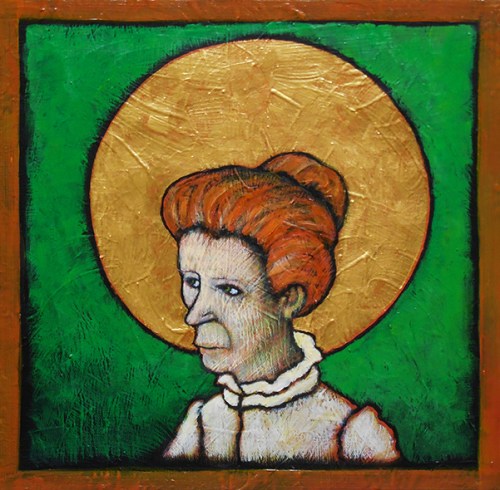 One of the things I am trying to emphasize with this current Icon series is the fact that we are all flawed in some way, that we all have deficiencies and stumbles along the way. Yet, uncovering these faults in my research, I find myself holding affection for many of these ancestors that dot my family tree. Perhaps it is the simple fact that without them I would not be here or perhaps I see some of my own flaws in them.
 My current Icon series has been a real pleasure for myself in that it’s refreshing to work on pieces that I realize are only for myself, not worrying if they strike a chord with anyone else. For me, it’s fulfilling to flesh out some of my ancestors and their stories, to give them an image that I an hold on to. As I’ve said these are meant as symbols– I’m not trying to recreate their actual appearance. In most cases, there is nothing to work with, nothing that would give me a clue as to how they might really look. So, this is how I see them in my mind.
 This painting, a new 24″ by 20″ canvas, is titled Icon: Peter the Scoundrel. This may not be my favorite painting from the Icon series that I’ve been working on as of late but this has been by far the hardest piece for me to complete. It just kept going and going and I completely repainted the head and face at least six different times. Each face never felt right and I could not get a handle on how I wanted to portray the person behind this painting.
 When you delve back into your ancestry you often uncover surprises, some pleasantly exciting and some a bit disappointing. In some cases, it’s a bit of both. Such is the case of the person behind this latest painting from my current Icons series. This piece is 24″ by 12″ on masonite and is titled Icon: Eleazer.
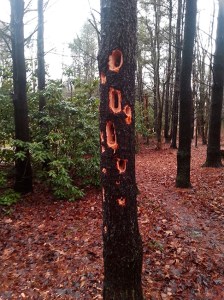 I posted a picture on social media a few days ago of a tree that had been recently visited by one of the several large pileated woodpeckers that reside in the woods around my home and studio. Earlier that day I had been coming through the woods to the studio in the early morning, As I passed this tree I stopped because it looked like the tree was casting a shadow in the moonlight which wasn’t unusual except for the fact that there was no moon out. The light around the base of the tree turned out to be a large piles of woodchips created by the woodpecker.
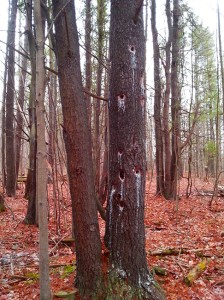 In the first few years we lived here they seemed very evasive and we seldom caught sight of them but as we settled in and they grew accustomed to us, the sightings increased. I think they see us now as part of the forest and we definitely see them as an integral part of the woods. And while they appear to inflict damage on some of the trees of the forest, we know that the trees they work on are already being damaged and destroyed from the inside by boring insects, most often carpenter ants.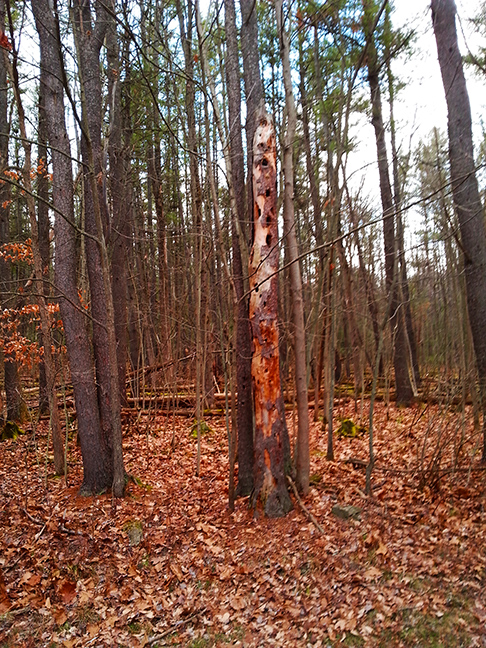
 As pointed out in recent posts, I’ve been working on a group of new work that I am calling Icons, images that put people that I have come to know through doing some genealogical work. They are not intended to be accurate depictions of these ancestors. In each case, I have just found something compelling that sticks with me. Such is the case with the painting above, a 10″ by 20″ canvas that I call Icon: William England.
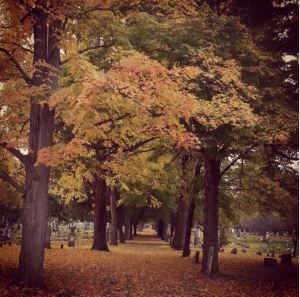 We take a walk just about every day in a local cemetery. It’s not overly large nor does it have grand mausoleums or many elaborate memorials. It’s not even an extremely beautiful cemetery, although there are lanes such as the one shown here that I find lovely. It’s just a pleasant place to walk in relative quietness.
 This is the next step in the Icon series of paintings that I talked about a few days ago. It’s an 18″ by 18″ canvas that I call Gilbert, going with the French pronunciation– more jill-bear than gill-bert. There’s a reason for that.
 It’s the New Year and I am finally back at work. I’ve started working on some pieces that have been brewing in my mind for a while, some that are out of my comfort zone. I don’t know how they will turn out and there’s a good chance that most of this work will never see the light of day. I have found that quite often work that is too idea based or thought out never gets into any kind of natural flow or rhythm, at least for me. I have plenty of examples from over the years that I won’t show here.
 Redtree Times