There’s a new documentary out (actually a re-edited version of a 2006 film) called Who Is Harry Nilsson? (And Why Is Everybody Talkin’ About Him) which concerns itself with the life, death and influence of the late American singer/songwriter. His career was both brilliant and tragic, qualities you can often see in many of his songs.
He had a genius for composing beautiful ballads yet often had a bitter edge, throwing in lyrics that catch the listener off guard. For example, in Don’t Forget Me Nilsson takes a tender song that has a wistful air and suddenly drops a line like “and when we’re older and full of cancer, It doesn’t matter now, Come on, get happy” that disarms you completely. Neil Diamond perfromed that song on a recent album and changed that lyric, which bothers me in that it alters the whole song. Or you can choose any of the lines from You’re Breaking My Heart with its happy rhythms and the ultimate punch of its chorus.
I’m hoping that more people will learn more about Nilsson and his talent to keep his music alive. It has been a staple for film-makers since his Evcerybody’s Talkin’ from Midnight Cowboy in 1969 captured the essence of film and its memorable characters. A personal favorite of mine is Martin Scorsese’s use of Jump Into the Fire from Goodfellas.
So, if you get a chance, take in this documentary or least find a Nilsson song and give it a listen. I guarantee you will find something in there to like. Here’s the trailer:
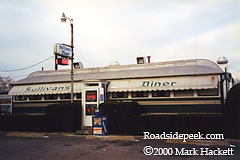
In yesterday’s post on the blog American Folk Art @ Cooperstown, Paul D’Ambrosio wrote about a bas relief carving in the collection of the Fenimore Museum. It was one of a series concerning Sullivan’s Diner in Horseheads, NY and was carved by renowned folk artist Mary Michael Shelley, who works just up the road in Ithaca. The piece shown here is different from the carving in the Fenimore Collection but both feature the diner’s intimate interior with counter that runs the length of the small trailer with round stools.
I was really interested in this blog post for a couple of reasons. First, I’ve always been interested in bas relief carvings and, as I wrote her before, started carving in the years before I became a painter. Much of my painting is done very much like a carving , in the way I see and render the elements. The second, and more important, reason was that Sullivan’s Diner has always been in my sight in some way for my entire life. Built in the 1940’s in New Jersey, it spent its early years as Vic’s Diner on Elmira’s eastside, from where my family hails. I have distinct memories of its appearance on the corner near St. Joe’s Hospital as a child, even a memory where I was sent sprawling on the sidewalk in front of it on my bicycle.
In 1974, it was moved up the road to Horseheads where Art and Fran Sullivan renamed it and ran it. Art was a railroad fanatic of the highest order and had an actual engine and an attached car behind the diner’s new location on Old Ithaca Road. Fran ran the restaurant , doling out generous portions of eggs and bacon for many years from the grill behind the counter of this small trailer diner. This was not one of the larger streamlined beauties you see along the turnpikes of Jersey. It was cramped inside with a few booths on one side of the aisle and the counter on the other. The woodwork and feel was more 1930’s even though it was built in the 40’s. Living in Horseheads, I ate many breakfasts there over the years and always felt like I was walking into Fran’s home kitchen when I walked through those doors, which seemed to transform you back to a much earlier time when you passed through the doors.
The food was okay, simple but satisfying. The coffee watery but tasty. But the attraction was the sense of community that the place fostered. Walking in through the old door you felt like you were entering Fran’s personal kitchen and she treated you as though you were a guest in her home. Even though I was only a sporadic visitor she always made me feel as though I were one of her regulars, making me feel as comfortable as the regulars who laughed and joked at the counter each morning.
I haven’t been there often since Fran retired but the place was reopened under new management and seems to be flourishing. But I do have fond memories of that place and am gratified that Sullivan’s Diner will forever be immortalized in the collections of at least two museums. The piece at the bottom is the one from the Fenimore Museum and another is in the National Museum of Women and the Arts in Washington, DC.
Thanks for the fine work, Mary Shelley, and thanks, Paul, for pointing it out.
This is an early piece, a small painting on paper that was completed in 1996 or 1997. Called Night Clouds Creep In, it is one of those pieces that quickly left my hands but whose image remains with me vividly, forever burned into memory. Unfortunately, I had no real image of this piece. I had somehow either misplaced the slide of it or had not taken one in the first place. There were times early on, when this happened more than I would like to admit.
But the collector who acquired this painting those many years back recently brought several early pieces of mine that he owned back to the Principle Gallery so that they could photograph them properly for his records. I was thus able to be reunited with this image and several others that also fell into this category of lost images of mine.
As I said, this piece resonated with me. It’s a great example of my early work, with its spase composition and two distinct blocks that make up the sky and the foreground separated bya thin white line of unpainted surface. It is a continuation of a series that did early on that I called the Haiku series, inspired by the evocative three line poems of Japan. These paintings were meant to be simply put yet very imbued with feeling. Most were field scenes like this.
This piece really captures everything I wanted for this series. Quiet and still, yet filled with the anticipation of what is to come. There is a calmness and a tension at one glimpse. Soothing and ominous, but balanced. In equilibrium. It just works for me as I see it. I am grateful to have it back to reinforce my memory of it.
I usually don’t like remakes of older movies, don’t like taking something that stands up so well over the years and trying to redo it with a slicker look and more technology. You usually can’t outdo the original actors who made certain parts iconic. How could you remake Casablanca today and who could replace Bogart in it? Who could have the sheer charisma of Clark Gable’s Rhett Butler character in Gone With the Wind without appearing to do a lame impersonation of him? Or Henry Fonda’s Tom Joad in The Grapes of Wrath?
But after seeing the trailer for True Grit I am willing to make an exception, despite John Wayne’s iconic portrayal of Rooster Cogburn in the 1969 version. Maybe it’s the trust I have in the Coen Brothers who are doing this remake. Or maybe it’s the short clips of Jeff Bridges’ version of Cogburn that I’ve seen (this is no Dude here). I don’t know. It looks darker and angrier than the original, more about a biblical sort of wrath than the earlier version. I liked the early Wayne version but this looks like it could have fallen from the pen of Cormac McCarthy, and in the Coen’s hands that’s okay with me. I know it will be a different interpretation and not a mere retelling with new window dressing.
There are few films I look forward to but this is one. Look for it around Christmas. Here’s the trailer:
I wrote some time ago about how a series of my paintings from several years back, the Outlaws series, had been influenced heavily by the imagery from a number of silent movies. One that I mentioned specifically was Sunrise, the 1927 film from the great German Expressionist director FW Murnau of Nosferatu fame. I mention this today because TCM is showing the film tonight at 9 PM EST.
The film was made at a really interesting time in the history of films. Just as talking pictures were emerging , silent films were reaching their apex of artistic expression. Within a few years they would be gone completely.
This film is the answer to a trivia question in that it won won the award for Best Picture at the first Oscars ceremony in 1928. Trivia fans will be shouting at this point saying that I’m wrong, that Wings won the first Best Picture award. Well, they’re correct but I so am I, as Sunrise won the award for Best Picture: Unique and Artistic Production. There were originally two awards to honor two separate aspects of the industry- the popular and the artistic. This practice ended after this ceremony and Sunrise became the only winner of the award for a unique and artistic film.
The cinematography in this film is beautiful and there is a long continuous shot from inside a streetcar that shows the city passing by that is breathtaking for its freshness, even by today’s standards. The story is a fable telling the story of farmer and his wife and his struggles with a big-city temptress who nearly lures him into murdering his wife. It is beautifully expressed and is a must-see for anyone who has seen more than enough special effects extravaganzas of the Transformers sort. It is considered by many critics to be the finest silent film ever made and some even rank it up there with Citizen Kane as one of the greatest films ever.
I always hesitate in recommending films because we all have such different and subjective preferences, but if you get a chance and have any interest, take a look tonight on TCM.
In the town that I call home there is the local theatre and center for the performing arts, the Clemens Center, that underwent a remarkable renovation a few years back and emerged as a spectacular and beautiful showcase. It has real presence as you sit and take in the restored mural above the stage or admire the intricate carvings that form a frame around stage opening.
Just a beautiful facility. A gem.
Unfortunately, it is not always as well attended as one might hope, especially for events that are quite remarkable. Seeing so few people come out makes me wonder if we deserve such a beautiful theatre or if our area will soon lose the ability to attract world-class musicians.
Last night, there was a performance by world-renowned and Grammy nominated violinist Robert McDuffie accompanied by the Venice Baroque Orchestra. They were performing The Seasons Project which featured, in the first half of the show, Vivaldi’s Four Seasons and, in the second half, modern composer Phillip Glass’ composition The American Four Seasons. This new piece was written specifically for McDuffie and is inspirationally derived from Vivaldi’s seminal work.
Let me point out that I know little of classical music and cannot speak with any degree of specificity about any piece of music. I can only tell you what I like. Like art, all you need to know is your reaction to it.
The Vivaldi was wonderful. The sound of McDuffie and the 18 musicians of the Venice Baroque Orchestra played the well known work with passion and grace. There is something quite amazing in the power of an acoustic orchestra and I found myself wondering what it must feel like to be one of those violinists when they are fully immersed in such a piece, with the sound of the other instruments all around them in unison. Or how this piece must have stunned audiences in 1725. Truly powerful.
I really didn’t know what to expect for the second half. I had heard Glass’s work before and had found it always interesting, though not always pleasing to my ear. I can’t fully describe the piece but I will say that as it grew I began to realize I was witnessing something quite remarkable, both in the compostion and in McDuffie’s performance. His emotional rendering propelled the piece forward and as it climaxed all the pieces of the composition seemed to suddenly come together as a whole, giving the whole thing an impact that I hadn’t seen coming. I know that is hardly descriptive in musical terms but I can do no better.
It was breathtaking to see an original piece played with such passion.
And for a theatre that was perhaps filled to one third its capacity.
The elation of the show was tempered for me by the size of the crowd and thr realization that soon such shows would no longer be brought to our area for lack of an audience. As I looked over the audience last night, I saw a tremendous amount of gray and white hair. I was among the younger set there and I am no longer young. We, as an area, do not have a large number of young professionals that might take in such a show in larger metropolitan areas. Over the years, we have lost many of our brightest and best to larger cities due the limited prospects caused by the financial hardship that seems to have a permanent home in this area. The recession that swept the country over the last few years has been in these parts for about thirty years.
I guess that’s just the way things go. For now, I am pleased to have witnessed something special and will put aside the fact that it may not be a possibility here soon. If McDuffie is coming to a city near you with this tour, take advantage of the opportunity.
Well, I attended the opening for my show at the Kada Gallery on Saturday evening and came away with a great sense of satisfaction in my judgement of the work there. It was a great opening that that was similar in many ways to a lot of my openings- a nice sized crowd with most of the attention diirected at the work on the wall.
I’ve been to many openings where there are big crowds and a lot of hubbub but when you look around, there are very few people spending much time examining the work. These are primarily social events and the attendees are primarily faced inward, speaking to one another. I’ve noticed that my shows often have more people facing out toward the walls, spending less time gabbing and giving most of their attention to the paintings.
This gives the show a quiet atmosphere which used to unnerve me a bit because I was mistaking noise and conversation for excitement with the work. Over the years I have found this to be often the reverse. A quiet crowd ususally means they are really looking and interacting with the walls which was the case Saturday. The number of sales which was considerable, was also a great indicator of the interest of the attendees.
While the sales are great, they are secondary to the conversations I get to have with my collectors. I’ve said it here before that I believe I have the best collectors anywhere. They are really interested in the motivations behind the paintings, intent on finding as much info as they can about the pieces that draw their attention. They let me know how the work affects them and what they see in it. It is very gratifying and a validation of all the time and effort spent in the studio. This validation is very energizing, making me want to be immediately back in the studio and setting my mind spinning with new ideas.
Many thanks to Kathy and Joe D’Angelo, owners of the gallery, for their immense efforts in making this a successful show and for their constant encouragement. I have shown with them for over 14 years now and hold them in my highest esteem. And many, many thanks to everyone who showed up on a busy Saturday night to view the show. I enjoyed speaking with each and every one of you and carry many our conversations with me.
So today I am back in the studio, very pleased with this show and eager to have paint on my hands again. Time to get back to work.
It’s always disappointing as a baseball fan when your team’s season ends unceremoniously in defeat. Such is the case today as I ponder a long year that began in March with the high expectations of spring training for the Yanks and ended nearly eight months later with a loss to the Texas Rangers, who move on to the World Series. The Rangers outplayed the Yankees on every level, outhitting, outrunning and definitely outpitching the defending champs in all but a handful of innings in the series.
The Yankees had a pretty good year but the watchful fan had a feeling they came into the postseason out of rhythm. They struggled in September, losing their divisional lead and going into the playoffs as the wildcard. There was seemingly a renewal of spirit after their sweep of the Twins in the first round but, in reality, the Twins had come into the playoffs in as much of a funk as the Yanks and were even more out of step. It created a false hope that this team could simply turn it on and be back in a smooth winning rhythm.
The Rangers made certain that this was not the case and made the Yanks look older and slower and uninspired. Oh, they were professional and always on the verge of springing to life but never seemed to make the crucial pitch or play. As much as it galls me to say it, after watching George W. Bush clapping in the stands next to Nolan Ryan during some of the games, the Rangers were simply the better team.
For now.
So my investment of time rooting for my team comes to an end and my remaining fan allegiance for this season is transferred to the San Francisco Giants. They are a team that is fully in rhythm and playing as a cohesive unit. Although they have less talent than any of the teams still standing, they are doing the most with what they have, playing with an attitude of confidence and destiny. Hopefully, they pull it out tonight against the Phils.
I mean, how can you not root for a team whose best players are named Buster Posey (what a great moniker!) and Tim “the Freak” Lincecum?
We were in the car the other day and I flipped on the radio. It was on a goofy local channel that plays an odd hodgepodge of music–oldies, big band, 70’s pop and so on. I flip it on periodically and call out a song beforehand to see if I can guess what might be on at that moment. This started years ago when I was humming a tune and decided to turn on the radio and there was the same song playing. So I keep trying to match that coincidence. I get close sometimes but haven’t hit again.
Anyway, on this day Sam Cooke‘s Twisting the Night Away came on. It’s one of those wakeup moments when something you haven’t thought of for a long time reappears . At tha point you realize how wonderful it was and wonder how it had slid from your attention over the years. That’s how I felt after hearing this old Sam Cooke song.
I always loved his voice and the smooth coolness of his music. You Send Me. Bring It on Home to Me. Chain Gang. Another Saturday Night. Wonderful World and more. Growing up, we had a copy of his version of Frankie and Johnnie that I played over and over, trying to catch all the little nuances in his voice as the song’s tempo and emotion built. It remains my favorite version of that song.
But over the years, many of songs are well remembered but his presence has faded, probably due to fact of his early death at age 33 in 1964 in a bizarre shooting in an L.A. motel. One of his greatest songs, A Change is Gonna Come, was released after his death and what other great music may have emerged from him will always be merely but a question.
Here’s a great piece of film of him from the Jerry Lewis Show in 1963. I love the opening of the show with the emcee annoucing the guests. Senor Wences (if you’re old enough, you’ll laugh at the mere mention of the name), the Marquis Chimps and a special appearance by Cassius Clay. Now, that is a variety show of the sort you will not see today. But Sam Cooke was terrific, as he always was and will always be.
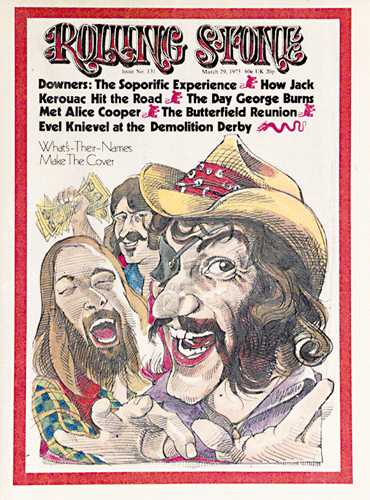
Last week, I picked up Rolling Stone: Cover to Cover, a set that includes a book on the history of the magazine and a digital archive that includes every issue from 1967-2007. When it arrived I installed the viewer on my computer and within a few minutes was knee deep in an issue from the 70’s.
I haven’t read Rolling Stone for many, many years now except for the random article or interview that I pick up online. It’s just a little too slick and polished now, at least in my perception. But looking back at these old issues brought back what I saw in the magazine as a young man. The issue I was viewing was from 1971 and has the frantic, ink splattered drawings of Ralph Steadman illustrating a serialization of Hunter S. Thompson’s Fear and Loathing in Las Vegas, a book that I used to read every year or so with great glee. If you’ve read the book, you know how perfectly the drawings mesh with the story.
Leafing through on the computer screen, I could almost feel the rough newsprint of the paper.
Inside, it came back immediately. The ads for Marantz tuners and Ovation guitars. The classifieds at the end of the magazine with multiple ads for rolling papers of all sorts. Ads hailing new albums from bands long gone and sometimes barely remembered. An ad offering any 2 Rolling Stone albums free with a subscription to the magazine. It was like dropping back into a time, as from a time machine of sorts.
Dr. Hook Finally on the Cover of the Rolling Stone
But the thing that struck me most was the amount of print on the pages. It was jammed with page after page of print. Oh, there were ads and pictures. But it was primarily the written word. I had forgotten how long their articles were then, how the interviews sometimes went on for 12 or more pages and were truly in depth. It was wonderful to see all those words and sentences and paragraphs.
It made me wish I still had an attention span.
Perhaps in the dead of this winter, when the snow is piled up and I feel like idling away a few hours, I will be able to muster up a remnant of my existing attention span and read more of those pages. But for now, I just jump in here and there when I have a minute and browse, taking in the artifacts of our culture and my youth.
And hum along to Dr. Hook’s refrain that’s playing in my head—-Gonna get my picture on the cover, gonna buy five copies for my mother…
 There’s a new documentary out (actually a re-edited version of a 2006 film) called Who Is Harry Nilsson? (And Why Is Everybody Talkin’ About Him) which concerns itself with the life, death and influence of the late American singer/songwriter. His career was both brilliant and tragic, qualities you can often see in many of his songs.


 Redtree Times