 As pointed out in recent posts, I’ve been working on a group of new work that I am calling Icons, images that put people that I have come to know through doing some genealogical work. They are not intended to be accurate depictions of these ancestors. In each case, I have just found something compelling that sticks with me. Such is the case with the painting above, a 10″ by 20″ canvas that I call Icon: William England.
I grew up knowing almost nothing about my ancestry. In fact, I thought that a generation or two back, somebody had inadvertently tipped over a big rock and we had spurted out before they could put the rock back in place. Not a lot of esteem at that point. So it was a thrill as each new layer of our family history was uncovered. I was pleased to see how many ancestors served in all of the wars of our country going back hundreds of years. Many had fought in the American Revolution.
It turns out, on both sides of the conflict.
I can’t remember the source but I read once that during the revolution the American public was divided pretty evenly into three parts: a third that desperately wanted our independence from Britain, a third that wanted to remain part of the British Empire and a third that really didn’t care either way so long as they could live their lives as they had up to that point. The first group, of course, were the Patriots that we have come to believe was everyone living in America at that point and the second were the Loyalists who identified themselves as British living in the America colony.
One of my ancestors was a man named William England who fell into the Loyalist group. Born in Staffordshire, England, he came to America as a teen and settled in the Saratoga Springs area of New York after serving in the British 60th Regiment during the French and Indian War. He purchased a farmstead in Kingsbury, NY and was settled in when the Revolution broke out.Faced with the choice of breaking from his homeland or remaining loyal, he chose to protect what he felt was his British homeland.
Serving as a Sargeant with McAlpin’s Rangers, he fought in a number of battles including Burgoyne’s defeat at Saratoga. British troops and families were driven north into Canada, settling in the Three-Rivers area of Quebec. It was there that he, along with many other Loyalists, settled and raised his family in the years after the war, most of his children integrating through marriage into the early families of French Canada.
Many worked their way back into America in the late 1800’s, including his grand-daughter Mary England who died in St. Regis Falls, NY in 1896. She was my 3rd great grandmother who was married to Jean-Baptiste Therrien. Many of their children’s names were anglicized from Therrien to Farmer when they moved into NY. I came across a photo of her when she was quite old and you can see the hardness of rural Canadian life written in her face.
This painting shows the conflict ( or at least the conflict I perceive) that took place in William England when the war broke out. He had to make a hard decision, one that cost him his farm and all of his possessions, in order to stay loyal to his homeland. He had to break the bond ( shown here in the form of the broken tree limb) with the America that emerged and face a new life in a territory he did not know.
We all have interesting twists in our family trees, some that take us in directions we would never imagine. While I am proud of my ancestors who fought for the American cause, I am equally pleased with the loyalty and devotion shown by William England.

 This is the next step in the Icon series of paintings that I talked about a few days ago. It’s an 18″ by 18″ canvas that I call Gilbert, going with the French pronunciation– more jill-bear than gill-bert. There’s a reason for that.
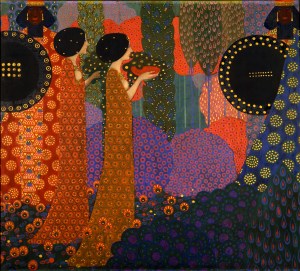 Looking for more info I found that background info on Zecchin was sketchy. He was raised on Murano, one of the famed islands of Venice known for its glass-making. His father was a glass-maker and Zecchin grew up immersed in color and form. He studied art but, feeling his voice would not be heard in the somewhat conservative artistic atmosphere of Venice at the time, put it aside in his early 20’s to pursue a job as civil servant. However, he came back to painting around the age of 30, spurred on by a new movement in Venice of artists inspired by Klimt and other artists.
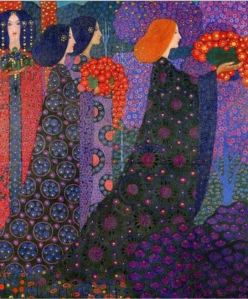 All of this pieces shown here are from his grandest work, a mural completed in 1914 for the Hotel Terminus that consisted of 11 or 12 panels ( I have found conflicting reports) that measure around 300 feet in total length. Called Les Milles et Une Nuit ( A Thousand and One Nights), it depicts the entourage of kings, queens, princesses and princes as they bear gifts to encourage the Sultan to give his daughter’s hand to Aladdin. You can see the influence of Klimt but more importantly you can see the influence of the glass and color of Venice. Unfortunately, the panels are no longer together, having been dispersed throughout the art world over the years.
 It’s the New Year and I am finally back at work. I’ve started working on some pieces that have been brewing in my mind for a while, some that are out of my comfort zone. I don’t know how they will turn out and there’s a good chance that most of this work will never see the light of day. I have found that quite often work that is too idea based or thought out never gets into any kind of natural flow or rhythm, at least for me. I have plenty of examples from over the years that I won’t show here.





 In this part of the country, childhood memories from this time of the year usually include the cold and snow in some form. Frozen ponds with skaters on them. New sleds at Christmas going down white covered hills. Bundling up in heavy clothes and hats and boots.
 Chaim Soutine was yet another brilliant but tragically short lived painter, dying at the age of 50 in 1943. He was a Russian Jew who studied art as a youth in his native Belarus then emigrated to Paris in 1913. There, among the many diverse artistic influences, his distinct expressionistic style found its voice and over the next two decades he produced a powerful body of work. However, he wasn’t hailed as the great painter he truly was until the days just before the start of World War II.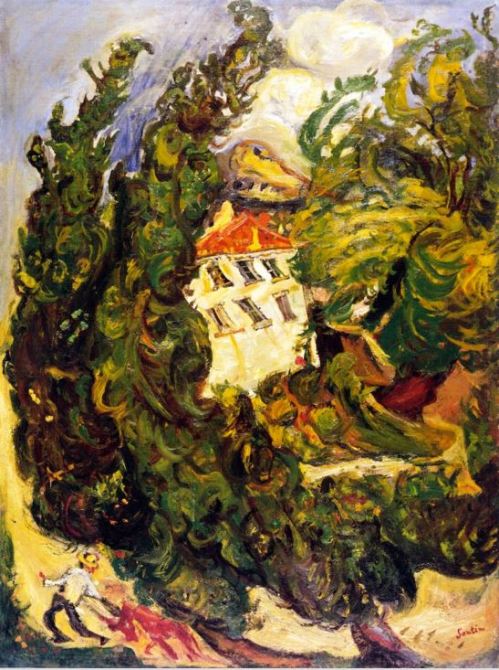


 I’ve been a fan of the work of Chuck Close for some time, admiring the grand scale that much of his work assumes as well as his evolution as an artist, especially given his challenges after a spinal artery collapse left him paralyzed from the neck down in 1988. He regained slight use of his arms and continued to paint, creating work through this time that rates among his best. He also suffers from prosopagnosia which is face blindness, meaning that he cannot recognize faces. He has stated that this is perhaps the main reason he has continued his explorations in portraiture for his entire career. The piece shown here is a portrait of composer Phillip Glass that was made using only Close’s fingerprints, a technique which presaged his incorporation of his own unique form of pixelation into his painting process.
 Redtree Times