Feeds:
Posts
Comments

Archive for the ‘Influences’ Category

No Rules

I do what I can to convey what I experience before nature and most often, in order to succeed in conveying what I feel, I totally forget the most elementary rules of painting, if they exist that is.  In short, I allow faults to appear, the better to fix my sensations.

–Claude Monet, 1912

**********************************

I have had this little sign hanging in my studio for the last 16 years or so, a rough reminder to myself when I begin to feel like my work is bending to the rules and judgments of others.  It reminds me that I am working in my own realm, my world.  I control the parameters of what is possible, of what defines reality in my work.  The rules of others mean nothing in my little painted world.

Over the years  I have glimpsed this small sign at times when I have been feeling that my work is stagnating or beginning to adhere to  accepted conventions  and have been spurred to push my work in some  new direction.  Heightening the intensity of color or introducing new hues that seems incompatible with nature, for example.  It’s as though these two words are prods that constantly  tell me that nobody can control me when I am here in my created world.  There’s a great liberation in this realization and I find myself trusting my own judgment of my work more and more.  Because I have created  my own criteria for its reality, criticism from others means little now.

I think that’s what I am trying to get at here, that an artist must fully believe that they are the sole voice of authority in their work, that they, not others, determine its validity. Maybe that’s why I am so drawn to  Outsider artists, those untrained artists who maintain this firm belief in their personal vision and create a personal inner world of art  in which it can live and prosper.  Rules mean nothing to them- only the expression of their inner self matters .

Read Full Post »

When I was speaking last week with the docents at the Fenimore Art Museum, I was confronted with a question that asked about the repetition of forms and themes of my paintings, particularly my use of the Red Tree.  I think I answered the question satisfactorily, stating that I tried to paint as far as possible from the conscious part of my mind . I pointed out that painting in series of repeated forms allowed me to put aside thoughts of composition and focus on the color and texture that carry the emotional weight of the painting.  The theme and focus of the painting was really just an invitation to the viewer to enter the picture and experience the underlying emotional content.  And that was where I hoped the viewer ultimately arrived .

But driving home, I thought about a  blogpost from a few years back that addressed the same question and my own concern early in my career with allowing myself to simply paint whatever came out of me.  I hope that  posting this piece from October of 2009 helps better answer that question from the Fenimore docents:

There was an episode of Mystery! on PBS starring Kenneth Branagh as Swedish detective Wallander. It was okay, nice production but nothing remarkable in the story but there was a part at the end that struck home with me and related very much to my life as a painter. Wallander’s father, played by the great character actor David Warner, was, like me, a landscape painter. Now aged and in the beginning stages of Alzheimer’s, his son comes to him and intimates that he can’t go on as a detective, that he can’t take the stress. The painter then recalls how when Wallander was a boy he would ask his father about his painting, asking, “Why are they always the same, Dad? Why don’t you do something different” 

He said he could never explain. Each morning when he began to paint, he would tell himself that maybe today he would do a seascape or a still life or maybe an abstract, just splash on the paint and see where it takes him. But then he would start and each day he would paint the same thing- a landscape. Whatever he did, that was what came out. He then said to his son, ” What you have is your painting- I may not like it, you may not like it but it’s yours.” 

That may not translate as well on paper without the atmospheric camera shots and the underscored music but for me it said a lot in how I think about my body of work. Like the father, I used to worry that I would have to do other things- still lifes, portraits, etc.- to prove my worth as a painter but at the end of each day I found myself looking at a landscape, most often with a red tree. As time has passed, I have shed away those worries. I don’t paint portraits. Don’t paint still life. I paint what comes out and most often it is the landscape. And that red tree that I once damned when I first realized it had became a part of who I am. 

I realized you have to stop damning who you are…

Read Full Post »

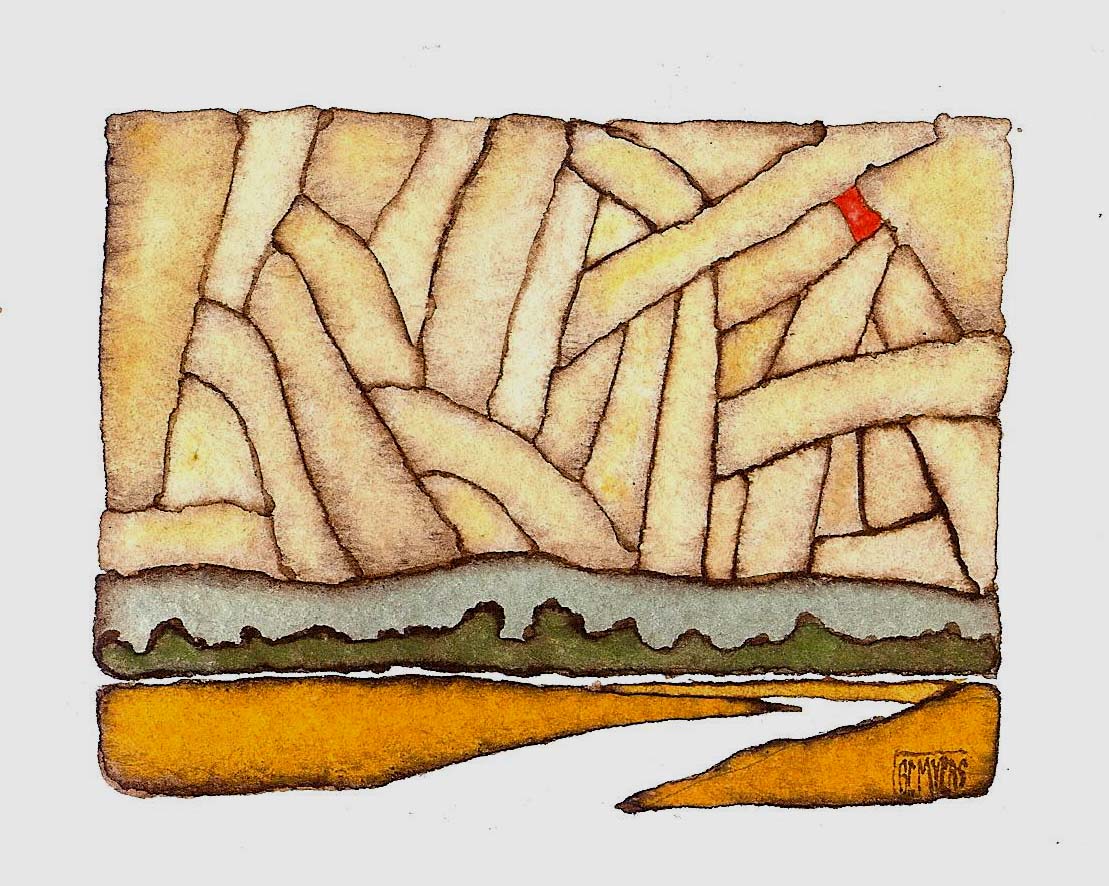
I wrote last week about a   painting, Babette’s Feast,  that was part of a small group of my early formative work on display at the Fenimore Art Museum.  Each of these pieces marked a new step forward in the development of my work that became more and more obvious as the years went by.  The painting shown here, Redstar, is another of this group.

It’s a tiny little piece, only around 2″ tall by 3″ wide but it spoke loudly to me.  It was painted in the format that characterized my early pre-Red Tree work, a larger block of color over a contrasting smaller block of color separated by a white line.  This line was actually just the paper showing through, not a painted line at all.  The distinction of this painting is in the larger block of color that made up the sky.

It was a random pattern of smaller blocks of color that gave the piece a different rhythm and feel that my earlier pieces in this format.  These curved lines that crisscrossed the sky gave it a  texture  that was distinctly different from the smooth, textureless  work I had been producing until this point.  This sparked something in my mind and set me on a path where I sought more and more ways to create texture within the picture.  I saw this texture as an enhancement to the colors of the work, something that gave the color the  added dimensions of depth and complexity-  perhaps the most important elements to the color in my work.

So, while it may be an easy piece to overlook due to it’s diminutive size , it appears  very large  for me.

Read Full Post »

There is a  group of four small paintings that are part of my current exhibition at the Fenimore Art Museum.  They represent the very earliest pieces that showed the way for all of the work that followed, establishing a format and look that I had been seeking in vain up until the time that these pieces arrived.  This little painting is titled Babette’s Feast and is the first indicator of the Red Roof paintings that were to come in later years as well as one of the first pieces that featured a path that leads into the picture plane, a feature of many of my recent paintings.  It is also one of my wife’s treasured pieces.

The title, which was given to this painting by my wife after the title of  one of her favorite movies, a 1987 Danish film and Academy Award winner for best Foreign Film that is based on a story from Danish writer, Isak Dinesen,  best known for her autobiographical tale Out of Africa.  It is a wonderful tale set in a 19th century village in Denmark and, without getting into all of the details of the film, has great humor, beauty and humanity.    You can read a pretty good synopsis of the film on Wikipedia.

One of the docents at the museum asked me about the title and, knowing the film,  commented that it fit the piece perfectly.  That was a gratifying comment for me even though the painting was not done with any thought of the movie.  And even though I see different significance in this little painting, especially as a precursor for what was to come, it  is a great compliment to have a piece bring to mind a favorable comparison with such an evocative and stirring film.

Read Full Post »

I recently came across this piece of writing from Eugene V. Debs that struck a chord with me, reminding me of this particular painting from a few years back, The Heart’s Standard Bearer.  I think it captures what I would like much of my work to represent– the flag of high hope and high resolve, as he puts it.  I know that in these politically divided times invoking the name of Debs is probably a risky proposition.

He was, after all, a prominent Socialist, a term which raises the hackles of many, most who have no true idea of what it truly means or has represented in the not-so-distant past.  Debs, who lived from 1855 until 1926, was absolutely committed to the fight for fairness and rights for the poor and the working class, spending several stints in prisons over the course of his life for the stands he took.  He ran for president from his cell in 1920, the last of the five campaigns he led for the high office as the candidate of the Socialist Party.  You may cringe at the current populist interpretation of socialism, but you should realize that we have all benefited from the efforts of Debs and others like him who fought for living wages and decent working conditions for all citizens and against exploitation of all sorts.

I am often asked why I use the color red in many of paintings.  Red trees.  Red chairs. Red roofs.  Red fields. I always struggle to describe what meaning it has for me.  But reading this made me feel that the red in many of my paintings might somehow be, as described in Debs’ words, the pure red that symbolizes the common blood of the human family, the equality of mankind, the brotherhood of the race.

Debs’ The Crimson Standard was published in 1905 in Appeal to Reason, a weekly progressive/socialist publication of the era that featured the writings of Upton Sinclair, Jack London and Helen Keller.  It was an extremely popular magazine, with the fourth highest circulation of any weekly at the time.  As I said, socialism was not the anathema then as now.

**************************

A vast amount of ignorant prejudice prevails against the red flag. It is easily accounted for. The ruling class the wide world over hates it, and its sycophants, therefore, must decry it.

Strange that the red flag should produce the same effect upon a tyrant that it does upon a bull.

The bull is enraged at the very sight of the red flag, his huge frame quivers, his eyes become balls of fire, and he paws the dirt and snorts with fury.

The reason for this peculiar effect of a bit of red coloring upon the bovine species we are not particularly interested in at this moment, but why does it happen to excite the same rage in the czar, the emperor and the king; the autocrat, the aristocrat and the plutocrat?

Ah, that is simple enough.

The red flag, since time immemorial, has symbolized the discontent of the downtrodden, the revolt of the rabble.

That is its sinister significance to the tyrant and the reason of his mingled fear and frenzy when the “red rag,” as he characterizes it, insults his vision.

It is not that he is opposed to red as a color, or even as an emblem, for he has it in his own flags and banners, and it never inflames his passion when it is blended with other colors; but red alone, unmixed and unadulterated, the pure red that symbolizes the common blood of the human family, the equality of mankind, the brotherhood of the race, is repulsive and abhorrent to him because it is at once an impeachment of his title, a denial of his superiority and a menace to his power.

Precisely for the reason that the plutocrat raves at the red flag the proletaire should revere it.

To the plutocrat it is a peril; to the proletariat a promise.

The red flag is an omen of ill, a sign of terror to every tyrant, every robber and every vampire that sucks the life of labor and mocks at its misery.

It is an emblem of hope, a bow of promise to all the oppressed and downtrodden of the earth.

The red flag is the only race flag; it is the flag of revolt against robbery; the flag of the working class, the flag of hope and high resolve – the flag of Universal Freedom.

Read Full Post »

“When I am in my painting, I’m not aware of what I’m doing. It is only after a sort of “get acquainted” period that I see what I have been about. I have no fears about making changes, destroying the image, etc., because the painting has a life of its own. I try to let it come through. It is only when I lose contact with the painting that the result is a mess. Otherwise there is pure harmony, an easy give and take, and the painting comes out well.”

–Jackson Pollock

*************************************

Well put words from Pollock, words that very much fit with how I feel about my own work and process, even though our works seem to have little in common in appearance.  I think it’s the harmony that he speaks of that is our common ground.  At least, I hope.

Note:  The show, Internal Landscapes: The Paintings of GC Myers, has opened two days early at the Fenimore Art Museum in Cooperstown.

Read Full Post »

Well, the exhibition of my paintings, Internal Landscapes: The Paintings of GC Myers, has been delivered and is being installed at the Fenimore Art Museum in Cooperstown for its opening on Saturday, August 18.   I’m experiencing levels of excitement and satisfaction, along with my normal anxiety, at the prospect of this show.  Who wouldn’t be excited at the prospect of showing their work in a beautiful world-class facility where your work will hang in close proximity to the great artists of the past?  It’s the goal of most artists to be allowed to show their work in such a setting, to feel the validation and atmosphere that the institution  offers.

I am no different.

It is also a marked point on the timeline of any artist, where they can pause for a moment from the constant creative push forward to reflect on the years leading up to it,  to once again examine all the steps (and missteps) that brought them to this point.

To look back on  the many  thousands of hours spent alone in the studio and feel as though they were well spent.

To think again about all the kind words of encouragement over the years from those who found something for themselves in the work, words that have served as creative nourishment.

To again see all the moments of serendipity that have occurred on the road to this point in time,  all the opportunities that  came unexpectedly, often at times when they were most needed.

To reflect on the many times that self-doubt threatened the personal voice that was forming and now shows in the work.  And how this doubt was overcome through a firm belief that the vision being followed was as real and as valid as any other artist’s.

I could go on but I won’t.  It is obviously a retrospective moment.  I can only hope that those who see the show will get a true sense of my work.  That will make this a successful show.  We shall see.

The show opens August 18 and hangs until December 31.  I will be giving a talk at the museum on November 7, from 12:30- 2:30  as part of their Food For Thought lecture series.

Read Full Post »

I have completed my show, In Rhythm, for the West End Gallery and will deliver it today in advance of the opening next Friday.  While it’s a big relief to finish a show and have it in the gallery, there is always a pang of loss in seeing works that mean a lot to me personally move out into the wider world.  Some are paintings that resonated with me immediately, almost from the first lick of paint hit the surface.  Those are the instinctual, native pieces that just emerge without a struggle and seem to have their own perfectly natural rhythm.

Others are paintings that show their meaning long after they are completed  Such is this painting shown here, Ribbon and Memory, a 12″ by 16″ piece on paper.  When I was done with this and was searching for a title I wondered what it might mean.  It still seemed to be a mystery even though I liked it very much without knowing its meaning.

I knew that the Red Chair often represents memory for me so I felt that the title would have something to do with memory.  And the path that runs through the foreground seemed more like a ribbon than an actual road so I immediately tied the two words together for the title.  Done. Enough said.

But early this morning I looked again at this piece and I more fully saw a meaning in it for myself, one still rooted in the title words but with more depth.  I have a friend whose wife has early-onset Alzheimer’s and it has turned their lives upside down as they try to cope with the changes and stresses that it brings.  Their struggles are in my thoughts quite often.  So when I saw this painting this morning it suddenly seemed plainly obvious to me that this could represent their situation.  The Red Chair is the wife, the Red Tree is the husband and the Red Roofed House is early memory of home and family.  The path, the ribbon, is that remaining memory that still tenuously connects her with this past that has began to recede into the distance.

The Red Tree, the husband shown here in a heroic stance, is apart from her and everything else, alone in his struggle to stay connected with that ribbon and to oversee her welfare.  The Red Chair, the wife, is also alone, facing  a solo journey forward with little connection to her past, separated here by the water.

I have to reiterate that this is my personal meaning that I see in this piece.  You may see it in a completely different way with your own personal meaning.  As it should be.  But for me, seeing this painting this morning with this new perspective made it seem  deeper and more precious than just a day earlier.  One that gives that pang of loss that I spoke of above.

Read Full Post »

I have painted several pieces over the past few years based on the mythic tale of Baucis and Philemon, taken from the Metamorphoses from the Roman poet Ovid.  I have described the story here several times of the visit  to a village by Zeus and Mercury, disguised as beggars.  They are roughly tuned away from every door in the village until they come to the home of the poor elderly couple, Baucis and Philemon, where they are welcomed with warmth and gracious hospitality despite the  poverty of their household.  Sparing the couple as he destroys the village in his wrath, Zeus then grants them any wish they might desire.

They choose to be allowed to stay together for eternity.  When they pass away simultaneously years later, they are resurrected as two separate trees that grow from the same trunk, united forever.  It’s a lovely fable and one of my favorites.  I have always chose to depict this story simply, with two trees, one red and one green, intertwined together.

I call  this painted version The Gift of Zeus.  It is a n 18″ by 18″ canvas that is headed to the West End Gallery for my annual solo show there which opens next Friday, July 20.  There’s a crispness in this piece that I find very appealing as well as interesting contrasts and subtleties in the sky, which may not show up well in the photo here, that give this piece a dramatic edge that catches my eye each time I pass by it in the studio.

Read Full Post »

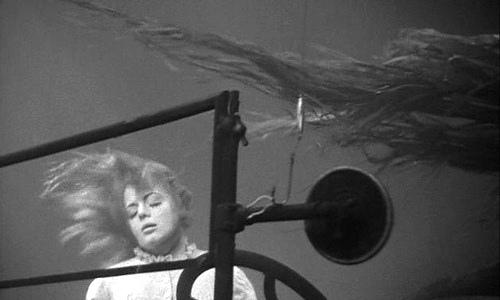
One of my favorite actors is the late Charles Laughton, the portly Englishman who is perhaps most famous for his portrayal of Captain Bligh in Mutiny on the Bounty from 1935.  His looks were not like those of a typical leading man but he was able to overcome this with his sheer acting abilities and a screen presence that enhanced everything in which he was cast.  He could pay both despicable villain or the comic hero with ease.  But one of his most amazing performances for me was that of  the director of the movie The Night of the Hunter from 1955.

His first attempt at directing for the big screen, the film  was a flop at the box office and was panned by critics causing Laughton to forever give up directing.  But over the years the film has grown in stature and Laughton’s beautiful treatment of the creepy tale has garnered accolades, making me wonder what other great films he might have made if he has found greater initial success with The Night of the Hunter.

I am really drawn to his use of stark black and white imagery, using the contrasts to really accentuate the struggle within the tale between good and evil.  Robert Mitchum’s evil preacher, Harry Powell, with tattoos reading LOVE and HATE on his knuckles is contrasted with the delicate strength of Lillian Gish’s character.  It seems as though every scene is composed like a beautiful black and white painting. with imagery that reinforces the tension of the tale.    Just a wonderful film to look at.

TCM is showing The Night of the Hunter on July 5 at 10 PM.

Here’s a great scene with Mitchum and Gish.

Read Full Post »

« Newer Posts - Older Posts »