Feeds:
Posts
Comments

Archive for the ‘Influences’ Category

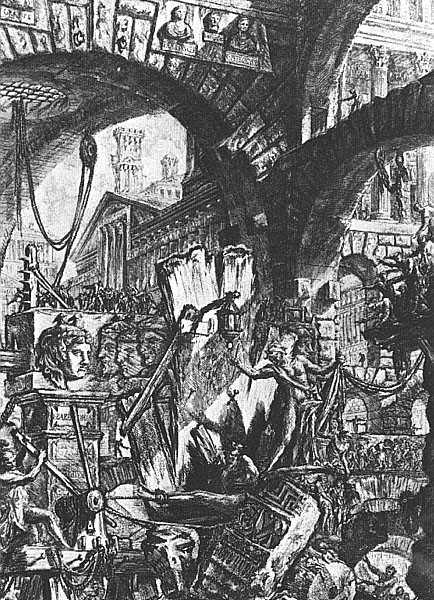
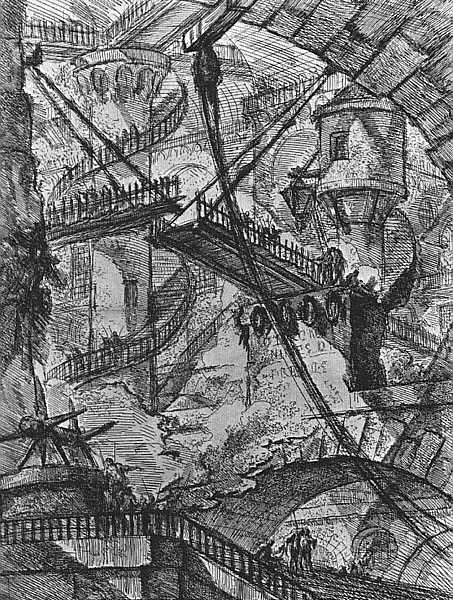
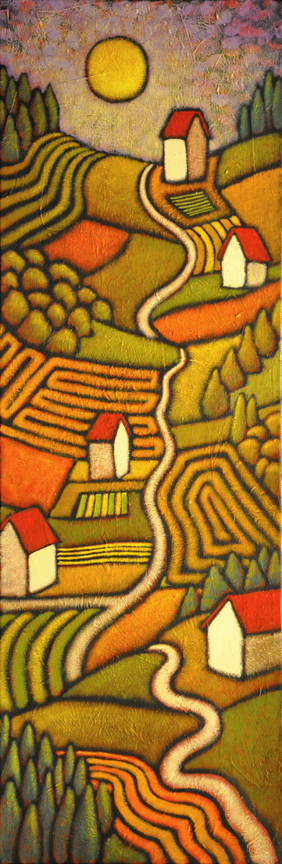
I consider my landscapes to be internal, which is to say imaginary. Places that represent a place where I wish to be or at least have the feeling of it in my real world.  Places that act as refuge from the sometime harshness of the real world.  Giovanni Bauttista Piranesi had a much different sort of internal world.  Piranesi (1720-1778) was an Italian artist who gained fame for his engravings of the views and architecture of Ancient Rome.  He meticulously measured the ruins of Rome and would recreate them as they had once stood.  Beautiful work.

But he is also well known for a series of engravings issued  in 1745 and reworked and reissued in 1761.  These were his Carceri  d’invenzione, or Imaginary Prisons.  They were dark and foreboding visions of cavernous subterranean prisons with twisted , strange stairways that foretell the work of the M.C. Escher and ominous machines of torture.  Over the centuries they were cited as being very influential on the writers and artists of the Romantic and Surrealist movements. 

They’re very intriguing and they are filled with layers of detail, the result of his time spent among the architectural wonders and ruins of Rome.  There is a site, CGFA, which has the entire series of prints online.  Below is a wonderful video created by Gregoire Dupond that takes you on an animated  journey though the details of these internal  prisons. It’s really interesting and worth a look.  It’s in high-definition so you can put it up full screen to capture all the details.  

Piranesi Carceri d’Invenzione from Grégoire Dupond on Vimeo.

Read Full Post »

 With the recent release of The Lorax, an animated film based on the environmentally centered Dr. Seuss book and the continued popularity of his books (I think there are 6 in the top 100 of the NY Times bestsellers list), I thought I would reblog this post from back in August of 2010. 

Yesterday’s post about the 50th anniversary of Green Eggs and Ham by Dr. Seuss made me think about a piece that I’ve had hanging around my studio for the past decade. It’s a painting that I did in 2001 that I call Red, Hot and Blue. It’s an oil on panel piece that is pretty big, almost 5 1/2′ tall in its frame. It could be a small door. It showed in a few galleries after it was first painted and never found a home so it retired to my studio, to keep me company.

I mention it because it was been called the “Dr. Seuss painting” by several people who saw it when it was hanging in the galleries. They saw something in the way the trees were shaped and colored that gave them the appearance of a Seuss character. I had no thought of Seuss when I painted the piece but when I heard these comments I began to see it.

The expressive sway of the trees as though they were dancing. The bright primary colors- the red of the foliage and the bright blue of the trunk. Even the two trees in the background added to the Seuss-y feel.

The foliage actually looked like the endangered Truffala trees from Seuss’ cautionary fable about the environment, The Lorax.

It was not intended but it made sense. Seuss’ books were about communicating by giving strange creatures and things we often see as objects, such as trees and flowers, human qualities. His characters moved with a rhythm that made them feel alive. Just what I was trying to do with my painting. I’ve often felt that we best see and better understand things that possess human qualitities. I remember being taught that the Native American tribes in the area where I grew up gave names to local hills based on the human qualities they had. It made an impression and started me looking for the human form in all things.

The curve of a tree trunk. The roll of the land. The fingers of clouds in the sky.

To communicate.

So, while it was never intentional, this painting was very much a product of the influence of Dr. Seuss and others. When I look at it today, I don’t see the name I gave it. I see it as that “Dr. Seuss painting”.

Read Full Post »

There’s an exhibition currently hanging at  one of my favorite museums, the  extremely comfortable Phillips Collection in Washington, DC, called Snapshot: Painters and Photography, Bonnard to Vuillard.  It bascially shows how the advent of personal photography in the late 1800’s, with the invention of the Kodak handheld camera, changed how many artists worked.  The camera allowed artists to capture moments without their easel as well as permitted them to ponder an image long after the moment had passed.  This exhibit focuses mainly on the effect fo the camera on the Post-Impressionists, such as George Hendrik Breitner, whose photo of a girl in a kimono and the resulting painting is shown here.

I have seldom used photos as a pure reference source but, as this blog will attest, have been influenced by many of the photographed images I have come across through the years.  I think this exhibit would be a wonderful insight into how the photographed image is used to translate the artistic vision.   It runs at the Phillips until May 6 of this year

Read Full Post »

Not too long ago, I displayed a Chuck Close quote where he said that work is inspiration in itself, that by simply steadfastly doing  what you do will open up creative avenues to follow.  I frimly believe that and have experienced it on many occasions including just this past week. 

 As I have been documenting, I am working on a large canvas, which is nearing completion, by the way.  I showed, in a post last week, how I would cut the image into sections to weigh the strength of each area of the canvas to make sure that it had its own visual power to contribute to the painting as a whole.  I showed the two section from each edge of the canvas and concluded that both pieces stood up well as strong parts of the overall painting as well as compositions in their own rights. 

 In fact, the section from the far right kept me coming back to it.  I really liked the way it flowed upward with each piece interacting with those around it, creating a lovely harmony that really worked well, for my personal taste, at least.  It gave me a great sense of peace looking at it and I soon began exploring ways to make it work in a separate piece.

I felt a real sense of immediacy in creating something based on this and, searching the studio, realized I didn’t have any prepared surfaces ready in any dimension close to what I was seeing in my head.  There was a painting that was in a later state of completion, one that I had mentioned here recently.  It never really sang for me and had sat in a corner of the studio for quite  a long time, just waiting for me to give it the needed attention.  But every time I looked at it, I was less than inspired.  It just wasn’t working. 

 So, looking at it as a possible new surface to paint, it wasn’t a difficult decision to paint over  the image that had never really taken off for me.  It wasn’t a perfect choice, a bit smaller and narrower than the inspiring image, shown here to the left.  The original is somewhere in the 24″ wide by 54″ range whereas this piece is only 10″ wide by 30″ high, making it a much more condensed space in which to work.

  The resulting image is therefore different, which is as it should be.  It is inspired by, not a copy of, the original image.  For me, it flows in much the same manner and has the same sort of feel and harmony.  It works for me and having said that creates its own new sense of inspiration for other work to come.  Just like Chuck Close said– one thing leads to another.


Read Full Post »

This is a small piece that I used here last year in a blogpost featuring Richard Thompson’s song Shoot Out the Lights.  I showed this piece but didn’t say anything about it which I think was an oversight because it is one of my personal favorites from this particular series.  It’s called Two Sides and is part of my Outlaws series from several years back, a group that was influenced by some small Goya works done in carbon on ivory as well as by powerful imagery from some later films of the silent era.  Many of the pieces featured a single figure, often holding a handgun, usually in a monchromatic sepiatone.  A few, such as this piece, incorporated more color as well as a copper foil border.

Some folks saw these pieces as being a bit scary, with the handgun imagery and the figures often seeming to be peering out (or in, as some saw it) a window.  I understood the scary part but not for the same reason as those who saw it this way.  They saw the figures as menacing while I saw them as being frozen with their own fears.  These figures were the scared ones.

The title of this piece, Two Sides, is a reference to the polar opposites that make up a yin-yang symbol.  In fact, it’s composed like a yin-yang symbol. with the light of the hand and gun appearing in the dark shadow in which he stands and the darkness of his face appearing in the incoming light.  I see this as representing the light and dark,  the good and evil, that resides in everyone.  At any one time, we may appear to be more to one side  or the other but we normally, and hopefully,  exist between these opposing forces.  This piece reminds me to temper my darker side when it wants to push outward, to maintain this equilibrium.  It makes this a special piece for myself.


Read Full Post »

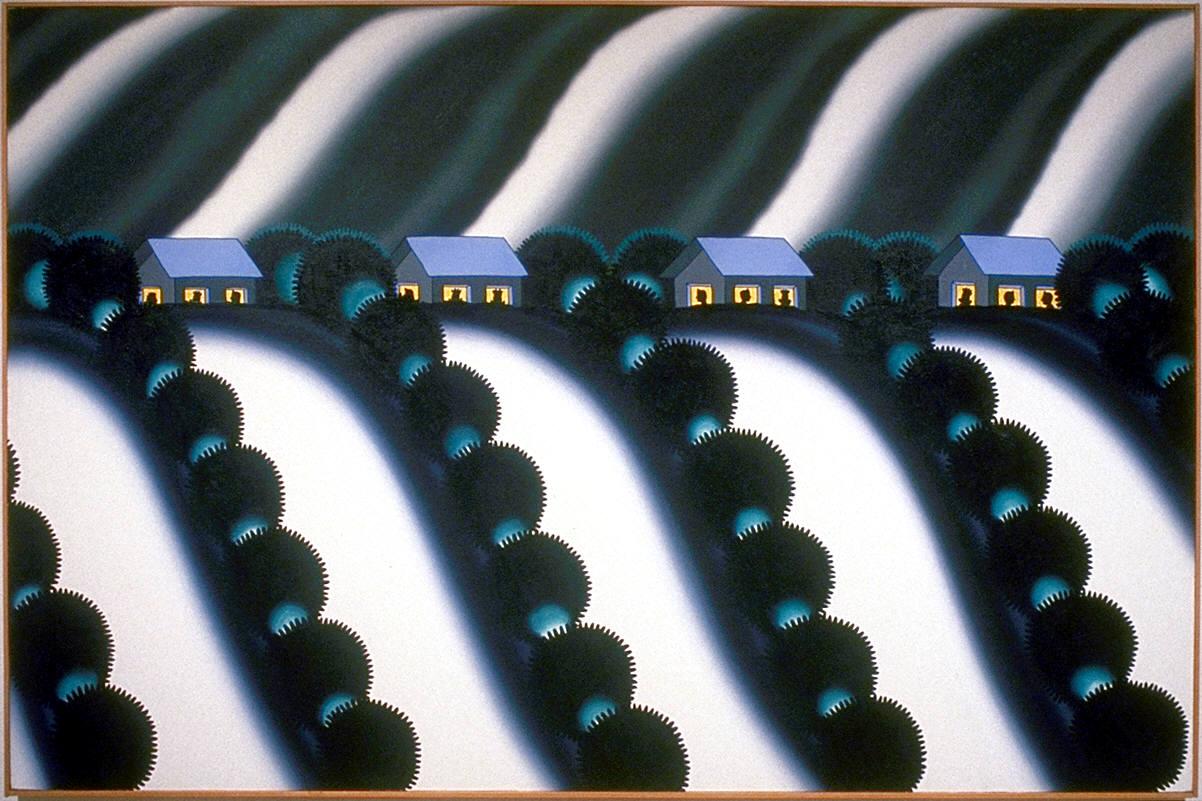
I was looking up something totally unrelated to his work when I stumbled across the paintings of Roger Brown, a painter who was one of the group of Chicago Imagists, an informal school of art in the late 1960’s that had it roots in comic book art, Surrealism and  Primitivism.  The work was highly individual and always bold in style and statement.  When I saw Brown’s images, I wondered how I had missed him before.  Strong work with big rhythmic patterns.  Just plain good stuff that turns my wheels.

Brown was born in Alabama in 1941 and came to Chicago in 1962 to study at the Art Institute of Chicago and remained a resident of the Windy City until his death in 1997 from liver disease at the age of 55.  I can’t give a lot of info here about his biography as I am still learning about his life and work myself.  I will let his images tell the story here .

Read Full Post »

I’ve been a fan of the work of Chuck Close for some time, admiring the grand scale that much of his work assumes as well as his evolution as an artist, especially given his challenges after a spinal artery collapse left him paralyzed from the neck down in 1988.  He regained slight use of his arms and continued to paint, creating work through this time that rates among his best.  He also suffers from prosopagnosia which is face blindness, meaning that he cannot recognize faces.  He has stated that this is perhaps the main  reason he has continued his explorations in portraiture for his entire career.  The piece shown here is a portrait of composer Phillip Glass that was made using only Close’s fingerprints,  a technique which presaged his incorporation of his own unique form of pixelation into his painting process.

His determination to overcome, to keep at it, is a big attraction for me and should be an object lesson for most young artists (and non-artists, also) who keep putting off projects until all the conditions are perfect and all the stars align.  Waiting for the muse of inspiration to take them by the hand and lead them forward.  Sometimes you have to meet the muse halfway and Close has this advice for those who hesitate:

The advice I like to give young artists, or really anybody who’ll listen to me, is not to wait around for inspiration. Inspiration is for amateurs; the rest of us just show up and get to work. If you wait around for the clouds to part and a bolt of lightning to strike you in the brain, you are not going to make an awful lot of work. All the best ideas come out of the process; they come out of the… work itself. Things occur to you. If you’re sitting around trying to dream up a great art idea, you can sit there a long time before anything happens. But if you just get to work, something will occur to you and something else will occur to you and something else that you reject will push you in another direction. Inspiration is absolutely unnecessary and somehow deceptive. You feel like you need this great idea before you can get down to work, and I find that’s almost never the case.

Amen to thatThe process provides the inspiration.  I’ve stumbled around for some time trying to say this but never could say it as plainly and directly as Close has managed.  Thanks, Chuck.  I think I’ll take your advice and get to work.

Read Full Post »

Once again, I came across a painter from the past of which I knew absolutely nothing.  That is nothing new but when I first saw these paintings I was shocked he was unknown to not only me but to most other people as well.  Actually, his biography is pretty thin in content but the sheer power of his work makes up for it. 

 His name was Thomas Chambers and he was born in England in 1808, probably training there as a decorative painter for the theatres of London.  He popped up in the States, in New Orleans, in 1832, filing for American citizenship.  Over the next few decades he moved along the Atlantic Coast and New England working as a landscape and marine painter as well as a fancy painter, meaning that he also painted  objects such as mirrors and furniture in a decorative fashion.  After the death of his wife in 1866, he returned to England, where he died in 1869.  He never really prospered as an artist, just scraping by for most of his life.  He died in an English poorhouse.

All of that seemed impossible to believe when I first saw his work.  It was unlike anything I had seen from that era.  They felt like folk art but with a stylized sophistication that displayed a distinct and fresh voice.  They seemed so modern, feeling to me as though they were perhaps 75 years before their time.  The colors were powerful.  The forms were stylized and rhythmic, the skies often having wonderful whirls of clouds and light.  Looking at some of these landscapes, I could believe that they were influenced by some of my heroes such as Thomas Hart Benton and Grant Wood even though I know that this is impossible because of their age.  I wondered if some of the more modern painters had come across his work or if his work was merely a similar artistic evolution, just earlier, isolated in time.

It’s hard to believe that this work was practically unknown until around 1940 when a group of his paintings were found in upstate NY.  How something this dynamic and modern in feel could slide by unnoticed is a mystery.  The first major museum exhibit of Chambers’ paintings was only held in late 2009/early 2010 at the American Folk Art Museum in NYC. 

There’s a good article from the NY Times that offers a good overview of Chambers’ life as well as a review of this museum show that I found very interesting, particularly when the author, Roberta Smith, writes about the works included in this exhibition of other painters who were better known contemporaries of Chambers, such as Thomas Cole and William Matthew Prior.  She writes:  This exhibition includes landscapes by other artists, including Cole, Thomas Doughty and William Matthew Prior, but don’t be surprised if you pass them by. Chambers’s work may lack the historic pedigree and national symbolism, say, of Cole’s paintings, but on the wall, it’s no contest.

As I said, potent stuff.  I’m hoping to find out more about Chambers but for now I am basking in these rich images. 

Read Full Post »

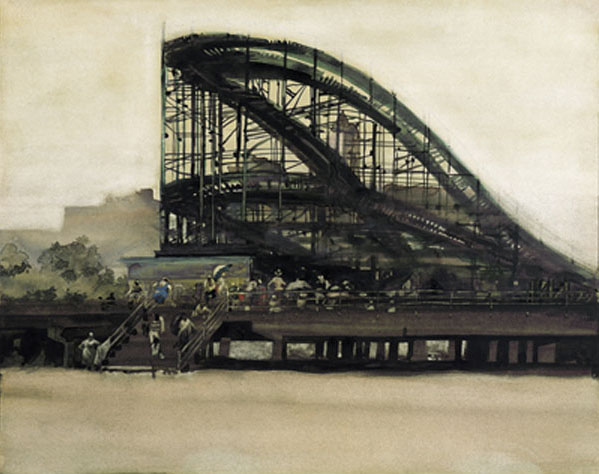
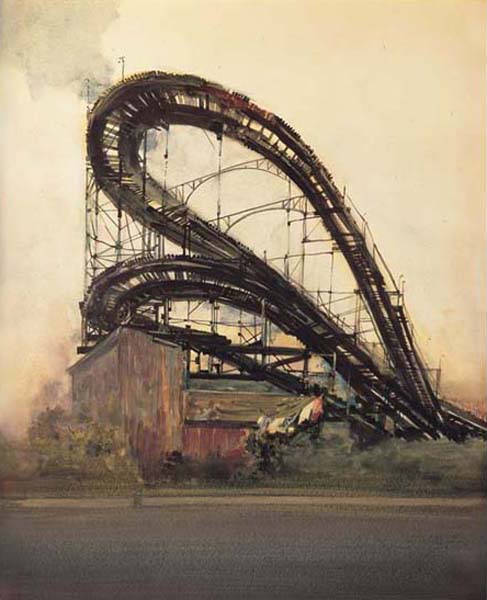
I’ve written here before about the work of David Levine, the late artist best known for his wonderful caricatures of public figures and politicos that graced many magazines for several decades, writing once about a caricature of composer Richard Wagner and another time about a painting of a pig’s head .   Despite his fame as a pen-and-ink caricaturist,  Levine was also a fabulous painter, executing  many works beautifully in oil and watercolor.  Though not as famous as his caricature work, his work is very seriously collected and respected.  A series of pieces he painted depicting the landscapes and people of Coney Island is among his best work and one of my favorites.

I particularly love his images of the Thunderbolt roller coaster of Coney Island.  There’s a monumental quality in the way Levine depicts the coaster, it’s skeletal framework towering above the boardwalk like the remnants of a long gone and enormous dinosaur.  In fact, he shows the coaster in varying states of decay before its demolition in 2000.  I still remember vividly riding the fabled Cyclone at Coney Island with my Dad and feeling that same sense of awe that I feel in these pieces.  I think that Levine understood that child’s sense of awe and I think that might be why he turned to Coney Island again and again as a subject.  There is a real sense of  affection in this work which I think enhances its power, inspiring the same in the viewer. 

You can see more of Levine’s  paintings, including the Coney Island series,  at a site that  represents his work, D. Levine Ink.  Though there only a small handful of his original paintings available on the market, they still make his work available through limited-edition prints.  Just plain good stuff.

Read Full Post »

« Newer Posts - Older Posts »