Feeds:
Posts
Comments

Archive for the ‘Influences’ Category

There are a couple of new paintings that have been added to the group of work I have hanging in my studio.  The two paintings could not be more different yet both have meaning and inspiration for me.  The first is the oil painting shown here, Pig’s Head from David Levine

The late Levine was the celebrated caricaturist whose work was a staple of  Esquire Magazine, the New York Review of Books and other publications over his illustrious career.  I wrote about him a few weeks back in a post about a caricature of Richard Wagner of his that also hangs in the studio.  He was also an easel painter and watercolorist of great renown, particularly his works depicting Coney Island and its people.  He was a really marvelous painter.  This piece was obtained from the estate of the late Thomas Buechner, who was a friend as well as a colleague of Levine, having painted with him and curated exhibitions of his work.

At first, I thought the piece was a bit macabre.  I mean,  it’s a pig’s head on butcher’s paper.   But the more I looked at this painting the more I came to see it in terms of color and form, taking in the light and shadows and the contrasts of color.  I see it as an expression of paint now and am constantly amazed by it when I turn to it from my painting table or desk.  It has real presence on the wall and is a beautiful piece of painting.  I am really proud to hang it with my work and find inspiration in it.

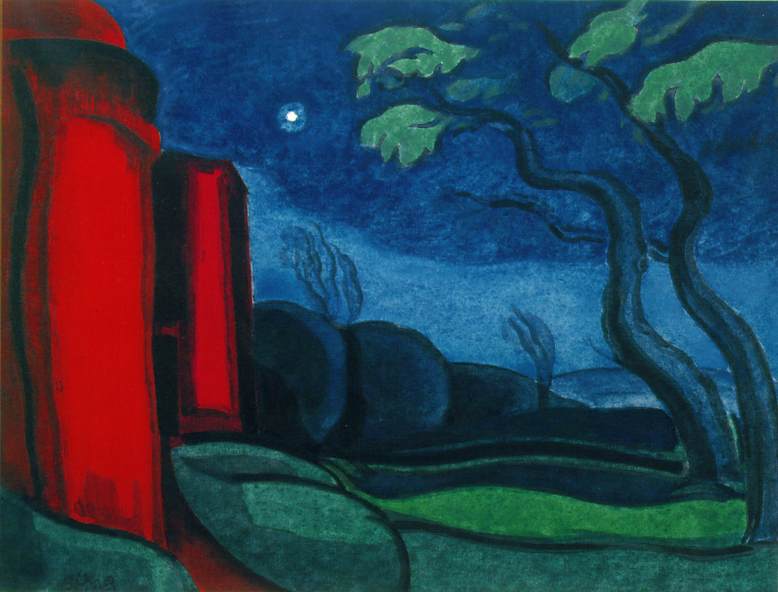
The other painting that graces my studio is from an artist much less accomplished at this point in her young life.  It is an interpretation of my Red Tree done by my friend Olivia from Illinois.  Olivia is a nine year old whose father recently contacted me, telling me how much he and his daughter enjoyed my work online.  I sent them a small print in appreciation and Olivia responded with the wonderful watercolor shown here.  She also sent a thank you that included a drawn self-portrait that I really like a lot.  Nice, strong lines.  Confident.  I can’t tell you how much this gesture from a young artist I may never meet means to me.  Just knowing that she has found something in my work in which she finds inspiration of some sort is gratifying enough for me.

So, there they are, two paintings done by two artists, one whose career is finished and another whose career, in whatever field she may someday choose, has yet to begin.  One is immensely accomplished whose work graces museums and great collections,  and the other just learning.  Yet both hang side-by-side,  both equally filling me with great inspiration and hope.  I can’t thank David Levine but I can send out my thanks and best wishes to my friend Olivia.

Thank you, Olivia, for your kind gift.  You made my day!  Keep up the good work…
Read Full Post »

I’d go out to my snowfield and dig out my jar of purple Jello and look at the white moon through it. I could feel the world rolling toward the moon.”

-Jack Kerouac, The Dharma Bums

******************************************

This line from the Jack Kerouac novel was sent to me yesterday by my friend Miescha who had thought of my paintings when she had come across it.  I really liked the association she found in those words and my work and especially the connection she found with it in Kerouac.  When I read the line I was immediately transported back in time to a trip I made with my brother when I was fourteen years old to the Adirondacks to hike around Mt. Marcy.  Kerouac’s On the Road was in my backpack.

It was in the midst of a very hot summer and we hitchhiked, first from the horse track in Canandaigua to Syracuse then from there up through the mountains.  It was a different time, obviously, to see a fourteen year old to be hitching with his older brother and not think it completely out of the ordinary. Probably not something many parents would even consider letting their kids today but for me it fostered a real sense of independence.

 I remember distinctly so much of that trip, especially the people who gave us rides.  The older guy who was commuting northward, drinking canned beer which he shared with my brother.  I politely turned him down when he offered me one.  Whenever we passed a female of any sort he would stick his arm out the window and pound the side of this car as he let out a wolf-like howl.  Then there were a couple of young gypsy housepainters from Lubbock, Texas who played an eight-track of the Doobie Brothers and offered us beer and pot, both of which I again declined.  After they let us out, my brother told me to take the beer and pot and simply hold it for him for later.

Then there was a couple of Italian tourists with their  son who was only a couple of years younger than me.  They didn’t offer any beer or drugs which was fine with me.  I remember the awe of the father as we climbed through a pass in the mountains where the highway had been carved through the stone, leaving shere walls of stone on either side of the wide road.  He spoke in Italian to his son as he pointed at the  stone in admiration.  I had the feeling he was some sort of engineer.

I also remember a long day coming out of the mountains and being at the Thruway entrance near Albany, trying to get a ride through to Syracuse on a Sunday evening, a tough get for a young man and a boy together.  We sat there for about six hours and I finally fell asleep in exhaustion, laying on the road shoulder against the guardrail until a kind soul gave us a ride all the way home, smoking pot with my brother as I slumbered in the back seat.  We walked the last few blocks in the early morning heat through  the streets and I remember a feeling of great contentedness.

The trip and the Kerouac novel’s depiction of the frantic pace of that early Beat generation made the idea of the open road seem irresistible in the mind of a young teenager, a feeling that haunted me for years until it finally faded into the past as my aspirations of being Dean Moriarty turned to the quieter. stabler reality of my current life.  I was never cut out to be that nomadic figure.  I know that now.  But the inspiration it provided those many years ago has remained with me and I still carry that memory of that feeling of being young and alive and on the road.

Funny how a few simple lines can bring back so much memory.  Thanks, Miescha.

Read Full Post »

Xavier Mellery

‘He who will manage to have us forget colour and form at the price of emotion will achieve the highest goal of all.’

—Xavier Mellery (1841-1925)

***************************

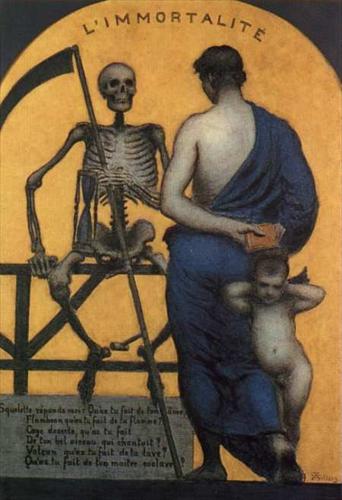
I’ve been spending the last several days putting a new roof on part of my home, so haven’t been as productive in the studio as I would like.  But I have been looking at imagery when I can, much of it some of the symbolist painters who have shown up here in the past few weeks.  One painter whose work always makes me stop and spend a few moments looking is the Belgian painter Xavier Mellery, another artist whose name is not well known to the general public.  In fact, there is not a lot of info to be found.

Mellery did some typical representative work in his career that was quite nice.  Some of his interior scenes are beautifully done and are very filled with a contemplative ponderance.  For instance, After Evening Prayers, shown below, has a wondrful sense of quiet atmosphere, most fitting for the subject.   But the work that really stands out for me are his allegories set against solid, often golden,  backgrounds.  Many incorporate text that speak to large concepts such as death and immortality, such as the piece shown here, Immortality.  They are beautiful in design and execution and, as I say, always stop me in my tracks as I thumb through the few books that contain their images.  I am glad to have come across them and feel inspirations in them that I hope wwill someday show through in my own work.


Read Full Post »

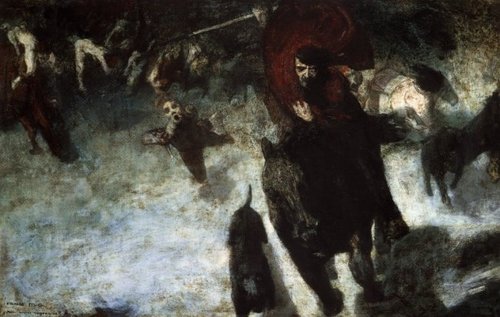
We all are influenced by the stimulus around us and art is a big part of that, from the music we hear to the visual imagery that we take in every day.   Most of us simply take it in and don’t process it directly to our behavior.  Well, maybe we do but not in ways that seem obvious to the outside world.  But Adolph Hitler did. 

Biographers state that he was very drawn as a very young man to the work of the German symbolist painter Franz von Stuck (1863-1928) whose paintings were dark in nature and filled with the symbology of Germanic myth.  In fact, the painting above, The Wild Chase, is referred to by many biographers as the main influence for Hitler’s signature moustache and forelock.  The central character in The Wild Chase depicts the Germanic god Wotan ( the equivalent of the Norse god Odin) as he sweeps across the sky in a thunderhead, accompanied by a pack of wolves.  He bears a creepily ominous resemblance to Hitler.  The painting was from 1899 when Hitler was  a mere 10 years old. 

It’s probably no coincidence that he chose this particular piece as he used a lot of Germanic mythology in his manipulation of the German population and the idea of a German god sweeping across Europe, terrorizing everyone in his path seems in line with how Hitler viewed his mission.

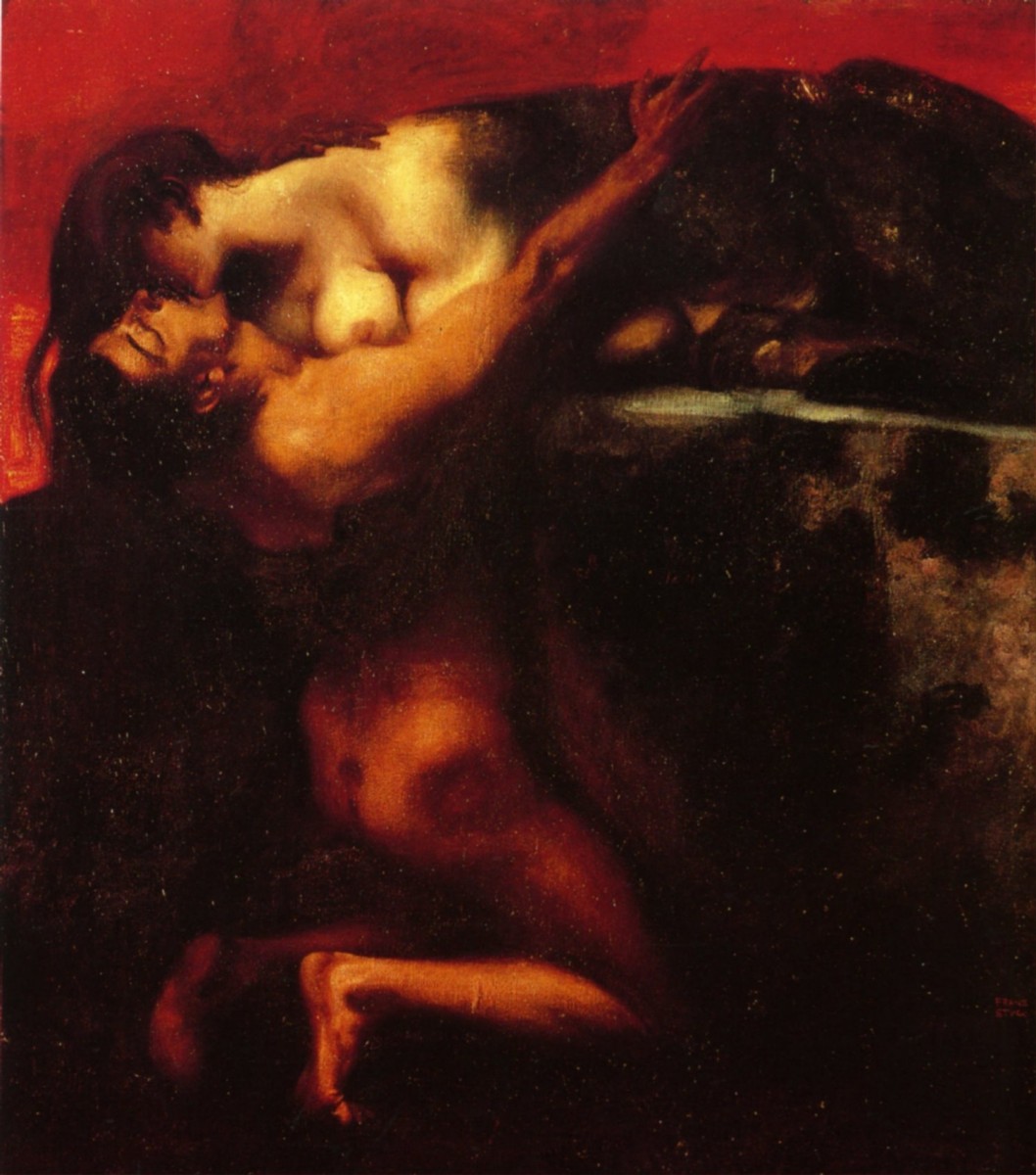
It’s a shame that von Stuck’s main claim to fame is probably this awful connection.  He was a well known teacher and some of his students are among the best known painters of the 20th century– Paul Klee, Kandinsky and Albers among them.  His  own work, which lost favor in the later part of his life,  is filled with deep, dark colors and extraordinary imagery that, while sometimes bordering on decadent or creepy, is beautifully striking and deserving of recognition. 


Read Full Post »

Frantisek Kupka was another one of those supremely talented painters from the late 19th/early 20th century who is little known outside the world of museums these days.  You probably won’t stumble across a Kupka calendar or mousepad.  But when I  see the scope and quality of his work I wonder why.  I know I hadn’t heard of him when I first came across his work in a book of Symbolist paintings.  I saw this image shown here, Resistance or The Dark Idol, and was immediately struck by the tension and drama in its mysterious setting.  I was surprised when I saw his other work that was beautifully colored and striking in other ways.

Kupka- The Yellow Scale (1907 Self Portrait)

Frantisek Kupka was a Czech painter who was born in 1871 and died in 1957 in France.  His career saw his work move from the early symbolic work to pure abstraction.  In fact, Kupka is considered one of the founding members of  the group, Abstraction-Creation, that set off the abstract movement.  While I found much of his abstract work beautiful, it was the early work that really pulled me in.  It was obvious that he could have worked extraordinarily well in any style he chose.  But his relative anonymity remains a mystery to me.  Perhaps he never had that one  iconic image or series that became associated with his name.  Monet’s water lillies.  Van Gogh’s starry night.  Gauguin’s Tahiti. Whistler’s mom.

I don’t know the whys behind this.  But his talent is no mystery at all.  It is evident in every piece I have come across. 

Read Full Post »

Rohrshach

I think this is the pelvis from an extraterrestrial being.  Or Wile E. Coyote with his back to a mirror.

My friend in Texas wrote the other day that looking at some of my paintings is a bit like taking a Rohrshach test.  I had never thought of it like that but we do indeed often examine the paintings I present here and try to interpret them in ways that go beyond what they actually appear to be.  A tree becomes more than a tree and the landscape is often expressive of more than a result of geology.  We are filling our interpretations with the same psychological content that one of Rohrshach’s patients might have when he first started using the inkblots as way of diagnosing patients around 1920.

Hermann Rohrshach based his tests on a popular19th century parlor game called Blotto ( or Klecksographie for you German speakers out there.)  There were decks of different cards cards available and a sort of charades-like game was played where you would try to get the other players to see what you saw in the inkblot.  Rohrshach was studying schizophrenic patients and made the inadvertent discovery that they responded quite differently to the game than most other people.  This led him to a systematic examination of their responses which led to the Rohrshach test as we know it.  It was used quite extensively in psychiatric examinations for a number of decades until it began to fall out of favor in the 1960’s.

We used to have some sort of parlor game in the 1960’s based on the Rohrshach test.  I don’t think we ever really played it or even read the instructions and my sister probably doesn’t even remember it.  I remember looking at the cardsat the time and not seeing too much.  A few butterflies.  Sheep.  I saw more interesting things in the folds of the curtains in the living room or in the bark of the trees around our home.  Or the clouds in the sky.  They all seemed more compelling to a child than those goofy inkblots.

But I do see the connection between the tests and what we do as a group here.  Hopefully, some of you don’t see a demon’s head or anything that disturbing when you look at one of my paintings.


Read Full Post »

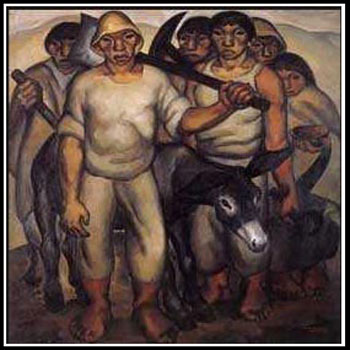
Another Labor Day

Just another Labor Day, the annual holiday here that marks the end of the summer.  Most of us don’t even think for a moment about what the name of this holiday anymore, don’t realize that this holiday was meant to honor the trade and labor unions that have been so demonized in recent years. I know that I’m aware of the history of this holiday and even I forget it most of the time.  And that is a shame because we all could use a reminder of how the working class of this country has truly built the great wealth of the nation.

I guess I’m a labor guy.  My first real job was in a grocery store, a Loblaw’s, and we were unionized.  My next two jobs were also unionized and for a couple of years I was  a Teamsters’ union steward for my department  when I was working in the A&P Food Processing Plant.  I learned a lot from that experience, things that shaped how I still view the world today, thirty years later. 

There were some good guys who were supervisors at the plant. Bosses.  Management.  I could  see how people would say there’s no need for all the labor regulations and the protections of unions when I worked for these select few.  They were fair and pragmatic in their approach to dealing with the workers and most of us worked harder than hell for these guys. 

 But many were not fair-minded and used their position of authority as a hammer to try to pound everyone under them as though they were nails.  They continually tried to circumvent every rule and regulation and were constantly at odds with their workers.  These guys were the face for me of why there was a need for labor unions in many places.  I can still see many of their faces so vividly in my memories of that time.  They were the first layer of management, the least trained and most ill-equipped, and they would do anything to meet the demands that the layer of management above that had placed on them, even if it meant abusing the rights of the workers under their supervision.

It’s not that they were bad guys.  They had goals set for them that had to be met and they were simply not very skilled at dealing with people, specifically their workers.  So they would try to bully and punish.  Probably in the same way that they had been dealt with most of their lives.  As a union steward, I could see that the behavior of these abusive bosses made the need for protecting the workers imperative even though there were other fair and just bosses out there.  There would always be some bad bosses, especially at the lowest and middle levels, and they were the ones who dealt primarily with the labor force.

We were built with our labor force and we have prospered most as a nation when the labor force shares equitably in the wealth being created.  On this labor day, we should remember that and be thankful for the sacrifices made by those workers and unions before us in creating protections against the bad bosses of this world.


Read Full Post »

Doppelganger

A month or so back in a post, I wrote about the late Modernist painter Oscar Bluemner and the odd feeling of connection I felt to his work.  There was something in it that seemed beyond familiar and that really intrigued me, making me want to find out more about this little known painter.  I found one book, Oscar Bluemner: A Passion for Color, written by Barbara Haskell , the curator for a Bluemner retrospective of the same title at the Whitney Museum of Modern Art in 2005.

When it arrived yesterday I opened the package and flipped through it quickly, taking in the images that all seemed so right to me.  Stopping on a page of print, the first sentence I read surprised me and made this feeling of connection with Bluemner seem even more palpable.

Bluemner considered subject matter irrelevant except as a conduit through which to convey his moods and inner consciousness, yet he also believed that art must be based on the real world in order for it to communicate with viewers.

That sentence succinctly captures much of what I try to convey about my work when I stumble through my writtten explanations.  Looking further I came across pieces of his that so meshed with my own work, particularly in my earlier phases, that it was eerie.  The colors and forms and even the sense of rhythm seemed so close.   Even the words he chose when writing about his work seemed to mirror my own.  He spoke of that same rhythm to which I often refer.  The words continuum and polarity seem to pop up frequently as well as I glimpsed through, both words that draw my antennae. 

I begin to wonder about he connection.   Perhaps it is inevitable in this wide world of ours that two widely separated minds would view thie world in the same spatial way and would emply the same colors and forms and rhythms, would try to communicate may of the same emotions and perceptions.  Perhaps we all have these creative doubles, our artistic doppelgangers, and the only exceptional thing is that I may have come across such a person and recognize it. 

I don’t know.  I have yet to read deeper into this treatise and may come across something that will make me deeply regret connecting my work in any way with his.  Judging from his life and death, he was obviously deeply flawed.  I hope that my own many flaws do not match too well with those of Bluemner.

We’ll see.

Read Full Post »

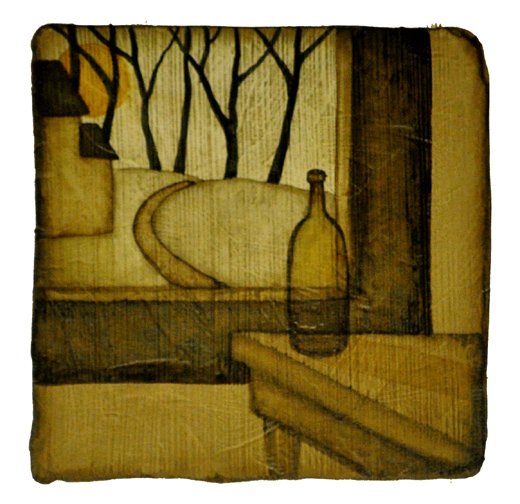
This is a painting I recently finished, a small piece, only 4″ square on paper.  It’s a mix of landscape and very uncomplicated still life with stark but distinct elements throughout.  There’s a simplicity that runs through this scene that covers a depth of feeling, a pang from the heart.

I sat this aside for a day or two after finishing it and found myself coming back to it.  There was a familiar tone to it that reminded me of something that I couldn’t quite identify until this morning when I walked into the studio.  I looked at it as I sat down and instantly said to myself, “Far From Me.”

It was the old John Prine song from his first album which came out forty years back, in 1971. There was something in this piece that filled me the feeling of Prine’s lyrics of gradual loss:

And the sky is black and still now

On the hill where the angels sing

Ain’t it funny how an old broken bottle

Looks just like a diamond ring

But it’s far, far from me

This piece will probably always be that song now for me, a personal avatar for a song buried deep inside and often forgotten.  Funny how things work…

Here’s Far From Me  done by Jamestown Ferry,  a Berlin, Germany based duo who performs Americana music as well as traditional Scotch and Irish music.  It’s a lovely and faithful version.

Read Full Post »

Paris Blues

Wednesday morning in the summer.  Starting some new work, looking forward to trying some new things and psuhing some other things a bit further.  Trying to focus on work and block out the debacle of our current political system, hoping that we somehow emerge from the deep, dark tunnel in which we now find ourselves.  Just writing that sentence gets me agitated.  Who needs that on a quiet August morning?

Seems like a good time to hear a little Django Reinhardt, the late great Gypsy guitarist whose music I’ve featured hear a few times.  There’s something in his distinctive playing that is both sad and happy, with a sort of weariness in even its most joyful passages.  Don’t know if that makes sense .  Guess it doesn’t matter.  His playing simply soothes.

Just give a listen to his Paris Blues and take it easy on this August day wherever you may be.

Read Full Post »

« Newer Posts - Older Posts »