Feeds:
Posts
Comments

Archive for the ‘Influences’ Category

January-- Grant Wood

I’ve expressed my admiration here for the work of Grant Wood more than once.  I find his imagery compelling, especially the way he creates mood and tension in what seem to be typical, mundane scenes.  His paintings and lithographs often have a wonderful rhythm throughout them that sings to me.  I see these qualities captured beautifully in a series of stone lithographs he created that capture the feeling of the winter months in quiet and moody tones.  The subtle shifts in the grays of the ink recreate the seasonal sense of atmosphere, a point illustrated wonderfully in this piece shown above, January.

February- Grant Wood

This print on the left, February, was completed in 1941 and has an ominous yet beautiful quality about it. I love the rhythm in its simple composition, from the patterned fields of the farm in the background to the placement of the dark figures of the horses to the three strands of barbed wire that cross the picture plane.  The way the dark horse in the foreground plays off the graded darkness in the right of the sky.  Just beautiful.

Maybe the foreboding nature of this print was an omen of Wood’s own death from pancreatic cancer the very next February.  He was born in February and died in February, one day short of his 51st birthday.  I am staggered by the work Grant Wood created in his relatively short life and wonder what might have been had he lived to a ripe old age.  I guess that doesn’t matter when he left such a rich legacy behind as it was.

Below, March is tour de force for the kind of rhythmic elements I’ve been describing.  The sway of the farm structures and the bare tree at the top of the frame.  The wagon and draught horse  riding in on the point of the winding path. The roll of the hills and the staccato rhythm of the fenceposts running upward.  Great stuff.  Instant inspiration…

March- Grant Wood

Read Full Post »

Tomorrow is the first day of March.  It was in this month 100 years ago, that the Triangle Shirtwaist Factory caught fire, killing 146 garment workers, mostly women and children.  It was discovered that the factory owner had locked the exits to prevent workers from leaving early.  This was an event that brought to light the plight of workers and how they were often subjected to exploitation and dangerous work environments.  It led to the growing support of labor unions and a crusade for labor and safety reform.

Tonight, PBS is airing an episode of The American Experience that features all the grisly details of the Triangle Fire, highlighting the events and factors leading up to the fire along with its consequences.  It’s an interesting time to be showing this show with this national movement currently afoot to destroy labor unions and strip away many of the regulatory controls placed on businesses.  It’s an object lesson in what can happen in an unregulated environment and I recommend it for all those who feel that an unbridled free market will solve all our ills. 

This episode airs at 9 PM in most areas and will be available also on the PBS website within a week or so.

Read Full Post »

Northern Lights

Earlier this week there were reports that the Northern Lights might be visible in our area, a fairly rare occurrence.  Unfortunately, from our viewpoint it wasn’t visible.  I’ve only seen these lights two times from where I live and I remember them being quite mesmerizing as a child, riding with my father in the car one evening with my eyes glued to the northern sky.  Even now, when I see images of the lights I am immediately filled with  the desire to pick up my brush and run dashes of color through other colors.

Here’s a pretty good video of the changing lights set to music played by a 7 year old Emily Bear.  Quite nice.

Read Full Post »

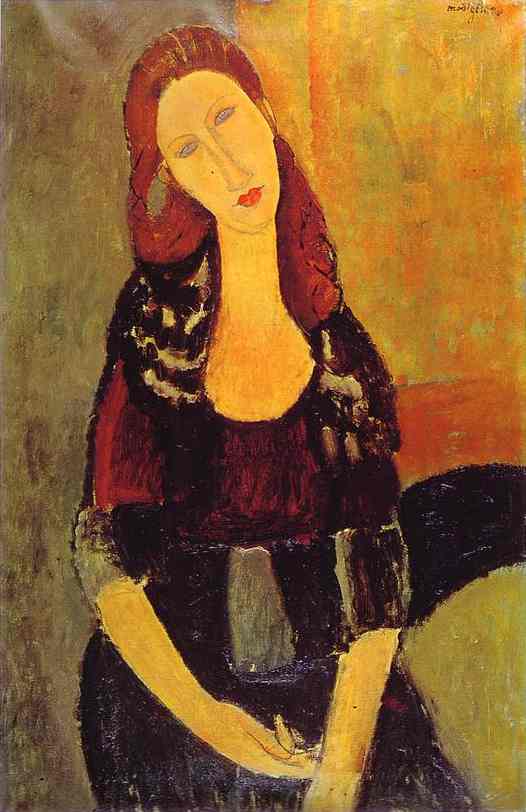
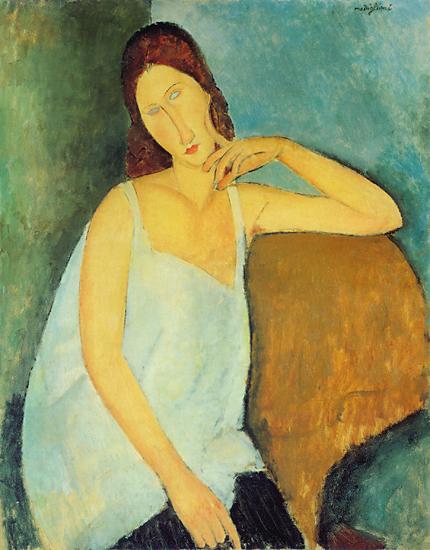
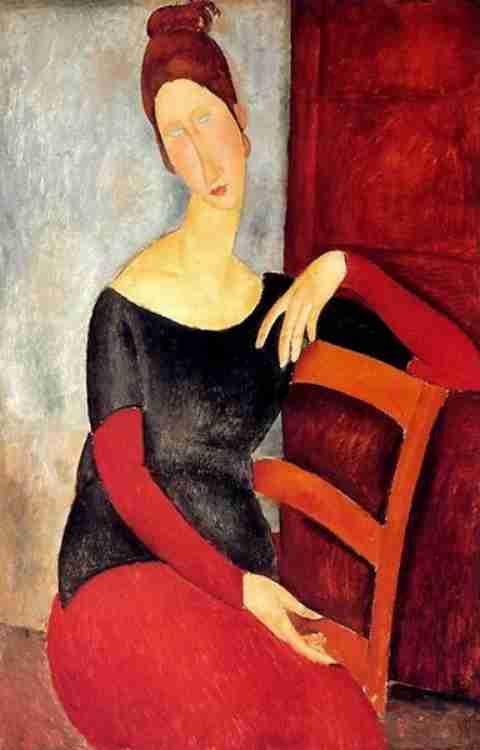
You wouldn’t know it to look at the work of Amedeo Modigliani, but it was quite an influence on my painting.  Modigliani’s work through his short, self-destructive life consisted primarily of stylized portraits and  nudes.  The heads of his subjects were long and oval, often set at an angle aperch an overly long neck.  The eyes are almond shaped and the nose pinched.   Hardly words to describe great beauty yet they maintain a graceful allure that is immediately recognizable as the work of Modigliani.

  His instant recognizability of his style and subjects from across large galleries was striking and was the great message I took from seeing Modigliani in museums over the years.  You couldn’t mistake it for the work of anyone else and as a painter early in my career, still seeking the direction of my work, this was an invaluable observation.  With each Modigliani I came across, the idea that my work should be somehow unique and have a quality of instant recognition was reinforced in my mind. 

Also, his limited subject matter made an imprint.  The idiosyncratic nature of his portraits and nudes made the repetition of his forms seem like a moot point, making the viewer easily enter the picture plane and focus on the unique qualities of the piece in the colors and forms.  It wasn’t the subject that mattered but the way in which it was painted.  Another valuable lesson.

Fortunately, I didn’t learn the lessons of the other parts of Modigliani’s life.  His drug and alcohol addictions, combined with tuberculosis, led to an early death at the age of 35.  Even more tragic is the story of Jeanne Hebuterne, the model for the paintings shown here and the common-law wife of the artist.  She was the subject of at least 25 of Modigliani paintings.  The day after the artist succumbed to death in Paris in January of 1920, a distraught and pregnant  Jeanne threw herself out the window, killing herself and her unborn child.  She was 21 years old. 

 Coincidentally, her death came on this date, January 25.  I didn’t realize that until I just looked it up.  Hmmm…

Read Full Post »

Yesterday I mentioned Bryan Talbot and his book Alice in Sunderland.  One aspect of the book that I failed to mention was an interesting case he made about the beginnings of the British comic books genre.  He cites the Bayeaux Tapestry (which I have been meaning to highlight here for some time) as an early example of a story, the Norman conquest of Britain, being told through the use of pictures.  He also goes into an interesting discussion of  William Hogarth, the British painter/printmaker whose work, particularly his prints, were often serial in nature, telling a story by their relationship to one another.

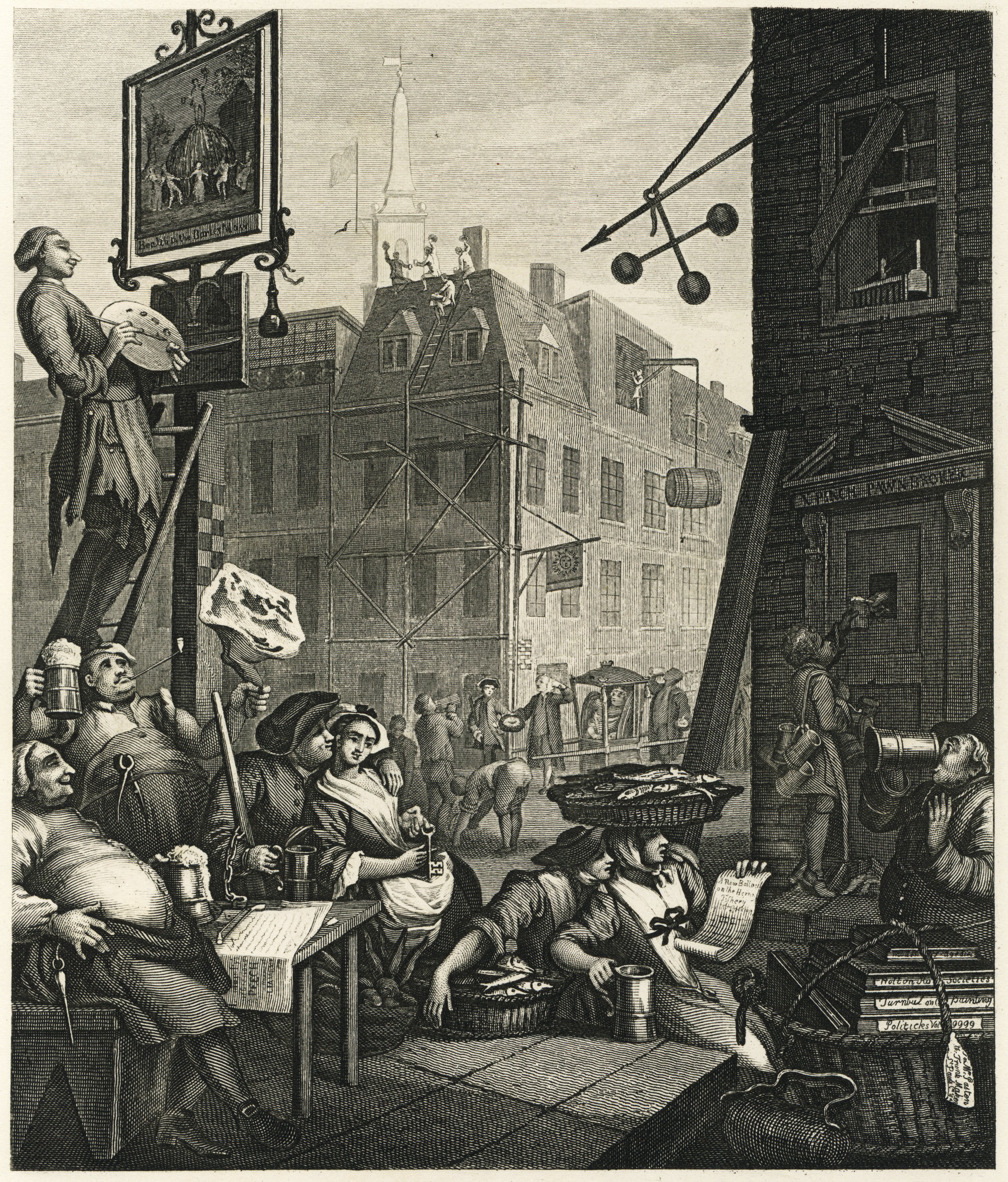
Hogarth (1697-1764) is an icon of British art and a populist whose prints reached across many levels of British society, hanging in homes of many classes.  His work was often satirical in nature and dealt with pressing social issues of the time.  His most popular was Gin Lane, which was coupled with another print, Beer Street.  They were made in order to garner support fot the Gin Act of 1751 which was enacted to curtail the gin craze that had seized Britain for the first half of the 18th century.  Gin was inexpensive to produce and was sold cheaply.  At the time the average Londoner was purported to be drinking up to 2 pints of gin per week and authorities of the time felt that this was leading to idleness and moral decay.

Hogarth dealt with the issue by showing the contrast between the accepted practice of drinking beer (considered safer than drinking the water of that time, given the unsanitary conditions) to the evils brought on by drinking gin. In Beer Street, Hogarth depicts the drinkers as well clad, jolly and fat– signs of health and wealth.  There is a sense of orderliness with workman at labor and all businesses being prosperous, except for the pawnbroker, whose building is in disrepair.  The artist who is shown painting the sign is in rags and is shown to be a gin addict through the detail on the smaller sign where he has painted a gin flask rather than a beer bottle.

The contrasts in Gin Lane are drastic.  Scenes of decadence and decay abound.  At the forefront is the drunken, bare-chested mother who has lost her grip on her child who tumbles over the railing down to an underground gin house. Her companion is an emaciated balladeer whose sheet music has the title The Downfall of Madame Gin.  In the background, the scenes are evn more lurid.  A barber hangs himself, his business failing because the gin addict spends all his money on drink, not haircuts.  A woman is feeding baby gin.  A man is gnawing on a large bone while his friend is so drunk that a snail has time to crawl upon his shoulder.  Buildings are in disrepair and falling down.  The only businesses that prosper are the undertaker, the gin houses and the pawnbroker, where a workman is pawning his tools for drink.  There are other signs of madness, as the detail shown here illustrates.

It’s pretty powerful stuff and Talbot does a nice analysis of the compositions of the two prints, showing how Hogarth creates a feeling of orderliness and calm with the strong vertical and horizontal lines of Beer Street and contrasts that to Gin Lane with a composition that features frantic motion with clashing diagonals.  There is little stability and chaos reigns in his composition.  Masterfully done.

The Gin Act of 1751 was written into law and by the mid 1750’s the gin craze had subsided, although many cite the higher cost of grain at the time which drove up the price substantially as a larger factor.

Whatever the case, Hogarth has produced two intriguing prints that have great interest even today.

Read Full Post »

Well, it’s the day after Christmas and I’m trying to clear my palette from the holiday and get ready for the new year.  Not the holiday but the actual year 2011.  I’m starting to really begin to think about moving in new directions, even in a subtle fashion.  I’ve talked before about how this change is important to me and how it keeps me excited in the work.

Sometimes this new direction comes in the form of new compositions or a differing use of the materials at my disposal.  Sometimes in entails visiting past work or influences and seeing how they interpret at this point in time.  The same composition painted at different times often brings surprisingly different results.  Maybe my color palette is different at one time versus the other or maybe my emotional state is different, which has a huge effect on my work.

As for past influences, sometimes the time that has passed allows me to see different aspects of the painting I’m looking at and take this aspect into my own work.  The painting I’m showing today is an example of a past influence that I have used.  It’s Death on the Ridge Road from the great Grant Wood in 1935.  I love this painting.  It has so many aspects to ponder and take from.

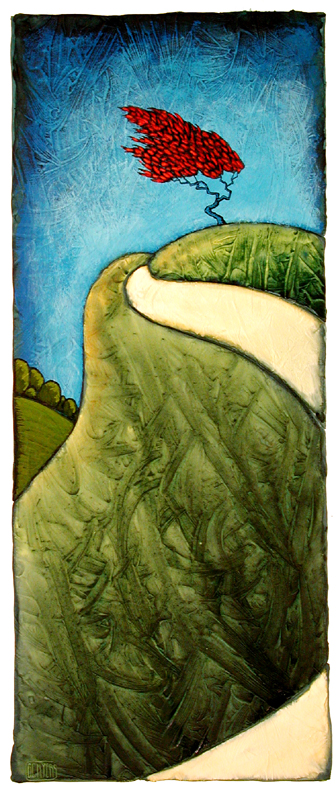
When I first used this as an influence, in this painting from 2001 on the right, I focused mainly on the movement in Wood’s painting.  The curve of the road and the shapes and positions of the vehicles hurtling at one another, along with the lean of the telephone pole at the top of the hill set against the moving sky, all give this piece a sense of motion and action.

At the time, I wanted my painting to carry that same sense of movement as I felt in Wood’s piece but in an even simpler composition, without the drama of the vehicles potentially crashing together.  In my painting the road and motion in the leaves of the tree carry the action aspect.  It very much a different piece, compositionally and emotionally than the Wood painting.  At that time, when I painted this, that was what I took mainly from the Wood painting.  Now, I might focus on other aspects and create work that is quite different than what I first pulled from this influence.  For instance, today I might want to pull something from his shadowing at the bottom of the painting, something I actually have used in a number of paintings over the years.  Or the symbolic aspect of that lower telephone pole and the way it creates an almost shadow-like effect of a cross on the hillside.  That is filled with possibility.

So I will spend the next several weeks taking some time to look at past work of my and work from those I consider influences, such as Grant Wood, and hopefully something new will merge.  At least, a newer version of my work with a new facet.  We shall see.

Read Full Post »

I recently picked up a book, Andrew Wyeth: Autobiography, which is not really an autobiography but features over 130 of his pieces throughout his career along with short descriptions about them by the artist.  It’s quite a striking collection of images especially if you’re attracted to the Wyeth palette of  earthy browns and greys, as I am.

I have many favorites here  but perhaps the one I like best is this piece, Night Sleeper.  There’s a lot here to look at yet it maintains a quiet and  contemplative stillness that one associates with Wyeth’s work.  The two windows provide two separate examples of landscapes, the moonlit mill in one and the dam and millstream in the other,  that could be great paintings on their own.

  It’s all held together and anchored by the tee of the interior windows and the sleeping dog, an image I’m really drawn to.  There’s something about the posture and comfort that dogs adopt when sleeping that I find interesting, something that plays on a sense of reciprocity that I have with dogs, one where they watch out for me when they are  awake and I watch out for them when they are asleep.  Their sleep indicates a deep trust and a sense of security.

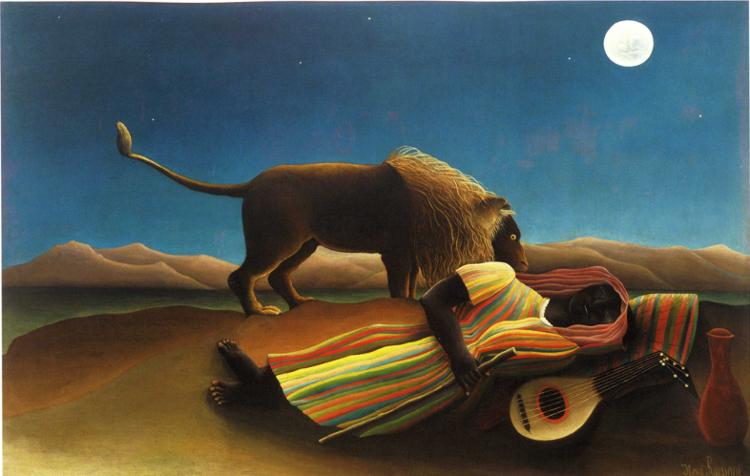
But the bit of this painting that makes the whole thing sing for me is the pale blue striping on the pillow or bag or whatever it is that the dog rests against.  That bit of color adds a whole layer of depth that would not be there otherwise and creates a beautiful harmony, echoing the moonlight that plays on the window frame on the right.  For me, it immediately brings to mind Henri Rousseau’s Sleeping Gypsy and its whole feeling.  They are very different paintings in many obvious ways but there is a ribbon of feeling that runs between them, in my mind at least.  I think this immediate visceral association adds a layer of appreciation of this painting for myself.  That little blue striping adds all the warmth of the Rousseau painting to my sense of this Wyeth painting.

In short, I think this painting is a peach.

Have a great Saturday.

Well,

Read Full Post »

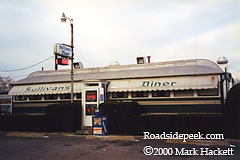
In yesterday’s post on the blog American Folk Art @ Cooperstown, Paul D’Ambrosio wrote about a bas relief carving in the collection of the Fenimore Museum.  It was one of a series concerning Sullivan’s Diner in Horseheads, NY and was carved by renowned folk artist  Mary Michael Shelley, who works just up the road in Ithaca.  The piece shown here is different from the carving in the Fenimore Collection but both feature the diner’s intimate interior with counter that runs the length of the small trailer with round stools.

I was really interested in this blog post for a couple of reasons.  First, I’ve always been interested in bas relief carvings and, as I wrote her before, started carving in the years before I became a painter.  Much of my painting is done very much like a carving , in the way I see and render the elements.  The second, and more important, reason was that Sullivan’s Diner has always been in my sight in some way for my entire life.  Built in the 1940’s in New Jersey, it spent its early years as Vic’s Diner on Elmira’s eastside,  from where my family hails.  I have distinct memories of its appearance on the corner near St. Joe’s Hospital as a child, even a memory where I was sent sprawling on the sidewalk in front of it on my bicycle.

In 1974, it was moved up the road to Horseheads where Art and Fran Sullivan renamed it and ran it.  Art was a railroad fanatic of the highest order and had an actual engine and an attached car behind the diner’s new location on Old Ithaca Road.  Fran ran the restaurant , doling out generous portions of eggs and bacon for many years from the grill behind the counter of this small trailer diner.  This was not one of the larger streamlined beauties you see along the turnpikes of Jersey.  It was cramped inside with a few booths on one side of the aisle and the counter on the other.  The woodwork and feel was more 1930’s even though it was built in the 40’s.  Living in Horseheads, I ate many breakfasts there over the years and always felt like I was walking into Fran’s home kitchen when I walked through those doors, which seemed to transform you back to a much earlier time when you passed through the doors.

The food was okay, simple but satisfying.  The coffee watery but tasty. But the attraction was the sense of community that the place fostered.  Walking in through the old door you felt like you were entering Fran’s personal kitchen and she treated you as though you were a guest in her home.  Even though I was only a sporadic visitor she always made me feel as though I were one of her regulars, making me feel as comfortable as the regulars who laughed and joked at the counter each morning. 

 I haven’t been there often since Fran retired but the place was reopened under new management and seems to be flourishing.  But I do have fond memories of that place and am gratified that Sullivan’s Diner will forever be immortalized in the collections of at least two museums.  The piece at the bottom is the one from the Fenimore Museum and another is in the National Museum of Women and the Arts in Washington, DC. 

Thanks for the fine work, Mary Shelley, and thanks, Paul, for pointing it out.

Read Full Post »

Eyvind Earle

I  was asked by artist and teacher Dave Higgins to sit in on one of his classes at the local community college last week, to critique an assignment he had given his students.  It was a class that focused on creating digital graphics and animations using primarily Photoshop.  The assignment was to make a graphic based upon one of two subjects.  One choice was to select any sign of the zodiac and the other was based on the term red tree.  For red tree, he gave the students no indication of my work , just the phrase.

This was an entry level course but the work was wonderfully creative.  Of course, being a class of mainly 18 and 19 year-olds, there was a fair amount of angst and morbidity expressed in images of death and plenty of blood.  But the work was great.  I could find something of value in each student’s work, something that showed a real spark of imagination and inspiration.  One of the students who has chose red tree had a simple composition of a weeping willow (that weeped blood!) set on a mound.  Very simple but well done.

The color of the mound set against the silhouette of the willow immediately reminded me of the work of Eyvind Earle.  Earle was an artist/illustrator who died in 2000 at age 84.  He was a child prodigy and had his first one man show at age 14 .  He exhibited his work in shows for many years but gained fame through his stylized Christmas cards throught the years and with his time spent working with Walt Disney in the 50’s and 60’s as a background artist.  He was responsible for the look of many of the animated films of that time from Disney, including the classic Sleeping Beauty.  Shown here is some of Earle’s work from that film.

 I came across his work about the time of his death, seeing ads in framing magazines for prints of his highly stylized paintings.  There was something  very familiar and attractive in the work and upon reading his bio I saw the connection between this recognition and his work from having absorbed it in as the settings and backgrounds for many Disney animations I had seen as a kid.  It was very attractive work, very much of the graphic rather than painterly variety.  Strong colors and great and unusual juxtapositions of compositional elements.  Tree limbs extending into the picture like an arm reaching into the center of the image.  Very evocative as well.  It was easy to see how it was so successful in setting the tone for the action that ran across it in the Disney films and how something like it could have subliminally influenced a young student, or me, over the years.

Here’s a short animation that highlights more of Earle’s work.  I believe this is Russian-made so excuse the error in the title as they switched the names around making him Earle Eyvind instead.  I think you’ll feel that same familarity even though you may never had heard the name Eyvind Earle.

Read Full Post »

I wrote some time ago about how a series of my paintings from several years back, the Outlaws series, had been influenced heavily by the imagery from a number of silent movies.  One that I mentioned specifically was Sunrise, the 1927 film from the great German Expressionist director FW Murnau of Nosferatu fame.  I mention this today because TCM is showing the film tonight at 9 PM EST.

The film was made at a really interesting time in the history of films.  Just as talking pictures were emerging ,  silent films were reaching their apex of artistic expression.  Within a few years they would be gone completely.

This film is the answer to a trivia question in that it won won the award for Best Picture  at the first Oscars ceremony in 1928.  Trivia fans will be shouting at this point saying that I’m wrong, that Wings won the first Best Picture award.  Well, they’re correct but I so am I, as Sunrise won the award for Best Picture: Unique and Artistic Production. There were originally two awards to honor two separate  aspects of the industry- the popular and the artistic.  This practice ended after this ceremony and  Sunrise became the only winner of the award for a unique and artistic film.

The cinematography in this film is beautiful and there is a long continuous shot from inside a streetcar that shows the city passing by that is breathtaking for its freshness, even by today’s standards.  The story is a fable telling the story of farmer and his wife and his struggles with a big-city temptress who nearly lures him into murdering his wife.  It is beautifully expressed and is a must-see for anyone who has seen more than enough special effects extravaganzas of the Transformers sort.  It is considered by many critics to be the finest silent film ever made and some even rank it up there with Citizen Kane as one of the greatest films ever.

I always hesitate in recommending films because we all have such different and subjective preferences, but if you get a chance and have any interest, take a look tonight on TCM.

Read Full Post »

« Newer Posts - Older Posts »