Feeds:
Posts
Comments

Archive for the ‘Influences’ Category

My post yesterday was about the guitarist Django Reinhardt and the beauty of the guitars he played.  I replied in a comment that I was surprised more painters didn’t use the guitar as a subject because, to me, it has a feeling of iconic expression.  It’s there in the shape of the instrument with its sensuous curves and neck.  The way the player holds- no, embraces the guitar.  The way they move their hands over the strings. 

It made me wonder how often the guitar had been used as subject and prompted to me to do a quick search. Now I don’t know what most people think and I don’t have a comprehensive knowledge of art history but for me the piece that must be the most recognized is Pablo Picasso’s The Old Guitarist from his Blue Period, around 1903.  I have used this piece as the inspiration for paintings of my own and love the expessiveness of the hands and the bow of the player’s neck.

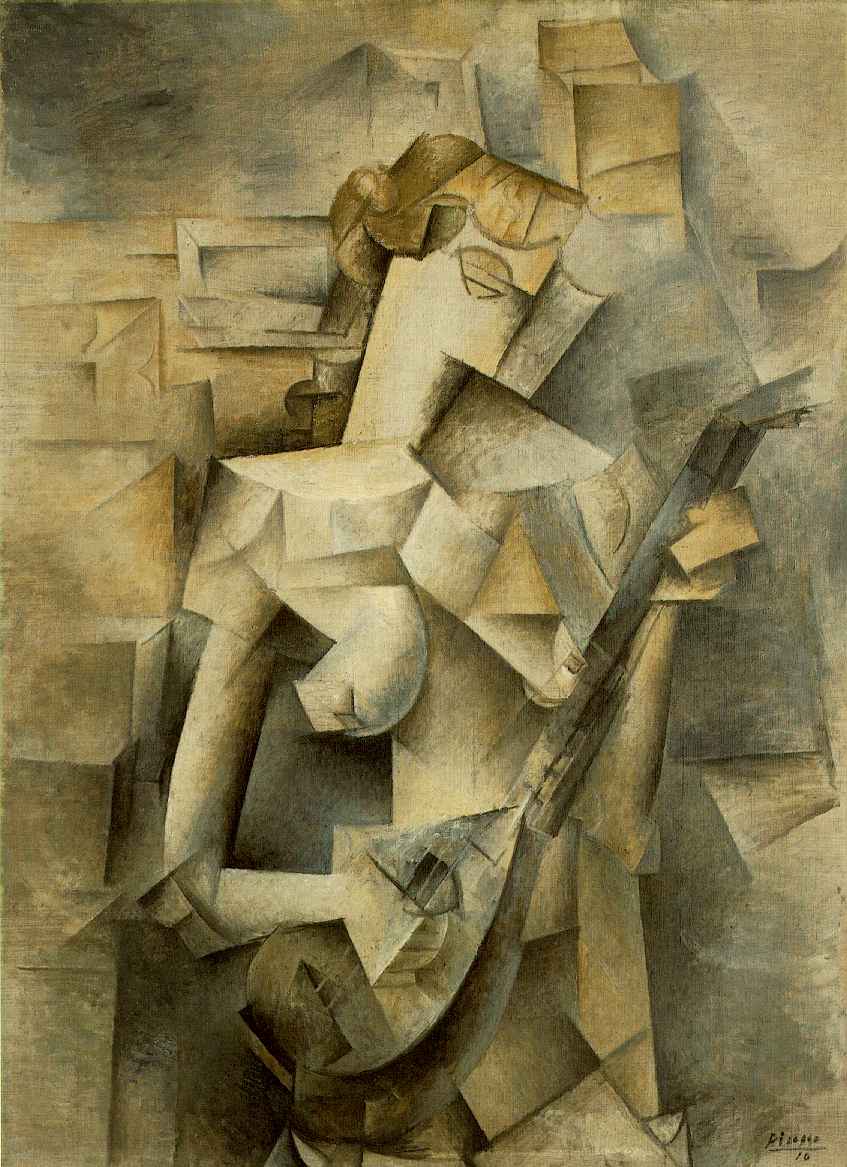
Another was from Georges Braque, one of the prominent names in Cubism with Picasso.  His Woman With a Guitar from 1913, shown here, is a beautiful example of the Cubist style.  I’m not sure it carries the emotional impact of the Picasso piece above but it is a fine piece.

Many of the earlier paintings I found containing stringed instruments were not guitars but lutes.  Perhaps the best of these paintings is this gorgeous painting from Vermeer, The Guitar Player.  On closer examination, you can see that it is a lute.  But it’s such a beautiful piece of painting, does it really matter?

Renoir- Young Spanish Woman with Guitar

Edouard Manet used the guitar player as a subject in several paintings as did Auguste Renoir.  Renoir really seized on the romantic aspect of the instrument which worked well with his style.  His players, usually his female subjects, cradle the instruments in a number of paintings.

There are certainly many, many more paintings out there that I failed to see or mention.  If you come across one that strikes your fancy, let me know.  There are some new kitschy paintings out there that are painted to appeal to guitar owners, not to actually create a sense of emotion which is  what I’m discussing here.  I’m talking about using the guitar as a subject for expression in the paintings, not simply as an object.

Read Full Post »

Southern Gardens- Paul Klee

I was asked yesterday if I talked to my paintings.

  Interesting question.

I talk to animals.  I talk to trees and plants.  I talk to my car. I talk to my studio, which actually has a name. I talk to ghosts, present or not.   Whether any of these things or beings listens is another matter.

But talk to my paintings?

It immediately brought to mind a section of a famous lecture that I had been reading recently and had really resonated with me.  It was On Modern Art,  delivered in the 1920’s by Swiss artist and a personal favorite of mine Paul Klee :

May I use a simile, the simile of the tree? The artist has studied this world of variety and has, we may suppose, unobtrusively found his way in it. His sense of direction has brought order into the passing stream of image and experience. This sense of direction in nature and life, this branching and spreading array, I shall compare with the root of the tree.

……..From the root the sap flows to the artist, flows through him, flows to his eye. Thus he stands as the trunk of the tree. Battered and stirred by the strength of the flow, he guides the vision on into his work. As, in full view of the world, the crown of the tree unfolds and spreads in time and space, so with his work.
……..
Nobody would affirm that the tree grows its crown in the image of its root. Between above and below can be no mirrored reflection. It is obvious that different functions expanding in different elements must produce divergences. But it is just the artist who at times is denied those departures from nature which his art demands. He has even been charged with incompetence and deliberate distortion.
……..
And yet, standing at his appointed place, the trunk of the tree, he does nothing other than gather and pass on what comes to him from the depths. He neither serves nor rules–he transmits. His position is humble. And the beauty at the crown is not his own. He is merely a channel.

This very much sums up how I’ve always felt about art, especially my place as an artist.  A mere channel or transmitter.  And when I look at my paintings, it is not in the form of a conversation so much as listening  to what the painting has to tell me.  I paint because I question and, at best, the paintings provide some answers and insight that I might not find or see otherwise.

So, do I talk to my paintings?  Not so much.  But do they talk to me?  Yes.  And I do my best to listen…

.

Read Full Post »

Yesterday’s post about the 50th  anniversary of Green Eggs and Ham  by Dr. Seuss made me think about a piece that I’ve had hanging around my studio for the past decade.  It’s a painting that I did in 2001 that I call Red, Hot and Blue.  It’s an oil on panel piece that is pretty big, almost 5 1/2′ tall in its frame.  It could be a small door.  It showed in a few galleries after it was first painted and never found a home so it retired to my studio, to keep me company.

I mention it  because it was been called the “Dr. Seuss painting”  by several people who saw it when it was hanging in the galleries.  They saw something in the way the trees were shaped and colored  that gave them the appearance of a Seuss character.  I had no thought of Seuss when I painted the piece but when I heard these comments I began to see it. 

The expressive sway of the trees as though they were dancing.  The bright primary colors- the red of the foliage and the bright blue of the trunk.  Even the two trees in the background added to the Seuss-y feel.

The foliage actually looked like the endangered Truffala trees from Seuss’ cautionary fable about the environment, The Lorax

It was not intended but it made sense.  Seuss’ books were about communicating by giving strange creatures and things we often see as objects, such as trees and flowers, human qualities.  His characters moved  with a rhythm that made them feel alive. Just what I was trying to do with my painting.  I’ve often  felt that we best see and better understand things that possess human qualitities.  I remember being taught that the Native American tribes in the area where I grew up gave names to local hills based on the human qualities they had.  It made an impression and started me looking for the human form in all things. 

The curve of a tree trunk. The roll of the land.  The fingers of clouds in the sky.

To communicate.

So, while it was never intentional, this painting was very much a product of the influence of Dr. Seuss and others.  When I look at it today, I don’t see the name I gave it.  I see it as that “Dr. Seuss painting”.

Read Full Post »

Yesterday marked the 50th anniversary of the publication of the classic children’s book  Green Eggs and Ham from Theodor Geisel, better known as Dr. Seuss.

  I grew up in the heyday of  Dr. Seuss in the 1960’s and his strange characters and clever wordplay seem as familiar as breathing, so ingrained were they in the popular culture of the time.  Everyone knew the Grinch and the Cat in the Hat but the sheer simplicity and rhythm of Green Eggs and Ham always made it my favorite.

Using only fifty words with all but one being monosyllabic, Geisel created a book that is not really a story so much as a mantra of sound and rhythm.  There is some strange human element, an allure,  in it that I can’t put my finger on.  Whatever the case, I have a huge place in my heart for the simple words of this book.  Fifty years dosen’t seem like too long a time for the timeless.

Perhaps one of the best readings from the book came on Saturday Night Live in 1991.  It was the week after Dr. Seuss died and in tribute the Rev. Jesse Jackson did a dramatic reading .  It is a classic…

Read Full Post »

A few weeks back,  I wrote a post about a commission I was working on that was based on the Greek myth of Baucis and Philemon.  It was an interesting request and I hoped to be able to deliver a painting that captured somewhat the spirit of the tale of the humble couple who the gods ultimately favored with eternal lives together in the form of  a tree.  The painting shown here is the final product of the request.

My original conception of the painting was closer in detail to the myth with the two trees, sprouting from one trunk,  being located on a wide barren plain.  But the more I thought about it, the more I realized that it would be a cooler painting in feel than I think was requested.  I wanted to purvey more warmth, a sort of comfortable affection between the elements in the painting.  So I placed the tree on colorful rolls of land with a road that runs by.  I left out all other trees and vegetation, near and far, so that the tree and its relationship to the moon were the central focus.

This tree is very unique in my body of work.  Typically, when I have trees with separate trunks that intertwine together,  the crown of foliage  they form together becomes one solid unit of color, as though they had merged into one entity.  This piece was different.  The two trees were different but stemmed from the same trunk.  I chose to give their crowns separate colors to highlight the fact that, while they appeared to be one, they are two individual trees.   

For me, the moon here represents the watchful eye of the gods in the myth  (even though Zeus was not a lunar deity) and the horizon set by the water below represenst a feeling of eternity, of transcendent time.  The road leading to them represents the couple’s lives on Earth before they became part of eternity.

So, it may not be a literal translation of the myth, as many earlier classic artists have depicted, I think it carries the spirit of the story and the unity the couple feels together.  For me, it works…

Read Full Post »

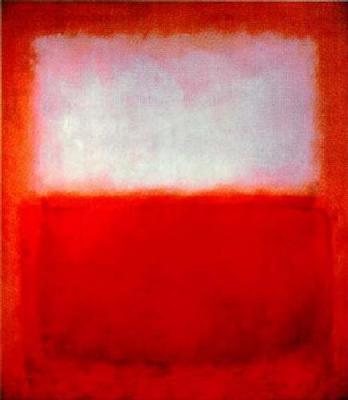
Rothko

I ran into my neighbor a few weeks back while walking out my driveway to get my newspaper.  We chit-chatted for a few moments and he told me that he and his partner had recently seen the theatrical show Red in NYC.  It’s about the artist Mark Rothko, played onstage by Alfred Molina who gave what my neighbor described as a dazzling performance.

As we parted and I headed back, I began to think of how little I knew of Rothko and his life.  I knew a number of his paintings, especially his signature works which are called multi-forms by critics and collectors.  The pieces shown here are examples of this work.  I have always been drawn to these paintings, especially when confronted by them in museums.  They are normally large in size and have two blocks of color placed one over the other.  They often have a blurred, almost fuzzy appearance created by multiple layers of paint that creates a preternatural glow in some of the colors. 

I have thought many of these to be exceptionally beautiful and meditative,  finding myself mesmerized by the aura of these paintings. I have even referenced these paintings many times over the years as an influence on the forms of many of my own paintings.  But I knew (and still know) little of the man or how he came to this form and style. Or his theories on his work.  It just seemed enough to take that feeling I recived from his work and translated/integrated it into my own, without words and theories.  Even this morning as I write this, I know practically nothing of Rothko, his life or his work prior to the multi-forms that I do know.

Maybe that’s the way it should be.   As Rothko said, “Silence is so accurate.”

Read Full Post »

Today is the first day of  our local County Fair.  The Chemung County Fair is in its 168th year and for a good part of my youth was the high point of the summer.  I wasn’t in 4H and had little to do with farming, so outside of quickly racing through the barns to look at the prize cows and chickens, I wasn’t there for any of the agricultural aspects of the fair.

No, I was there for the Midway.  The whirling  rides, the challenging games and the lurid shows— it all conspired to trigger the maximum emotional response for a twelve-year old kid.  Or a thirty year old man with a twelve-year old’s brain. 

Every year at the beginning of August, the James E. Strates train pulled into town, 61 railcars packed with rides and all the paraphenalia it took to put on the spectacle.  Their carnies were easy to spot at that point.  Guys with greasy hair and cigarette packs rolled into the sleeves of their grimy white tee-shirts.  Crude tattoos running up their arms that were deep brown from a layer of  dust and spending their days in the full sun, tending to the machines that ran this carnival.  I always remember a tooth being absent in the smile of many of them.

These carnies would soon have all the rides assembled with their creaking  and spinning parts that didn’t give you the greatest feeling of confidence that they would remain intact as they whipped you through the hot summer nights.  They were adorned with flashing lights that raced all around the rides and many had blaring rock music to just add to the visceral overload of the experience.  I still associate the Foghat’s Free Ride with the Himalaya, one of the more popular rides at the fair.

Then there were the shows with their barkers, their voices crackling over their little speakers as they tried to lure you into see the Gatorboy or the World’s Smallest Horse or some poor hybrid creature (half chicken – half cat!) that you could hardly see and never moved, leaving you with a seed of doubt that it was even alive.  The barkers cajoled, they insulted, they prodded– whatever it took to get you into their tent. 

The biggest crowds were, of course, at the tent with the peep shows with the showgirls. They would parade out a girl with piled hair,  heavy makeup and a skimpy, glittery outfit to tempt the assembled men with the promise  of much more inside.  I was too young to go in and always wondered what really went on in there.  There was a book out several years ago (can’t remember the title or author)  that examined this cultural aspect, the county fair peepshow, and revealed that it was even more lurid than I imagined at the time.

I was a big games guy, trying to win the rich treasure trove of prizes they lured you with.  Off-off brand transistor radios.  Pepsi bottle vases with long stretched necks.  Ceramic unicorns.  More ashtrays than you can imagine.  Oh, I just had to win that stuffed snake doll!  And of course,  the games were almost impossible to win, with their tight, smaller than normal  rims that kicked out your basketball before it could find its way to the bottom.  Or the fruit baskets whose bottoms seemed like trampolines for the softballs you attempted to toss into them.

I could write and write about the fair.  The smells of the midway– Italian sausage and the sugary smell of taffy.  The sounds of the grandstand shows that wafted over the din — the country and rock acts that rolled into town for the day to play on the stage that stood on the inside of the track where harness racing had taken place earlier in the day.  And the people!  Oh, what folks you would see at the fair.  I could write pages and pages.

But I won’t.  Not now.  If you’ve been to a county fair, you have your own sensory memories that fill in the blanks.  If you haven’t been to one, go at least once.  On a hot August night.  But don’t look for me there.  I have enough memories to carry me through.

Read Full Post »

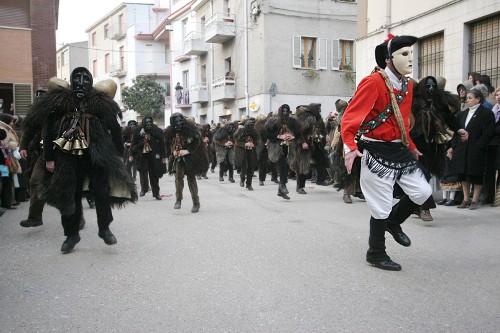
Mamuthones and Issohadores

Off the coast of Italy, on the island of Sardinia, there is a village called Mamoiada where festivals are held throughout the year, many having origins in ancient pagan ceremonies.  Appearing in several of these fests, some of which are described as being Festivals of Good and Evil,  are two symbolic characters called Mamuthones and Issahadores, representing the two forces.

It’s not completely clear as to the exact meaning of the symbols but in the most widely believed version it is said that the Issahadores, dressed in their red shirts and white wooden masks,  represent the early shepherds of Sardinia and their victory over the invading Saracens who are represented by the Mamuthones, dressed in their furry suits laden with cowbells and wearing black masks.  They parade through the town with the Issahadores leading a procession of the imprisoned Mamuthones in rows of two.  As the Mamuthones walk they heave upward with their bodies in unison and come down hard creating a huge sound with the many cowbells on their costumes.  It creates a rhythmic throb of sound that fills the streets.  The Issahadores at the front and rear of the parade periodically use their lassos to snare women from from the crowd.

There are other interpretations as to what these characters represent but whatever the case, it’s quite a spectacle.  I don’t know why I show this today.  I saw a brief clip of their parade and was really taken by it.  The sound, the rhythm, the the striking sight of the costumed characters as they do their simple choreography.  It just reeked of a symbolism that you don’t need to know to appreciate, like looking at a painting and being moved without understanding why.

So this Sunday I start my day with echo of the Mamuthones’ bells throbbing in my ears, inspired…

Read Full Post »

This is a new painting that is also part of the New Days exhibit at the West End Gallery.  Titled Roots Show Through, it’s one of those paintings that, for me, brings to mind an immediate thought.  When I look at this piece I am instantly reminded that we are the products of our past and that our ancestry deeply dictates many of our behaviors.  We may believe that our actions are ours alone and that our forebearers are remote from us in all ways but they show themselves in ways we may never recognize.

I was watching the end of the PBS series Faces of America with Henry Louis Gates (of the infamous arrest and subsequent Beer Summit at the White House) which traces the genealogical background of a number of well known folks, showing how they came to be and how they are interrelated to many others.  I was captivated by how they were able to break down the genetic composition of their subjects, showing how richly we are endowed those things that make us unique by prior generations.  Each one of our direct anscestors made it possible for us to be here in the form, for better or worse, that we are at present.  Take away any of them and we become much different people, if we exist at all.

The roots show through.

Now there are roots that we would like to keep deeply buried.  I know from doing genealogy that there is a tendency to want to see our ancestors in the best possible light, to give them the most positive attributes.  You imagine them to be wise and good and often you can find some evidence that some of your ancestors were .  But sometimes you find things that are less flattering, things you hope haven’t found their way to you through the genetic network.  In doing my own genealogy ( and my guess is that it is similar to a great many people out there) I have found a number of good and learned people who had places of respect in their communities.  But for every one of these folks I found even more who were less accomplished. 

 Going through census records, I find many ancestors in the recent past  who could not read nor write.  Some are listed on these same records in prisons and county poor houses and sanitariums.  Some are found in other records listing their misdeeds.  I have thieves and swindlers in my line.  My favorite was a beaver thief from the late 1600’s up the Hudson Valley.  I have some ancestors who were killed in various battles and massacres and as many who took part in other massacres, including one who was darkly remembered for the lifelong  revenge he took against the Indian tribes who had killed his father.  I have murderers including a great-great grandfather from several generations back who was hung in the town square in Easton, PA  for the murder of his wife. 

You hope some of those roots found a dead-end generations ago.  But they probably found their way through in some form and you ultimately deal with the background that brought you here in ways you hope allow you to live and prosper, with some semblance of wisdom and good.  You hope that the positive traits handed down to you by your ancestors far outweigh the negative ones.

Oddly enough, all of this and more comes to mind when I glimpse this piece.  It has almost become an icon for this particular thought.  How others see it, I cannot guess…

Read Full Post »

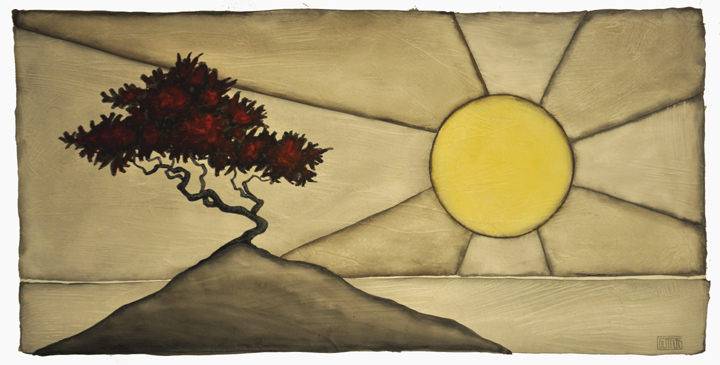
Sometimes a title for a piece is so undeniable that it makes all other attempts at naming it seem utterly futile.  When I completed this 8″ by 16″ painting on paper, I tried to find something in it that reminded me of  something other than  the feeling of  Eastern influence that seemed to drip from the surface.  The bonsai-like tree and the mound from which it sprouts.  The rising sun.  Even the way the sky is segmented and shaded seemed to bring forth thought of a flag from the East.  It all conspired to give the painting a decidedly Eastern Zen flavor.

I was trying to get away from having the viewer see the piece as only a product of influence, as though that might somehow lessen the work.  But isn’t every painting a product of influence somehow?  I can often see the onfluence of others in my work.  A bit of color here borrowed from something I’ve seen in another artist’s work.  I remember doing a piece when I was first showing and I had used a green in the work that had a wonderful rich earthiness to it.  This little bit of my painting so reminded me of the greens that Albrecht Durer had used in some of his lovely paintings of small wildlife such as rabbits and squirrels.  One day, I was in the gallery and the piece was hanging when another artist who also showed his work there saw it.

“That’s Durer’s green!” he exclaimed. 

I was thrilled that he caught it, that he saw the same qualities in it that I saw in Durer’s use of the color even though there was no other similarity in the work.  It provided a real insight into how influence works in how we create and view work.

So, why fight it when an influence shows through even more prominently?  It was influenced by the East as am I.  Even as I sit here now, my desk looks out an east-facing window as I watch the sun’s rays filter through the thick foliage of the trees as it rises from the east.  Every morning that I look into the eastern sky I am influenced by it.  You can’t deny your influences or habits, the things that shape your views.  So to call this piece anything other than Eastern Influence would be like trying to force a square peg into a round hole.

This painting is part of the New Days exhibit of my work at the West End Gallery in Corning, NY  that open this Thursday, July 22.

Read Full Post »

« Newer Posts - Older Posts »