Feeds:
Posts
Comments

Archive for the ‘Influences’ Category

When a writer knows home in his heart,

his heart must remain subtly apart from it.

He must always be a stranger

to the place he loves,

and its people.”

—William Morris

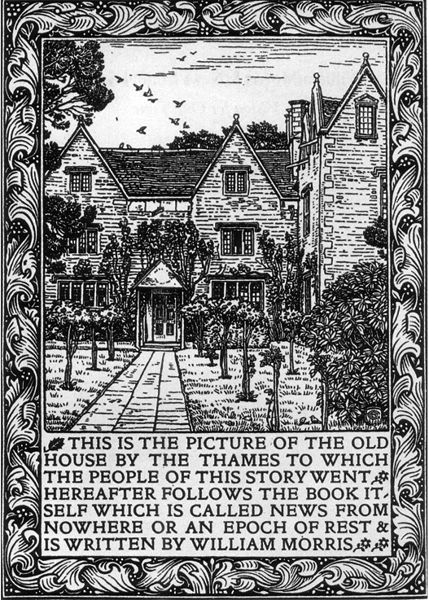
I came across this quote from William Morris, the English artist/designer/writer who basically set the Craftsman aesthetic movement into motion in Britain and here in the States.  I found this as a quote without any context and  was immediately intrigued by it.

It seems somewhat sad at first glance, that one should remain somewhat aloof in one’s home but I think I understand what he’s saying.  To understand what home means to you, you must be able to step away and view it with a slightly distant eye, to put yourself in the corner as a dispassionate observer.  From this vantage point one can see and understand the bonds of home.
I don’t know why I mention this today.  Maybe it’s that lately my work has dealt with the concept of home and what it means symbolically.  What does home really mean?  Is it a place or a state of being?  Is it formed by the sense of security one experienced and maintains from their childhood?  Does the search for home ever feel fulfilled?  Maybe it’s questions such as these  that draw me to these words.

Like anything, to truly understand something you must be able to step back from it and view it from a distance.  When you’re in a house you may have only an idea of what it looks like put together from going from room to room, getting a sense of size and shape.  But it’s only when you step outside the house and take it all in from a more  distant view, that you truly see how the house looks and sits in its environment.  I think this is what Morris is saying about one’s sentimental home as well.

Read Full Post »

I went to the Little Gems opening last night at the West End Gallery.  It was a really great crowd and I was able to see a lot of people I don’t get to see but a time or two a year.  A lot of good conversation.

One friend, guitarist Bill Groome, reminded me of a piece that I had given him back in 1999.  It was a little piece I had done years before that, before I ever thought of showing or selling my work.  It was done with crayons and was of a guitar player dancing to his own playing.  I called it Rockin’ Billy after rockabilly guitarist Billy Lee Riley, who distinctive, edge-of-wild studio playing rocked most of the early rockabilly recordings at Sun Records, including his own hits Red Hot ( …my gal is red hot, your gal ain’t doodley-squat…) and Flying Saucers Rock and Roll.   There was just something about the player in this little piece that felt liked he was moved by the spirit of that early music.

I didn’t have any images of the piece but when I got into the studio this morning, I found that Bill had emailed me a scan of Rockin’ Billy.   Thanks, Bill.  Even though it’s rough edged and maybe not a virtuoso piece in itself, I still really like this little guy a lot.  I can still hear Billy Lee’s guitar echoing in my memory…

Read Full Post »

I’m battling a cold and don’t feel like I have much to share today but I did want to show this piece, Flower Beds, from Vincent Van Gogh.  It’s not one of his better known iconic pieces but whenever I come across it, it makes me stop and look.  It’s from early in his career and is painted in a more impressionistic fashion than his later, more signature works with their bold strokes of vivid color.  This piece seems to be a bridge between his influences and the style that he later adopted as his own, going from the darkness of the past as represented by the cottages to the new, colorful strokes that are the flower beds.

I like seeing that transition, almost can feel how Van Gogh was taking on his own voice at that time.  Seeing things with his own eyes for the first time.  Becoming the Van Gogh we know now.

I don’t know why I mention this piece today.  I was thinking that I don’t often mention Van Gogh as an influence even though I consider him a large one.  I think I try to avoid invoking his name simply because I hear so many painters list him as their primary influence and seldom see the energy or passion in their work.  His work had an incredible accessibility and drew such an  immediate  basal  reaction  that it makes him an easy, romantic choice as an influence for many.  I guess it’s a fear that if I come out and say it, that I’ll be lumped in with the posers when I would rather just have my work speak for itself, away from any comparison.

As it should be.

But how do you not like the guy’s work, not feel inspired by his need to constantly move forward in his desire to express the rhythm and feeling of the world around him?  How can a painter not want to capture the essence of his singular voice?

Read Full Post »

The other day I had a post about Lon Chaney and my friend, Dave, commented that he had wanted to be Chaney when he was a kid.  This made me wonder what movie hero I wanted to emulate when I was young.  It’s easy to rattle off stars now, when you’re older and know their full careers and the impact they made.  But when you’re a kid the attraction is more basal, less thought out.  More limited to the scope of your own small world.

I wanted to be Audie Murphy when I was a boy.

Though hardly known today, Audie Murphy lived for me in the B-movie westerns that were shown every Saturday morning at 7:30 AM on our local TV station.  They were pretty predictable stories with Audie as the lawman or the wrongly accused cowhand who ferrets out the bad guys, often played by Dan Duryea, another name that is little known today, and finds justice with his fists or his six-guns, riding off into the western sunset.

His appeal for me was in that, as a kid, he seemed both like the hero and the underdog.  He wasn’t a big  tough guy who physically dominated the screen like John Wayne.  He seemed smaller than the villains who threatened him.  Maybe that was the appeal to a kid.  But he had quiet determination and grit and always upheld the heroic qualities of honesty, courage and justice.  He always persevered.

While most of his films were B-movies, he did have a few higher quality outings.  He starred in the classic The Red Badge of Courage and in The Unforgiven with Audrey Hepburn as well as a starring role as himself in the biographical To Hell and Back.  Did I forget to mention that Audie Murphy was a real-life  war hero?  Audie Murphy was the most decorated soldier of World War II and his exploits in the field are legendary.  He received the Purple Heart  when a German bullet hit and shatter his hip.  He recuperated for all of ten weeks, came back and was wounded within days by a mortar then again some time later  during incredible combat actions which led to him receiving the Medal of Honor.  He received 33 medals, all that were  possible, plus 6 medals from France and Belgium.

Not bad for a guy who was listed upon enlisting as being 5′ 5 1/2″ tall and weighing 110 pounds.

But I didn’t even know about his offscreen heroics then nor did  I know about the emotional struggles that came with such brutal war experiences that haunted him until his death in 1971.  He was just the little guy in the light colored hat with the fast fists and quiet determination, fighting for what was right.

Not a bad guy to want to emulate…

Read Full Post »

Before I was a painter, I had jobs, as a service tech and a salesman,  that quite often had me in the homes of clients.  One of the first things I did when coming into a home was to look for bookshelves and scan them quickly.  You could tell a lot about a person by seeing if and what they read.  I was looking for something that gave me an idea of common ground we might have.  It was disheartening how many homes had no books visible and many times, if they did have books, the books were mass market romances or self-help books.  But sometimes there were shelves filled with great books that jumped out at me and generally I was able to establish instant rapport with that person.  I became very adept at glimpsing shelves and judging what was there.

This particular edition of The Catcher in the Rye had a cover that my eye could glimpse at a hundred feet.

JD Salinger died yesterday, at age 91.

I don’t know that this tale of teen Holden Caulfield still resonates with the youth of today but for the generations of the 50’s, 60’s and 70’s, this book was an eye-opener, one that gave voice to the real emotions of many young adults.  It was bold and funny and real.  It was unlike any literature that featured a teen protagonist ( if you can call Holden a protagonist) at that time.  I don’t know if Holden was just a reflection of true behavior of disaffected teens or if he became the template.  That will have to fall to sociologists and cultural anthropologists to determine.

Whatever the case, Holden Caulfield and JD Salinger both became cultural  icons.  Salinger became the very definition of recluse, eschewing all publicity and interviews with steadfast determination for all these many years, and living a quiet  life in New Hampshire.  While his last published piece, a short story,was in the mid 1960’s, he continued to write but only for himself, filling bookshelves with his written notebooks.  I wish I could have scanned those shelves.

I wonder if Holden lived on in his private writings, moving through his phony-filled life in the manner of  Updike’s Rabbit Angstrom?  Perhaps we will never know.  If so, let it be JD Salinger’s choice to share it with us.

Read Full Post »

I wrote yesterday about how music and other stimuli influence my work.  Since then I’ve been thinking about that and a comment made by writer David Terrenoire about knowing other fiction writers who refuse to read other writers for fear of having the voice of this other writer creep into their own.

I believe the creativity of any artist, writer, or musician comes from their own unique perception of the world around them, how they see and take in everything to which they’re exposed and reflect it back to the world.  I don’t think it’s so much that they create new worlds but how they synthesize what they encounter in this world into their own personal version of it.  This synthesis of influences is what gives an artist their unique voice.

I was recently talking to a young painter, still in a college program, whose work showed real promise but it was obvious he was still in search of a voice.  Every painting carried the earmarks of the painter he was influenced by during its making.  While all were well done, there was nothing yet visible that stood out as being uniquely his in any of the paintings.  It was obvious he was still gathering influences, seeing what was out there and trying to copy it first.  I asked him how he liked to paint, how he saw his work in his mind and he said he wasn’t sure yet.

He hadn’t started synthesizing yet.  While obviously talented, his voice was not present yet.

But at some point, for any creative person,  there has to be the transition from simply taking in information and reflecting it just as it entered to a thought process that allows new data, new influences, to be taken in and transformed internally into something uniquely their own.  Their own voice becomes unmistakable.

When that happens, I can’t say.  It’s probably different for every person and maybe it never happens for many.  Maybe there’s an aspect to this I’m overlooking because I am just thinking out loud here.

As is often the case, I don’t really know…

The piece at the top is a tiny new painting,  the image being 1 1/2″ by 3 1/2 ” in size and matted in a 6″ by 8″ frame, called Hold Your Banner High.  It is available at the West End Gallery as part of their Little Gems exhibit.

Read Full Post »

I was listening to music this morning as I read email and puttered around.  My iPod was docked and in random mode so anything could come on.  At first one of my favorite pieces, Tabula Rasa from composer Arvo Part, played.  It’s a modern classical piece that I have always identified with.  Tabula Rasa translates as empty slate and was actually very influential in a lot of my early painting, helping me visualize the feeling of wide space as I painted.

Next up was Highway Patrol from Junior Brown, which is worlds away from Tabula Rasa.  It’s clunky and chunky and throttles along on Brown’s deep twangy voice and his unique guit-steel guitar licks.  I began to think about how the mood shifts so quickly between the two selections, how the mind is suddenly thrown from silence to chaos.

Something very interesting in this contrast.  I began to wonder if this has an effect on my painting, on strokes and color selection.  Am I looking for different things in my work when different types of stimuli are present?  It’s something I’ll have to examine further.

The picture shown is of a visual/psychological phenomenon called the contrast triangle.  Just above the reflected light on the water is a dark triangle in the sky.  Supposedly, it’s not really there.  If you cover the water, the darkness fades away.  It is only in our eyes and minds that it exists.  Don’t know why I put this in today except that maybe this little area of created vision is similar to the influence of other stimuli on someone’s creative work.

I don’t really know.  I am working off the cuff here, you know.

Here was the next song that came up this morning.  Another favorite, Gillian Welch with Miss Ohio.  I think that fits somewhere in my contrast triangle.  We’ll see…

Read Full Post »

When most people think of paintings by Georges Seurat, the French pointillist painter, they probably think first of his famous painting,Sunday Afternoon on the Island of La Grande Jatte which is probably remembered by many as Sunday In the Park With George , from the Stephen Sondheim play which revolves around the Seurat painting.  For me, the Seurat paintings that spring to mind are a couple of his pieces that revolve around the circus, such as the one at the top of this post, Circus Sideshow.

For me, this painting just has magical, mysterious  feel.  I can imagine the tinny sound of the musicians, a kind Kurt Weill/Threepenny Opera  quiet cacophony.  The composition of this piece also reads very easily into my brain and I find myself excited by it to the point of envisioning work of my own that will borrow from  the light and dark blocking of the piece, the way the figures are between dark borders formed by the patterned edge at the top and  the shadowy people at the bottom.

While I can appreciate many paintings just for what they are and their own sheer beauty, it’s the paintings that spark something in myself, that inspire something in my own work from some connection in that painting that jumps out at me, that are usually my favorites. These Seurat circus paintings do that for me.  While I find many of Seurat’s other paintings pleasant enough and lovely to see, they don’t fire my imagination in the same way.

Maybe it’s the subject matter.  Maybe it’s the angular edges in these compositions compared to the softer , rounder edges of  the Park painting, for instance.  Maybe it something as simple of the colors of these pieces.  I don’t know.  I just know they make me want to get something down on paper or canvas quick before the inspiration fades.


Read Full Post »

I’ve been scanning some slides of old work, putting them into a more accessible digital form.  It’s been interesting, seeing a lot of the older work, much I haven’t seen in many years.  It’s enlightening to see the changes in the work and inspiring when I come across pieces where I remember what I was going for in the painting, the concept behind the work.  Sometimes it’s an idea that I’ve put aside at that time, to be used later but end up completely forgetting.  Seeing them anew brings that idea back to life but years later with a different base of knowledge to work with it.

Other times I come across pieces that I remember so well for the feeling they produced while painting them and the feeling of the final product.  This is one such piece, called Neighbors, that is from about 14 years back.  It’s a painting that I remember painting so well.  It was at a time when I was still forming a lot of the technique that became staples of my work and this piece seemed to come together so well.  There was something very delicate in the way I painted this, a lighter touch with the brush.  I don’t know if it’s visible but I feel it and remember it.

There’s also a certain nostalgic feel to this piece that I remember very well.  The location of this scene is not representative of any place I’ve known but strikes a very reactive chord within me as though it is an icon that is representative of something important within me but is there without my knowledge, laying dormant.

It’s an unusual, more complex reaction to a simple, straightforward painting than I would expect.  It makes me wonder what it is that makes me react this way and if this is the same emotional trigger that makes certain pieces raise similar reactions in other people.  What is this intangible?

I’ll have to think on that for a while…

Read Full Post »

When I was first starting to paint, one of the painters that I admired when I first ran across his work was the Modernist painter of the early 20th century, Arthur Dove.  As I was beginning to form my own visual vocabulary, I found many similarities in how Dove and I represented certain elements in our paintings. This gave me a feeling that I may be following the right path and gave me a little more certainty and confidence in my own work.  I was also drawn by the duality in his work between the abstract and the representational.  There was always the sense that you were looking at something recognizable and familiar even when there was definite abstraction present.  This was something I have aspired for in my own work.

I didn’t know much about the man but was also pleased when I found that he was from the Finger Lakes region of NY  and had been educated just up the road at Cornell.  No big deal, obviously, but it gave me an insight into the influence of the local landscape in his work and his eye that I could compare to my own.

One of the factors in being self-taught for me, was in finding an artist that I could identify with , who seemed to have a similar feel for how things would translate in different media.  I am surprised, even today, how much of my early work resembles some Dove pieces that I have only seen recently for the first time.

I can’t say I loved all of Dove’s work.  I don’t know if anybody can say that about any other human if their work fully represents them.  But I do admire the spirit and feeling of his work and know my work is better for it.

Read Full Post »

« Newer Posts - Older Posts »