Feeds:
Posts
Comments

Archive for the ‘Neat Stuff’ Category

Rohrshach

I think this is the pelvis from an extraterrestrial being.  Or Wile E. Coyote with his back to a mirror.

My friend in Texas wrote the other day that looking at some of my paintings is a bit like taking a Rohrshach test.  I had never thought of it like that but we do indeed often examine the paintings I present here and try to interpret them in ways that go beyond what they actually appear to be.  A tree becomes more than a tree and the landscape is often expressive of more than a result of geology.  We are filling our interpretations with the same psychological content that one of Rohrshach’s patients might have when he first started using the inkblots as way of diagnosing patients around 1920.

Hermann Rohrshach based his tests on a popular19th century parlor game called Blotto ( or Klecksographie for you German speakers out there.)  There were decks of different cards cards available and a sort of charades-like game was played where you would try to get the other players to see what you saw in the inkblot.  Rohrshach was studying schizophrenic patients and made the inadvertent discovery that they responded quite differently to the game than most other people.  This led him to a systematic examination of their responses which led to the Rohrshach test as we know it.  It was used quite extensively in psychiatric examinations for a number of decades until it began to fall out of favor in the 1960’s.

We used to have some sort of parlor game in the 1960’s based on the Rohrshach test.  I don’t think we ever really played it or even read the instructions and my sister probably doesn’t even remember it.  I remember looking at the cardsat the time and not seeing too much.  A few butterflies.  Sheep.  I saw more interesting things in the folds of the curtains in the living room or in the bark of the trees around our home.  Or the clouds in the sky.  They all seemed more compelling to a child than those goofy inkblots.

But I do see the connection between the tests and what we do as a group here.  Hopefully, some of you don’t see a demon’s head or anything that disturbing when you look at one of my paintings.

 

Read Full Post »

Rocket J. Squirrel

I’ve written about these guys before, those brave but crazy few who climb into nylon flying suits and dive headfirst from ultrahigh perches to blaze through the sky at incredible speeds like a superhero or something from a dream.  I’m envious beyond belief at the thrill and sensation they must be feeling as they hurtle through the sky and everytime I come across videos of them doing their thing I’m mesmerized.

Jeb Corliss is one of the big daddies of wingsuit jumping, shown here as he flies over Sugarloaf in Brazil, and travels the world over finding new challenges to conquer.  Besides an upcoming threading of a narrow canyon with his wingsuit in China in late September, his goal is to do this at some point completely without a parachute, landing upright on the ground.

This is his newest video called Grinding the Crack which shows him in Switzerland, I believe, where he soars along a rockface ( watch for his timy shadow as it descends away from him on the rocks) and threads through several trees barely 10 or 15 feet from the ground.  There are shots from the ground in this video that show how close it really is.. It’s pretty remarkable.  It certainly makes my day look pretty dull, and extremely safe,  by comparison.

I’m not complaining.  It’s just that this is- wow!

Read Full Post »

The Longshoreman Philosopher

Power corrupts the few, while weakness corrupts the many.  Hatred, malice, rudeness, intolerance and suspicion are the fruits of weakness.

–Eric Hoffer  ( The Ordeal of Courage  1963)

************

Read the above quote and was captovated by the idea behind it and tried to fit its content into what I observe.  There was a certain resonation and I wanted to know more about its writer, Eric Hoffer.  I am ashamed to say I knew nothing of his life or his work, this man who died in 1983 known as the longshoreman philosopher.  But thanks to the internet, there is a wide array of available resources including several sites who focus solely on the work of Hoffer.  Below is the short bio from the website of The Eric Hoffer Project:

Former migratory worker and longshoreman, Eric Hoffer burst on the scene in 1951 with his irreplaceable tome, The True Believer, and assured his place among the most important thinkers of the twentieth century. Nine books later, Hoffer remains a vital figure with his cogent insights to the nature of mass movements and the essence of humankind.

Of his early life, Hoffer has written: “I had no schooling. I was practically blind up to the age of fifteen. When my eyesight came back, I was seized with an enormous hunger for the printed word. I read indiscriminately everything within reach—English and German.

“When my father (a cabinetmaker) died, I realized that I would have to fend for myself. I knew several things: One, that I didn’t want to work in a factory; two, that I couldn’t stand being dependent on the good graces of a boss; three, that I was going to stay poor; four, that I had to get out of New York. Logic told me that California was the poor man’s country.”

Through ten years as a migratory worker and as a gold-miner around Nevada City, Hoffer labored hard but continued to read and write during the years of the Great Depression. The Okies and the Arkies were the “new pioneers,” and Hoffer was one of them. He had library cards in a dozen towns along the railroad, and when he could afford it, he took a room near a library for concentrated thinking and writing.

In 1943, Hoffer chose the longshoreman’s life and settled in California. Eventually, he worked three days each week and spent one day as “research professor” at the University of California in Berkeley. In 1964, he was the subject of twelve half-hour programs on national television. He was awarded the Presidential Medal of Freedom in 1983.

“America meant freedom and what is freedom? To Hoffer it is the capacity to feel like oneself. He felt like Eric Hoffer; sometimes like Eric Hoffer, working man. It could be said, I believe, that he as the first important American writer, working class born, who remained working class-in his habits, associations, environment. I cannot think of another. Therefore, he was a national resource. The only one of its kind in the nation’s possession.” – Eric Sevareid, from his dedication speech to Eric Hoffer, San Francisco, CA, September 17, 1985

I think I have found some new reading material for the winter…

Read Full Post »

There was an opening round game last night at the Little League World Series in Williamsport, PA.  I know that doesn’t sound too interesting at face value.  I mean, c’mon, it’s a couple dozen 11 and 12 year olds playing ball. And it’s only an opening round game  in a double elimination tournament.  So if they lose it doesn’t rule them out from potentially winning eveything.  In other words, it’s not now or never.

But this game was not your typical game.  It matched a team from LaGrange , Kentucky with a team from Clinton County, Pennsylvania, a rural Central Pennsylvania county only twenty minutes down the road from Williamsport.

Local boys.  Local fever. 

The crowd started amassing before the 5 PM  game prior to the Clinton County game which started at 8 PM.  Convoys of buses from Clinton County swarmed into Williamsport.  By the time the first pitch was thrown the stands and hillsides of the landscaped bowl in which the field sits was packed in a way that it had never been in the 64 years of its existence. 

41,848 fans to be exact. 

To put that in perspective, the first place New York Yankees were playing the Twins in Minnesota and drew a sell-out crowd of 41, 328– 500 less  fans.  And the Boston Red Sox were in Kansas City  playing before a crowd of 21,262– almost half the size of the crowd smushed together on a Pennsylvania hillside, most rooting for a Clinton County victory.

But, alas, fortune was not smiling on the youngsters from Clinton County.  They lost 1-0 in a tense, action filled game that featured the LaGrange ace striking out 12 Pennsylvanians as well as scoring the only run of the game on a first inning home run.  Clinton County had several opportunities but just couldn’t push a run across the plate. But both teams played extraordinarily well and didn’t seem at all phased by the huge crowd around them.  I am always amzed at the composure these kids maintain in what seem to be pressure packed scenarios.  I think of the people who talk about having thrown out the ceremonial first pitch at  major league games and how they say the pressure is just remarkable.  And that’s just to throw a lob in the general direction of the plate.  Myself,  I would have  a hard time just swinging a bat before such a crowd, let alone trying to hit a fastball.

But these kids seem oblivious and perform in a cool manner with skills that seem out of line with their typically small bodies.  Amazing. I’m hoping Clinton County can bounce back.  If they can somehow fight their way to the final game, I think they might have to close down Williamsport.

Read Full Post »

The Spotnicks!

It’s funny how your intent sometimes leads you to some interesting things.  Well, maybe not so much interesting as goofy or kitschy.  I was thinking this morning about a version of a song, the theme from the classic movie The Third Man (great film!), that I had posted on this blog a few years back.  It was from the early ’60’s from an Indonesian guitar band called The Crazy Rockers, a group of which  I was totally unaware. 

 Looking it up this morning, I began to notice all the different versions of this song from many different types of musicians.  There were Gypsybands, which seemed in character with the music.  Jose Feliciano did a guitar version and Herb Alpert and the Tijuana Brass did a horn version.  The Band did a chunky, lumbering version.  There were so many versions, so many takes on the same song.  I began to think this wouldbe an interesting subject to write on– how one composition can be tranlated in so many various ways.

But as I clicked on several versions of The Third Man theme I noticed  something on the side of the YouTube page I was on among the suggested videos.  Spacemen with guitars.  It looked like they were on some early ’60’s TV set.  The Spotnicks.  Looking them up quickly, I found that they were a Swedish band that started in 1961 , gaining popularity throughout Europe for their electric guitar sounds.  They have sold over 18 million records over the last half century and are still performing together. 

That was all interesting but I wondered how they sounded.  I clicked on this video and I was sold.  It’s their version of My Bonnie Lies Over the Ocean and it’s performed in full Spotnicks spaceman regalia.  They seem to be singing the song phonetically which adds to the charm of this wonderful early 60’s period piece. Take a look and behold The Spotnicks


Read Full Post »

I’ve always been drawn to the work of self-taught artists and the way they synthesize their experience into their work, finding forms for their need for expression.  There is a great freeness and rawness to much of the work of self-taught artists, an energy that is so electric that many well trained artists try to capture it in their own work.  Expressionism is pretty much based on this energy.

This point is well made in Purvis of Overtown,  a 2006 documentary made about outsider artist Purvis Young who lived his life in the Miami neighborhood called Overtown.  Being not well educated and poor, Young found trouble at an early age and spent time in prison before pursuing the art that led him to some pretty spectacular heights before his death in 2010 at the age of 67, from diabetic complications.  He has said that he was called to his art by a meeting with angels in a dream.

He basically lived much of his life in the warehouses where he painted, sleeping among the accumulated trash and eating junk food.  His whole existence seemed to be driven by his need to create and he produced what appears to be a huge body of work.  The work itself had that electric energy that I wrote of above, a blistering raw qualityand rhythm that marks it as authentic.  It was not a contrivance for Young, not the product of some intellectual exercise.  It was pure emotion and it can’t be replicated through style alone.

Here’s the trailer for the documentary Purvis of Overtown:


Read Full Post »

Watching the way the world is reacting to recent economic events brings to mind how connected we have become.  A significant movement in one location causes ripples that move quickly and often forcefully around the globe.  It makes me wonder if thought and consciousness moves in the same way, like a wave of energy that moves around the globe on some unseen grid that surrounds and connects us all.  The universal mind, if you will.

Well, there is a long-term study based at Princeton University called the Global Consciousness Project( also knowns as the EGG Project)  that may be beginning to discern such a thing.  They seek to find if there is a way to detect our collective consciusness, to discover if there is a force that connects our minds.  In 70 locations around the woprld, they have placed random number generators which basically produce high-speed versions of coin flips.  A heads on the coin, to illustrate the point, would show up as a zero and a tails would appear as the number one.  There should be total randomness in these flips. especially over long periods of time.  And especially between the results from the 70 different generators.

However, they have found that when large events occur the results veers from random and takes on an apparent pattern in these machines.  And this same departure doesn’t simply take place at the generator nearest the event but through the whole system, as though they are synchronized.  For example, on 9/11 the machines produced a remarkable synchronicity in their results in the hours before, during and after the event.  These results defied all odds.

Even though this has been going on for many years already, I still don’t think they’ve reached any concrete answers as to causation.  Perhaps they never will.  Perhaps they don’t even know the question to the answers they’re beginning to find.   But it makes you wonder.

Here’s a more in depth explanation fromproject participant Dean Radin:

Read Full Post »

Mind the Pedestrian

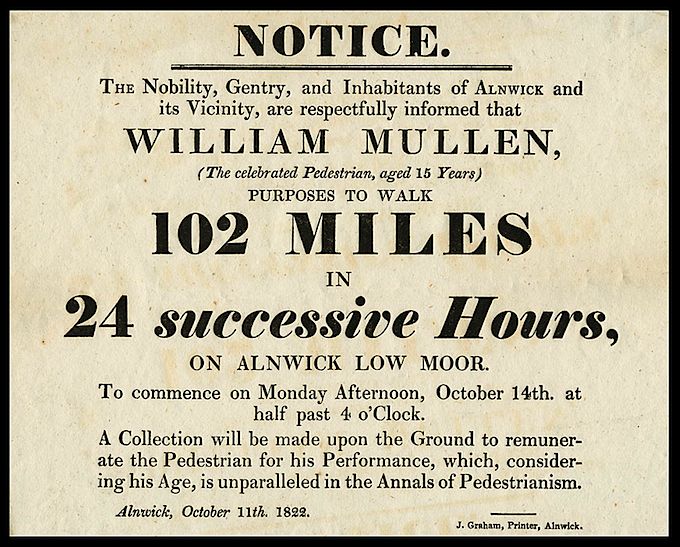
I received a comment recently and clicked on the website from which it originated to be pleasantly surprised.  It was from a site called Sheaff: Ephemera and is a fantastic collection of paper ephemera from the past.  It’s a huge collection of interesting advertising and printing and other things.  Bronzed shoes and coal carvings, for example.  Or a great assemblage of photos of people holding the fish they have caught.  There is a treasure trove of imagery for those who love the printed image and the beautiful colors and artistry often employed by printers of the past.  Well worth a visit when you have some time to browse the large group Mr. Sheaff has collected.

One of my favorites that I first came across was the notice shown above from 1822  for William Mullen (the celebrated 15 year old pedestrian!) and his attempt to walk 102 miles in 24 hours, an event unparalleled in the Annals of Pedestrianism.  I haven’t had a chance to check out the records for pedestrianism so I can’t tell you much about Mullen and this attempt.  Perhaps he was the Babe Ruth of  pedestrianism and somewhere, probably around Alnwick Low Moor, his name is still uttered with deep reverence.

The photo below is also from this site and really brings home how the world has changed in the 99 years since this photo was taken somewhere on the plains of America.  I find this a really striking image.


Read Full Post »

First, I would like to thank everyone who came out to the gallery talk at the West End Gallery yesterday.  It was a great group who made my task there very simple in that they began asking questions from the opening moments.  It made for a very fluid conversation which I think made for a more entertaining hour than me droning on.  Hopefully, most felt that it was an hour well spent and that they took something away from it.  I know I did.  Again, many thanks.

I came across this online the other day, a sculpture made from stacked galvanized pipe that resembles the form of a tree.  It’s located in the county of Lancashire in the northern part of England and is called the The Singing Ringing Tree.  It was erected as part of a project called Panopticons which featured several large pieces of environmental art across the county to celebrate its economic and cultural renaissance. 

Sitting on a hill overlooking Burnley, the pipe of this sculpture capture the winds and makes an eerie, discordant moan.  I can only imagine what the sheep or cattle in the surrounding fields think as they hear these almost groan-like emanations from the monolith above them. 

As sculpture, it may not be beautiful in the classic sense with the industrial feel of the steel pipes but it has a certain grace in the curves and lines of its design.  The sound that comes from it serves to more animate it.

Just a little something for your Friday.  Take a look:

Read Full Post »

Grieg Is a Headbanger

I came across this video from a band called Apocalyptica.   I had never heard of them before but soon discovered that it was a Finnish group that was formed in 1993 and consisted of four cellists who were all classically trained at the Sibelius Academy.  They are fairly popular in Europe and around the world. 

 And they play heavy metal with their cellos.

Okay.

I’m not a metal head so I wasn’t as intrigued as I had thought but I gave a listen.  Some was okay but could have been any metal group that had simply inserted cellos for guitars.  Interesting but not my cup of tea.

But a version they did of In the Hall of the Mountain King that Norwegian composer Edvard Grieg had written for Henrik Ibsen’s Peer Gynt caught my ear and made me think.  I wondered how someone like Grieg, who died in 1907,  would react to such a treatment of his music.  The more I listened the more that I thought he might have actually enjoyed it, might see that it captured some of the spirit of what he was offering in his original composition.  There is a cavelike quality to the arena setting.

Plus, from looking at a few pictures of Grieg I thought he might appreciate the fact that his music was being performed by a hair band.  In all the photos, Grieg’s hair seems to be a point of pride with him and I could almost imagine him throwing his head forward like the heayy metal guys do so that their hair flies forward then back in rhythm to the music. 

Or maybe not.

Grieg was not all that happy with this composition at the time, saying,  “I have also written something for the scene in the hall of the mountain King – something that I literally can’t bear listening to because it absolutely reeks of cow-pies, exaggerated Norwegian nationalism, and trollish self-satisfaction! But I have a hunch that the irony will be discernible.”  Maybe this treatment of his music would have pleased him from an ironic standpoint.

Anyway, here’s the Apocalyptica version.  It will either  have you banging your head or have your head banging. 

Read Full Post »

« Newer Posts - Older Posts »