Feeds:
Posts
Comments

Archive for the ‘Neat Stuff’ Category

Yesterday I mentioned Bryan Talbot and his book Alice in Sunderland.  One aspect of the book that I failed to mention was an interesting case he made about the beginnings of the British comic books genre.  He cites the Bayeaux Tapestry (which I have been meaning to highlight here for some time) as an early example of a story, the Norman conquest of Britain, being told through the use of pictures.  He also goes into an interesting discussion of  William Hogarth, the British painter/printmaker whose work, particularly his prints, were often serial in nature, telling a story by their relationship to one another.

Hogarth (1697-1764) is an icon of British art and a populist whose prints reached across many levels of British society, hanging in homes of many classes.  His work was often satirical in nature and dealt with pressing social issues of the time.  His most popular was Gin Lane, which was coupled with another print, Beer Street.  They were made in order to garner support fot the Gin Act of 1751 which was enacted to curtail the gin craze that had seized Britain for the first half of the 18th century.  Gin was inexpensive to produce and was sold cheaply.  At the time the average Londoner was purported to be drinking up to 2 pints of gin per week and authorities of the time felt that this was leading to idleness and moral decay.
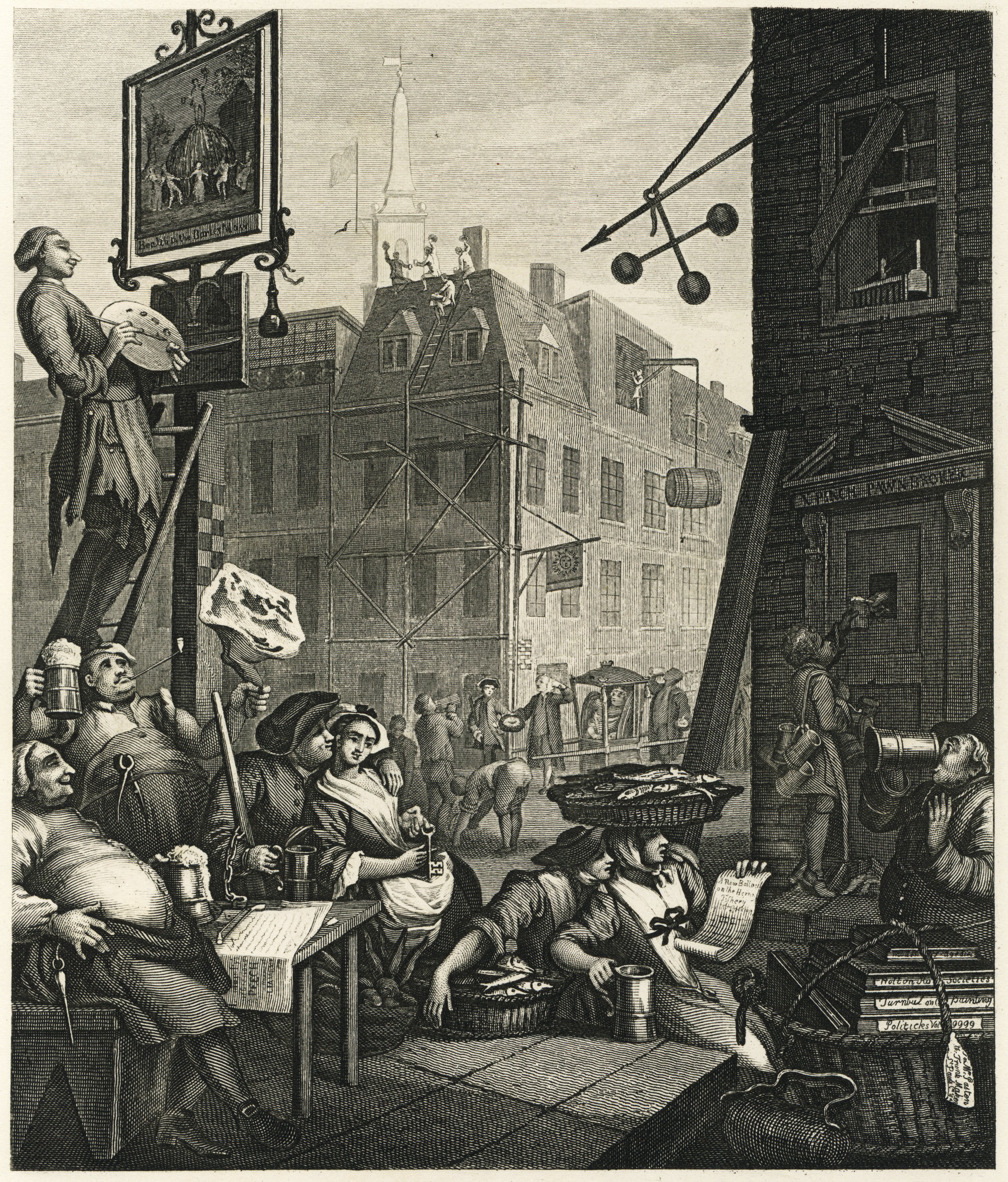
Hogarth dealt with the issue by showing the contrast between the accepted practice of drinking beer (considered safer than drinking the water of that time, given the unsanitary conditions) to the evils brought on by drinking gin. In Beer Street, Hogarth depicts the drinkers as well clad, jolly and fat– signs of health and wealth.  There is a sense of orderliness with workman at labor and all businesses being prosperous, except for the pawnbroker, whose building is in disrepair.  The artist who is shown painting the sign is in rags and is shown to be a gin addict through the detail on the smaller sign where he has painted a gin flask rather than a beer bottle.

The contrasts in Gin Lane are drastic.  Scenes of decadence and decay abound.  At the forefront is the drunken, bare-chested mother who has lost her grip on her child who tumbles over the railing down to an underground gin house. Her companion is an emaciated balladeer whose sheet music has the title The Downfall of Madame Gin.  In the background, the scenes are evn more lurid.  A barber hangs himself, his business failing because the gin addict spends all his money on drink, not haircuts.  A woman is feeding baby gin.  A man is gnawing on a large bone while his friend is so drunk that a snail has time to crawl upon his shoulder.  Buildings are in disrepair and falling down.  The only businesses that prosper are the undertaker, the gin houses and the pawnbroker, where a workman is pawning his tools for drink.  There are other signs of madness, as the detail shown here illustrates.

It’s pretty powerful stuff and Talbot does a nice analysis of the compositions of the two prints, showing how Hogarth creates a feeling of orderliness and calm with the strong vertical and horizontal lines of Beer Street and contrasts that to Gin Lane with a composition that features frantic motion with clashing diagonals.  There is little stability and chaos reigns in his composition.  Masterfully done.

The Gin Act of 1751 was written into law and by the mid 1750’s the gin craze had subsided, although many cite the higher cost of grain at the time which drove up the price substantially as a larger factor.

Whatever the case, Hogarth has produced two intriguing prints that have great interest even today.

Read Full Post »

I was having a discussion with a friend several weeks back about graphic novels and the use of illustration in storytelling.  As a result of our conversation, he loaned me this book, Alice in Sunderland by acclaimed British illustrator Bryan Talbot, which I have been poring over for the last few weeks.  It’s a massive enterprise, from a graphic standpoint, containing over 300 densely packed pages of intricate illustration. 

While mainly concerned with Lewis Carroll and his Alice in Wonderland story and the relationship of Carroll to the area of northeast England containing the city of Sunderland, the story goes into great detail about Carroll’s life and the lives of those who inspired the book.  It also tells much of the history, both real and mythical, of the Sunderland area, doing so in the fashion of a writer who loves his home area.

It is a treasure trove of information and story about many subjects, all told in surprisingly coherent manner.  When I first opened the book I was overwhelmed by the amount of graphic information my brain took in.  It seemed scattershot and all over the place at first glimpse but once I entered the mass of color, shape and word I found its composition sensible and functional.   Not to mention very informative.  It made me appreciate the amount of labor and research Talbot put into this work.

I didn’t think I would find the subject matter interesting at first.  I mean, what do I know of northeast England?  And while I admire Alice in Wonderland it is not my favorite childhood tale.  But Talbot’s ability to tell a tale with a mix of word and image and the interesting tangents he pursues make this a great read.  I find myself continually picking it up and rereading sections of it, taking in new details and sometimes simply enjoying the illustration.

So, if you’re looking for something a bit out of the ordinary, soemthing that will send you in all different directions as you’re reading, check out Alice in Sunderland from Bryan Talbot.  Good stuff…

Read Full Post »

Turner Classic Movies (TCM) starts a 24 hour marathon tonight  featuring the Our Gang shorts from producer/director Hal Roach

 If you’re not familiar with the Our Gang films (or The Little Rascals, as they were also known), they were a series of shortcomedy  films produced from 1922 up until the late 30’s that featured children as the stars of the storylines.  The children acted in a very naturalistic manner and the stories often had the kids, who were poor, at odds with authority figures and the wealthy.  For the time, there was surprising evidence of racial and gender equality in these films, with girls and young black child actors performing in  starring roles.  There was a level of stereotyping that may not be politically correct today but , at the time, this equality was new and ground-breaking in films.

For those of you who do know them, simply reciting the names of some of the gang are enough to raise some memories.  There was Spanky, Alfalfa, Darla, Chubby, Stymie, Buckwheat ( parodied in a huge way later by Eddie Murphy on SNL), Farina, and Dickie among the many children who appeared in the cast over the years. Not to mention Petey, the white dog with the black ring around his eye. 

I mention this not because of any special love for these films, although I saw and enjoyed most of them over and over again as kid.  I mention it because Hal Roach was a fellow native of this area, born and raised in Elmira, going to the same high school as me.   While known for the Our Gang films, Roach is perhaps better known for his Harold Lloyd and Laurel and Hardy films.  It is legendarily said that Roach’s path in life was greatly influenced by hearing Mark Twain speak at his school when he was a young boy.  Twain spent the better part of twenty summers here in Elmira, writing some of his best loved works from his study overlooking the city, and is buried in the same cemetery here as Roach, who died in 1992 at the age of 100.  I often wonder if those same Eastside Elmira streets above which Twain lived are represented in these Our Gang films.

So, if you get a chance, take a peek tonight or tomorrow at some true Americana.  The Our Gang films represent a unique time in our history and are entertaining,  to boot.

Read Full Post »

I am always fascinated with the need for self expression displayed by many folk or outsider artists.  There is a great purity in it,  a direct line to the artist’s inner drive and self that can’t be replicated with all the craftmanship available to the most trained of artists.  It’s just real.

I was reminded of this when I came across the painting shown here for sale on the Candler Arts website.  It’s a wonderful  nativity scene painted by the late Jimmy Lee Sudduth, a self-taught artist from rural Alabama who died in 2007 at the age of 97.  His drive to express himself started at an early age and, despite having few if any resources, was able to create paintings with pigments with the red and grey muds of his home soil.  In later years he used house paints and finally acrylic paints as his fame (he was fortunate enough to have his work discovered by the larger outside world) peaked.  But his lack of supplies or training provided no obstacles for his need to create. 

Probably a lesson there for us all.

I was immediately struck by this painting.  There’s a real sense of rightness about it that really resonates with me.  I don’t know if this is a mud painting or whether he was using house paints here but it doesn’t matter.  It’s simply a raw and real expession, something I wish that more us could capture with our own works.  To put aside craft and technique, or at least make them secondary to the expression of something deeper pulled from within.

Then we might be on to something truly special.  Like Jimmy Lee Sudduth.

Read Full Post »

It’s nearing the end of the year and I’ve exceeded my quota for inane words written so I’m just going to show a video from The Music Machine.  They were a mid-60’s band from LA that played a garage-punk brand of music that characterized their biggest hit, the Top 20 Talk Talk.  They were definitely products of the era with their helmeted hairstyles and their funky all black garb, complete with one single glove worn on the right hand of each band member, predating Michael Jackson by decades.  They didn’t make it out of the 60’s,  going through a couple of incarnations in the 4 or 5 years of their existence.

I was going to feature Talk Talk but I came across this little gem, their cover of Neil Diamond’s classic Cherry Cherry.  It’s a surprisingly cool and restrained version.  It’s got a little bit of everything.  Jazzy flute solos.  Go-go dancers in groovy threads doing some kind of  swaying low-impact calisthenics.  Neat 60’s backdrop.

Oh, it’s a happening.

But it somehow works.

Read Full Post »

I was looking earlier online for a video of the song Blue Christmas to accompany this little painting that I have used as a Christmas card in the past.  I wanted something other than Elvis’ version, which is the standard by which all other versions are judged.  I was amazed at how many different people have covered the song.  There are rock versions , big band and country versions from dozens and dozens of various artists from every segment of the musical spectrum that all seem to pay homage to Elvis’ particular take on the song.  There are different instrumental versions including a charming version on the harp played by a teen who is lamenting the loss of her homeschool teacher, versions from various handbell groups (I particularly liked the one from the Trinity University) and one on the ukulele from one of my favorites, the Ukulele Orchestra of Great Britiain.

It is an amzing array of sounds and styles that cover this beloved holiday song.  But I found one video entitled Blue Christmas that is another song altogether.  It’s features the trumpet of Miles Davis and the sax of Wayne Shorter and is even bluer in tone than the songs above.  Maybe it’s the odd little animation that accompanies it that gives it even a glummer feel for the holiday.  But it swings.

Take a look-

Read Full Post »

There was an interesting story on 60 Minutes last night about a condition that it is very rare called hyperthymesia where the affected individuals have superior autobiographical memory.  That is the the ability to recall practically every moment from their lives and all the events they encountered in those moments.  They are able to somehow, withoutany effort or without  resorting to the use of mnemonics of any sort, organize this vast store of memory and randomly pull the information out as needed.

It’s an extremely rare  condition with only 6 known cases in the USA, although there are probably many more out there who have not come forward for examination.  Actually, before this 60 Minutes story there were only 5 known cases.  Reporter Leslie Stahl, who was doing this report, upon hearing the effects of this condition thought it sounded like her friend, actress Marilu Henner, best known from her role as Elaine on the show Taxi.  She agreed to be tested and was added to the so far small group of individuals.

The story was fascinating.  If anything it raised more questions than it answered.  Would this be a good thing or a curse for those who possess it?  How does it affect their day-to-day life?  Does this recall have any effect on these individuals’ overall intelligence?  Is there a tradeoff of some sort for this ability?

These are not savants or people who are crippled by the seemingly compulsive nature of their condition.  The 5 of the 6 known cases that were shown (one did not want to appear as part of this story) all appear to be extremely high functioning people.  Besides Henner, there was a concert violinist, a radio talk show host, and  a man in the production end of the entertainment field.  The final man’s occupation was not disclosed. 

Only Henner was married or in a relationship.  Perhaps the inability to set aside another person’s flawed moments would hinder any relationship or perhaps there is a certain alienation caused by the condition that inhibits intimacy.  The concert violinist expressed a certain alienation when she spoke of feeling as though she were fluent in a language that nobody else knew, one that she couldn’t share with anyone.

Not mentioned in the story was a recent documentary film about one the subjects.  Called Unforgettable, the film, made by his brother Eric Williams, focuses on the life of Brad Williams who is a radio talk show host and is known as the Human Google Jeopardy super champion Ken Jennings makes an appearance.  I don’t know if they show the two of them competing but,  in his blog, Jennings talks of Williams “wiping the floor” with him when they ran into one another at a trivia contest at a local bar.  He also makes the distinction between the way his and Williams’ minds work, pointing out they are functioning in completely different ways.

I’ve been thinking about this ever since seeing it, wondering if it would be great to possess such an ability.  I obsess, as it is, over the loss of memory so why not be able to have such an organized brain that you could easily find that which was put in there to begin with?  Would it make our lives different?  The concert violinist made an interesting point when she spoke of it as a gift that allows her to live her life with great intention.  By that she meant that because she knew she would remember every moment she strived to make every day significant.  No throwaways.  An intriguing concept.

I feel like someone in the 1970’s who has Commodore computer and is suddenly given a glimpse of the best computer available in the year 2020.  Envious, but stuck with what I got.  Oh, well…

Read Full Post »

Wanderers

I wrote yesterday about the site Square America which is a great collection of everyday photography of all sorts from the last century.  I came across this photo in one of the galleries, Down By The Tracks, which features photos of railways and railway adjacent places.  This photo just caught my eye and made me stop.

It filled me with an inexorable sadness.  I’ve sat for a while looking at this photo and can’t fully explain how it makes me feel other than to say that. 

 The fading from age and probably a flawed camera or poor processing give this photo a ghostly feel, as though you’re watching lost spirits wandering in search of a final place to rest.  The fact that you can’t see the faces give this piece a greater sense of anonymity and the posture of the lady in the rear, with her arms set straight down as she shuffles forward, feels like hopelessness.

It’s an odd little picture and one that raises many more feelings than probably was meant when it was snapped those many years back.  There was probably at one point a series of photos that accompanied this photo and gave it context, filled out some sort of narrative for the people in and around the scene.  But taken from this context it becomes ghostly and forlorn for me. 

I wonder where they were heading and why they were walking the tracks.  Why did someone take a photo like this?

Read Full Post »

I love this site that I’ve recently come across.  Called Square America, it is a site dedicated to preserving vintage photos from the first 3/4 of the 20th century.  Not art photography but everyday family photos, police photos and other vernacular photos of the time.  These photos give a beautiful narrative to life in America during this time and are really engrossing.  I could spend hours just browsing through the many galleries.

There are many, many great galleries of photos coveing a multitude of subjects, some that contain police mugshots, photos that chronicle  television coverage of JFK’s funeral (actual pictures of a TV!) and, my favorite, the ones that have photobooth pictures that play as a slide show to give the effect of moving pictures.  If you click on the photo above you will see a great example as the young girl ages through the pictures until she is well into middle age. 

The creator of this site is Nicholas Osborn who also has a book of these photos that he compiled in collaboration with photographers Michael Williams and Richard Cahan, called Who We Were.  It looks like a great, albeit late, gift for those who love such things as Americana and how we lived in the last century.

If you can find a few minutes to just browse a bit, check out this site.  There is definitely something for everyone.  Here’s a beautiful Christmas memory from their site.  I think it might have been inspired by the poor little tree from A Charlie Brown Christmas.

Read Full Post »

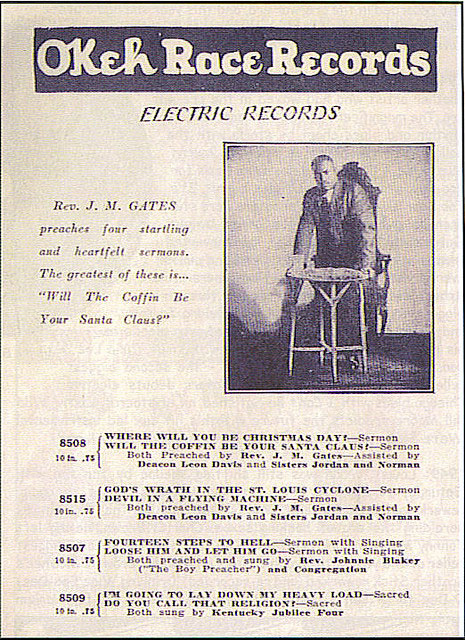
Last night on The Colbert Report, Paul Simon appeared and played a new Christmas  song called Getting Ready For Christmas.  Before singing he explained that it was based on a sermon from December of 1941, in the weeks after Pearl Harbor.  The preacher was the Reverend J.M. Gates, a fire-and-brimstone Baptist from Atlanta who was famous for recordings of his sermons in the years before his death in 1945.  I don’t know much about him.  Actually, I had never heard the name before last night.

But the song Simon played was pretty good and there were samples of Gates’ recordings in the background at certain points in the performance that intrigued me.  I don’t know exactly which sermon Simon sampled but there are several examples of Gates’ work online.  One, Death’s Black Train Is Coming, was his bestseller and is a great example.  My favorite however is Hitler and Hell which plays very well in the video off the sound of the footsteps of the jackbooted figure that goes through the darkness in it.  I’m thinking that one of the recordings in the advertisement shown here might be the one used in Simon’s song.  Will Your Coffin Be Your Santa Claus! sounds like it might be the one.  Funny, that with such a catchy title it never caught on like Jingle Bell Rock or  Grandma Got Ran Over By a Reindeer.

Anyway, gives a listen to the Rev. Gates, if you are so inclined and here’s Paul Simon’s new song, Getting Ready For Christmas.  It’s a very watchable video.

Read Full Post »

« Newer Posts - Older Posts »