Feeds:
Posts
Comments

Archive for the ‘Neat Stuff’ Category

Chang and Eng Live On

When I was a kid I had a copy of the Guinness Book of World Records  that I read unti it was dog-eared and tattered.  It featured many prodigious and  ridiculous feats performed by folks from around the world but also reveled in human oddity.  The tallest man in the world.  The fattest twins.  Things like that. I always remember it as the place where I first saw the photos of Chang and Eng, the original Siamese twins who gained popularity in the midcentury 1800’s as an attraction with the P.T. Barnum shows. 

The child’s imagination struggled to figure out how they accomplished the little things we take for granted while being attached to one another.  It all seemed such a great obstacle, the trouble it must’ve been in doing something so basic as going to the bathroom. Or anything, for that matter.

Yet, they persevered and prospered wonderfully in this country, despite their obvious handicap.  They married and had 21 children between them.  I’m sure their wedding bed was a crowded affair.  But they were more than circus freaks.  They stressed integrity and intelligence and became known as shrewd businessmen who maintained a successful plantation in Mount  Airy, North Carolina which you may know as the de facto location of Mayberry, the fictional small town Utopia from the Andy Griffith Show.  Barney Fife and the Siamese Twins!  Imagine the possibilities!

Of course, this was long before the time of Barney and Andy and Opie.  In fact, it was before the Civil War and the twins, in fact, owned a number of slaves and supported the Confederacy in the conflict.  Two of their sons fought for the South.  After the war, they lost much of their property to the government .  They died within  hours of one another in 1874.

I bring this up because I just read that Alex Sink, the Democrat from Florida who is leading in the polls in the gubernatorial race there, is the great-granddaughter of the twins.  I thought that this was an interesting sidenote to this election season, one that doesn’t involve yelling and character defamation.  It is a great example of the American Dream, the descendent of immigrants (yes, immigrants!) who came here and succeeded despite the many obstacles they faced, leaving a legacy that brings one of their ancestors to the doorstep of a high office in government.  What a great story in such a shrill time!
Read Full Post »

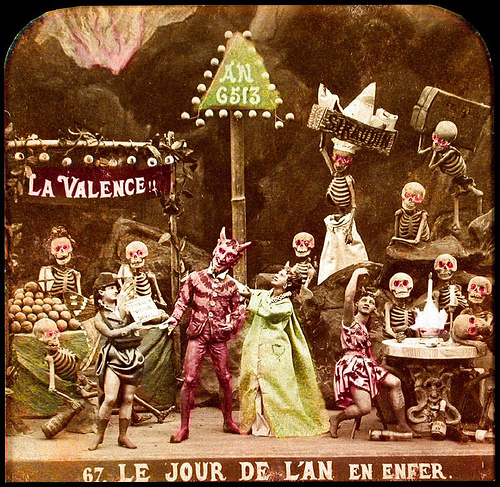
I received a comment on yesterday’s post about the Victorian era stereopticon plates  that mentioned the year 6513 that was in one of the photos, New Years Day in Hell,  from the Les Diableries series that I was highlighting.  He thought the significance of the date was in indicating a very distant date that suggested eternity.  Sounded good to me.

But I began to think and was wondering if this date had to do with some prophecy, some Mayan calendar or Nostradamus thing.  After all, if the Mayan calendar ends on December 21, 2012 ( when doomsayers predict an end to our time on Earth), New Years day in 2013 would be pretty hellish.  At least I would think.

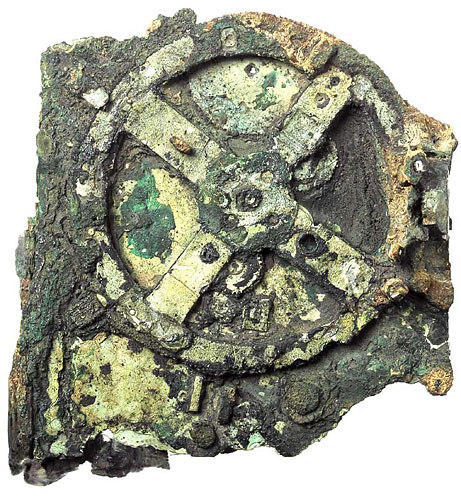
So I looked up dates and tried to figure some significance for 6513, thinking that the calendar used in such predictions went back that far.  But I came up with nothing.  Seems the Mayan calendar is in the 5200 year range.  But as I was looking it up I came across the Antikythera Mechanism, which I have always found incredibly intriguing.

The Antikythera Mechanism, considered the first known analog computer, was found in a box in an ancient shipwreck found off the Greek island of  Antikythera in 1900.  The mechanism was a mystery from the beginning and remained so for decades until technology allowed the device, heavily cemented from being deeply buried in the sea for millenia, to be scanned internally and dated.  It is dated back to about 150 BC and appears to be a very sophisticated device for ascertaining the location of the planets and moon and sun ( along with eclipses) at any given date.  It is complex and finely machined, predating modern clockmaking by about a thousand years. 

I find this amazing and just a bit more proof of how we often we are wrong when we view ourselves in this time as being so intellectually superior to times past.  We may have expanded our base of knowledge and our use of technology but at the base, the brilliant minds then would be the brilliant minds now.  The capacity for thought and intellectual inquiry has not grown over the eons, nor has our capacity for performing barbaric deeds diminished.  In fact, this mechanism shows that we have changed far less than we would like to believe, despite our advances in science and technology.  We are, at the core, the same as we’ve always been.

I don’t know if that’s comforting or sad. 

I would hope that 2000 or 3000 or 4000 years would find us more evolved, less tied to our baser self, less prone to stupidity and viiolence.  But it doesn’t.  We are no more civilized or intelligent than the folks who conceived and built that ancient device.  I guess that’s sad.

Well, now that I’ve depressed you,  here’s an animation of how the mechanism is assembled…

Read Full Post »

Les Diableries

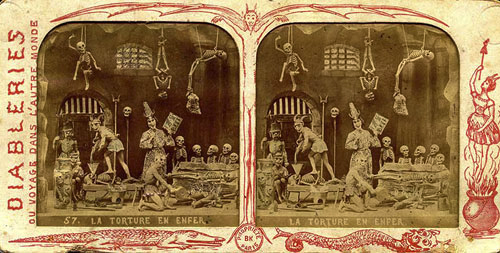
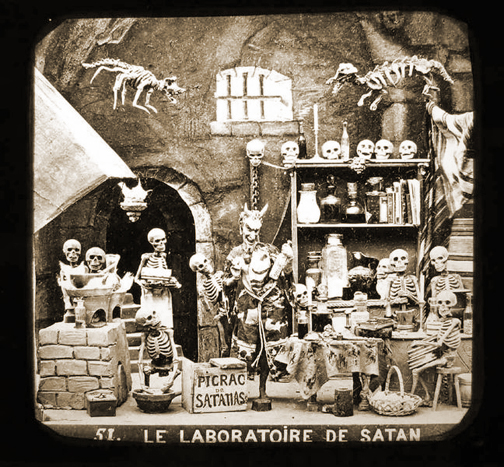
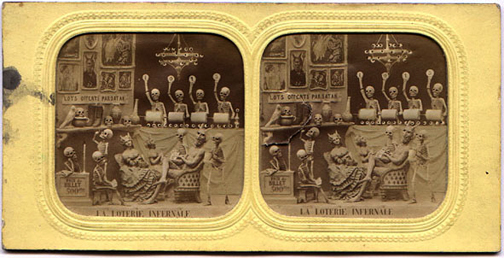
I came across these photographic oddities and thought they would be fitting in this week that ends with Halloween.  The stereoscope was invented in Paris in 1850 and became a worldwide sensation over the next decade.  In 1861, a series of 72 of these stereoscopic photos were printed anonymously in Paris that consisted of macabre scenes of Satan and various aspects of Hell.  Called Les Diableries, these plates were a drastic turn away from the often mundane photos seen in early stereoscopes and were quite the hit in 1860’s Paris.

The photos remained anonymous in that time because they were viewed as politically satiric of the French government of the time, the Second Empire under Napoleon III.  To openly chide the Emperor at that time could bring dire consequences but the images circulated freely, nonetheless.  I think they are a remarkable set of images from that time and I can imagine how they must have resonated in the minds of people who weren’t exposed to the mind-boggling array of imagery that we often experience in a single day in our time.

Read Full Post »

Last week, I picked up Rolling Stone: Cover to Cover, a set that includes a book on the history of the magazine and a digital archive that includes every issue from 1967-2007.  When it arrived I installed the viewer on my computer and within a few minutes was knee deep in an issue from the 70’s. 

I haven’t read Rolling Stone for many, many years now except for the random article or interview that I pick up online.  It’s just a little too slick and polished now, at least in my perception.  But looking back at these old issues brought back what I saw in the magazine as a young man.  The issue I was viewing was from 1971 and has the frantic, ink splattered drawings of Ralph Steadman illustrating a serialization of Hunter S. Thompson’s Fear and Loathing in Las Vegas, a book that I used to read every year or so with great glee.  If you’ve read the book, you know how perfectly the drawings mesh with the story.

 Leafing through on the computer screen, I could almost feel the rough newsprint of the paper. 

Inside, it came back immediately.  The ads for Marantz tuners and Ovation guitars.  The classifieds at the end of the magazine with multiple ads for rolling papers of all sorts.  Ads hailing new albums from bands long gone and sometimes barely remembered.  An ad offering any 2 Rolling Stone albums free with a subscription to the magazine.   It was like dropping back into a time, as from a time machine of sorts. 

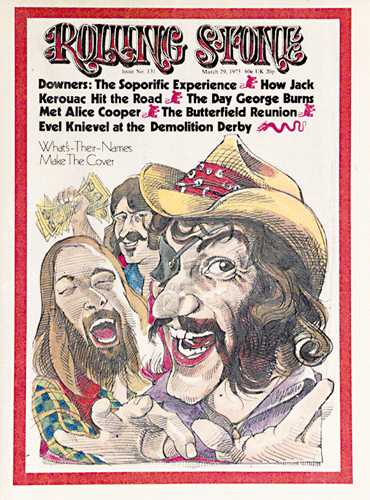
Dr. Hook Finally on the Cover of the Rolling Stone

But the thing that struck me most was the amount of print on the pages.  It was jammed with page after page of print.  Oh, there were ads and pictures.  But it was primarily the written word.  I had forgotten how long their articles were then, how the interviews sometimes went on for 12 or more pages and were truly in depth. It was wonderful to see all those words and sentences and paragraphs. 

 It made me wish I still had an attention span.

Perhaps in the dead of this winter, when the snow is piled up and I feel like idling away a few hours, I will be able to muster up a remnant of my existing attention span and read more of those pages.  But for now, I just jump in here and there when I have a minute and browse, taking in the artifacts of our culture and my youth. 

And hum along to Dr. Hook’s refrain that’s playing in my head—-Gonna get my picture on the cover, gonna buy five copies for my mother…

Read Full Post »

I went to an opening last night at the West End Gallery for a memorial exhibition of paintings by the late Tom Buechner and an accompanying display of work by the many, many artists who painted with or studied under him.  It was a great show and was heavily attended.  A fitting tribute to Buechner, whose influence in this area has been immense.

At the opening a friend, Brian Hart, who is a great talent of a painter, told me I should stop over to a local arts center, 171 Cedar Arts, to see an exhibit by artist Dave Higgins.  It was a show of illustrated pages and Brian said it was incredible.  After a short while at the West End, Cheri and I snuck out and headed over to 171.

I have mentioned Dave Higgins before in this blog in a post about his Yellow House painting, which he has painted over a hundred times.  He is incredibly talented and creative with a slightly skewed sense of the world that often shows through in his work. We share a love of goofy pop culture, such as Hee Haw .

 I remember sitting in for the owners of the West End many years ago and selling one of his paintings to an older couple .  It was a dark night scene of the city of Corning as seen from a neighboring hilltop.  In the sky above the city was the perfectly rendered head of a red demon with tongue extended.  It could have been awful in the wrong hands but in Dave’s care it became a wonderful painting, with beautiful color and feel. The couple that bought it were an elderly couple who were just swept away by the piece.

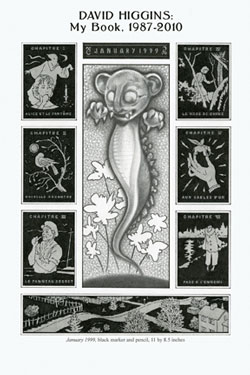
This show, David Higgins: My Book 1987-2010, features pages much like the one shown above from the show’s postcard.  Dave started doing at least one of these pages per month back in 1987 and over the years has amassed a treasure trove of these pages.  They are remarkable.  Each page is so different from the next and each shows multiple styles and influences that boggle the mind of someone like me.  Some are purely in black and white while others have rich color.  There are little stories and narratives on some pages and wonderful wordplay throughout.  One of my favorites was a page with the headding that read “Lester, Said Hester, Let’s Pester Sylvester“.   There are references to pop culture and literature, with much of the work influenced by one of three things– children’s books, the Head Comics of the 1960’s and 70’s and the Beauty Books of early 1900’s, which were produced to illustrate the quality of a publisher’s printing process.

I came out of there in complete awe of his creativity and talent.  It is always daunting to look upon a grand expression of talent obsessed.  I wish I had more sheets to show because I know my words lack the impact of the work itself.  If you’re in Corning before the show ends on Novemebr 12, do yourself a favor and stop in at 171 Cedar Arts.  I’m hoping that Dave publishes these as a group soon so that the rest of the world can discover this work that we are so fortunate to experience.

Read Full Post »

Stats

The Work of Hundertwasser

I’ve been doing this blog for just over two years now.  I write something every day although to be honest, there are a lot of days when content is less than I would hope.  But I try to do something everyday just to maintain the discipline.  The site recently went over a million hits and gave me cause for a little investigation of where some of those hits came from over the past two years.

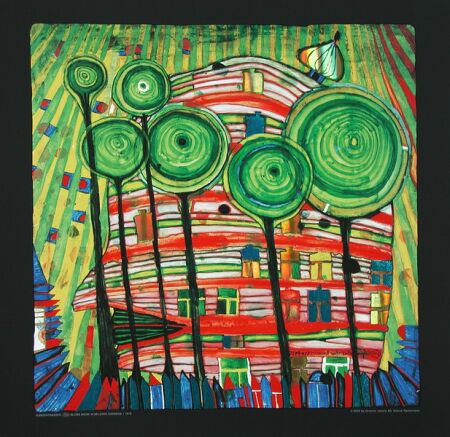
By a wide margin, a post on the work of Friedensreich Hundertwasser from August of 2009 has been the most popular post.  It still receives about 100 hits a day and over 21000 hits overall, a testimony to the great attraction of the late painter’s work.

Urwald Mit Tigern- Henri Rousseau

Several posts on other artists also continue to pull in substantial numbers of hits.  One on Henri Rousseau has consistently attracted a large number of views as has one on the wave paintings of Hokusai.  Another on the densely textured paintings of Ivan Albright is another consistent favorite among visitors.

One of the posts that also draws a large number of views on a consistent but sporadic basis is one that I did on the ridiculous uproar over Barack Obama’s birth certificate.  It will mosey along pulling in a few hits here and there for months then suddenly get 70 or 80 hits a day for a week or so, shadowing the activityof the birther movement at the moment.  This amazes me.  I still occasionally get comments  from some loonies who want to argue the point, almost 18 months after its initial appearance on the blog.  I moderate most of them out now, not wanting to continue this absurd argument and refusing to give it credence by engaging in heated debate.  I guess it’s just another example that shows how intensely these people refuse to believe that Obama is our president.

It’s always interesting to examine what triggers response in readers and viewers.  Whether it’s just a matter of curiosity or whether I will use the info in some way in the future is debatable.  I’m just glad folks continue to stop in.

Thanks.

Read Full Post »

Sweet Home Helsinki

I was feeling like something light and perhaps musical this morning when I came across this.

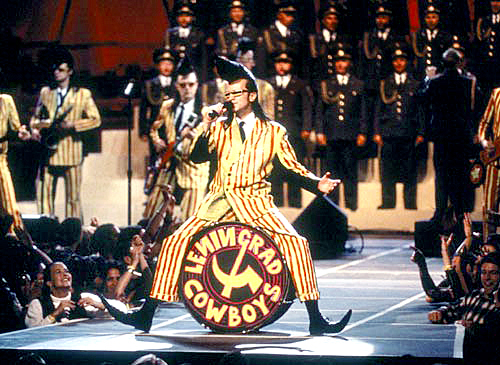
The Leningrad Cowboys.  From Finland.

With the Russian Red Army Ensemble and Choir.

Singing “Sweet Home Alabama.”

What could be better?

The Leningrad Cowboys are actually a sort of Spinal Tap-like creation that starred in a couple of Finnish films a number of years back and evolved into a real band.  Of sorts.  Whatever the case, it’s fun to watch.  Where can I get some of those shoes?

Read Full Post »

Off the Coast

Another one of the interesting things that came from Saturday’s talk at the Principle Gallery was a photo that was given to me by one of the audience members.  After the talk a young man named Nathan approached me and told me he had been on a boat off the coast of Venezuela when he saw this sight.  He immediately thought that this was one of my trees and snapped a shot with the disposable camera he had at hand. 

I’m glad he did.

I’ve always maintained that the locales of my landscapes are imagined.  It’s really interesting to see a photo that shows that there are trees and places like those represented in my work, that they are possible.  I wonder if there’s room on that tiny island for me?

Thanks for the photo, Nathan.

Read Full Post »

In a recent post on WestEndTalk, the blog of the West End Gallery, artist Jeff Perrault wrote about how a piece of art is best seen when viewed under the proper conditions and the proper setting– framing was the point of his article.  Without the correct frame, a fine piece of work can sometimes be overlooked.

He cited a social experiment done by a Washington Post reporter, Gene Weingarten, back in 2007, one that I had missed.  In the experiment, one of the great violinists of our time, Joshua Bell, showed up on the Metro platform at L’Enfant Plaza in Washington.  He was as shown in the photo here, in a long-sleeve T-shirt and a baseball cap.  Nothing denoting his stature as a musician.  Well, maybe the $3.5 million Stradavarius he was playing was a giveaway but who among us would have noticed?  I mean, jeesh, the thing doesn’t even have a decal on it.

So there he was with his violin case on the floor in front of him, open and waiting for the money to start pouring in.  He started playing selections of Bach.  Part of the experiment involved him playing music that was extremely difficult, to show his virtuosity to the crowds.  For 45 minutes, he played  and at no point did he attract anything close to a crowd.  The busy commuters rushed by, coffees in hand and cellphones at their ears, never noticing the extraordinary talent on display for free, far less than the $100 tickets often charged for his normal shows.  Most people didn’t even glance his way, let alone stop.

It came down to context.  Many of those folks scurrying by could have and would have appreciated Bell’s music had they heard it in a setting in which they were expecting the performance.  It made me wonder about how many times I’ve passed by someting extraordinary simply because it was out of context, thus changing my perception of it. 

 I know this happens in a lot of cases.  One of my favorites spots in NYC is the lobby of one the Equitable Center’s building, the one on the Avenue of the Americas.  The three walls are filled with Thomas Hart Benton’s epic mural, America Today.  It is spectacular, a celebration of the breadth of American life filled with motion and magnificent color.  It never ceases to take my breath away.  Yet, day after day thousands and thousands of people passby outside those windows and through the lobby itself, many never giving it a look.

Context.

I want to try to look beyond context and just see things as they are but it is difficult in this busy world.  But I am going to try.

Read Full Post »

I watched a documentary last night on ESPN, Little Big Men, that tells the tale of the Little League team from Kirkland, Washington as it marched through the 1982 Little League World Series to face  and defeat the mighty Taiwanese team in the final game.  It was considered a huge upset at the time as Taiwan had thoroughly dominated the World Series for the past decade, winning 9 times out of 11 years.  The only time they didn’t win came in a loss to champion Japan one year and in 1975 when foreign teams were temporarily banned from competing.  Apparently, the Little League wasn’t quite committed to the term “world” in World Series in 1975. 

It’s a nice documentary of a group of kids accomplishing big things.  All of the team members carry great memories from their experience but the documentray is not just about the glory of the moment.  No, it’s concerned more with the aftermath and the treatment of one player, Cody Webster, by other parents.

Cody Webster was the big star of the 1982 Kirkland team.  He was a 5′ 7″, 174 pound 12 year-old who threw the baseball hard and hit it even harder.  In the final game, he baffled the Taiwan team with his fastballs and curves  and at the plate hit a tape-measure homerun that sealed their fate.  After he struck out the final Taiwanese batter, his teammates poured onto the mound and he carried his first baseman in one arm like a child.  He certainly seemed larger than life.

But he was simply a 12 year old kid who wanted to just be part of the team, not be the big star.  Even at the time, he expressed concern that his teammates weren’t getting the recognition they deserved, that there was too much focus on him. 

And there was focus on him.  Parades.  Rallies.  Television appearances.  It was pretty heady stuff for a shy 12 year old.

But the worse part came soon after.  His celebrity made him a huge target.  In the years after, as he competed in baseball, other teams wanted to beat the kid who won the World Series.  In their minds, to beat the champ made them the champ, which is all fine and good.  However, the parents of these other  teams took it to another level.  Cody Webster was swore at repeatedly and even spat on by opposing parents.  In the documentary, one of his teammates broke down in tears, recalling all the terrible taunts Cody had to endure as a kid but saying that he was glad that it was Cody, of all the team members, who had to take it because he was the only one of them who could have endured it.

And he did.  Thankfully, this is a cautionary tale that doesn’t have a tragic end.  Cody doesn’t end up dead or living in a cardboard box.  He did give up baseball several times in this teens until throwing it in for good as a college freshman.  As he said, he was a good baseball player at 12 but not at 17.  The fun had left the game with every curse hurled at him as a 12 and 13 year old until the joy that was so apparent in the team’s victory seemed like ancient history. 

But he did endure.  And as he says, it’s okay.  He coaches and instructs elite players in the Seattle area now and I’m sure he has a lot to pass on about handling the pressures put on these kids by parents with grand expectations.  Adults who take the joy out of a little boy’s game.

Read Full Post »

« Newer Posts - Older Posts »