Feeds:
Posts
Comments

Archive for the ‘Neat Stuff’ Category

Well, it’s Saturday morning and I think I’m in line for some higher culture this morning.  A little music,  maybe operatic.  A little “O Sole Mio” perhaps? I could easily listen to some Pavarotti or  Placido Domingo singing out their guts.

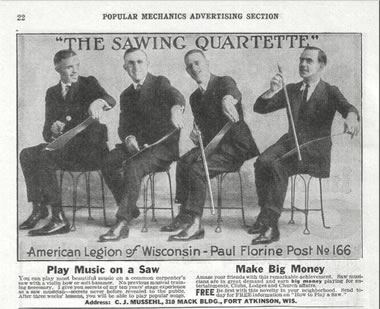
Sure.  But to get the real feel for the song it should be played on a saw.

Here’s Austin Blackburn on saw.  I don’t know if the saw is a Stradavarius or a Craftsman but it’s a bit of highbrow fun on a nice Saturday morning.  Have a great day…

Read Full Post »

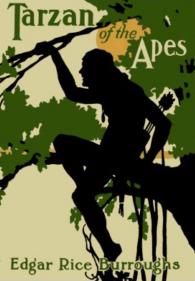
I’ve got a busy Friday lined up so I’ll simply send out a Happy Birthday to Tarzan.  He turns 98 years old, published first by author Edgar Rice Burroughs on this date as a magazine serial in 1912.  I’m sure he swings through the trees a little slower these days and his trademark yell is a little weaker at his age.

This story of a child of a British lord who is orphaned in the wilds of Africa and raised by apes has triggered the imaginations of fans in the near century since 1912, with each generation resurrecting him in some form, in comics and on film.  Most recently he was the animated hero a Disney film but first hit the big screen back in 1918.  Of course, his portrayal by Johnny Weismuller is the one that springs first to most minds. 

I don’t know what it is about this feral manchild that sets our minds a-whirling.  Perhaps it’s the idea of living outside the reach of the modern world, living by the laws of the jungle. I mean, he makes it look a pretty sweet gig, with all the swinging and swimming and such.  Of course, while many of us dream of such a life, most of us are afraid to walk through the park in the dark.  But it sounds good.

Whenever I see tarzan on film, I always wonder why he bothers to shave as meticulously as he does.  I have a hard time shaving on a good day.  But maybe that’s what makes him who he is and me who I am.  He is, after all, King of the Jungle.

Happy Birthday, Apeman…

Read Full Post »

It’s very early Sunday morning and there’s the sound of rain falling outside the windows of the studio.  Still dark and the rain provides a steady rhythm section of sound as it rolls off  the leaves of the trees and the roof.  Very organic sound that makes me think of music.

I’ve come across a neat video from 1939 featuring Django Reinhardt along with his Quintette du Hot Club de France, featuring violinist Stephane Grappelli.  It’s sort of a very early music video.  It’s a great chance to see Django’s two-finger playing which has been a huge inspiration to generations of guitarists.  It’s also a great chance to see the unique Selmer guitars used by the band’s members, which had the very distinctive oval and D-shaped soundholes.  Django’s influence can be seen in the guitar industry today as luthiers around the world still try to reproduce the Selmers that Django made famous but ceased to be made after the early 1950’s.  The guitar shown here is a Selmer replicant from Manouche and is as beautiful a piece of craftmanship as you’ll see.

Anyway, here is the acoustic sounds of Django and the Hot Club.  Organic sounds for an organic morning…

Read Full Post »

In the area where I live,  near the the NY/Pennsylvania border just south of the Finger Lakes, there is a great monthly magazine called Mountain Home.  It’s a beautifully produced and edited magazine that is free, distributed through grocery and convenience stores and a variety of other outlets throughout the Northern Tier of Pennsylvania and the Southern Tier of NY.  When it first came out several years ago, I was immediately taken with the quality of the writing about local stories.  The writers really focused on real storytelling, giving the stories of local people and places real depth and interest, exposing aspects of everyday life here that are often overlooked.  Just plain good writing.

A rare thing in modern journalism of any kind.

Turns out there’s good reason for this.  The publishers are a married couple, Theresa and Michael Capuzzo, who had both been journalists in the Philadelphia area and relocated back to Wellsboro in Tioga County, PA, where Theresa grew up.  Michael had been a police and crime writer for the Philadelphia Inquirer and the Miami Herald, nominated four times for the Pulitzer Prize and the winner of numerous other awards for his writing.  He is also the author of Close to Shore, the bestselling account of the summer of 1916 when Great White shark attacks along the northeast coast were epidemic, providing the inspiration for Jaws.

More recently, he has a new book out, The Murder Room, which has been garnering tremendous reviews and media coverage, including a recent ABC special cenetring on the book’s main character.  It is the real-life account of the Vidocq Society, a group of the best detectives and forensics experts from around the globe who meet monthly in Philadelphia where they go over and attempt to solve the most baffling cold cases, on a pro bono basis.  You can read an excerpt from the book as well as an interesting article on the main character of the book by clicking on the magazine cover above and going to the Mountain Home website.

The great writing and editing of the Capuzzos and their staff has been a real gift to this area.  They shine a flattering light on the places, people and history of this area and make me proud to call it home.

Read Full Post »

I try to keep up with pop culture but it spreads so far to the horizon that sometimes there are phenomenons that go unnoticed in my little world.  It took seeing a clue on Jeopardy ( a year old repeat, at that) to bring this YouTube sensation to my attention.

It’s called The Evolution of Dance and has been viewed  almost 150 million times in the past few years, making it the most viewed video ever on YouTube.  It features motivational speaker/dancer Judson Laipply going through quick takes on pop dancing and while it’s pretty clever and entertaining, and while hedoes have a knack for communicating with his movement, I still find myself baffled at the huge popularity of the video. 

Even more baffling, and startling, is the amount of time spent watching this video.  Doing some quick math, the time spent watching this 6 minute video 150 million times amounts to 15 million hours.

Wow.  15 million hours spent in front of the computer screen to see just this.  Taken out even further, it’s 625,000 days.  Talk about lost productivity!  It makes one wonder about how we spend our time.  I know I feel like I’ve lost hige chunks of my precious time on earth gazing at much too much goofy stuff.

Anyway, if you’re one of the last people to have not seen this or heard of it, here it is.  Sorry for the lost time.  I know it’s 6 minutes I’ll never get back.

Read Full Post »

The Raised Fist of Protest

Fist by Frank Cieciorka

On the television show History Detectives on PBS, there was a story investigating a protest poster that was made around the time of the famous protests surrounding the Democratic Convention in Chicago in 1968.  It featured two images, one a glowering police officer in helmet and sunglasses and the other this fist.  The segment went on to examine further how the image of the fist evolved and became one of the most powerful symbols of the protest movement of the time, used by the Black Panthers and multitudes of Labor movements as well.

They gave the name of the artist who was responsible for this iconic image, Frank Ciecorka, but gave little  information on the man or his life.  I wondered what became of him or what  his work was like after the 60’s. Looking him up, I found out that Ciecorka was raised just down the highway from here, in Johnson City, NY, leaving after high school to head to California to go to college.  He became involved with the Civil Rights Movement , organizing African American voter registration in Mississippi at the time of  of the infamous murder of the three student organizers that was later portrayed in the film Mississippi Burning.  It was this time spent in Mississippi that sparked Ciecorka to produce the famed fist.

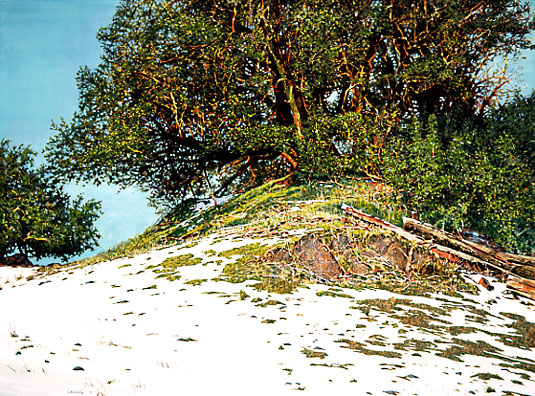
Pepperwoods, Snow-- Frank Ciecorka

The interesting thing to me was seeing his other work after that era.  It turns out Ciecorka became a modestly well known watercolorist living in a rural area of California.  The work was very traditional and well executed.  Quiet in tone. Hardly radical at all.  Looking at them said a lot to me.  This was a man who was branded a radical at one time but was simply a person seeking peace and quiet for themself and others.  Not an idealogue.  Wanting to give others the same rights and freedoms he had experienced in his life put him at odds with those who sought to oppress or exploit others.  Wanting to do the right thing became a radical idea.

Frank Ciecorka died in 2008 at the age of 69.  His  image of a fist raised in protest, however, lives on as a symbol of the power of the common people to fight oppression.

Read Full Post »

Yesterday marked the 50th anniversary of the publication of the classic children’s book  Green Eggs and Ham from Theodor Geisel, better known as Dr. Seuss.

  I grew up in the heyday of  Dr. Seuss in the 1960’s and his strange characters and clever wordplay seem as familiar as breathing, so ingrained were they in the popular culture of the time.  Everyone knew the Grinch and the Cat in the Hat but the sheer simplicity and rhythm of Green Eggs and Ham always made it my favorite.

Using only fifty words with all but one being monosyllabic, Geisel created a book that is not really a story so much as a mantra of sound and rhythm.  There is some strange human element, an allure,  in it that I can’t put my finger on.  Whatever the case, I have a huge place in my heart for the simple words of this book.  Fifty years dosen’t seem like too long a time for the timeless.

Perhaps one of the best readings from the book came on Saturday Night Live in 1991.  It was the week after Dr. Seuss died and in tribute the Rev. Jesse Jackson did a dramatic reading .  It is a classic…

Read Full Post »

The Mothers-In-Law

Sometimes when I’m looking for something for this blog I come across other things that distract me like a shiny object flashed in front of an infant.  Whatever I was seeking is forgotten and I’m off on a new tangent.  Such is the case today.

I was looking for a piece of film of a 60’s garage band when I stumbled on this.  It’s from the short-lived television series The Mothers-In-Law which ran from1967-1968.  It was an unremarkable but funny sitcom starring Eve Arden and Kaye Ballard as mismatched in-laws of a young married couple.  I remember watching it as a kid and enjoying it but can’t remember anything specific.  It was just there.

I only bring it up because of this clip featuring the TV family somehow hosting the 60’s band The Seeds in their living room, where the band performs their garage classic Pushin’ Too Hard.   It’s a great bit of kitschy television, the kind of moment that the 60’s TV often produced.  It’s almost as good as the clip from the Mike Douglas Show with a performance of Mustang Sally by a band called The Cavemen, dressed in goofy Fred Flintstone costumes.  What the heck, I’ll throw that in as well.

Read Full Post »

Today is the first day of  our local County Fair.  The Chemung County Fair is in its 168th year and for a good part of my youth was the high point of the summer.  I wasn’t in 4H and had little to do with farming, so outside of quickly racing through the barns to look at the prize cows and chickens, I wasn’t there for any of the agricultural aspects of the fair.

No, I was there for the Midway.  The whirling  rides, the challenging games and the lurid shows— it all conspired to trigger the maximum emotional response for a twelve-year old kid.  Or a thirty year old man with a twelve-year old’s brain. 

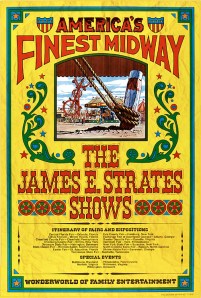
Every year at the beginning of August, the James E. Strates train pulled into town, 61 railcars packed with rides and all the paraphenalia it took to put on the spectacle.  Their carnies were easy to spot at that point.  Guys with greasy hair and cigarette packs rolled into the sleeves of their grimy white tee-shirts.  Crude tattoos running up their arms that were deep brown from a layer of  dust and spending their days in the full sun, tending to the machines that ran this carnival.  I always remember a tooth being absent in the smile of many of them.

These carnies would soon have all the rides assembled with their creaking  and spinning parts that didn’t give you the greatest feeling of confidence that they would remain intact as they whipped you through the hot summer nights.  They were adorned with flashing lights that raced all around the rides and many had blaring rock music to just add to the visceral overload of the experience.  I still associate the Foghat’s Free Ride with the Himalaya, one of the more popular rides at the fair.

Then there were the shows with their barkers, their voices crackling over their little speakers as they tried to lure you into see the Gatorboy or the World’s Smallest Horse or some poor hybrid creature (half chicken – half cat!) that you could hardly see and never moved, leaving you with a seed of doubt that it was even alive.  The barkers cajoled, they insulted, they prodded– whatever it took to get you into their tent. 

The biggest crowds were, of course, at the tent with the peep shows with the showgirls. They would parade out a girl with piled hair,  heavy makeup and a skimpy, glittery outfit to tempt the assembled men with the promise  of much more inside.  I was too young to go in and always wondered what really went on in there.  There was a book out several years ago (can’t remember the title or author)  that examined this cultural aspect, the county fair peepshow, and revealed that it was even more lurid than I imagined at the time.

I was a big games guy, trying to win the rich treasure trove of prizes they lured you with.  Off-off brand transistor radios.  Pepsi bottle vases with long stretched necks.  Ceramic unicorns.  More ashtrays than you can imagine.  Oh, I just had to win that stuffed snake doll!  And of course,  the games were almost impossible to win, with their tight, smaller than normal  rims that kicked out your basketball before it could find its way to the bottom.  Or the fruit baskets whose bottoms seemed like trampolines for the softballs you attempted to toss into them.

I could write and write about the fair.  The smells of the midway– Italian sausage and the sugary smell of taffy.  The sounds of the grandstand shows that wafted over the din — the country and rock acts that rolled into town for the day to play on the stage that stood on the inside of the track where harness racing had taken place earlier in the day.  And the people!  Oh, what folks you would see at the fair.  I could write pages and pages.

But I won’t.  Not now.  If you’ve been to a county fair, you have your own sensory memories that fill in the blanks.  If you haven’t been to one, go at least once.  On a hot August night.  But don’t look for me there.  I have enough memories to carry me through.

Read Full Post »
I am always intrigued by symbolism and this date, August 1, marks a day and the start of an event in history that was filled with symbolism,  It was on this day, seventy four years ago,  that the 1936 Olympics held their opening ceremonies in Berlin in the Nazi Germany of Adolph Hitler

 Hitler used the event as a world showcase for his vision of Aryan dominance  and coordinated a spectacular ceremony that brought the Berliners to a feverish pitch as theyconstantly thrust their arms forward in the Nazi salute as their yells of “Heil” reverberated throughout the immense stadium.  The Nazis knew how to use symbolism and spectacle, that’s for sure.  Leni Riefenstahl’s Olympia, was a spectacular documentary of the games put together by the same woman who brought the world perhaps the greatest piece of propaganda ever produced, The Triumph of the Will.  Both films used stark, powerful imagery and pageantry to convey a sense of power that overwhelms the screen.  One can’t watch them withour feeling a bit of awe, mixed with an uneasiness akin to fear.

Now on that day, as the teams of each nation made their way into the stadium they would pass the dais where Hitler and the Olympic officials sat.  Each team would dip their flag in deference to their host and the assembled team members would collectively turn their faces to the right, in the direction of the dais.  Many of the countries saluted in the Olympic manner which is very much like the Nazi salute except that instead of extending the arm forward, one extended their arm to the right.  Of course, the partisan Germans that made up the majority of the 100,000 or so of the crowd that day took this salute to be the Nazi gesture and voiced their pleasure at seeing it.  And to be sure, there were many who chose to honor the Fuhrer with the Nazi salute.  The Bulgarians even goose-stepped their way past the dais.

Symbolic of their opposition to the fascist regime and of what would take place in the next few years, the British assembly did not salute at all, simply turning their heads to the right as they passed.  To the credit of the United States our athletes did not salute as well , instead taking off their straw hats and placing them over their hearts.  And as we passed, our flag was held high, the only flag to do so that day.  It dipped for no one, which brought on a thunderous chorus of  derisive whistles.

Of course, this is the Olympics of Jesse Owens, the black American whose achievements on the track rattled the foundations of Hitler’s idea of Aryan supremacy.  Ironic, that he should strike such a symbolic blow against ridiculous ideas of racial supremacy even as he was being denied many basic rights in his own homeland.

Here’s a bit of the opening ceremonies with narration by Jesse Owens and the sounds and music of the actual ceremony:

Read Full Post »

« Newer Posts - Older Posts »