Feeds:
Posts
Comments

Archive for the ‘Opinion’ Category

   Yesterday, I  delivered the group of paintings for my show, which opens next week,  to the Fenimore Art Museum in Cooperstown.  It felt pretty good to finally have the work out of the studio and in place for this show which I have been anticipating for so long.  Relief set in on the drive home  and soon turned to fatigue.  I had a chance to think and began to consider all of the things that one has to do in order to pursue a career such as mine, all of the seldom thought of aspects that are necessities but have little to do with the actual act of painting.  Things like dealing with galleries, framing and matting, packaging, delivery, pricing and the endless promotion of the work.  The gritty unromantic details that take a toll on one’s energy.   Basically, the same things any small business owner has to face.

It’s like someone who has a gift for cooking, making glorious food in their kitchen with great ease.  They dream of opening a restaurant where they can share their gift with the world and make a living doing what they love most.  But once they open the doors they find that the act of cooking, their great pleasure, is only one aspect of being a restaurateur.  They find themselves buried in heap of things far from their love of cooking.  They must deal with staff, advertising and promotion, dealing with suppliers and a thousand other details.  They find themselves fatigued like they never felt before from their cooking.

That’s kind of how I felt yesterday.  I was fatigued from all of the detail work– the driving, packing and shipping, framing paintings, the talking about and  promotion of my work and events.  Even writing this blog.  They were all things that, while necessary, were far from  the creation of the work itself.  Actually, I never felt real fatigue from the act of painting.  In fact, quite the opposite.  For me, painting is invigorating, energizing.  So much so that it makes these other tiring details tolerable, especially if it  means that I can do what I love as my livelihood.

I hope this doesn’t sound like I’m complaining.  I am definitely not.  Every job, every career, is tough in it’s own way and I have done enough other things in my life to know that  this is, by far, the sweetest gig I have encountered.  The many positives of my job far outweigh the negatives.  It’s just that occasionally when I am away from painting for too long, I get a little tired and stressed, feeling that need for the rejuvenation that painting offers for me.

Probably like that onetime cook-turned-restaurateur who, standing in the midst of a busy dining room,  longs to be in front of  a stove, simply cooking and happy.

Read Full Post »

John Ruskin- Ferns on a Rock 1875

The greatest thing a human soul ever does in this world is to see something and tell what it saw in a plain way. Hundreds of people can talk for one who can think, but thousands can think for one who can see. To see clearly is poetry, prophecy and religion, all in one.

–John Ruskin

**************************

I have been very interested lately  in the work and life of John  Ruskin,  who lived from 1819-1900.  He was one of those Victorian British sorts who displayed a wide range of talents throughout the era.  He was one of the greatest of  British watercolorists, perhaps second only to the great JMW Turner, whose work he defended in a book, Modern Painters, that sought to prove the superiority of the landscape painting of the time  over that of the early Masters.

John Ruskin- Amalfi

Although his painting is wonderful, he is probably best known for his criticism and his writing.  He had a real dogmatic sense of certainty in everything he took on, a quality that was very appealing if you agreed with his views but one that didn’t always sit well with those who did not.  I am not going to go into a biography of his life here but I wouldn’t deter anyone from looking further on their own by clicking on his name above or going to his bio page at the Victorian Web.  It is a most interesting life filled with famous names, controversy ( a famous court case with Ruskin being sued by James MacNeil Whistler for libel) , madness and tragedy.  All the elements of a great story.

The thing that first caught my eye was not his painting, though I do really like and appreciate it, but a rather a passage from a lecture he gave that I thought could have been written for our time as well as we seem to be ever more embracing of a culture that is anti-intellectual, anti-environmental and anti-science.  He wrote:

No nation can last, which has made a mob of itself, however generous at heart. It must discipline its passions, and direct them or they will discipline it, one day, with scorpion-whips. Above all, a nation cannot last in a money-making job; it cannot with impunity,–it cannot with existence–go on despising literature, despising science, despising nature, despising compassion, and concentrating its soul on Pence.

There are days when I fear that we must prepare ourselves for those scorpion-whips that Ruskin foresaw.

Read Full Post »

I’ve been running a few of my favorite posts from the past recently as I’ve been very busy in the studio.  This one from back in December of 2008 speaks a bit about our perceptions of an artist and how these views might affect the way we see their work. 

In the comments from the original post, someone made the point that the work should stand on its own regardless of the mannerisms or perception of the artist.  Of course, I agree completely with that in theory.  But I point out that sometimes the artist can affect, both positively and negatively, how their work is viewed with their words and actions.  I cite a story I’ve told innumerable times of going to a local college to hear a famous author speak.  I was seventeen years old and aspiring to be a writer at the time, armed with a legal pad filled with questions that I hoped to ask this author so that his words of wisdom might guide me along.  At the reception afterwards when I finally got a chance to speak with him, he was half in the bag drunk and a prick as well.  He rudely  dismissed me and moved on without taking a second to consider my question to him.  I was crushed and left knowing that i would never read another word that fool would write, which I haven’t to this day.  I also vowed to myself that if I was in that position I would never treat anyone dismissively.  Hopefully, I have kept that promise.

 This was written in the first few months of writing this blog so some things have obviously changed.  I was still up in the air about writing this blog, something which I have obviously reconciled with myself.  But I am still the same middle-aged guy with a thick waist and a sloppy gray beard.

************************

At the opening for my show at the Haen Gallery in Asheville, a young woman approached me, telling me first that she had a piece of mine and she loved the work. We talked for a bit then she came out with the inevitable.

“You’re not what I had expected. I thought you might be wearing a beret or a cape or something like that.”

I get that a lot.

People expect something much different than I appear to be. More flamboyant, I guess. Maybe more boorish. Maybe like this guy, Salvador Dali, who exemplified that stereotype of the crazy artist. But they’re faced with me- a thick-waisted, middle-aged guy with a sloppy gray beard. I used to kid with the folks at the Principle Gallery that I would show up at a show one day in a Dali-like manner, swooping in to hold court in my flowing black cape, waving my arms about in dramatic flourishes. Maybe wearing a monocle? I sometimes wonder if people would look at my work differently if I donned a cape and had a long waxed mustache. Would they find different attributes in the paintings? Would they find a different meaning in each piece?

I don’t know. I hope not. But I do know there is an illusion behind each person’s impression of a piece of art, that it is a delicate web that supports how they value a piece and that can be affected by my words or actions or even appearance. That is one of the reasons I’m a little reticent to do this blog. I could write something off the cuff, something that I might soon realize was a product of flawed logic, and quickly destroy someone’s whole interpretation of my work.

Perhaps that is not giving the work enough credit for its own strength and life. Perhaps this is the flawed logic I mentioned. Whatever the case, it’s something I bear in mind. But for the time being, I will keep the cape in storage and stick with the credo of my childhood hero, Popeye: “I yam what I yam.”

And that’s all that I am…

Read Full Post »

I saw a news analyst yesterday discussing the ongoing Republican presidential primary who was discussing the general lack of enthusiasm for this group of candidates, both within the party and across the country as a whole.  None of these characters had sparked any real fires in the hearts and minds of the populace. The analyst admitted that he was a Democrat so he was somewhat pleased but he then made a point that really stood out for me. 

 He said this group of candidates’  lack of imagination and the ability to produce a single big idea were the most disturbing aspect of this whole fiasco.  They had not given us, the citizenry of this country, anything that made us dream forward, made us want to rally behind them.  They had not challenged us in any way, save for one feeble effort from a damaged and bitter Newt Gingrich who pandered to the Florida space community by proposing what I think amounted to senior citizen housing on Mars.

This lack of vision and imagination is not only bad news for the Republican party effort but is detrimental for the entire country.  It allows the Democrats to not have to respond with an even bigger vision of their own, lets them run simply on a smaller scale, missing a grand opportunity to unite the citizenry behind the type of grand idea that might define us as a people.  Think of JFK proposing the Peace Corps as a candidate in 1960 or his challenge to us to  put a man on the moon by the end of the decade.  Or FDR and the sweeping New Deal porposals of his 1932 campaign.  Ideas that put our vision forward in a united way instead of focusing on the divided present.

I don’t see any of this group of clowns coming up with a grand vision of where they wish to steer this country.  They offer the same old proposals of  trickle down economics and tax cuts for the wealthy that have been a drag on this country for over 30 years.  They offer no hope, no inspiration for betterment  for anyone trapped in the lower classes of our society.  They certainly don’t give us a vision of the future that unites us as a people, bound together by a single large goal. 

I know that it may be asking too much for someone running for president but I  wish they would come up with a single  big idea.  Perhaps I couldn’t get behind it but at least it might spur an even bigger and better idea that would excite me and millions of others to action. 

 And that would be something to see.  Just imagine what we might accomplish…

Read Full Post »

This is a small painting, only 5″ by 6″ on canvas,  that recently went to the Principle Gallery in Alexandria.   I call this piece Everyday Hero and even though it’s small in size, it’s one that I find full of meaning for myself.

As they often do in my paintings, the fields of alternating rows of color represent the act of labor.  The day-to-day sort of work of the people who toil every day with little if any recognition, trying to merely live their lives.  They raise their kids, they pay their bills and they simply try to just get along without bothering anyone or being bothered. 

 These are the people who built this country.  They built our infrastructure– the roads and bridges and the schools and factories.  They worked in the fields and in the foundries and factories and manned the trains and trucks that brought the products to market.  Moreover, these are the people who consumed the products that were made, moved and marketed here.  These were the people who created the wealth of this nation.

I know that this is sounding like a 99% spiel and maybe it is.  I have gotten so tired of hearing about the job creators and how they must be protected when very few are pointing out that the great wealth that these few possess came from the sweat and pocketbooks of the many.  I may be missing something here but I can’t think of anyone whose wealth was created in a vacuum that didn’t depend on the sale of their product, be it a manufactured item or a natural resource.   You might say that a hedge fund manager might not depend on the sale of a product but he only serves as a casino operator for those who wealth was created of the people.  Without their wealth, he has nothing.

Now don’t get me wrong.  It seems that when anybody makes the case for more equality of wealth, they are branded as being anti-capitalist and anti-business which is not the case.  The greatness of this country comes from this opportunity to succeed in a huge way, to take an idea or an innovation and set the world on fire with it.  You should be rewarded richly.  But unless you have the people to buy the products or ideas, unless you have the infrastructure to carry that product to these buyers, unless you have the fire fighters and police to protect your homes and offices, unless you have have clean air to breath and water to drink— it will never happen. 

You can be a hero to many by being a  job creator but you must  take some responsibilty for the everyday heroes who have made you wealthy, probably beyond anything most of these folks could fathom.  It is part of the unwritten contract of our land.  It is only fair.

Massachusetts Senatorial candidate Elizabeth Warren made a very passionate  statement of this same thought recently in a video from a fundraising event that most of you have probably seen.  It is as compelling and precise an argument as anyone I’ve seen make while standing up for the everyday heroes.  Here it is:

Read Full Post »

A couple of things stuck out recently for me when following the mass media.  On The Daily Show,  comedy writer Merrill Markoe appeared this week and during her interview made the statement that there are now so many socially acceptable ways to exhibit a pathological lack of empathy.  I knew this  already but it was so succinctly put that it stuck in my mind, especially when listening to the GOP candidates such as Herman Cain and Newt Gingrich basically attack the poor in recent appearances, blaming the poor’s own lack of initiative for their condition. 

 I do not disagree there are ways for some to dig out from the depths of poverty.  But for some it is a pit that can’t be escaped.  I often think of a man I worked with for a number of years at the Perkin’s Restaurant where I worked when I first started painting.  He was a few years older than me which put him around forty years old at the time.  He worked as a dishwasher and busboy making around six dollars an hour.  I can’t remember what the minimum wage was at the time since I was a waiter and was only paid $2.35 per hour.  This fellow’s wife was ill with some sort of chronic disease and it was constant struggle to stay afloat without assistance for their medical bills.  To me, he remains the face of the working poor.

Now this man had no escape routes in his life.  He had little education and it was painfully obvious.  His prospects for doing a lot better than his current position were slim, at best.  The jobs that once might have paid more in the factories and plants of our area were gone and probably weren’t coming back anytime soon.  He couldn’t leave.  He didn’t know where to go and if he did, he couldn’t afford to move what little he did have.   He made a few extra dollars helping a friend pick junk but he was unfortunately near the top of his potential.  This was a man who worked hard and did the right things, all that he knew,  but still found himself at the very bottom. 

He deserves our empathy.  He deserves a hand extended. 

Instead he and many thousands, maybe many millions, like him are categorized as merely lazy slackers who suck on the public teat.  The hubris dispalyed by these politicians makes me angry.  They anxiously seek to protect the wealthiest among us whose fortunes have been made possible by the blood and sweat of people like this dishwasher, who have been both the primary workers and customers for their businesses.  Yet do they feel a tinge of empathy for anyone other than the so-called job-creators?

I don’t think so.  At least, it’s not something they dare to exhibit in public.

Maybe I’m wrong in talking about such things here.  Maybe this verges on political statement.  I don’t care.  Too many of us have remained silent and on the sidelines or have started to buy into that Ayn Rand-ish tenet that selfishness is a virtue that these people spout at every turn.  Maybe someone will not like what I say here and suddenly find my work not to their liking. 

So be it.  I have to believe that people who find something in my work  also have high capacities for empathy towards others.  Those are the people for whom I want to paint.  People who believe there’s a better world a-coming, as Woody Guthrie sang in his song many years ago.  When I see how forcefully he stood up for his beliefs and the rights of others, I am ashamed at how little I have done myself.  Here’s his song:


Read Full Post »

 “Why do we still live here?”

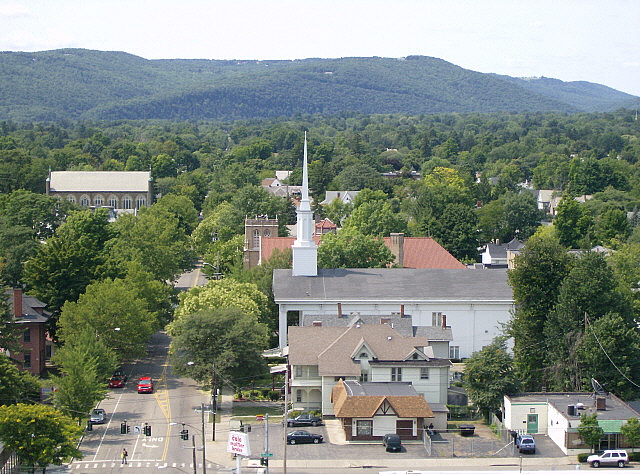
This question opened an article in the op-ed section yesterday in my  local newspaper, the Star Gazette.  Written by a younger columnist, John Cleary, it described his feelings over the possibility of leaving his lifelong home in Elmira, seeking a new home where the problems that now seem to beset the streets of the this small city seem further away.  It’s a difficult decision because he has only known this area and never even considered the possibility of leaving it.  It is home, after all.

But, as he writes, “When we hear of dismal ratings of Elmira’s schools, when the newspaper is full of stories of police standoffs, shootings and meth labs, when we visit the neighborhoods we grew up in and realize we wouldn’t want our children to be there, the urge to go away feels very strong.”  He doesn’t even mention the extraordinarily high property taxes (some of the highest in the nation), the economy that was tepid even during the boom years were happening nationally or the brain drain of youth heading away from this area.

The article resonated with me, made me ask the same questions of my own life in this area.  Why do I live here?

Some answers are easy.  I like the natural beauty of the area, the lushness of the green in the summer and the gray hills and valleys in the winter.  We have the Finger Lakes just  to our north with their wineries and scenic vistas.   I like the history of this area and the connections my family has in it.  I like the familiarity of each place, knowing where things are and the ease of getting to them in this relatively small community.  It is home, after all.

There are family connections as well although many folks have left the area or passed away and I don’t maintain great contact with the ones that remain.

That doesn’t sound like much.  I think about my father  who now lives in Florida.  He had left this area after retiring in his 50’s, returning a time or two, the last after my mother died 15 years ago.  Since that time he has split his time between Florida and here with his new partner.  While here he is never really happy about it– actually, he’s miserable being here–  and counts the days until he returns to Florida. 

 For years, I never understood how he could feel such misery in being here but the more I thought about it, the more I could see his perspective.  He knew this area when it was larger and more vibrant,  filled with friends and family and life.  It must have been like seeing someone that you loved and remembered as young and strong start to die and emaciate before your eyes.  Soon you see just a hoolow carcass of the person that was and you don’t even recognize them.   Even sadder, they don’t recognize you.  The relationship has changed and the only thing that keeps you around is some sort of loyalty to the memory of what once was.  Staying becomes painful.

Maybe that’s overstating it.  I don’t know. 

Why I live here remains a difficult question to answer.  It’s the only place where I feel a connection to the place and my ancestry but is that enough?  Where we live is a relationship and like all relationships, there are negative aspects we must accept in order to maintain that relationship.  When the negatives far outweigh the positives, we tend to break off the relationship, or, at least, we should. 

Hard questions to ask, even harder to answer.  I hope Mr. Cleary finds an answer that satisfies his life and needs. I know his article has made me think.


Read Full Post »

Crybaby

Lately, I’ve been doing some maintenance around here, building some things and doing a little reroofing.  Nothing big but at day’s end I find myself beat and physically sore with aches and pains in most areas of my body.  I write it off to advancing age and a bit of  relative inactivity in recent years.  I whine about it and limp around until I begin to think myself a big crybaby.  At that point I begin to think about people from the past and all they faced physically and how my little aches would make them laugh.

I think about old Mike whose place, the Mule Farm,  I wrote about a couple of years back and remains firmly entrenched in my memory.  Mike had been a lumberman and a railroad worker in his life.  He told me about going out into the woods when he was seventeen, armed only with an axe and a crosscut saw.  He cut and split over two hundred cords of wood that year.  He said that the labor had made him appreciate a sharp saw and axe blade.  He also talked about shoveling railroad ballast onto trackbeds for months at a time.  Mike knew how to work and when we worked with him cutting logs with his buzzsaw, even when he was in his late 70’s, he could easily outwork any one of us much younger men and boys. 

Then I think of my great-grandfather who I have also written about here.  He also headed into the north woods as a young man and had his own crew at age 17, acquiring his first big lumber contract at age 18 in the early years of the Adirondack lumber business.  He worked his entire life   as a lumberman until he was 80 years old, always in a career that required immense physicality, especially at that time before the time of the chainsaw and the tractor.  He would surely have shown disdain for my crybabying.

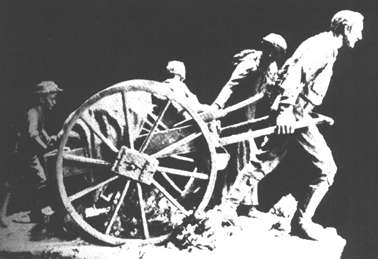
Or I think of those people through history who made tremendous migrations by foot, often pulling their belongings behind them on a cart.  One example of these are the Mormon handcart expeditions of the 1850’s that covered about 1300 miles.  Families would put as much of their worldly possession as would fit on a 60-pound wooden handcart that was then pulled and pushed across the central part of the country from Illinois to Utah.  Mind you, this was a land devoid of graded roads.  They would slog through mud, up steeps slopes and through all sorts of bad weather.  I try to imagine pulling my garden cart to town going through fields and crossing creeks and my aches only intensify.  Many of these people did not finish the journey, dying from  exhaustion along the way.

So, now humbled, I stop whining about a sore back or aching knees.  While being thankful for living in a land where we do not have to endure such straining lives simply to survive, I can’t help but think that the labor that these people lived through gave them an attitude that believed that anything was possible, that any obstacle could be overcome.  No project  seemed too daunting, from clearing tracts of land for  farming to taking on the great public works projects that built this country.  I’m not sure that we have that same gritty will in us anymore. 

But I won’t whine about that or my aches anymore.  Today.


Read Full Post »

Jose Feliciano at the 1968 World Series

In 1968, in that turbulent year that saw Martin Luther King and Robert Kennedy assassinated and war protesters rioting in the streets, there was a controversial incident at the 1968 World Series.  It seems so minor in the scale of retrospection but I find it very interesting and symbolic of how we as a people resist the inevitability of change.

In October of 1968, the musician Jose Feliciano was asked by legendary Detroit Tigers broadcaster Ernie Harwell to perform the National Anthem a before one of the World Series games in Detroit between the Tigers and the St. Louis Cardinals.  Feliciano performed a slow and slightly jazzy version, much in the style for which he was known.  Little did he know, it inspired a storm of controversy.

This was before anyone had performed stylized versions of the song, before the crashing fury of Hendrix’ version or any of the myriad other versions since.  It is said that World War II vets were throwing their shoes at their televisions and the network switchboards were swamped with angry calls.  Soon, many radio stations refused to play Feliciano’s music altogether and his career went into a tailspin that took three years for him to overcome.

When I hear the version now, I am mystified by the reaction of the time.  It is a respectful and lovely version, perhaps not as bombastic or as confident as some like in their national anthem.  And certainly not as ridiculous and disrespectful as some versions since.  But we were a country in turmoil and our confidence was surely shaken by all that was happening around us.  The world seemed to be changing every day and in ways that seemed out of the control of the average person. 

 Much like today.

Here are two short videos.  The first is Jose Feliciano telling the story and the second is the recording of that performance from 1968.  Tell me this isn’t a beautiful version of the song.

Read Full Post »

In the ongoing debate about the financial situation of the United States, there is always an analogy that is used, usually by those on the right,  to justify simply slashing all spending to bring down the deficit rather than raising revenues through taxation.  They usually say that the USA is like a normal family and when you are over budget you must cut back on things.

It’s a nice, simple comparison that even the lowest of our common denominators can understand. 

Now, I’m all for bringing things down to the simplest terms.  I think we all do this for our own understanding of most everything.  But this analogy has always bugged me in that it seemed to lack the nuance and depth of the real problem that it is supposed to represent.  Now, I’m thinking off the top of my head here, but I think you can still use the USA-as-a-family analogy but there needs to be a tweak to better show the reality of the situation. 

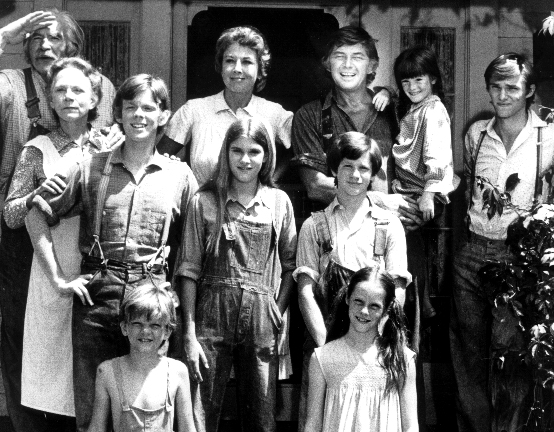
 Instead of a simple father and mother and two and a half children as the original analogy infers, I think you can substitute the  Walton family from the long-running CBS TV show The Waltons.  The USA is Walton Mountain and the family represents our citizens.  There is John Sr. and Olivia, Grandpa and Grandma and the seven children– John Boy, Jason, Mary Ellen, Ben, Erin, Jim Bob and Elizabeth.  You have a much more representative cross section here with the addition of the grandparents.

The family homestead, Walton Mountain, is mortgaged to the bank, much as our nation is indebted  to our treasury and foreign lenders such as the Chinese.  John Sr’s lumbering business has been on shaky ground lately and its income has dropped even though it still has all the same bills and financial obligations.  The bank is threatening to foreclose.  Under the simpler analogy, the family would just cut back on extras and everything would work out just fine.  But if you watched the show, these folks were working with a lot of extras to begin with.  Simply cutting out the Christmas ham and shutting out all the lights at 8 PM and buying a yard less gingham at Ike’s store won’t balance their budget.  They need more income.

Now John Boy has become a best-selling author and is making a nice living and paying a nominal rent for his place on Walton Mountain.  Jason had been a musician but things dried up and he lives at home now, helping at the mill in exchange for his rent.  Ben was injured in a logging accident and requires medical care on an on-going basis.  Mary Ellen takes care of Ben around the clock.  Erin works the gardens and does paperwork for the mill.  Jim Bob and Elizabeth are in school still with hopes of following John Boy’s path to an education at Boatwright University.  Grandpa has several prescriptions that are costing the family a lot and Grandma has gotten to the point where she can’t help around the house as much as she once did.

Now, according to the first, simpler analogy, wouldn’t the relatively well-to-do John Boy be asked to give a little more to help out the family?  The John Boy I know would  never turn his back selfishly on his family.  Or would you just cut back on the meds that are keeping Grandpa Walton alive?  Would you take away Ben’s care?  Would you tell Jim Bob and Eizabeth that the path to an education that served the successful John Boy so well was no longer a viable option for them?  There are so many different scenarios in this story that better represent the situation of our nation and its debt and budget than the we’re-a-family-and have-to-watch-our-household-budget mantra that we all hear constantly.  And that’s just off the top of my head.

The answers here are not simple and you can’t really give the whole story with any analogy.  The majority of theAmerican people have been saying for some time  that it will take some cutting and some revenues, meaning taxation, to get out from under the wight of this situation.  Even many of the wealthy John Boys of this country understand and accept this.  But for some reason there is a resistance by some to the only viable solution that is visible.

I don’t know why.  I only know that their simple story is never as simple as they’d have us believe.

G’night, John Boy.


Read Full Post »

« Newer Posts - Older Posts »