Feeds:
Posts
Comments

Archive for the ‘Painting’ Category

Big Foot Stomp

Singing and Mending-- Robert Gwathmey

I was looking through a book containing many of the works of the painter Robert Gwathmey when I came across an image that reminded me of a small piece that I had painted several years back.  Gwathmey’s painting was titled Singing and Mending and featured, like many of  his paintings, a depiction of  African-American life from the rural South.  This piece had a man in overalls playing a guitar while a woman mended a piece of clothing. It was the man playing the guitar that caught my eye.

Perhaps it was the overalls or the position of the guitar or the bare feet but all I could think of was a similarity in its nature to a small painting that I had painted a few years ago and which now hung on my sister’s wall.  It is a little oddity that I always look at with interest whenever I go to her place. 

 I call it Big Foot Stomp.

It was an experimental piece, a revisiting of another earlier foray in paint when I was just starting  years before.  I can’t quite recall what my initial intentions were with this piece. I remember that I laid down the splattered background with spray bottles of paint, masking the lighter center with a piece of matboard as I did the darker outer edge.  But I don’t think I ever had this figure in  mind when I began to paint in that center.

But I’m glad that he came out in this way.  I recall painting the head first, just laying down a silhouette of paint then trying to make something from it.  I remember liking the way the dark paint seemed to pop from the lighter background, making me think this was a black man.  The rest is hazy in my memory except for a slip in my brushstrokes that affected the size of his feet and for the decsion to leave out  the parts of his clothing that would normally be visible.  For me, these two elements really make this little guy special. 

There’s something about the white space where his clothing  would be that brings a spiritual element to this piece for me, as though his playing and the rhythm of his large feet on the floor are taking him to a place beyond the here and now.  I think the way he rests in the splattered background enhances this.

I’ve never painted another piece like this.  Maybe he was just meant to be one of a kind.  He certainly feels that way.  But at least in the Gwathmey piece I have found a spiritual relative to this lone guitar player.

Read Full Post »

Seeking Rhythm

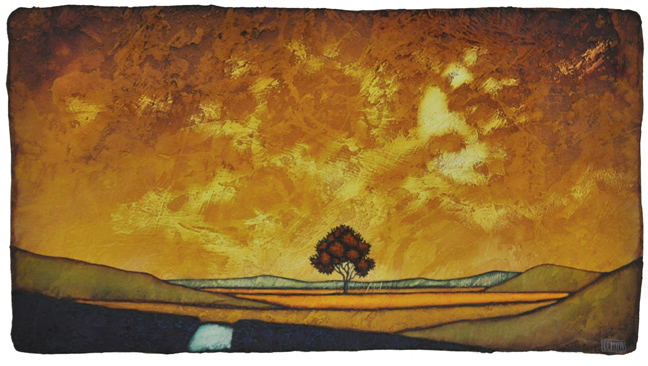
This is a new piece, a small painting about 7″ by 11″ on paper.  I still have no name for it.  I’ve been spending the last several days trying to refind my normal painting rhythm.  I use the term rhythm quite often in describing what I do and always struggle when trying to descrribe exactly what I mean when using it.  But this time it means the actual ebb and flow of the act of painting, the tempo of the creative process as an idea forms and takes shape before me on the surface. I normally fall easily into a pattern where one action of painting inspires another and so on, almost self-perpuating.  Color begets color and line begets line, each sparking a new idea, a new thought.  It’s a rhythm that I have depended on for most of the time I have painted.

When I’m away from painting as I have been lately, doing needed projects around the home and studio, I fall out of this rhythm.  I can tell during the day, an uneasy knot forming in my gut.  This rhythmic pattern has become vital to my well-being  and when it’s disrupted, I get antsy and out of sorts.  Usually, I am back into it within a day or two with little loss of momentum and this unease fades quickly into the paint and routine.  Some times, as is the case at the moment, it becomes more of a struggle to regain that rhythm, to find that groove in which to take hold.  Nothing starts nor finishes easily.  Color doesn’t sing on the surface, laying there with an uninspired flatness.  Lines are listless and forms dull.  One piece does not inspire the next.  In fact, it brings dread to the next piece.

 I find myself trashing piece after piece,  something I seldom do.  I normally can find something that I want to keep in a piece even if it is only for the lesson learned from its deficiencies.  But these failures seem dismal and dull.  Their very existence bothers me and they go in the trash.

But time has taught me not to panic when I am struggling to find footing.  I became more determined and go back to basics, working on small blocks of color, trying to find life and visual excitement in each little block.  At first, even this was a chore, like slogging in ankle deep creative mud.  But eventually, something broke loose and I find myself finding a stirring of life in the colors and forms and soon I am excited by what I am seeing.  The next move has been inspired and soon my mind is filled with possibilities and potentialities for several new pieces.  Rhythm seems almost at hand and the knot in my gut begins to subside, my mind settling into a familiar hum.  Like that red tree in the image above, looking out over its domain and feeling that, for the time being, all is right with that world.


Read Full Post »

Colors

I’ve been back in the studio for several days now after a period where I was engaged in doing some maintenance projects around here.  I have been progressively worse at compartmentalizing the tasks in my life so that when I work on something outside the studio I find it difficult to work for short periods in the studio on those days.  As a result, once I am back in the studio I sometimes fall out of rhythm and have to find ways to regain it.  For the first day or so, I seem to flounder around and everything seems just out of sync and flat.  Throw in a material failure like I mentioned in yesterday’s post and it gets to be frustrating.

Yesterday, I finally turned back to my old ally, color.  It seems that whenever I feel this creative frustration color is inevitably the answer for me.  I don’t worry about what I am creating, simply start creating blocks of colors.  Colors that are familiar to me and combinations that I haven’t used for a while.  I aim for bold and dark-edged color then begin manipulating the gradation of the block to create a contrast within it, flushing out the flatness of the last few days.

 It has to be intuitive for me, just grabbing colors and throwing them in.  I’ve never used a colorwheel , never really tried to understand them.  Whenever I have looked at them, the colors never made me want to see or use any of them.  To me, they seemed to take out all of the emotion of the colors and make it dry and tasteless.  I found that by using my own colors and taking the time I could find the emotion in the colors through this exercise.

It’s amazing how this simple exercise in color cleanses away the stifling feeling that had been there before and prods some hidden creative impulse.  Suddenly, momentum is born and begins to move forward.  Rhythm is nearly regained and I look forward to jumping back in today.

Here’s a little Sunday music with a title that fits this post.  It’s Colors from Amos Lee with an assist from Norah Jones.


Read Full Post »

In the Studio

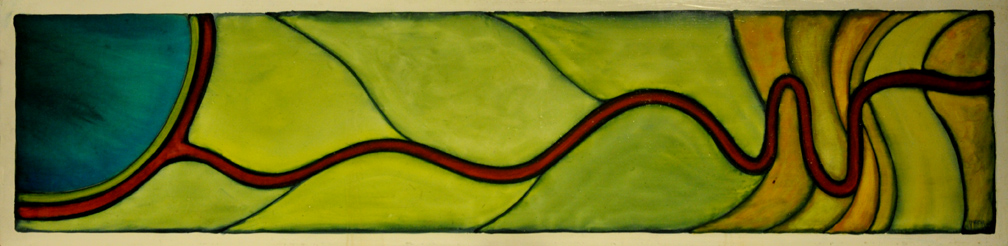
This is a painting that is from a number of years back, part of a very small group of similar pieces.  Maybe three at the most.  I’m not even sure if I ever publicly showed these pieces, although I think I did exhibit one for a very short time.  This particular piece is 12″ by 48″ and is on a masonite panel.  It sits unframed in the main part of my studio and has remained one of my personal favorites for years. 

 I can’t really describe fully why I so like this painting, it being so atypical of my work. Perhaps it is the color and the sense it gives of light streaming through stained glass.  It has a lovely transparency.  Or maybe it’s simple abstraction of it, the idea of its possibility of representing anything.  For me, it is the obvious– a bird’s eye view looking down on a red road as it weaves down the topography of a hill to a lakeshore. 

But I also see it sometimes at the same time as being a feather from some exotic bird.  The blue circle reminds me of the eye from a peacock’s feather and the green plays off this color in a way that recalls some sort of feather.  I call this piece Red Feather Road but try not to tell anyone for fear it will alter the way in which they see the painting, trying to make their view fit into the title’s parameters.

But maybe I like this piece because it is not typical of my work but I still see myself in it while others may not.  Perhaps it is this sense of disguise that I like.  Like the feel of wearing a mask , walking about in anonymity.  Maybe I should call this painting The Mask.

Read Full Post »

Frantisek Kupka was another one of those supremely talented painters from the late 19th/early 20th century who is little known outside the world of museums these days.  You probably won’t stumble across a Kupka calendar or mousepad.  But when I  see the scope and quality of his work I wonder why.  I know I hadn’t heard of him when I first came across his work in a book of Symbolist paintings.  I saw this image shown here, Resistance or The Dark Idol, and was immediately struck by the tension and drama in its mysterious setting.  I was surprised when I saw his other work that was beautifully colored and striking in other ways.

Kupka- The Yellow Scale (1907 Self Portrait)

Frantisek Kupka was a Czech painter who was born in 1871 and died in 1957 in France.  His career saw his work move from the early symbolic work to pure abstraction.  In fact, Kupka is considered one of the founding members of  the group, Abstraction-Creation, that set off the abstract movement.  While I found much of his abstract work beautiful, it was the early work that really pulled me in.  It was obvious that he could have worked extraordinarily well in any style he chose.  But his relative anonymity remains a mystery to me.  Perhaps he never had that one  iconic image or series that became associated with his name.  Monet’s water lillies.  Van Gogh’s starry night.  Gauguin’s Tahiti. Whistler’s mom.

I don’t know the whys behind this.  But his talent is no mystery at all.  It is evident in every piece I have come across. 

Read Full Post »

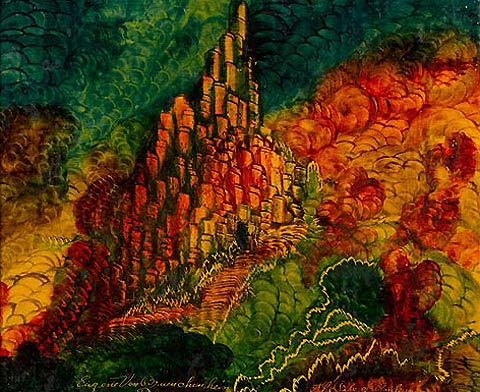
I’ve been thinking more about Eugene Von Bruenchenhein since writing about him yesterday, mainly about how he continued creating prolifically throughout his life, all the while keeping it pretty much to himself and his wife and perhaps a friend or two.  I try to compare his obsession with my own need to paint and I find they are quite different or at least appear to be.

I don’t think I could do what artists like Von Bruenchenhein and other private artists have done.  I don’t think I could maintain that intensity in the work if I thought it was only for myself.  I suppose these artists get their satisfaction in the actual creation of the work and  that, in itself, is their reward.  That makes sense but is different from what drives my own obsessive need to paint.

I think that the actual creation of the work is vital to me  but more important  is the communication that comes with each piece.  Knowing that the work is going to be seen and is going to be able to reach out to others is the driving point in what I do.  If I thought that the work would only be seen by myself I probably wouldn’t create it, wouldn’t feel the need.  The painting itself is an expression of something I hold inside already and wish to get across to others so, if I’m not going to show it to others, why do it

That being said, there is work that I do periodically for only myself.  I don’t do these pieces in the prolific manner of Von Bruenchenhein but those few I do are meant to stay with me and are painted only to be seen by me.  They are private expressions, different parts of my own personal prism that will remain hidden from sight.  Perhaps I do this because so much of my life is shown in relation to my work and feel the need to have something that is created only for my eyes.  That is different than the obsessive creators.  Maybe because their urge to create is so different than my own is why I find these possessed few so fascinating. 


Read Full Post »

Goya’s Miniatures

I have written here about a series of small dark pieces that I painted a few years back which I called my Outlaws series, pieces that were of shadowy figures often holding pistols next to windows.  They had been greatly influenced by a number of later silent films of the 1920’s which featured haunting dark imagery as well as a group of small late paintings by Spanish master Francisco Goya that I had seen at the Frick Collection in NYC, along with other works from near the end of his life. 

The Goyas were were painted on small squares of ivory around 4 inches square  that had been coated with a ground of black carbon on which he dripped water which removed the carbon to reveal the shadow of white ivory below.  He would then look into this wetness and manipulate it to produce the images that he saw emerging from it.  The result was a series of small but powerful pieces that really resonated with me, especially in that I easily identified with his process in producing these plates, one that was very similar to the method of painting I first adopted in my earliest forays.

Here is a clip from the introduction to the Frick exhibition that describes his process:

Goya departed from the traditional miniature technique of stippling — applying tiny touches of color with a fine-pointed brush until they coalesce into the desired images — for a broader means of execution. His improvisational process is described by a young painter friend, Antonio de Brugada, who witnessed Goya at work:

His miniatures bore no resemblance to fine Italian miniatures nor even those of [Jean Baptiste] Isabey. . . . Goya had never been able to imitate anyone, and he was too old to begin. He blackened the ivory plaque and let fall on it a drop of water which removed part of the black ground as it spread out, tracing random light areas. Goya took advantage of these traces and always turned them into something original and unexpected.

In transforming the stains of water into recognizable forms, Goya added accents by scratching the surface with a sharp pointed instrument; touches of watercolor were deftly applied; outlines were reinforced in black; and small patches of the surface were wiped to produce a range of shadows and highlights.

It’s an interesting little group of pieces from Goya, one that I’m glad to have stumbled across.  I had looked often at his work and had admired much in it but this was the first work from this master that really hit me, sparking me in my own work.  You can see the rest of these images here.

Read Full Post »

Changing Perspective

Yesterday, I wrote about paintings that are returned from a gallery and how my view of them has changed over the years.  In the comments, Clint, a staff member at the Principle Gallery (and a great guy ), wrote about he is often surprised by certain pieces that don’t sell at a show, pieces that seem to really strike a lot of people.  I, too, think it’s interesting to see what paintings don’t find a home despite much interest.

Sometimes it’s  just a matter of size when the painting starts to take on larger dimensions, such as paintings that are 30″ by40″ or larger.  The size naturally eliminates many collectors who simply don’t have the space.  The size also means that the pieces are more expensive which is also limiting.

But sometimes it’s not size or price.  Sometimes, like with the painting above, Defining Moment, it’s just not the right time or place.  It’s still a surprise although not as much as earlier in my career.  Then, I seemed to be able to tell when a painting was finished if it would leave the gallery quickly and was generally correct.   I could often tell that a painting would go quickly, often within hours of hitting the gallery.  But over the years I have seen this ability diminished and the paintings that I think will go quickly now seem to be the ones that linger, that don’t leap off the wall into the arms of a new owner.

I don’t know what has changed but think it may be that my eye has changed over this time.   Early on, I wasn’t far removed from my days where I worked at other jobs where I was serving and reading other people on a daily basis.  My eye was used to looking at things from someone else’s vantage point, a useful quality in any job where you are trying to satisfy other people, and I really think this allowed me to see my early work as others might.

  But over the years I have become more isolated in my studio, less attuned to reading other people.   My perspective now is only what I see in the piece, not what other’s eyes might see.  I suppose this is as it should be.  But it was pretty exciting when I felt like I was looking through other eyes and the work felt like it was someone else’s.  Now I solely judge a painting by what it does for me, knowing that it is my work.  Sometimes those pieces which most excite me take a bit longer to find someone whose reading of it matches mine.   

But they usually do find a like mind.  This I’ve learned.  So, even though they may not find a home quickly, I am patient in knowing they will eventually.

Read Full Post »

The Returning

I went to the Kada Gallery yesterday to drop off some new work and to also retrieve some pieces that had been with them for a while, unsold.  It’s just part of this and almost every business, this  exchanging of new product  for older.  Of course, most artists try to dissassociate themselves from the concept of their work as a product but in the long run that is what it amounts to, in the business sense.  I know my work is a product when I deal with galleries as far as inventory andsales and such but also try to keep an equal footing with them in maintaining the artistic merits of my work.  It can be a fine line.

When I first started in this business, I viewed the return of work to me from a gallery as a failure of sorts.  My work had failed to spark the interest of any potential collector so there must be something amiss in the work was how I viewed it.  I mistakenly attached a shelf life to the work early on as a result.  But time passed and I soon realized that each locale had different tastes and preferences and that each gallery had their own way of presenting the work which affected how the different paintings were viewed.   After a time, I realized that the work was soon gone away to the homes of collectors, often after having been at one or more galleries previously.  It wasn’t a failure of the work when work was returned, it was simply not the time or place for those pieces that found their way back to me.  In almost every case, they found homes somewhere.

The sense of failure I experienced early on when work was returned also made me question the validity of my work.  I’ve often said that when you’re first showing your work, you want to sell every piece because every sale is a form of validation, a bolstering of your confidence in your own work.  So when work didn’t sell, it made me wuestion the value of the work.  But over time,  I recognized the error in thinking this way and actually began to hope that certain paintings didn’t sell, that I could somehow hold onto them a bit longer, as if holding onto a piece of myself that I had let go too soon.

So yesterday, when I picked up several paintings, including the one above,  I wasn’t disappointed.  Instead I was almost excited to see these paintings, to have them in my hands again.  Even now, as I glance over them scattered around the studio, I get a great sense of pleasure and fullness of self in having them there even though I know that eventually most will be gone.  Some I take great pride in and some have some sort of  personal bond.  But all feel like parts of me and, for the moment, it’s good to have these parts of myself back.

Read Full Post »

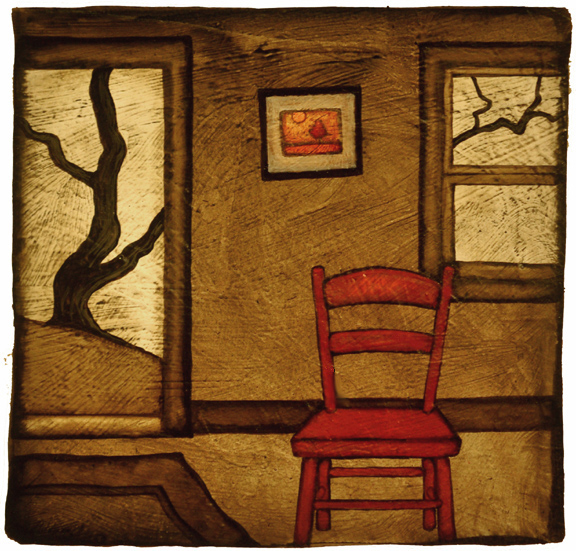
I’m in the last few days of preparation before the delivery of my new show, Avatars, to the West End Gallery in Corning, which opens on July 15, next Friday,with an opening that starts at 5 PM.  This is one of the paintings from that show, an 11″ by 11″  piece that I call Family Pictures

 It’s a continuation of the work that started primarily as black and gray work and has slowly evolved into more of a sepiatone with dashes of color.  The sepia adds to the feeling of old family photos that gives this piece its name.  I see the red chair and the self-referencing picture hanging in this scene as the basis for this painting.  As the title of the show implies, they are both avatars for the living, in this case descending generations of a family.

At least that’s what I think it might mean.

I was intrigued by this piece from the moment it was done and find myself going back to it over and over.  I can’t really put a finger on it but there’s something here that draws me in personally, that poses questions that I can’t yet answer.  Actually, the questions themself are enigmatic and hard to discern.  But I keep looking with the hope that questions and answers will reveal themselves at some point.  But while I’m waiting the simple geometry of the composition is somehow soothing and protective and the red of the chair and the picture pulse like a heartbeat in that sepia room, creating a rhythm that soon blends with my own.

Like looking at family pictures.

Read Full Post »

« Newer Posts - Older Posts »