Feeds:
Posts
Comments

Archive for the ‘Painting’ Category

Silence is as full of potential wisdom and wit as the unshown marble of great sculpture. The silent bear no witness against themselves.

—Aldous Huxley

___________________


I’ve been scratching around in the studio for the last few days.  Straightening up a little, putting things in their places.  Taking inventory, as it were.  Seeing what materials I have on hand, what I’m short on.

I do the same with the creative side of my mind.  I take this time, as I’ve noted in the past, to look back at the year and the body of work I’ve created over this period.  What have I done?  What is strong and what needs to improve?

One thing I’ve done in the past year is the continuance of this blog.  It’s done far better than I ever expected as far as readership and it has become a big part of my morning in the studio.  The feedback has been great and  I’ve taken a lot from the comments and e-mails received as a result of this blog but I still worry that this provides too much information about a subject, painting as an art, that often communicates best without words.  I still fear that the impact of my words and thoughts will never add up to anything near the sum of my painted work and, as a result, a seed of doubt will be planted.  A doubt that makes the viewer question their own view of the work.  If I speak and write and eventually expose all my flaws and deficiencies, will the work still stand up?

As Huxley said, the silent bear no witness against themselves.  There’s much to be said for that.  Maybe the silent artist allows the narrative surrounding their work to form on its own, to grow beyond what they themselves may be.  I can see that in many cases.

But I’ve found that I’ve always wanted to control the narrative around my work.  To not let it be spun out of my hands.  So I talk and write.

For better or worse…

The inventory goes on.

Read Full Post »

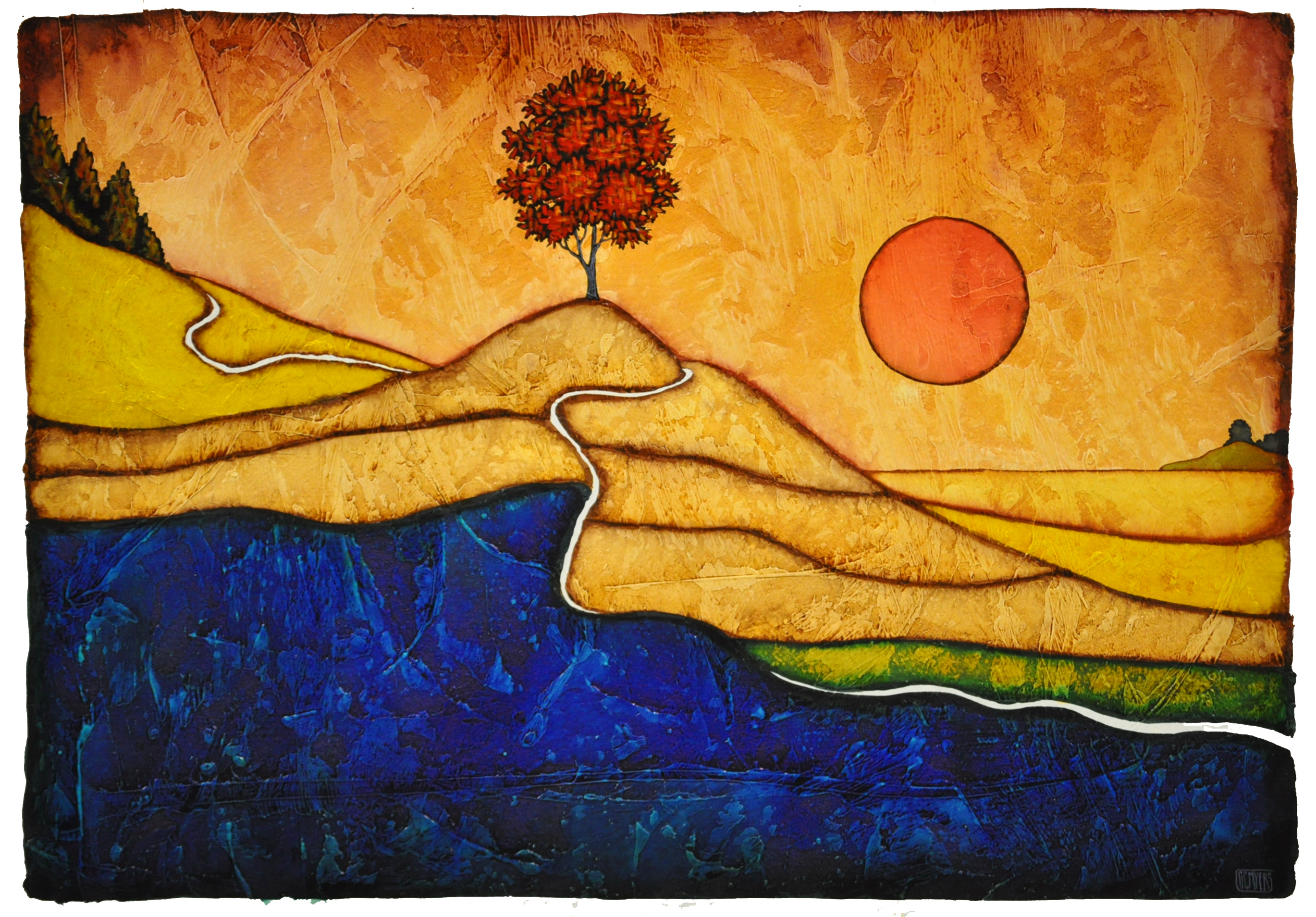
I was looking for a painting in my files and came across this piece, Time and Tide, from a few years back.  It was a piece, an 18″ by 25″ image on paper, that  I well remember but had lost a few of the details in the creases of my memory.  I had forgotten how well this piece came together and the impact it carried.  Even though it possesses many of my standard elements, such as the red roofs, it feels as though it is a bit of an anomaly.  Maybe that’s why I had to stop over this image and look for a while.

The title, of course, is a reference to the old proverb, time and tide wait for no man, which is basically saying that all men are equal in the eyes of time and nature, that no man has any greater reign than another in those realms.  We are all equally powerless before the passing of time and the movement of nature.  It’s a message that I often see in my work, or at least hope to see.

When I stop to look at pieces from the past, I’m always looking at the differences in the textures and the way I’m handling the colors from what I’m doing currently.  Sometimes I’m able to find something that I really liked in the piece, something I was using that really contributed greatly to the piece, that I was not consciously aware at the time.  It was just part of the process.  For instance, the texture in the open part of the sky in this piece was just done in the way I normally would do that at that point in time.  But as time goes on there are subtle, unthought of  changes in the process that after a time alter the whole feel.  So when I look back what I’m trying to ascertain is how a painting of mine is different and if those differences are things that I might want to revisit. Perhaps I was at a certain juncture then and moved in one direction yet there was another direction available– do I want to step back and try that other direction?

That’s the beauty of art, one can go back in time in a way and for a while defy time and tide….

Read Full Post »

This is a painting from back in 2002 titled Muse.  It was part of a series I was painting at that time, in the months after 9/11, that some of my galleries still call my Dark Work. It was painted in a style that I call my obsessionist style these days, meaning that it is painted by building layers of color over a dark ground as opposed to the reductive style I have used so much in the past where I apply a lot of wet paint, puddles, then pull it off the surface until I reach the desired effect.

When I was doing these paintings they seemed like a stark contrast to the reductive work, especially given the tone of that time.  They were well received although not with same gusto as the lighter, more transparent,  work.  I felt very strongly about this work but allowed my desire to please the galleries need for my most sellable work override my desire to pursue this work to further levels.  I moved back to primarily painting the wetter reductive work and was able to continue to push that work further through color and texture.  I never regretted the move back to this work but there was always a little nagging voice in the back of my mind that I hadn’t pushed the other work to its full destination and had let outside influences hinder an inner process.

I have begun to see my body of work as my own personal narrative, the story of who I am and how I am seeing my world at any given time.  In order for it to be so it must be an honest and complete reflection, guided by my own inner muse and not outside forces telling me what I should or should not do.  It took a while but I realized that I have the ability and right to control my own personal narrative, to tell my story in my own way.

I’ve done this in many ways for years already.  I am constantly given ideas for paintings or am requested to do commissions but seldom do I follow up on them unless they fit in with where I see my work heading.  In that aspect, I normally reject outside influence.  I stick to my narrative.

The piece above, Muse, actually fits this post well in that it now belongs to a man who asked me to do a painting of his son, a truly gifted guitarist.  He sent me photos and they were wonderful.  He was long and lanky with a really interesting ethereal  look, a portrait painter’s dream.  In fact when I looked at the pictures I could only see him as painted by other painters I know.  I struggled for a while trying to do something with this but in the end I realized it wasn’t part of who I was at that point, not part of my narrative.  I let it slide and after a long while, apologetically explained this to the father who was extremely gracious.

So I am back focusing more, at this time, on this obsessionist work, allowing it to be a bigger part of my story.  I will continue to paint in the other style but I just feel that there is something waiting to be told, something to be discovered in this other work at this time.  That is my decision made without outside influence, my choice for my personal narrative.

Read Full Post »

I’ve had the term body of work in my head recently and was reminded of it once again by a couple of sports related stories in recent days.  First, New England Patriots coach Bill Belichick made a risky decision this past weekend that failed and may have paved the way for his team’s loss.  This morning, sports talk radio was filled with analysts calling it a bonehead move but one analyst made me think when he said that sure, it was a mistake but he wouldn’t judge him on this one mistake. Instead, he would look at his whole body of work.

Then there is the case of Andre Agassi who, in his recent biography, revealed that during a year in the 90’s he had regularly used crystal meth during the tennis season.  He was widely attacked for this revelation, many judging his entire life on this episode of bad judgment.  He expressed surprise at the reaction, saying he hoped people would judge him by the whole of his life and not a time he openly and honestly regrets.  He wanted to be judged for his body of work.

It made me think.  How many people out there have judged me on one bad moment I may have had?  Something idiotic I said?  How many people was I holding judgement on whose only exposure to me was in a less than stellar moment in their lives?  How many of these people had changed, grown and evolved, yet I only knew them from a much less developed time in their lives?

I guess the same dynamics are in play when I speak of my painting as body of work.  There are certainly people who have seen my work and it may not have hit them favorably at that point and they formed a judgement that becomes set in their minds, making it hard to overcome.  Like Belichick and Agassi probably realize, there’s not a lot that can be done except to try to focus on what you can control, to try to constantly evolve and improve and create a body of work that shines brighter than the inevitable lowlights we all encounter in our lives.

I try to keep that in mind when I’m in the studio, that I cannot worry about those whose opinions of my work I can’t control.  I can only concern myself in satisfying that person whose opinion I can control and that’s me.  If I can do that, I will create a body of work  worthy of the most critical eye.

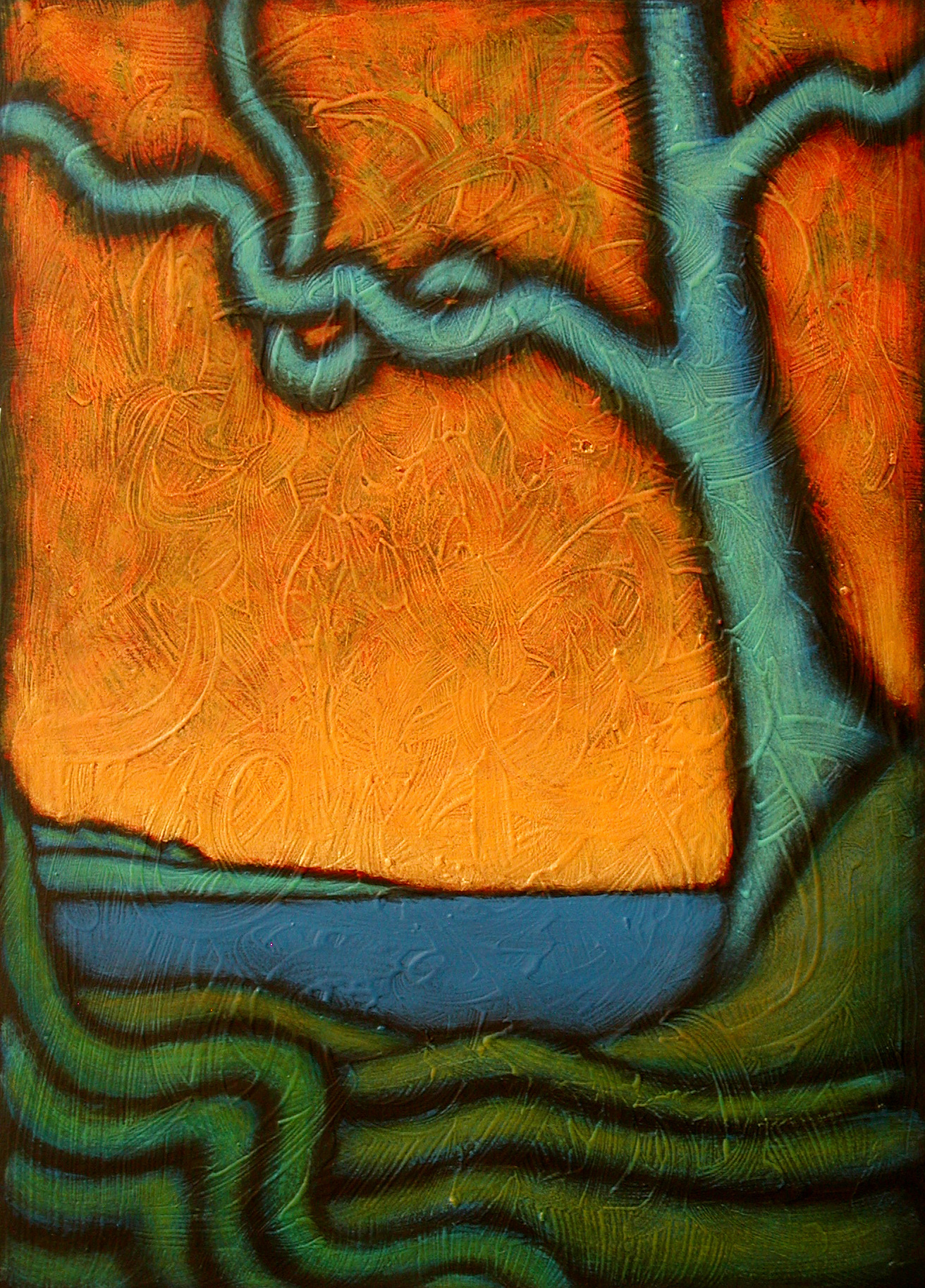
The piece at the top is Climbing Beyond the Blue and is on its way to the Kada Gallery in Erie, PA today.  I’m on the road again, visiting my friends in Erie before the holidays and delivering some new work.

Read Full Post »

GC Myers 2002Sometimes, at this point in my year, I spend a considerable amount of my time revisiting past work, going through old image files or leafing through older work that I still have in my possession.  It’s kind of a reminder of how my mind has been sparked in the past and I’m always looking for a revival of that spark, especially at the end of a period of time when I have been working a lot and have fallen into what I feel is a too predictable pattern with my painting.

I tend to focus on the odd little pieces when I’m doing this.  Pieces with figures in them, odd compositions, odd shapes- things of that nature.  I came across this little triptych from 2002 and had to linger over for a bit.  I remember it well, the way the surface had a smoothness, almost enamel-like finish and the way the three pieces played off one another.   I never fully understood the meaning behind this piece but I was always reminded by it of the music of Richard Thompson, a writer of many wonderful distinctive songs, many of them with dark undertones.

So, I’ll keep looking back, hoping for a rekindling of inspiration,  and in the meantime, here’s some Richard Thompson with Mingus Eyes

Read Full Post »

Life is like a game of cards. The hand that is dealt you represents determinism;

the way you play it is free will .        —Nehru

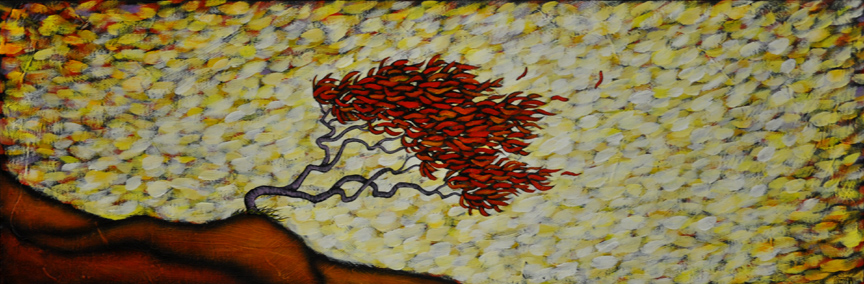
Will- GC Myers 2009The words of longtime Indian Prime Minister Jawaharlal Nehru seem to fit well with what I felt from this new piece that I delivered this past week to the Haen Gallery in Asheville, NC.  It’s called Will and is a 10″ by 30″ canvas.

For me, this piece is about enduring, weathering the winds and tides of change while sticking to one’s objective.  I see a lot of strength in this tree.  A lot of will power. It bends, it strains, yet stands.

As Nehru inferred, we are all subject to strains and obstacles that we could easily let waylay our best laid plans.  But we also all possess the ability to will ourselves past these barriers, if we only choose to do so.  This decision to do so is one that many give up on much early in their struggle and settle for a mediocre version of what they foresaw for themselves.  The tree in this painting refuses to settle.

That’s what I get from this piece.  Maybe you’ll see something other than this and come away with a completely different read on this painting.  That’s okay and as valid as my own translation. Hopefully, it will have something to say to you…

Read Full Post »

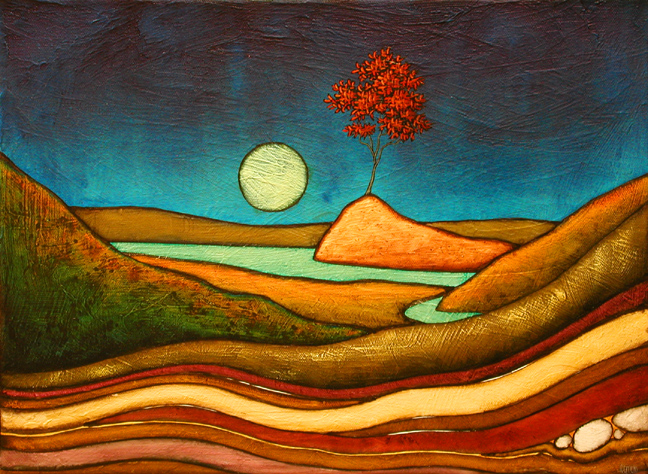
9909-293 Strata Under BlueI’m still on the road today, hopefully in Asheville, North Carolina at the Haen Gallery.  It’s a beautiful space in downtown, on Biltmore Ave.  It has high ceilings and big open spaces so it really highlights larger work well.

This painting shown, Strata Under Blue, is one of the pieces that I’m delivering to the Haen.  It’s a very vibrant piece that has the boldness and strength to hang in the large space of this gallery and not be overpowered by the space, even though it’s not a huge painting.

One of the things I like about showing in a large space is that it forces you to look at your own work in a different way.  You have to be able to accentuate the points in your work that have the most strength and let them grow even more.  When I first showed at the Haen, smaller works with a lot of subtlety tended to be dwarfed on the big walls, lessening the effect that the work might hold in a smaller, more intimate space.

So I would try to direct larger work there, work that was bolder and more dominant.  It’s been a good transition thus far and I have plans for some even larger work for this gallery.

Home tomorrow…

Read Full Post »

 The Incantation GC Myers 1994 I am traveling today so I thought I ‘d just show another little ditty from Spike Milligan.  The wordplay here always makes me smile.  Enjoy!

On the Ning Nang Nong


On the Ning Nang Nong

Where the Cows go Bong!

and the monkeys all say BOO!

There’s a Nong Nang Ning

Where the trees go Ping!

And the tea pots jibber jabber joo.

On the Nong Ning Nang

All the mice go Clang

And you just can’t catch ’em when they do!

So its Ning Nang Nong

Cows go Bong!

Nong Nang Ning

Trees go ping

Nong Ning Nang

The mice go Clang

What a noisy place to belong

is the Ning Nang Ning Nang Nong!!

——-Spike Milligan

The piece at the top is a little thing I did back when I was just starting to paint.  I call it The Incantation.

Read Full Post »

de chirico_mysteryA turning point for me when I was first stumbling around with my own painting was when I encountered the work of Giorgio de Chirico, an Italian painter of darkly toned metaphorical works.  He lived from 1888 until 1978 but was primarily known for his early work from 1909-1919 which is called his Metaphysical Period.  Metaphysics is  devoted to the exploration of what is behind visible reality without relying on measurable data.  Very mystical.  De Chirico’s work after 1919 became more realistic and less appreciated.  It is the work from this earlier period that defines him.

I was immediately drawn to the work.  It was full of high contrast, with sharp light and dark.  The colors were bold, bright and vibrant, yet there was darknessde-chirico-the-great-tower implied in them.  The compositions were full of interesting juxtapositions of forms and perspectives.  It was a visual feast for me.

At that time in my own painting, I was still painting in a fairly traditional manner, especially with watercolors.  That is to say that I was achieving light through the transparency  of my paint, letting the underlying paper show through.  It was pretty clean which was fine.  But it wasn’t what I was looking for in my work.

Seeing de Chirico’s paintings made me realize what I wanted.  It was that underlying darkness that his work possessed.  Almost a grittiness.  I immediately began to experiment with different methods that would introduce a base of darkness that the light and color could play off.  My work began to change in short order and strides forward came much quicker as a result of simply sensing  something in de Chirico’s work that wasn’t there in my own.

Perhaps that is what is meant by metaphysical…

de-chirico


Read Full Post »

Depth

GC Myers 2009I am still finishing up a group of paintings that I will deliver to a few of the galleries that represent my work in the next week.  I am doing bits of touch-up, varnishing paintings and final framing.  One that I am framing today is this painting, one that I’ve really been focusing on as it sits in the studio.

This is a 12″ by 36″ canvas which gives it a little size.  By that I mean the painting is big enough to have its size give additional impact.  For instance, if this piece were a much smaller size, say 6″ by 18″, it would still have the visual oomph of the painting itself but would not visually dominate a wall because of its size whereas this larger sized painting has the same visual impact and because of its size, could be the focus of a much larger area.

This painting has tremendous visual pull.  I find myself peeking at it at many points during the day, drawn in by the warm feeling of the layered fields.  It also has great depth into the piece which is something I often mention as a desirable trait in any of my paintings.  I don’t know if I can explain what I really mean by that.  When I look at one of my pieces, I visualize the horizon or focal point of the painting as being the point where the two planes of the sky and ground come together.  Like looking into the bottom of a triangle set on its side.  The further away that this line of convergence appears to me, the better.  I don’t know if this is just my particular preference or if this is something that is one of those common traits of response.

I struggled a bit with a title for this piece because I saw a lot of different things in  it.  There is a sense of moment, the sense of the new day coming ( or the present day fleeting, however you prefer to see it) in the light of the sky as well as a sense of place in the houses and fields.  The red tree has a feeling of pondering and the two nearest trees at the left give a sense of entering upon a scene or moment.  The whole thing has a nice unity with all elements coming together and playing off one another that I could use as well when considering a title.

I am considering calling it the In The Depth of the Sky.

I don’t know.  There’s still a little time to reconsider…

Read Full Post »

« Newer Posts - Older Posts »