Feeds:
Posts
Comments

Archive for the ‘Painting’ Category

GC Myers 2009 Taking ShapeI am now into the part of my process where things happen much quicker and all the pieces fall into place.  I first proceed by moving in with a combination of white paint, unbleached titanium, along with some deep cadmium yellow, painting the walls of the structures.  This really brings light to the surface and opens up the whole surface.  In painting these walls I generally highlight one side of each structure which gives the appearance of that side receiving light and the other being in shade.  I don’t necessarily have this representation of light completely accurate.  I’ve said before that I am more concerned with how the whole thing translate more than being completely true to nature.

GC Myers 2009 White in PlaceTo further illustrate my point, if you look at this second photo with all of the white in place, you’ll notice that the highlighted side of each structure is facing the center of the painting.  Much like my roofs, I am trying to bring the eye to the center of the painting.  I hope I am not jading how people will look at my work but in my mind, this manipulation of natural light translates in my brain as being natural, having a sense of rightness.

GC Myers 2009 Brightening the SkyNow I’m moving  along faster and decisions are made quickly.  I immediately jump from the village to the sky and start layering in different shades of yellows and whites, trying to locate where my light focus will lay.  Usually in a piece like this, one with a central cradle or saddle, I will have the light intensity grow from the low point.  Such is the case with  this piece.  It’s at this point that I begin to also start to re-darken the far edges of the sky, inserting more red and also a few selected strokes of a light violet.
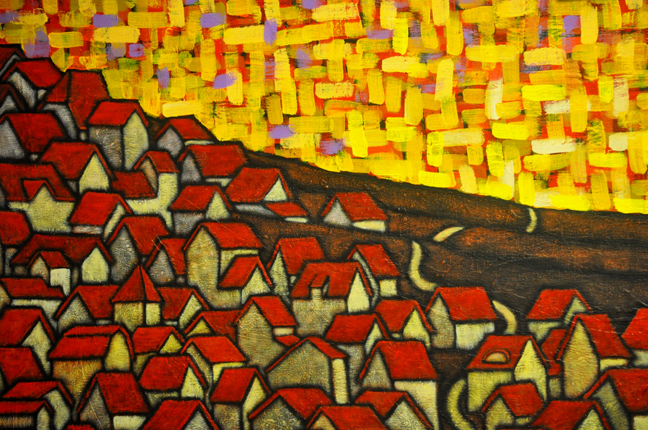
GC Myers 2009 DetailIn this detail you can see these violet strokes.  In the final version of the painting these strokes may barely show but even the smallest bit that does show through brings me a real sense of delight when I look at the sky of the painting.  This tiny detail, I feel, brings a fullness or richness to the whole piece.  I can’t fully explain this but I know I feel better when it’s there when I’m painting in this obsessionist manner.

GC Myers 2009 Building Up LandscapeSo I continue in the sky adding more and more layers of lighter and lighter color.  As you can see, the center is starting to glow a bit.  When I am close to where I want the final sky to be, I move to the edge and put on a thin transparent layer of  a nickel azo gold color, burnishing it so that it blends into the rest of the sky but darkens the edges.  When I’m somewhat satisfied ( I don’t have to be completely satisfied at this point- there is room to re-enter at a later point in the process), I begin to ponder how to bring the landscape alive with color.  I want it to maintain some darkness, to give a contrast to the sky and make it pop with light, but I still want a certain vividness.  I’m also trying to create more distance into the picture.  I have found that this creation of distance often dictates how effective my paintings will be.  In this painting I have chosen an orangish blend of color for the farthest layer and a deeper red for the one before it.  Both are deep and dark in color and show well under the brightest part of the sky above.

So, I stand back and look at this thing.  I think I’m ready to work on the waterway and the bridge next, starting to feel what I may need to do incorporate these elements smoothly into the rest of the composition.  I first add a light layer of the red oxide to the water surface.  It probably won’t show through much but what does will have a unifying effect with the rest of the painting.  I’m starting to look at the road on both sides of the waterway and how it rises to the horizon in a very viney, limb-like way. GC Myers 2009Wanting to mirror this effect, I’m beginning to think that I may use some bare, bony trees on the top ridge, dark silhouettes against the skylight.  This would be an expansion of an idea I used in this piece that I finished a few weeks back, a much smaller 12″ square piece.  It’s a piece that I like a lot and feel that the trees could be really dynamic in the sky of this larger piece.
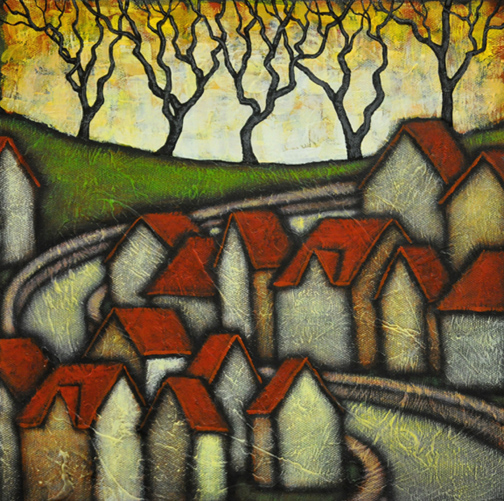
But that’s something I will have to debate in my head before I jump in too deeply.  Decisions at this point in a painting can have a major influence on the final feel of a piece and shouldn’t be rushed.  But, you never know.

To be continued…

Read Full Post »

GC Myers 2009 Buildiing UpI’m at a point with this work in progress, a 42″ by 60″ canvas, where I have basically finished the underpainting which is the process of blocking in the composition.  The next step for me is to start building up color throughout the piece, developing more depth from all the elements.  In this case, I start by using a light application, again almost drybrush, of a yellowish paint.  for this piece I’m using a yellow oxide.

The thinly applied yellow allows me to see dimension yet still lets the darkness of the base’s black and the red of the underpainting show through.  This is something that I feel is crucial to the feeling I’m trying to achieve.  Again, I could easily go through and simply paint each structure with one pure color and save a ton of time but it would lose the effect I desire.  Besides, it gives me more time to consider each subsequent move.

Now comes some red.  I start with a few cross-strokes of a crimson in the sky then start applying some yellow strokes as well, just to start to give light the sky.  I also start to lighten the path in all parts of the painting just to give some more depth.  At this point, I’m also pondering if I should start working a bit on the waterway as it is such a large and crucial element in the lower half of the painting and it’s darkness at this point might alter how I proceed with other elements.  After some thought, I decide against working on the waterway and move on to the roofs of the structures.

GC Myers 2009 Adding the Red RoofsAgain, I use a crimson red that is a bit darker which gives me a bit of leeway so that I can lighten roofs later as I see the need.  I’m beginning to see more and more light in the piece at this point and can see areas where I want to concentrate in some of the next steps in the process.  For instance, sides of the houses that will be a sort of focal points through the piece.  I’m reminded also at this juncture of how the roofs of the village act as little pointers or arrows that move the eye upward in the picture.  I do this with other elements as well, in may of  my paintings, everything pushing the eye toward the center of the painting.  It didn’t start as a conscious effort but I became aware that I was doing this years ago and have been doing this subconsciously, albeit with an awareness,  for years.

I was a little apprehensive in showing how I paint in this style, afraid that it might take away some of the mystique of the final paintings, make it seem that  the work was a pure product of process.  But taking the time to write down how I proceed makes me realize that while there is a process it is the decisions that are made during the process that make it either work or not work.  Intuition and a constant visual weighing of elements play huge roles in this decision making, which makes each piece unique beyond the process.  These are things that I take for granted in my day to day existence in the studio, parts of the process that are below the surface and operating on a subconscious level but are perhaps the most important aspects of the process.

So, I’m on to the next step.  Stay tuned…

Read Full Post »

GC Myers 2009 Underpainting #@So I’m well into the underpainting of this large 42″ by 60″ canvas, a step that is perhaps the most important in my process.  This part of the process really builds the final composition and gives me guideposts as it grows to what the final product might be.  As I’m painting, I’m taking in parts of the painting that I will later enhance and highlight.

In this top photo I build three layers of landscape beyond the village with a path running through them.  This adds depth and distance into the picture plane and creates an atmosphere of sorts.  It changes what the focus of the painting might end up being.  This addition, in my mind, brings in the possibility that the path running farther into this landscape says something about what might be coming or what has gone.  It’s not all about the static existence of the structures.

GC Myers Underpainting DetailAfter finishing this bit of landscape, I turn my attention to building my sky.  Again using a red oxide, I start a rough cross-hatch and fill the area where the sky will be.  At this point in the process, I am not yet thinking about the way the light will emerge from this sky.  I am merely putting down a base from which the sky will grow .

GC Myers Underpainting SkyTo many painters, this may seem like needless work.  By that I mean there are quicker ways to proceed with this sky to reach a similar final product.  However, for me, this is the way I have adapted that best fits with the way my mind operates.  It is slower in process and forces my mind to be less reactive, allowing me to take in the whole  picture and adjust, bit by bit.  I t just works best for me.

GC Myers 2009 Underpainting FinalMy next step is to finish the area on the right side of the waterway ,in the bottom right quarter of the painting.  I’ve decided I want to continue the road through the house and have some smaller roads off it.  I just felt that area needed a little more visual interest but don’t want it to be too fussy.  As I wrote before, I want the lower parts of the painting to enhance the whole, not dominate.  The only part of the painting that is left blank at this point is the waterway.  I sometimes also use a layer of red oxide in this situation but I’m leaving it blank for the time being to see how the areas above evolve.  They’ll dictate how I will proceed with the waterway.

So I’m basically done with the underpainting.  I have a really good idea at this point how the painting will grow although it can often change, especially in it’s emotional tone or feeling,  beyond this point in the process.  The next step is to start introducing more color and build.  I’ll let you know how it goes…

Read Full Post »

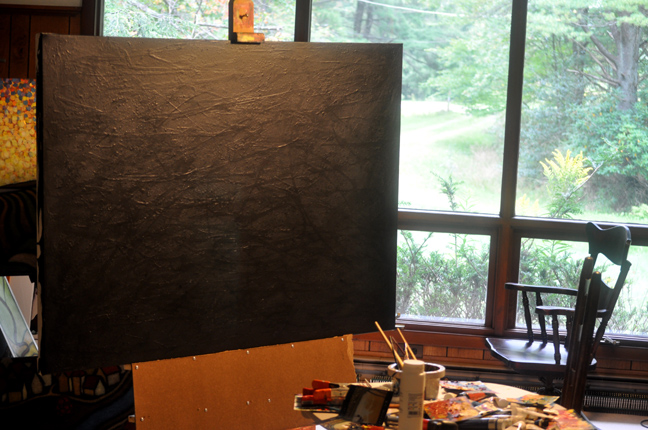
GC Myers 2009 Beginning PieceI started a new painting on Wednesday of this week, a 42″ high by 60″ wide canvas.  I first prepped the surface with layers of gesso and a layer of black paint.  I’m not sure if the texture of the surface will fully come through in this photo but it has an interesting surface with string-like bands running across it.

I’ve been working lately in my self-titled obsessionist style, work that is based on a dark ground with building color shapes on top.  It is the style I have used for much of my Red Roof work and is the type of work I have featured as of late in this blog.  I tend to work in surges, focusing on a certain style for an extended period, as though each piece, though self-contained and complete in itself,  is both rehearsal and an extension for the next piece.

By extension, I am referring to an extension of the thought process that forms my compositions.  For instance, I may take a concept that started in an earlier piece in the series and either expand upon it or take it in a different direction than the painting from which it stemmed, maybe in a direction that I recognized after the original had taken form.

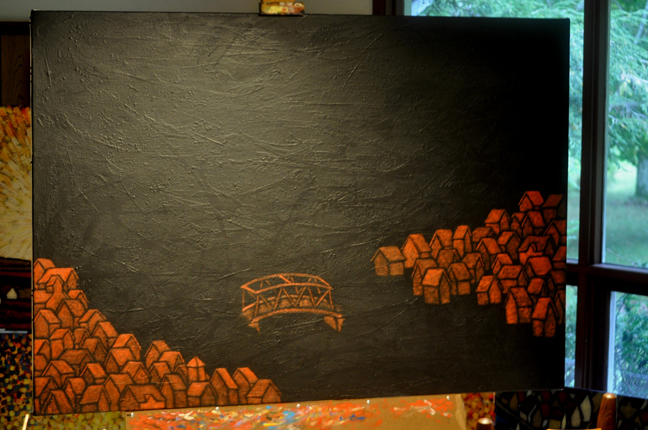
GC Myers 2009 UnderpaintingAs I have been doing a lot of Red Roof-like work I wanted to take something that I gleaned from a few of my recent pieces and move it to a larger canvas.  I wanted a large mass of structures building upward.  So I began working in the lower corners, blocking in the forms in a red oxide paint.  As I said before I have used other colors as an underpainting before, I prefer red oxide for the way it shows through and creates a warmth and depth in the whole piece.  My eye responds to the red breaking through the overlaying colors as the piece proceeds.  It’s something that  reminds me of the  bits of a vermillion color you often see braking through other colors in Paul Gauguin’s work, something I always look for in his work.

As I start bringing the corners toward each other, I start making decisions on how it will build upward.  Everything, except for the fact that I know I want masses of structures, is up in the air at this point and my forward vision is constantly shifting.  At this point on this piece, I have a feeling that I want to insert a canal or river, elements that I have used often as of late, and a bridge connecting the two sides.  I decide to start with the bridge and let the waterway build off of that.

Covering such a large canvas with small forms is time-consuming, more so than some of my other work which consists of large color fields and requires a different form of concentration because, as I said above, the piece is always shifting as each new element is added.  It requires me to stay fully engaged which is really the basis for obsessionism as I see it.  As a result, I often am thinking about my next move on the work even when I am not at the easel or when my day is done in the studio.

So, it’s time to get back at it…

Read Full Post »

Last Day of Summer

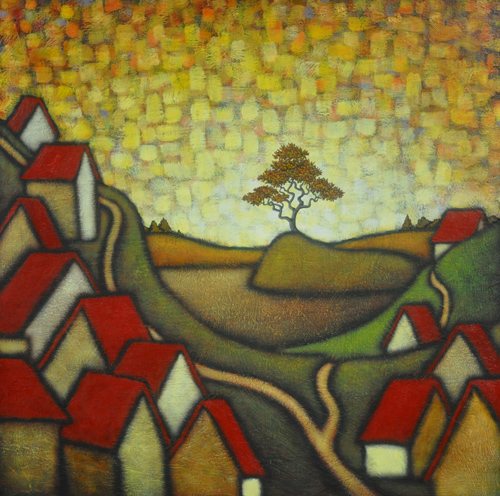
Last Day of Summer GC MyersI have this piece shown here in my studio.  It’s a 12″ square painting that I completed several weeks ago and has been in my sightline for about half of the last three months- half  my summer.

There’s something about this piece that reminds me that today is the last day of summer.  There’s something in this that speaks of a time of change, of the transition from one season, one time, into the next.  Maybe it has to do with the way the light in the sky is cooler at its center, fading to  the warmer yellows and reds at its edge.  Maybe its just the simple fact that the scene seems to be from an older farm, a symbol in its way of the changes that have occurred in our culture.

I don’t know.  Just makes me think that today is the last day of summer.

I guess I have my title for this work.

Got  to run.  Work to be done…

Read Full Post »

Trance

GC Myers Trance 2002

I came across this piece from 2002 yesterday while looking through some old files.  It’s titled Trance and is a 20″ by 24″ canvas.  It sold very quickly back then so as a result didn’t live with me for a long time.  So when I come across it as I did it’s almost like seeing it for the first time.  Eventually the feelings that the piece initially triggered when I was painting it are recalled.

It’s a very simple composition, so the feeling and depth of the painting are dependent on being carried by color and strength of line.  The imagery, though simple, is strong with all detail pared away leaving the viewer to focus deeper into the scene.  Though there is subtlety in the color it’s not delicate which goes back to what I’ve said before about preferring bold lines and colors, that a strong, confident stroke is always preferable to fussy or wishy-washy, of which this piece is neither.

In other words, I like this piece’s strength and simplicity.

No Way HomeI’m currently in the midst of preparing a group of new work for later this autumn for the galleries that represent my work.  It’s a different atmosphere and pace than prepping for a solo show.  There is less direction and more opportunity to examine new avenues, new concepts.  I’ve been primarily working in the obsessionist style I’ve spoken of before, a style that I’ve shown in recent posts.  The painting shown here, Trance, is an early example of the style although the newer work is more dependent on layers of brushstrokes in the sky to achieve the color and depth I’m seeking, giving it a much different look.  You can see the difference in this new painting that I recently posted.

I have some other new ideas that I’ve been rolling around in my head for some time about which I will hopefully have something to post at a later date.  But for now it’s back to the easel…

Read Full Post »

GC Myers 2009This is a new painting, sized at 24″ by 24″ on canvas, that I finished last night.  It has a wonderful warmth in the studio and really nice depth into the picture plane.  There is a real feeling of completeness in this piece and I get a real sense of satisfaction when I look at this.  I have talked about a sense of rightness in the past, about an instinctual feeling of whether something works or not, and  this piece has this feeling for me.  It’s one of those pieces that, if it were not to find another home, I would gladly keep for myself, which is something I don’t say very often.

 Open Your Eyes I did something with this piece that I have never done in the past.  I painted over an existing piece, meaning that the image shown here on the right, no longer exists.  It was a piece I created last year and had planned to show at one of my fall exhibits.  It seemed to work, had a nice surface and good color.  But as it sat in the studio it just seemed lifeless.  It lacked a certain brilliance, appeared flat up close.  It was missing that sense of rightness.  It actually appears better on the screen or printed page, unlike much of my work.

So one piece is no longer and another lives on in its place.  Even though it’s a mere image, a simple composition at that, there is a slight sense of loss, as though a little bit of possibility has been erased.  This would actually bother me if the new painting didn’t far surpass for me the first.  And it does and I am pleased to look upon the new work but still have a feeling of the work beneath.

Read Full Post »

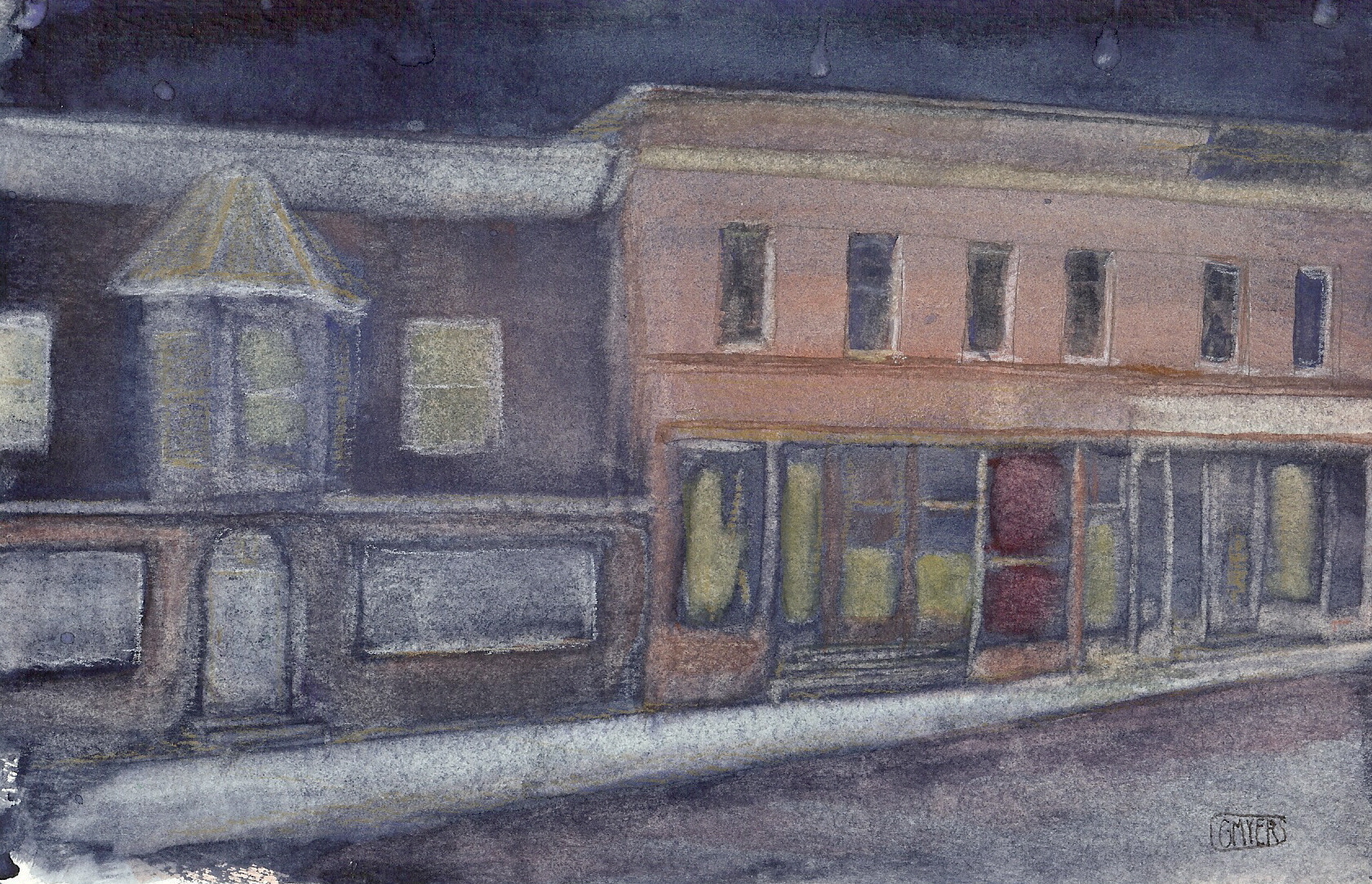
Elmira Street 1994This is an old piece from 1994 when I was still just beginning to realize that I might find something in all the time and effort I was putting into painting.  It’s not a great piece but there are things I like about, things that gave me a feeling of potential, at least in my own head.

I bring this up because of a brief conversation I had with a friend this past weekend.  I attended an opening at the West End Gallery and ran into a friend, also a painter, so naturally our conversation turned to baseball.  We were discussing a well known pitcher who had great abilities, great stuff, who, while occasionally displaying his brilliant talents, often performed far below his talent level.  His efforts seemed to betray his potential.

In the conversation, I equated the pitcher to a painter we both knew.  I had followed his work for a number of years ever since he had graduated from a pretty good college program, having seen a group of his collegiate work at a time not too long after I had painted the piece above.   I remember being very impressed at the time.  Actually, envious is a better word for what I felt.  I saw real potential in that work and realized that I was struggling to achieve things that obviously came easily to him.  I remember being a little disheartened at the time at my own talents compared to his.

But his subsequent work has yet to live up to the potential I saw.  It has been okay but hasn’t made any leaps above that early work.  It’s always puzzled me and made me feel he was somehow betraying his obvious talent and potential.  I pointed this out to my friend this past Friday and he had a different take.  He thought I was seeing more potential in that collegiate work than may have been there, that while there was talent most of what I was seeing was the result of a lot of supplied direction from his instructors, not the result of his own natural output.  He also pointed out that the other painter had other avenues that he was following, that his real potential might not even lay in the same field I was seeing it.

At that point in my head I immediately realized that I was so wrong in my appraisal of this painter’s potential.  I was seeing his potential against my own desires, not taking into account his own desires, which might include goals that were a million miles from my own.  I was imagining what I could do with the talent I saw in that early.  I was assuming that he had the need to express himself solely through his art, the same as I did.  His failure to followup on the potential I placed on his work was not his failure, it was mine in not seeing that his potential had merely moved in different directions.

It made me look at my whole attitude on the expectations of other’s potential.  What I might see as important might not seem so important in the lives of others and vice versa.  I see this artist’s life and potential in a whole different light, one not shaded with my own expectations of what he could or should be.

Phew, that feels good to get off my chest…

Read Full Post »

Quietheart I had my Gallery Talk yesterday at the West End Gallery in Corning and it went pretty well.  Really good group of people who asked insightful questions and seemed very open to the things about which I was talking.  I went quite a bit over the hour that was planned but I don’t think it dragged on.  Hopefully, they enjoyed it as much as I did.  They made it very easy for me.

One of the questions that came up was about whether I worked on more than one painting at a time or if I had paintings in varying degrees of completion.  I immediately spoke about this piece, Quietheart, which was the centerpiece of my 2007 show at the West End.

At the end of 2006 I prepped a large panel, 34″ by 60″, layering in multiple layers of gesso to create a visually interesting base to hold up the paint above.  I started the piece by painting a large block of color, consisting of varying reds and yellows that had quite a bit of intensity.  The orangish color of the sky is this color.  So I had this large block of color that I very much liked.  It had the intensity I mentioned and the surface had a great texture that seemed to be visually stimulating throughout.  It was right on the mark as far as I was concerned.

The problem was that I was now afraid to go any further with piece.

I so liked this first block of color, this base, that I felt I could only do harm to it by making another mark on it at this point.  I felt I couldn’t add to, could only diminish from it’s impact.  I gloried in the color and form but couldn’t see a next step at that point.

So I set it aside.  It sat, prominently displayed in my studio, for six months and I would look at it each day and think that someday that would truly be something I would be proud of if I could ever dare to step into it once more.  Finally, one day I pulled it down and said this is the day and with great trepidation, put a new brush of paint to it.

I was immediately engaged and the image as you see it above fell in place quickly.  I breathed easier.  I hadn’t diminished the original block, hadn’t made it secondary to the scene above it.  I felt that its strength bonded with what I had added.  I was pleased.

And that is the main criteria I have to meet.

So, yes I do have pieces at different points and most are just waiting for the right moment.  

Again, many thanks to those who came out yesterday.  It was most appreciated.

Read Full Post »

Gallery TalkWell, today’s my annual Gallery Talk at the West End Gallery in Corning in conjunction with my show, Dispatches, which is hanging there until the end of August.  I’ve done quite a few of these talks over the years, probably 11 or 12, so I know what to expect.  But there’s always a little anxiety anytime you have to speak in front of any group of people.

My gallery talks are always pretty much off the top of my head which, when it works and the audience is receptive and interacting, is good.  When it doesn’t work, it’s pretty ugly.  A lot of blank stares and awkward silences.  Luckily, that’s only happened once or twice.

The first talk I did at the West End was back in 1997 and I had put everything I wanted to get across into a short speech that I wrote out and memorized.  Well, the talk began and I reeled off my little speech.  It was pretty good until I came to the end of it and glimpsed the clock.  It had lasted about 4 minutes and my mind was a totally blank slate.  

Tom Gardner, then co-owner of the gallery and a well known painter, had told me a little trick before the talk.  He told me to always have a glass of water and when I came to a spot where I was stuck with nothing to say to simply walk back and forth in front of the audience and take a very slow sip of the water.  Look thoughtful.  I thought it was pretty good advice until I realized I would be pacing back and forth, sipping water, for 56 minutes.

Luckily, Tom rescued me with a question and from there it snowballed with the rest of the crowd asking questions, one subject leading to another. Phew!  Over the years I’ve gotten more comfortable with the whole thing and have an assortment of anecdotes to fall back on when things start to falter.

Another reason I don’t go in with a prepared speech is that each group of people is different.  Some groups are more interested in talking technique, wanting to know how each piece is painted.  What type of paint I use and how I achieve certain aspects in the paintings.  That kind of thing.  But others are not so interested in the how but in the why.  They prefer to hear what the stories are behind the paintings.  So, there’s a moment at the beginning of each talk  when I have to gauge what approach suits this particular group best.  I really try to stay away from the technical side for the most part because sometimes, when I’m droning on about such things, I can see the non-painters’ eyes glazing over.  I try to get off the subject as soon as possible when I spot this and try to engage their interest.

It usually goes pretty well and we all have a few laughs.  I’m hoping today is no different.  If you’re in the area today, the talk takes place at noon at the West End Gallery in Corning, NY.

Read Full Post »

« Newer Posts - Older Posts »