Feeds:
Posts
Comments

Archive for the ‘Painting’ Category

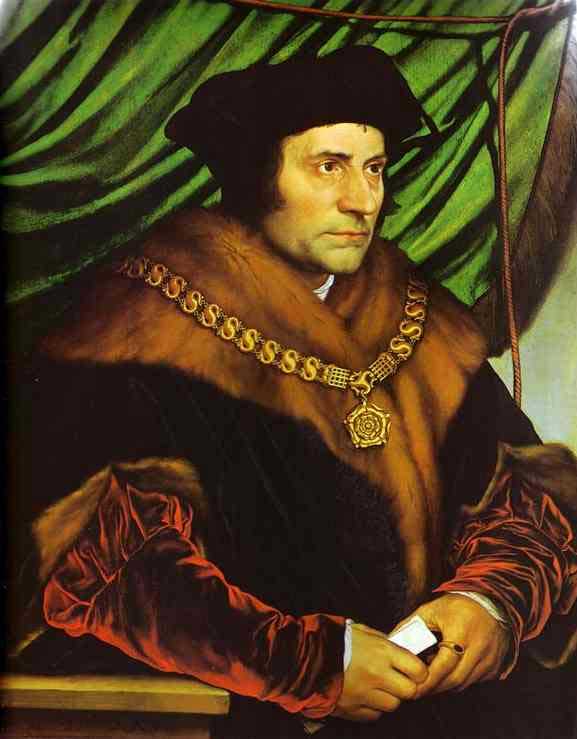
Holbein-SirThomasMoreYou run across a lot of people who are completely dismissive of anything from the past.  They feel that we at the moment are the leading edge of humanity’s progress, that we are the culmination of all that has come before us and thus, anything created long before our time can not have equal value  now.  There’s this sense that only the modern can fully express the complexity of our world.

When I see this painting of Sir Thomas More painted by Hans Holbein in around 1527 I realize what  flawed logic that is.  

Here is a painting that was painted nearly 500 years ago that, when seen in person at the Frick in NYC, has surfaces that are absolutely beautiful.  It still glows with its sumptuous colors.  All the years of technical progress have not produced materials that could accomplish any more than Holbein did with the materials of his time.

holbein_henryviiiI could stand and look at this piece for hours, marveling not only at the beauty of the paint but at the way Holbein captured More’s humanity and the sense of the time in which it was painted.  For me, this painting really illustrates, gives life to, an important figure in history.  More was the ultimate man of conscience, refusing to give in to Henry VIII‘s will that he endorse Henry’s divorce from Catherine of Aragon so that he might marry Anne Boleyn.  It ultimately cost him his head and cost the world a wonderful mind, one that gave us the concept of Utopia.

It is obvious to me that Holbein felt warmly towards More in the way the piece is painted and the way he captures his persona.  In the painting Holbein  did of Henry VIII (on the left) I get a different sense.  It’s meant to be large and strong, to be a display of regal power and that it is.  But there’s a coldness in the piggish eyes and an arrogance in the stance.  Oh, it’s a beautiful painting, on many levels, but when you compare the two it’s obvious where Holbein’s sympathies lay.

This is art and history coming together at single points.  It captures the humanity that is contained in all of us and remains unchanged even to the edge of our time.  Good stuff.  No, great stuff…
Read Full Post »

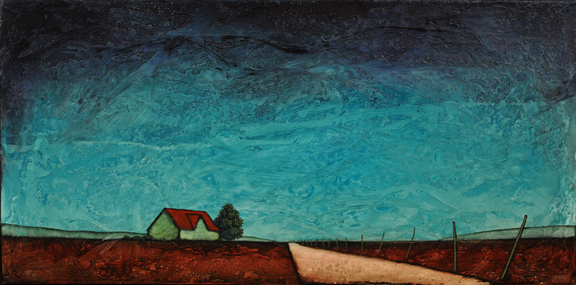
 The Dark Blue Above  This is a new piece that’s titled The Dark Blue Above.  It’s very much about atmosphere and feel, very much about the weight of the sky and the potency of color and texture that give it a certain presence.  I think the simplicity of the overall composition enhances this feeling.

Makes me think again of my own smallness, my own insignificance in this world and this universe.  It’s a catalyst and sets me thinking on the nature of all things.  How? Why?

I guess that’s all I can ask out of a piece of work.  

This piece is past of Dispatches, my solo show at the West End Gallery that opens July 24.

On this Sunday morning here’s a song from Johnny Cash that sort of fits the feeling of the painting…

Read Full Post »

 Given to the NightI spent some time looking back over  work from the past several years this weekend.  I was just seeing how the work moved from season to season and year to year, examining how the look of the work has changed.  How the technique I use continues to evolve.  How different colors revolve in and out of the parade of work through the years.

Blue is such a color.  I love working with blue and all the different hues within its spectrum.  I like its expressive quality and the sheer beauty of the color.  It’s easy to see why so many people inevitably say that blue is their favorite color when asked.  I see this in peoples’ reactions to work that is predominately blue.

At shows, folks who have followed my work over the years will sometimes ask why I don’t paint more blue pieces.  It’s always hard to explain because it sort of defies logic.  I mean, I love working with the color.  People react very strongly to the blue work.  I have only one blue piece in the studio that came back unsold.  The works in blue always do well.

So, I should be doing more, logically.  But there’s an feeling when working with blue that is hard to explain.  I call it color intoxication.  There’s an impulse when working with a color that has such a strong reactive quality as blue, especially when your face is constantly a foot or so from the surface of the painting, to be drawn deeply into the color.  It’s almost a trancelike state.  When I’m in this state I want to only see more of this color, to the point that it becomes obsessive.  So, despite it’s positive qualities, I have to pull myself back, have to fight the desire to continue deeper into the color.  If I didn’t my work would evolve into a blue drone, abandoning all the other colors that I also love to use.  

Maybe that would be interesting as an artistic statement but I kind of doubt it.  So I fight the pull of the blue and only do one now and then, just to keep the the beast alive…

Read Full Post »

Paul CezanneThere is an exhibit at the Philadelphia Art Museum that features about 60 works from Paul Cezanne as well as works of about 17 artists that were directly influenced by Cezanne.  There is work from masters such as Picasso, Matisse, and Max Beckmann as well as modern painters like Ellsworth Kelly and Brice Marden,  all influenced in some form by his work.Cezanne Mont Sainte Victoire

Some take something from his use of color or his compositional forms.  Others takes from his brushwork and application of paint.  The interesting thing is how each translates what they see in Cezanne’s work and puts that into their own work, which at first glance has absolutely no connection with Cezanne.  For me, seeing how another artist assimilates his influences into his work actually draws me closer to their work.  It gives a little insight into a part of their mind that I may not see in their work normally.  It basically creates a common bond that helps me be better appreciate the evolution of their work.

cezanne-estaque My attraction to Cezanne’s work comes in a couple of different forms.  First, there is an underlying warmth in his colors that really hits for me and always makes me comfortable when looking at his work.  There is an inviting quality in his color.  Secondly, I always admired his repeated use of certain subjects such as Mont Sainte Victoire (above) which he painted about a hundred times.  You can see that this was not mere repetition, each piece having a unique quality and freshness.

Actually, freshness is a word that comes to mind when I think of Cezanne and the allure of his work.  Most feel in the present.  Most have a most modern feel.  I get the sense when looking at one that it could have been created today and has bonds to our times.  That is one of those indefinable qualities that artists seek for their own work and can sometimes see in the work of others.  I suppose that is why artists borrow from other artist- to attain that sense of timelessness for their own work. 

At least that’s what I seek in the work of others.Cezanne

Read Full Post »

995-374-brisant-bellow1I am always mystified by how we perceive ourselves, either personally or through our work, in the eyes of others.  The disparity between how we see ourselves and how others see us is an interesting dynamic, one that has so many contributing factors that it can’t be fully explored in a daily blog.

For an artist this is an important point.  We definitely see our work in a certain light and often have little idea how the work is really thought of  in the outer world.  Every artist thinks of their work as serious and important but does the public see it as such?

If so, why?  If not, why not?

What makes some work weightier than others?

If you’re expecting an answer from me I’m afraid you’re going to be disappointed.  I’m in the dark like everyone else.  I have some ideas but of course they’ll only be justifications for why I see my own work as important.  Anyone who values their own work would do the same.

Now, I’ve seen work that is considered important and deep and have turned away scratching my head.  I am not impressed.  I am not moved.  I feel nothing from the piece.  Is this a reflection on my shallowness or lack of perception?  Sometimes it seems like a perception of the work is adopted that has little to do with how it is really seen and the public will go along with this popular opinion because most feel they lack the knowledge to dissent, especially when those who offer the popular opinion are considered expert- critics, gallery owners and curators.

Granted, these people have certain knowledge and a usually wider exposure to many forms of expression.  But again, art is not a calculable science and the opinion-makers, the trendanistas if you will, throughout history have often been wrong. 

So what’s the point here?  I don’t know.  Perhaps I only want to ask the question of the general public ( and feel free to answer):

What draws you to a piece of art?

Read Full Post »

Legendary HeartThis is a painting from a few years back that always sticks in my memory.  There are many things I like about this piece, many things which I think make it notable but the part that sticks most with me is its title. It’s  Legendary Heart.

I suppose the title visually came from the shape of the tree’s crown or maybe it was something in the atmosphere of the piece that suggested the name.  I’m not sure exactly except to say that I have always seen something quite heroic in this piece.

What do I mean by that?  What is heroic?

Oh, it’s easy to define heroism in terms of combat or competition, the obvious examples for displays of courage and bravery.   Soldiers racing forward through a hail of bullets to capture an enemy, a fireman climbing into a burning building to rescue a child or even a competitor fighting through injury to bring their team victory– all are truly heroic.

To me however, this piece speaks to the root form of heroism,  the element that defines all heroism, from the most glorious to the most mundane  everyday variety that often  goes unnoticed.  

I’m talking about self-sacrifice.

Heroism is the giving of  yourself to and for others.  Whether it’s a soldier or rescuer risking their safety so that others may be saved, a parent putting aside their own self interests for the benefit of their children or person who sacrifices their time  and  fortune for the betterment of those who truly need their help– all are heroic in terms of self-sacrifice.  Heroism is not about amassing accolades or wealth.  It’s about amassing a wealth of spirit and that that can only be achieved, paradoxically, through giving, not taking.  It’s about shedding the greed and meanness of spirit that dwells deep within us, side by side with our sense of charity and courage, in some cases pushing aside these better traits and overtaking our characters.  We are living in a time where this has happened all too often.

The heroic is in compassion and empathy, not in domination of any sort.  It is in having the courage to let the better parts of our character shine.  

We could all use a little of this courage.  I think many of us are always on a sort of hero’s journey, trying to find this bit of good while fighting back our baser demons.  Occasionally, even momentarily, it appears to us and we feel nourished, strengthened  enough to continue forward.

That’s what I see when I look at this painting.  Oh, it’s a striking image but it’s the message that I glean from it that makes it stand out and whenever I see this painting, on a computer screen or in my mind, I am reminded to keep moving forward.

Read Full Post »

Edward Hopper NighthawksWhenever I see an Edward Hopper painting I feel a bond with him, as though he were a kindred spirit in a world full of alienation.  There is always a great sense of distance in his paintings.

Aloofness.  A disengagement of sorts from the wider world.  Even in his cityscapes, one feels as though they are miles away from anyone else.

I suppose this disengagement may be the reason I and many others choose to communicate in paint.  With few exceptions, I have seldom felt inclusion in many groups of people,  always feeling a bit like an outsider.  And while I have actually become comfortable in this position, always bearing a sort of suspicion toward groups or cliques, the need to be heard drives my painting.  

Even in a world of alienation, one wants to have their say.

In my paintings, I sometimes see this aloofness in my red tree and the way it is often portrayed as a single figure in a large space.  Sometimes the pieces reflect a celebration of the self and self-reliance but sometimes there is this sense of a Hopper-like alienation.  The solitary character just wanting to be heard.

I don’t see this as being a sad portrayal.  There’s much more I could say on this but I think that’s enough for the moment.  Here’s a song from the great Hank Williams that kind of speaks to this subject.  It’s Lost Highway, a song that is, for me, one of the most transcendent songs Hank ever recorded, a song with a spirit that feels new and alive even today, even with its early ’50’s production values.

Read Full Post »

9908-302-endless-time-webI wanted to talk a little about the piece shown here, Endless Time, which is a 24″ X 30″ canvas.  This is what I consider a performance piece meaning that I have performed several paintings that have a similar palette and composition in different sizes.  

Each piece has its own character and feel, distinguished by differing color intensities and textures.  The colors of each are similar but have their own peculiar colors due to the factors that make my color palette differ from day to day.  Things like humidity and temperature, different gessoes that I use with differing absorption rates and my own lack of consistency in mixing color.

I call these performance pieces because I equate painting them to a musician performing their own composition.  The musician may often change bits of their own compositions, changing thing like tempo or intensity.  Changing the coloration of the notes and how they’re played.  The composition is intact and is identifiable but each individual performance has its own character, its own wealth.

You may notice something quite different in this piece as well.

No tree.  No red tree.  Nothing…

This is really a direct descendent from my earliest work that focused on open spaces and blocks of color, work that was meant to be spare and quiet.  The weight of the piece is carried by the abstract qualities of the landscape and the intensity of the colors.  

With this piece, I have chosen to forego the  kinship that the red tree often fosters with the viewer, acting as a greeter inviting them to enter and feel comfortable within the picture plane.   In Endless Time the viewer is left to their own devices when they enter the picture.  There is no place to hide, no cover.  They are exposed to the weight of the sky and the roll of the landscape.  They are alone with not a sound nor distraction.

It becomes, at this point, a meditation.  One is not merely looking at a landscape.  To go into this painting one must be willing to look inside themselves as well.  

And I think that is where the strength of this piece dwells.  I hope this is evident to some viewers and they feel welcome to enter this quiet space…

Read Full Post »

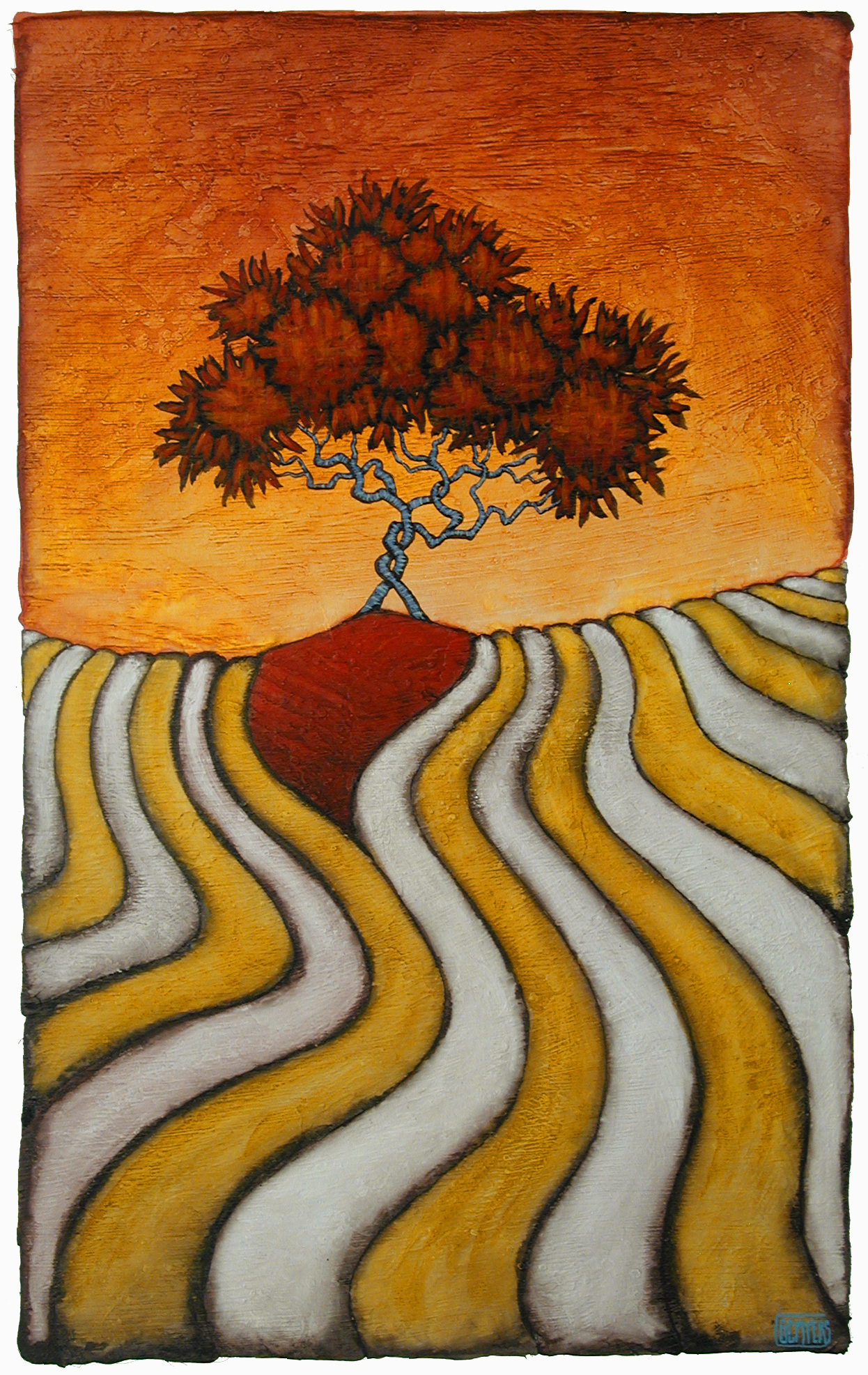
And the World Goes On

And the World Goes OnThis is a piece from a few years back, And the World Goes On, that always strikes me when I come across it in  my files.  It has all the elements that I’m looking for in my own work-  strong saturated color, evident texture, a sense of rhythm and flow.

It has some of my favorite icons.  It uses the red tree, of course, but it is two entwined trees, something that most see in my paintings as symbolic of love or partnership.  It also has the filed rows in the foreground, a symbol for either  the value of labor or the flow of time, depending on where the viewer stands in their own life.

Of course, it could just be a couple of red trees in a field.

And that’s okay…

Read Full Post »

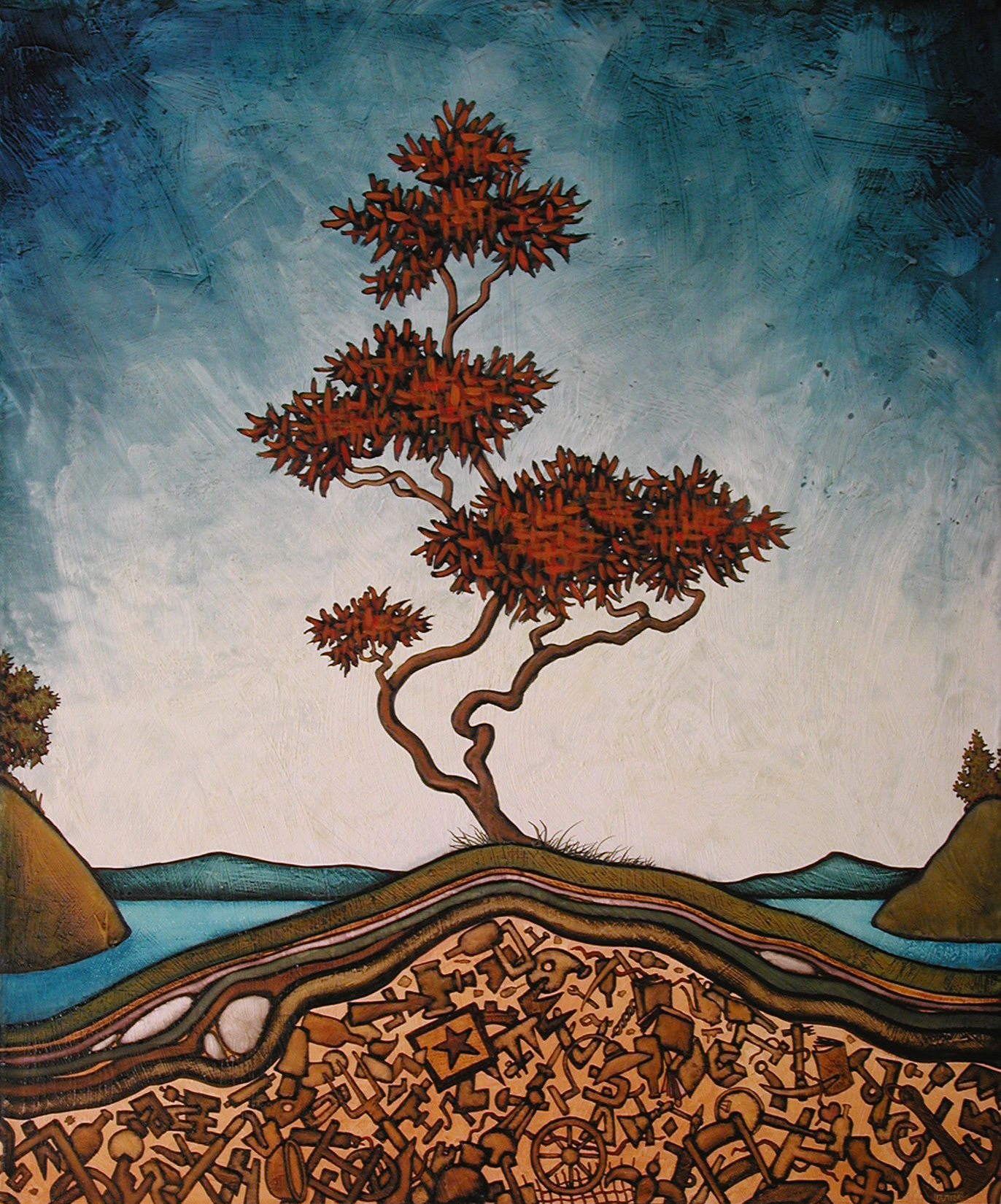
Archaeology: UnburdenedIt’s Sunday, the end of a long week with a lot of driving and certainly not enough painting to suit my needs, both professionally and personally.  

I’ve had a little time to mull over what I want to say with my work in the near future and am finally formulating concrete ideas that seem to be making sense.  It’s like stepping back and taking stock of yourself as a person, then determining what you are, in the present.  I want to go forward new and fresh, unfettered from the past.

It’s a hard thing to explain and even harder to do.  This painting, Archaeology: Unburdened, shows, in its own way, what I’m trying to say.  

We all emerge from the past but we must stand apart from that past, though our roots still run through it.  We must be adaptive to the present if we are to flourish.

I’m going to stop.  Too much rhetoric for a Sunday morning.  I actually just wanted to show this painting, one that I like a lot.

Have a good Sunday…

Read Full Post »

« Newer Posts - Older Posts »