Feeds:
Posts
Comments

Archive for the ‘Painting’ Category

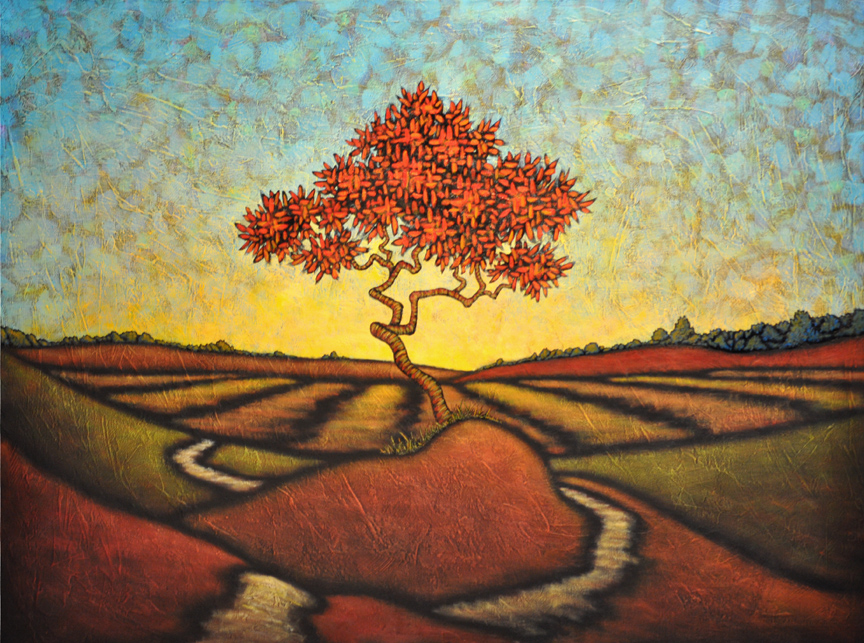
Solitary Crossing

Any fool can make a rule, and any fool will mind it.

     -Henry David Thoreau

I have always had a problem with adhering to rules, in practically all aspects of my life.  It’s as though when a rule is presented, a part of me automatically starts figuring out an exception to the rule, a way to go around it.  In everyday life this not always a desirable trait, often putting one at odds with the law and one’s own conscience. But, as luck would have it, this trait is indispensable in art.

It’s always amazing to me how many artists are tied to their own set of rules and nothing can deter this adherence, even if straying a bit might actually cause their work to really blossom. For instance, I know a painter who can only paint what is before him and will not add or subtract any detail from the scene. He once showed me a painting that was really painted beautifully, rich and bold. Everything worked well and the piece was really eye-catching except for a telephone pole that bisected, in a very intrusive fashion,  the very middle of the canvas. It was a real distraction that threw off the whole weight of the composition

Why is this pole here?” I asked.

He gave me a quizzical look and explained that it was in the scene as he had photographed it. When I asked if it had any purpose in the painting he said that it didn’t but it was part of the original scene.

There was a certain realization that came from this brief exchange. I realized that there were truly talented artists who would always be shackled by their own rules and that absolute adherence to any arbitrary rule can be the death of creative expression.

Now, I’m sure there will be those who would argue this point and would be able to point out any number of examples that might contradict this statement. So what? They are mere exceptions to this loosely formed rule.

So, kids, the moral of this story : In art, keep the rules around as guidelines, but when you need to paint outside the lines, just do it.

Read Full Post »

Simple GloryI am asked this question at every opening:  How long does it takes to finish a painting?  

This is a question that I’ve answered a thousand times and I still have to stop and think about my answer. 

You see, there are so many variables in my painting technique at different times that sometimes the actual process can be much longer or shorter.  Sometimes I can toil over a piece, every bit of  the process requiring time and thought.  There may be much time spent just looking at the piece trying to figure out where the next line or stroke goes, trying to weigh each move.  Then there are times when the painting drops out effortlessly and I’ll look up after a very short time and realize that it’s almost complete. Any more moves from me and the piece would be diminished.

I often cite an example from a number of years ago.  I had been working on a series of paintings, working with a particular color and compositional form.  Over the course of a month, I did several very similar paintings in several different sizes from very small up to a fairly large version.  Each had a very distinct and unique appearance and feel but the technique and color was done in very much the same way.

One morning at the end of this monthlong period, I got up early and was in the studio at 5 AM.  I had a very large panel prepared  and pulled it.  Immediately,  I started on the panel.  Every move, every decision was the result of the previous versions of this painting I had executed over the past month.  I was painting solely on muscle memory and not on a conscious decision making thought process.  I was painting very fast, with total focus, and I remember it as being a total whirl.  The piece always seemed near to disaster.  On an edge.  But having done this for a month I trusted every move and forced through potential problems.

Suddenly, it was done.  I looked over at the clock and realized it had only been two hours.  Surely, there must be so much more to do.  

But it was done.  It was fully realized and full of feeling and great rhythm.  I framed the piece and a few weeks later I took it to the Principle Gallery in Alexandria, VA. where I had shown my work for many years.  It sold within hours of arriving at the gallery.

I realized at that point that every version of that painting was a separate performance, a virtual rehearsal for that particular painting.  I had choreographed  every move in advance and it was just a matter of finding the right moment when plan and performance converge.

 It had taken a mere two hours but it was really painted over the course of hundreds of hours.

I hope you can see why I always have to think about this question…

Read Full Post »

The New Phoenix

dsc_0349-webI am calling this painting, for now at least, The New Phoenix.  It’s a new piece and is an extension of what I term my obsessionist work.  This is a 30″ X 40″ canvas and really seems to have a glowing vibration in the light.  

It also has the depth into the picture plane that I feel is the difference between effective and less effective paintings, particularly my own.  I’ve been looking at this piece for several days and feel that it’s a very strong example of one of my iconic images.  It has a bold look with great contrasts yet still has the calmness and quiet that I want in my work.  Strong yet thoughtful…

This piece has a certain degree of empathy that I find attractive.  I can’t quite describe what mean or how I see it- just a feeling I see in this painting.  Empathy is an important term for me, in my work and in many aspects of my life.  I want to write more about it at some point not because I want to bare some part of my self but because as a whole I think empathy is lacking in many of our lives.

But today I don’t want to go any deeper into that subject.  I just want to look at this painting a bit more before it goes out into the world alone…

Read Full Post »

The AngstWhen I used to enter a gallery or museum, even up until several years ago, I would be filled with a severe sense of dread and anxiety.  Angst.  The knot in the stomach.  The racing pulse. The whole thing.

I would go from painting to painting and would feel lessened because in each piece I would see something that I could not do, some technique that was not in my toolbag.  There were colors and forms that I could not replicate and all I could think was that I was somehow inferior.  

I didn’t belong.  

The resulting feelings would leave me reeling and sometimes angry, making me even more determined to create something that would validate my work.  

While this was a motivating force for many years, helping me actually find my voice, it gradually subsided over the years as I became more and more aware that I had been focusing on things I could not control and on being something I was not.

I began to see what I was.  I had an individual voice and vocabulary that was mine and mine alone.  I began to see that other artists felt about my work as I had felt about their work.  I saw that while they were doing things that I could not, the reverse was true as well.  I recognized that my voice, my technique and style, was finally mine and mine alone.  I saw that my form of expression was every bit as valid as any other artist hanging in any gallery or museum.

This was a liberating feeling.  It allowed me to go into galleries and museums and , instead of seeing what I was not, recognize the beauty of expression that was there and be excited and inspired by things other artists were doing.  Instead of coming out saying I’ll show them I was saying I can use that.  

It was merely a matter of trusting that what I saw in my own work was a true and real expression and would be visible to others.  I think this a lesson from which any viewer of art can benefit.  They must learn to trust their own instincts and reactions when looking at art.  Like my self-expression, their reaction to a work is theirs and theirs alone.  Their reaction is as valid as anyone else and no critic or gallery-owner can make a person like a piece that doesn’t move them.  When the viewer realizes that there is no right or wrong, that their own opinion is truly valid, their viewing pleasure will increase dramatically.  

By the way, the piece at the top is an old experiment from around 1994.  I always enjoy pulling it out even though it doesn’t fit neatly into my normal body of work.  No more angst.

Well, a different kind of angst…

Read Full Post »

dsc_0343-smallIn a comment from yesterdays post (Out Into the Wide World) there was a comment from David Terrenoire  (his entertaining blog A Dark Planet can and should be reached from my links list) where he thought he liked the shown painting because there an implied narrative.

I think there is something to this comment  and I think it’s central to some of the attraction that my work may hold for some viewers.  I may have addressed this before so if this seems familiar, excuse me.  

Years ago, Cheri, my wife, described my paintings as blank sentences.  By that, she meant that I was giving context, some detail and a bit of direction but the actual narrative of the piece was left to be filled by the imagination of the viewer and the experiences that they brought with them.

I immediately sensed the truth of her words.  It also explained a few things.  My writing had always lacked narrative depth.  I was more concerned about creating mood and emotion with the words rather than the story construct.  As a result, most of my writing centered around describing silence, ephemeral moments and wide open spaces.  Pretty limited stuff and it left me feeling as though I were missing the mark somehow.

I wanted to create an environment where someone could see the things in my writing- silence, space and moment- but in a way where I was not filling in every detail.  The viewer would add an actual element to the painting.  The narrative of the piece might be implied but was only there if the viewer so wished.

Maybe I’m off-base here or maybe I’m blathering on in the artspeak that I so detest.  I just don’t know.

The piece above is a new painting tentatively titled  Above Canaltown.  This might be a good example of what I’m trying to say here.  For me, this very much about shapes, color and creating a certain emotional rhythm with the placement of the buildings, paths and canal.  However, I can see where there is room for narrative and I may have my own for this scene.  But if this piece is to succeed and have a life of its own, the sentence will be completed by someone other than me.

That okay with you, Dave?

Read Full Post »

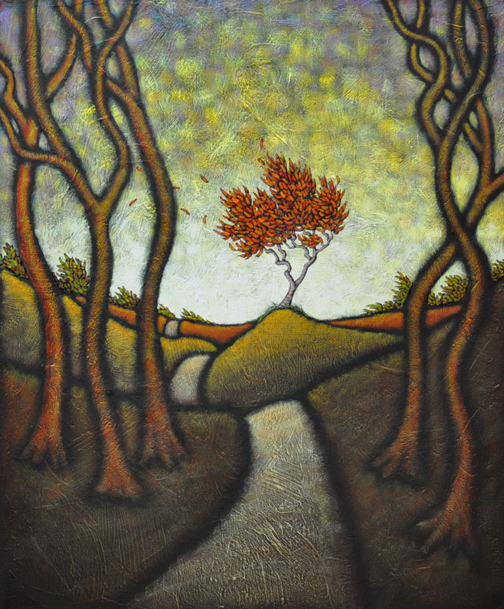
Out Into the Wide WorldThis is a new painting titled Out Into the Wide World.  It’s painted in the same manner as my Red Roof series, in a style that I call  obsessionism.

This piece uses some familiar icons that appear frequently in my work.  There is the path that winds through the scene and there is the ever present red tree, this time being wind blown.  The tree is often placed on a small mound that  lifts it above the surrounding landscape, giving it a sense of importance in this context.

In this particular painting, I see the red tree as a guide or mentor, indicating here that one must follow the path that lays before them and must get past the trees in the foreground which might obstruct the view ahead. I suppose this is really about keeping one’s focus on the bigger picture and not getting caught up in the smallness and pettiness of things which might prevent one from moving on in their path to growth.

Now, this is only an interpretation made after the fact of the actual painting.  I never intend such meaning or message beforehand and am never sure what will emerge.  Generally, when a painting succeeds visually it is fairly easy to read meaning into it.  The elements that create an effective painting for me- depth, texture, contrast, mood- are the very things that create thoughtful evaluation.  For me.

For others, it may (or may not) be just a pleasant  little picture and nothing more. And that is fine and equally correct.  That is the subjectiveness and beauty of art.

Read Full Post »

Endless PossibilityI talked with an old friend the other day who asked  about my paintings, specifically if there were works that I considered better than others.  

I’m asked this quite often, particularly at shows where the questioner might be trying to get some insight into what I think are the real treasures there.

I explained to my friend that I had a common interest in every piece I create and that I treat every painting, from the very smallest to the largest, with the same care and thought.  You see, I view every piece as a performance, much like a musician or a dancer.  To me, if I’m painting, I’m performing.  I don’t have sketches or studies.  Even if I’m at work on a small piece that that may well be the inspiration for a larger piece at some point, that smaller piece is treated as the primary painting.

Like any discipline, this creates muscle memory.  It’s like a performer treating a rehearsal as an actual performance.

This being the case, each piece is equal at some level.  One of my goals is to create work that is equal in performance and power regardless of size.  

However, the variable in this is that my technique is changing and adjusting day to day.  For instance, the piece above, Endless Possibility, is from a few years ago and one that stands out in my head.  It is performed in a composition that is very familiar to me, like a musician playing one of their favorite songs.  But because of variables such as my evolving technique, changes in materials, environmental factors (sometimes warmth and humidity play a significant part in the final product) and other such things, this piece, like most others,  is absolutely unique.  I would be hard-pressed to replicate this.  Probably couldn’t.  There are colors and textures that are unique in this piece because of the variables I’ve mentioned.  

That’s the goal for each piece: to emphasize the unique quality of that piece regardless of its size.  To unleash the the strength that is latent in each piece.

I guess there is endless possibility in that…

Read Full Post »

Two Sides

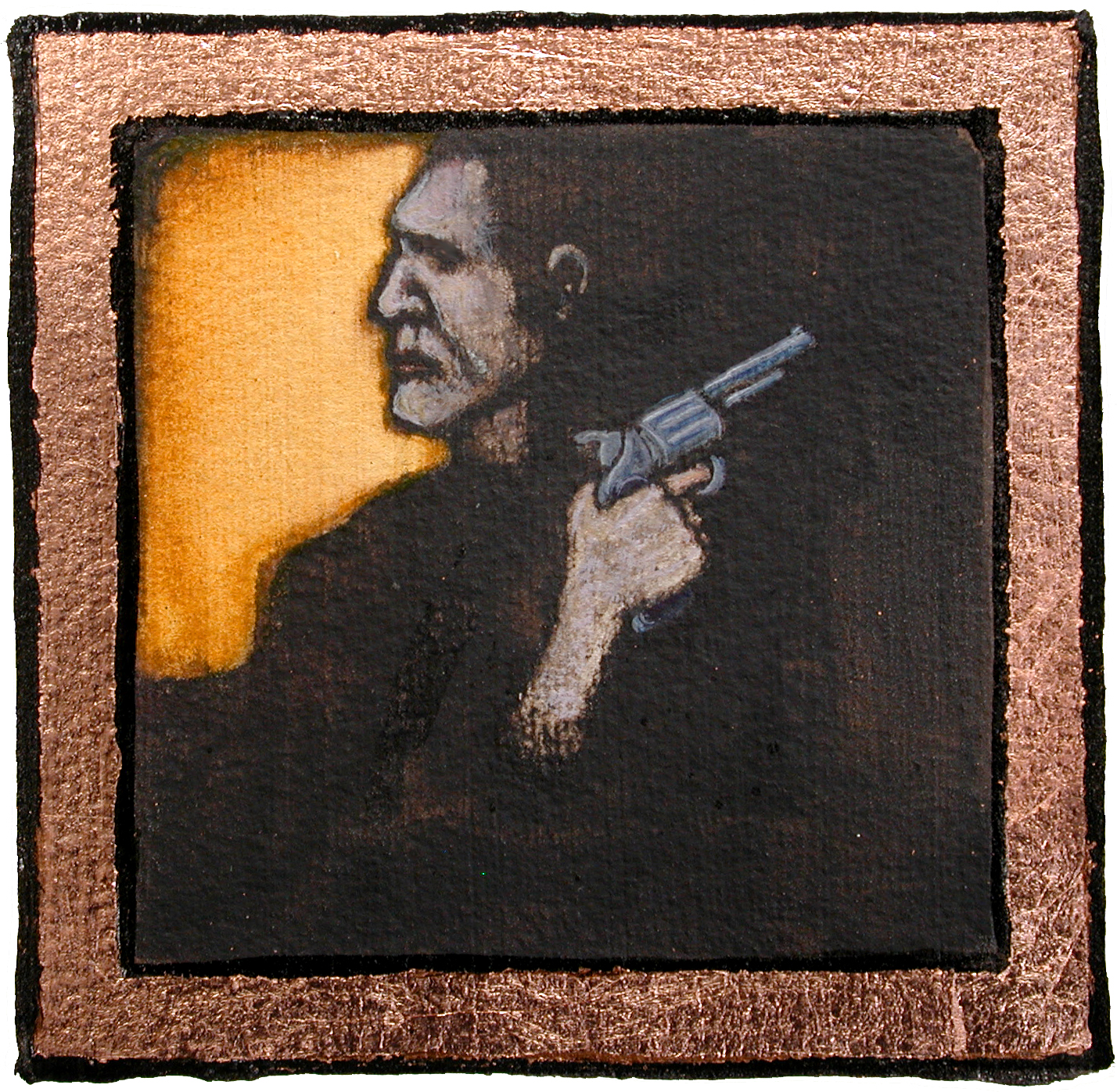
996-229-two-sidesThis is another piece from my Outlaws series, titled Two Sides.  For some, this is a little scary- a guy holding a gun.  For me, it is representative of the two opposing sides in everyone’s nature.

yin-yangI believe we are all comprised of equal parts of opposing valuesin our natures- man/woman, good/bad, light/dark.  Most walk that centerline that divides the two halves but both sides are always there, closer at hand that we may find comfortable.

This piece was designed to somewhat replicate the yin-yang symbol of Taoism.  Light and darkness make up the central character, although he appears to have slid slightly more to the darker side of his nature.

Perhaps appearances can be deceiving…

Read Full Post »

Railbirds

RailbirdsThis is an old piece called Railbirds.  I’ve always liked this little painting for the clarity of color and the composition and rhythm of the figures that are seemingly  engaged in a fistfight at the rail of a horse track.  It’s also a piece that calls back parts of my youth that are distant and remain only in memory.Between Races

The culture of gambling played a major part in my youth.  I spent an inordinate amount of time at racetracks and taverns, reading the Daily Racing Form and drinking watery Cokes,  as a kid.  There are a lot of stories and details I could add that might make this a personal mythology piece but I think in this instance, the less said the better.

However, I will say that this time was a great experience in watching people and how they click and interact with one another.  I was exposed to adults, often at their worst .

 Drunk. Angry.  Greedy.

I can’t say how this translates into my work or how it effected my becoming an artist .  Maybe it showed me the darker side of our psyche and took away the romance and influence it might hold for many.  Maybe it was important in forming my sense of light and dark.  Maybe it’s the basis for the darkness that I try to put behind my paintings.

As I’ve pointed out before, you can’t appreciate the good without knowing the bad -or the light without having been in the dark.

Read Full Post »

Struwelpeter

StruwelpeterThis is Struwelpeter, a small painting based on the famous German children’s book from the 1800’s,  containing 10 cautionary tales.  Struwelpeter translates as Shock-headed Peter which is the story of a unkempt young boy who refuses to bathe or cut his hair or trim his nails.

He is just one of the children with offending habits who fall victim to cruel ends as a result of their own foul behavior.  It’s macabre and sometimes gruesome but it has remained in print for over 150 years and is one of the most influential children’s books of all time.

I did this piece as part of my Outlaws series from a few years back.  I could only envision Struwelpeter as an outcast as an adult, never quite shaking the bad habits of his youth, and this is how I saw him.  A little creepy, yes.

But he is Struwelpeter, after all…

So groom yourself well and don’t suck your thumb!

Don't Suck Your Thumb!

Read Full Post »

« Newer Posts - Older Posts »