I recall an August afternoon in Chicago in 1973 when I took my daughter, then seven, to see what Georgia O’Keeffe had done with where she had been. One of the vast O’Keeffe ‘Sky Above Clouds’ canvases floated over the back stairs in the Chicago Art Institute that day, dominating what seemed to be several stories of empty light, and my daughter looked at it once, ran to the landing, and kept on looking. “Who drew it,” she whispered after a while. I told her. “I need to talk to her,” she said finally.
My daughter was making, that day in Chicago, an entirely unconscious but quite basic assumption about people and the work they do. She was assuming that the glory she saw in the work reflected a glory in its maker, that the painting was the painter as the poem is the poet, that every choice one made alone– every word chosen or rejected, every brush stroke laid down or not laid down– betrayed one’s character. Style is character.
— Joan Didion, Georgia O’Keeffe
This anecdote opens the essay Georgia O’Keeffe that is included in author Joan Didion‘s 1979 book of essays, The White Album. I can only imagine the awe and wonder in the eyes of her daughter along with the many questions it inspired, on seeing O’Keeffe’s huge painting– it’s 8 feet high by 24 feet wide!– in a large open space.
It raises an interesting question: Is style character?
That’s a tough question. I am not positive it holds true for all artists across the spectrum of artistic disciplines but, for the most part, I would like to believe this is true if the style of the artist is genuine and true to their self.
Determining what is genuine and what is contrivance is another question.
I think the reaction of Didion’s daughter is one reliable indicator of authenticity. There is something about the reaction of a child to art that I trust implicitly. Their perception is still unclouded and intuitive and they usually don’t yet feel the need to categorize or rate everything that they come across. They have an ability to see things clearly that I sometimes think we lose in adulthood.
They just react on a gut level, quickly and decisively, to some inner intuitive cues.
In my experience, I generally am most pleased with my own work when it catches the eye or mind of a child. It’s perhaps the purest form of validation, letting me know that the work speaks on a visceral, emotional level.
But is this, the style that speaks to that child, character?
I can’t say for sure. I know a number of artists for which this holds true and I believe it is true in my own case.
Or at least I want to believe that. A person can’t attest to their own authenticity without some form of bias. That puts it out of my hands.
But I hope so. My intention for my work has always been to be transparent and open, for it to be an expression of my character, for better or worse. It is work that is meant to communicate. Or so I hope.
I don’t know that an artist’s work can ever fully mask the strengths or deficiencies contained in their character. Nor should they.
For myself, I am okay with that. I am willing to be judged because I know that few will be as critical of my work and my character as myself.
As Georgia O’Keeffe said:
To create one’s world in any of the arts takes courage.
And don’t we all aspire to have courage?
Heading across New Jersey yesterday on my way into NYC, there was a bank of clouds in the sky off to one side. They had a remarkable resemblance– from a ground level viewpoint– to the famed Georgia O’Keefe painting at the top which displays clouds from a higher perspective. I thought there must be some synchronicity at play since I had been looking at this painting in recent days as part of the post above which has been shared here a few times over the years. I took it as a good omen for my upcoming consultation. And though nothing was changed or resolved from the visit, I did feel more confident and assured in the path forward after my visit.
And that was good enough.
Maybe those clouds were indeed an omen. Neither good nor bad, just an omen telling me to trust that things will play out as they should and that I should relax a bit. Take things as they come.
And that is good enough.
Here’s a song that has absolutely nothing to do with either this post or those clouds. I just like its rhythm. It reminds me of the rhythm and pace of that ride across Jersey yesterday, under those clouds.
You do not have to be good. You do not have to walk on your knees For a hundred miles through the desert, repenting. You only have to let the soft animal of your body love what it loves. Tell me about your despair, yours, and I will tell you mine. Meanwhile the world goes on.o Meanwhile the sun and the clear pebbles of the rain are moving across the landscapes, over the prairies and the deep trees, the mountains and the rivers. Meanwhile the wild geese, high in the clean blue air, are heading home again. Whoever you are, no matter how lonely, the world offers itself to your imagination, calls to you like the wild geese, harsh and exciting — over and over announcing your place in the family of things.
—Mary Oliver, Wild Geese
Listening to a flock of Canadian geese fly over last week as they headed south brought this poem from the late Mary Oliver to mind. The honks and squawks of the flock were, indeed, harsh and exciting, as though they were giddy with delight at the prospect of being homeward bound.
It sometimes sounds to me as though they are calling out for everybody and everything to join their ranks, to grab a spot at the end of one of the legs of their long vee in the sky. To share their joy and excitement as they make their way home.
I sure wished that I could fly at that moment. If I could I ‘d have been up there trying to honk out a giddy initiation for others to join along and take their place, as Oliver writes, in the family of things.
To go home once more.
I am on my way this morning to Memorial Sloan Kettering Cancer Center in NYC for a consultation there. I’m going to try to keep those geese in mind today.
Maybe one day, I’ll learn to fly up there in the sky with them…
Here’s a song that I’ve shared here a number of times, I’ll Fly Away. It was written over three years between 1929 and 1932 by Albert E. Brumley, who is credited with writing over 600 gospel songs. This song has been recorded by innumerable artists and is considered one of the most recorded gospel songs of all time. Being a fan of both artists here, I am kind of partial to the Gillian Welch/ Allson Krauss version from O Brother, Where Art Thou?
“In becoming forcibly and essentially aware of my mortality, and of what I wished and wanted for my life, however short it might be, priorities and omissions became strongly etched in a merciless light and what I most regretted were my silences. Of what had I ever been afraid? To question or to speak as I believed could have meant pain, or death. But we all hurt in so many different ways, all the time, and pain will either change, or end. Death, on the other hand, is the final silence. And that might be coming quickly, now, without regard for whether I had ever spoken what needed to be said, or had only betrayed myself into small silences, while I planned someday to speak, or waited for someone else’s words. And I began to recognize a source of power within myself that comes from the knowledge that while it is most desirable not to be afraid, learning to put fear into a perspective gave me great strength.
I was going to die, if not sooner then later, whether or not I had ever spoken myself. My silences had not protected me. Your silence will not protect you.”
― Audre Lorde, The Cancer Journals (1980)
I mentioned the Exiles series the other day when writing about my recent cancer diagnosis. It was a series that was my painted response to my mom’s short, painful battle with metastatic cancer that ended with death in November of 1995. It was a deeply personal series, obviously. It still creates an ache as I look at much of the work from the series.
I thought I’d share the piece above from the series, Bang Your Drum, and an early blogpost from 2009 that discusses what it meant to me then. It was different than the other work in the series. At that point, I saw it about the need to speak up as an artist to both incorporate their personal experience into the work as well as in actively promoting their own work so that it doesn’t get overlooked or passed over.
An artist must often be their own best advocate.
In light of the past several months and my experiences in the healthcare system, I have come to see this piece as being about bringing that same sort of self-advocacy in the search for getting good and timely care. You have to bang your own drum, seeking the ears and eyes of those can best help you.
As it is with most artists, this is a task that is often not pleasant or satisfying. It sometimes goes against your nature and is sometimes humiliating.
But beating your own drum when it comes to the most important aspects of your life, you must bang away and make people hear you. This echoes the passage at the top from the late poet Audre Lorde.
Your silence will not protect you.
So, you might as well beat your drum. Words that are pertinent in many important ways these days.
Here’s that early post.
[From 2009]
I have discussed the Exiles series here in the past, about how it was important to me in coping with my mom’s suffering in the months leading up to her death in 1995. The series was also important to me as an artist, showing me that my work is forever derived from my personal experience.
This is a later piece in the series, Bang Your Drum, finished in early 1996. Initially, I was a bit more ambivalent about this painting compared to the feeling I had for the other pieces of the Exiles series. It exuded a different vibe. For me, the fact that the drummer is marching signifies a move away from the pain and loss of the other Exiles pieces. There is still solemnity, but he is moving ahead to the future, away from the past.
Over the years, this piece has grown on me, and I relate very strongly to the symbolism of the act of beating one’s own drum, something that is a very large part of promoting your work as an artist.
For me and most artists, it is a very difficult aspect of the job, one that is the polar opposite to the traits that led many of us to art. Many are introverted observers of the world, passively taking in the world as it races by as they quietly watch from a distance. To have to suddenly be the motor to propel your work outward is an awkward step for many, me included. Even this blog, which is a vehicle for informing the public about my ongoing work and remains very useful to me as a therapeutic tool for organizing my thoughts, is often a tortuous chore, one that I sometimes agonize and fret over. Even though my work is a public display of my personal feelings, this is different. More obvious and out in the open.
There’s always the fear that I will expose myself to be less than my work. The fear that people will suddenly discover the myriad weaknesses in my character that may not always show in my paintings, forever altering their view of it. The fear that I will be revealed to be, as I have said before, a river that isa mile wide and an inch deep.
But here I stand with my drumstick in hand, hoping to overcome these fears and trusting that people will look beyond my obvious flaws when they view my work. Maybe they too have the same fears and that is the commonality they see and connect with in the work. Whatever the case, there is something in the work that makes me believe that I must fight past these fears and move it forward, out into the world.
What that is, as I’ve said before, I just don’t know. Can’t think about it now– I’ve got a drum to pound…
Hope is definitely not the same thing as optimism. It is not the conviction that something will turn out well, but the certainty that something makes sense, regardless of how it turns out.
–Václav Havel, The Politics of Hope – Disturbing the Peace (1986)
The words above from the late Czech President Václav Havel make an important distinction. People often mistake hope for optimism, but they are two separate entities, as Havel indicates.
You can have hope without optimism, but I don’t believe that optimism exists without hope. You hope that whatever happens makes some sort of sense, that you come away with an understanding, even it is not the outcome you desired.
Optimism is a firmer belief, well beyond the vague belief for the future held in hope, that things will turn out as you desire. It is a riskier bet than hope, one that sometimes doesn’t pay off.
The best, of course, is to have hope find its way into becoming optimism.
Maybe hope is that tadpole that becomes the frog that is optimism?
There’s a lot going on in the world right now that tests our ability to have either hope or optimism. I have no conviction that anything in the near future will make sense or give me better understanding.
As the always interesting Havelock Ellis wrote in the 1920’s: The place where optimism most flourishes is the lunatic asylum.
I hope for the hope that my tiny tadpole of hope somehow makes its way to becoming that frog.
You know something? Call me crazy, but I am kind of optimistic that it will.
Does that make sense of any kind?
I hope it does, but I am not optimistic about that.
This doesn’t sound pessimistic, does it? It’s not meant to be. Besides pessimism is a whole other creature than hope or optimism. Altogether different species and genus.
It deserves discussion but don’t get me started on it, okay?
Oh, well. It’s way too early on a Sunday morning and I haven’t been getting much sleep lately so who knows what sort of illogical gibberish will emerge from my keyboard. It surprises even me sometimes.
Let’s have a song for this week’s Sunday Morning Music. It’s a new song from Lucinda Williams called The World’s Gone Wrong. I know that sounds neither hopeful nor optimistic. But I think you have to take a clear-eyed view of things before you can have either hope or optimism. Neither have much power for those folks who wear blinders.
Once you are diagnosed with cancer, time changes. It both speeds up insanely and stops altogether.
–Eve Ensler, In the Body of the World: A Memoir (2013)
I promised myself yesterday that I wouldn’t mention my recent diagnosis of advanced prostate cancer in today’s post. I figured yesterday’s post said enough. But I came across the passage above from Eve Ensler, author of The Vagina Monologues, and felt that I needed to comment on the effect of the disease on time for me at this point.
Her words instantly struck a sharp chord in me when I first read them. The past several months, especially the last month or so, have found my mind racing at breakneck speed. I feel as though the big hourglass containing all the time of my life had been suddenly pierced. The grains of time are spilling out freely now and my mind is desperately trying to find a way to repair the leak so that as little time as possible is lost.
I have always known that time is limited for us all. But until I saw it spilling from my own hourglass, that seemed like a philosophical concept that you study from afar. A cold object to be held up and examined.
It now seemed real and my mind panicked in trying to find a solution or at least a competent repairperson to step in and take charge in making my hourglass somewhat whole once more.
It is here that time suddenly felt like it stopped completely even as it sped away in my mind. It was obvious that I would be dependent on the healthcare system, the repair shop of our physical lives. But it moves in a slow and often opaque manner that seems far removed from the rhythm and time the mind is expecting.
Every day, every minute, felt interminable, filled with the nervous anticipation of the wait. Every minute seemed to have 90 seconds and every hour 90 minutes. I often found myself sitting motionless, almost paralyzed as I waited for some movement to take place in the space outside of my control. Part of my brain was telling me that I had to try to ignore it and get to work while the other half was flashing red DANGER lights and blaring sirens.
It was like being caught exactly in the space between the fight-or-flight response. My creative mind felt shut down. My brushes and paints sat unmoved on my painting tables. The same canvas has been on my easel for weeks now, prepared to go but untouched.
It feels like this logjam of time will be with me for a while longer, until the appointments of the coming weeks establish the course of treatment showing me a path forward.
I suspect many of you who have been in similar situations with your own health issues will understand what I am saying. You know there is a problem and want to repair it.
I have said before that artists often come to be because that is the only way they understand how to solve the problems they perceive. In a gallery talk several years ago, I spoke about a passage from a Virginia Woolf book where she recounted three episodes from her youth that led her to becoming a writer. Two filled her with despair, pain, and hopelessness, an ugly physical confrontation with her brother and the suicide of a neighbor. The third was in the recognition that came in observing that a flower outside their door was whole in itself as well as connected to the whole of the earth. It was in itself the union of all things.
The first two awful experiences showed her that the world and people were sometimes broken. The wholeness of the flower showed her that there was a purpose and reason in our being and that she must try, as a writer, to use that reason and purpose to somehow repair the broken world.
I understand her thought completely. I think a lot of artists– and non-artists– feel that way, that their purpose is in healing the world somehow, even in a tiny way. Because even the tiniest flower has meaning as part of the whole.
In her book, Moments of Being, Woolf ends the section containing this episode with the following concluding passage. I think it speaks volumes:
From this I reach what I might call a philosophy; at any rate it is a constant idea of mine; that behind the cotton wool is hidden a pattern; that we — I mean all human beings — are connected with this; that the whole world is a work of art; that we are parts of the work of art. Hamlet or a Beethoven quartet is the truth about this vast mass that we call the world. But there is no Shakespeare, there is no Beethoven; certainly and emphatically there is no God; we are the words; we are the music; we are the thing itself. And I see this when I have a shock.
I don’t know if this post explains anything. Maybe it is just a release for me, one that might allow me to break out of the creative paralysis this episode has brought on. I sure hope so.
I need to get my hourglass fixed so I can get back to trying to repair the small part of this world within my reach. To make things whole once more.
PS: Many thanks to everyone who reached out to me yesterday. I was most touched and will be working on getting back to everyone today. Hey, at least. that’s doing something. And I promise, no cancer talk tomorrow!
There’s an inherent limit to the stress that any material can bear. Water has its boiling point, metals their melting points. The elements of the spirit behave the same way. Happiness can reach a pitch so great that any further happiness can’t be felt. Pain, despair, humiliation, disgust, and fear are no different. Once the vessel is full, the world can’t add to it.
–-Stefan Zweig, The Post Office Girl
This has been a stressful year.
I could probably leave that sentence hanging in the air alone and hardly anyone would disagree. It’s been stressful for most folks, with political upheaval and economic uncertainty across the board.
Those have been stress-inducing for me as well. The thought of our movement toward some form of authoritarian police state and the anxiety of trying to make a living as an artist in an economic downturn would provide more than enough stress for me in any year.
This year also had other stressors.
Some were emotional as I saw a number of friends pass away, some well before their time from disease, while at the same time, some family members were experiencing severe, life-threatening health crises. Again, that would be enough for most years, especially when you add in the current political and economic atmosphere.
But that just didn’t seem like enough stress for this banner year. I had some physical blips to throw into the pot.
I limped into the year with a fully ruptured tendon on in my ankle then suffered a mild concussion on a fall on the ice a couple of months later. I then had a bout with a tick-borne illness, anaplasmosis, that went undiagnosed for over 5 weeks in the summer. Throughout that time, I suffered severe symptoms– fever and chills, night sweats, body aches, headaches, extreme fatigue, dizziness when moving at more than crawl, disconcerting brain fog, etc– that left me feeling like a zombie. It was only diagnosed and treated at my insistence that I be tested for tick-borne illnesses.
In late May, a month before the anaplasmosis, routine blood work revealed that I had an elevated level of PSA, which is the protein produced by the prostate. A higher level may indicate cancer. At this point, I kind of shrugged it off, figuring that it couldn’t possibly be serious.
Rookie mistake.
I am not going to go into the complete timeline and the battles I had to wage to get things moving. It was slow going and was frustrating, often infuriating, and sometimes demoralizing. I may go into at some other time here if only to serve as an object lesson that people must be prepared to serve as their own outspoken advocate, something I learned from my run in with a case of anaplasmosis.
The short version is that my high PSA levels led to a long-delayed appointment with a urologist who found that my PSA had once more elevated.
That sent to another long-delayed MRI of the prostate which showed tumors indicating a high probability for prostate cancer.
A biopsy was ordered and took place 5 weeks later, in early October. It was originally scheduled for December, three months after the MRI, which I refused to accept. The biopsy results, which I received just days before my West End Gallery opening, revealed that I had an aggressive form of prostate cancer, indicated by a high Gleason score.
The next step would be a PET scan to determine if the cancer had moved beyond the prostate. This took place last Friday (which also took a major protest to get this scan moved back from December) showed that the cancer had spread to two spots in my bones, one in my rib and the other in my pelvis.
Though this technically makes it a Stage IV cancer, because the spread is showing in only two locations it is considered oligometastatic disease— kind of like Stage IV Lite. As I understand it, this may indicate that the spread was in an early developmental phase. Treatment for Stage IV cancer would normally consist of chemotherapy for a systemic attack on the cancer, whereas oligometastatic disease is treated with an aggressive mixture of hormone therapies and radiation treatments, often concurrently, on the affected areas.
It has been a rollercoaster of emotion since last Thursday when I learned that my protests after they tried to delay my scan two more week resulted in moving my PET scan up several weeks to the next day, last Friday. Lots of ups and even more downs. Lots of frustration with the lack of communication and guidance. I often feel like I have been dropped into a wilderness with which I am unfamiliar without a guide or assistance of any sort.
But at the moment I feel like we are close to being on a path through the wilderness. I have two appointments this coming week, one with my Radiologic Oncologist here and another in NYC with an Oncologist at Memorial Sloan Kettering who will review all my tests, scans, and pathologies as well as any plan of attack recommended by my Rad Oncologist here. I then see a Medical Oncologist the following week, the day before Thanksgiving.
At that point, hopefully, we will, have plan in place and treatment will get rolling.
I have some optimism. While it is serious, my prognosis is fairly good. I am in relatively good shape and have been steadily increasing my workouts to build up strength (which was still lacking from the earlier bout with anaplasmosis) to better withstand the coming treatments. Plus, recent studies provide evidence that intense workouts are truly effective in combatting certain cancers. I actually feel pretty good at the moment with practically no pain.
To be honest, I feel fortunate, almost embarrassed, since there are so many others out there experiencing much worse health episodes. I really feel for those folks, especially those trusting souls who passively go through the system, accepting that the delays and long waits for testing and treatment are just the way it has to be. I know there are people on the same timeline as me who, because of this trust in the system, are still waiting for biopsies and scans, putting them at risk of much worse outcomes for their health.
It shouldn’t be this way.
I am also fortunate to have a wonderful support system of family and friends that have become much apparent to me in recent months. Working alone and seeking solitude often hides the fact that there are people there for you.
One is my niece-in-law who is a highly respected Oncologist who has been advising Cheri and I as we stumble through the wilderness in which we find ourselves. It was at her recommendation that we seek a consultation with Memorial Sloan Kettering. As we near Thanksgiving, I couldn’t be more grateful for her keen guidance and her caring nature.
I hemmed and hawed about writing this, with revealing my diagnosis here. But sharing this came down to the fact that I have written this blog for over 17 years now and it has served in some ways as a diary for me. I have shared a lot of personal details, feelings, and opinions.
Probably too much.
However, there is a freedom that comes with this transparency. I have said before that my life is divided into two distinct halves, in which the first half consisted in trying to hide things whereas the second half has been devoted to revealing those same things and more. With this transparent attitude, I am infinitely happier now than I was in the first half of my life.
If you have been a regular reader for much of that time you most likely feel like you know me and, for the most part, you do. This diagnosis is now part of my life, much like my work, and most likely will be with me for at least a few years.
Maybe more.
The point is that it will affect my work in ways I do not yet know. On one hand, I am scared for what might transpire between this cancer and my work. On the other hand, I am kind of excited. It might be revelatory in ways I can’t imagine.
Or not. We won’t know for a while.
But we will know.
I used one of my most personal paintings at the top. It is A Prayer For Light from my early Exilesseries. This piece was painted in 1995 as my mom was dying from metastatic cancer in Florida, far from her family. This past Monday marked thirty years since her death. Looking at it yesterday morning, this painting resonated in ways that it had not for me before. I couldn’t help but cry, imagining with a better understanding now of the loneliness and loss she must have been experiencing at the time as she struggled through the last months of her life.
I feel her experience as the Exile in the wilderness much more profoundly now. And though I sometimes have felt the same over these past several months, I know now that it is not the case for me.
I have guides and companions to help me find my way out of the wilderness and home once more.
What more could I ask?
In parting, let me just add this: Don’t worry about me– I got this covered.
I probably don’t need to throw in a song on a post like this. But this came on yesterday while I was thinking about how to address my situation on the blog and I found myself once again tearing up, especially at the first section of the medley. This is the medley Golden Slumbers/ Carry That Weight/The End from the Beatles off their Abbey Road album.
The feeling is less like an ending than just another starting point.
–-Chuck Palahniuk, Choke: A Novel
Well, the show comes down at the end of the day. I am talking about my solo show Guiding Light which hangs at the West End Gallery. Many, many thanks to all who made their way in to see the show or who attended the opening or Gallery Talk. And many thanks to Jesse and Linda Gardner for allowing me to show my work at this wonderful gallery as well as for the tremendous amount of work they put in and the warmth which they have extended to me over the past 30 years.
There’s always a bit of sadness in seeing a show come down. What was once assembled as a unified entity dissolves into individual components that will attempt to stand on their own, to establish their own identity.
As I pointed out in an earlier post, it’s like the band or chorus is breaking up. What were once band or chorus members whose playing and singing supported and harmonized with the others around them are now soloists.
That’s sad in a way. It’s an ending, after all, and as much as we love a happy ending, endings are often sad. But there is also the exhilaration of being out apart from the other to consider.
A new start. A new chance to stand apart and let your own light shine.
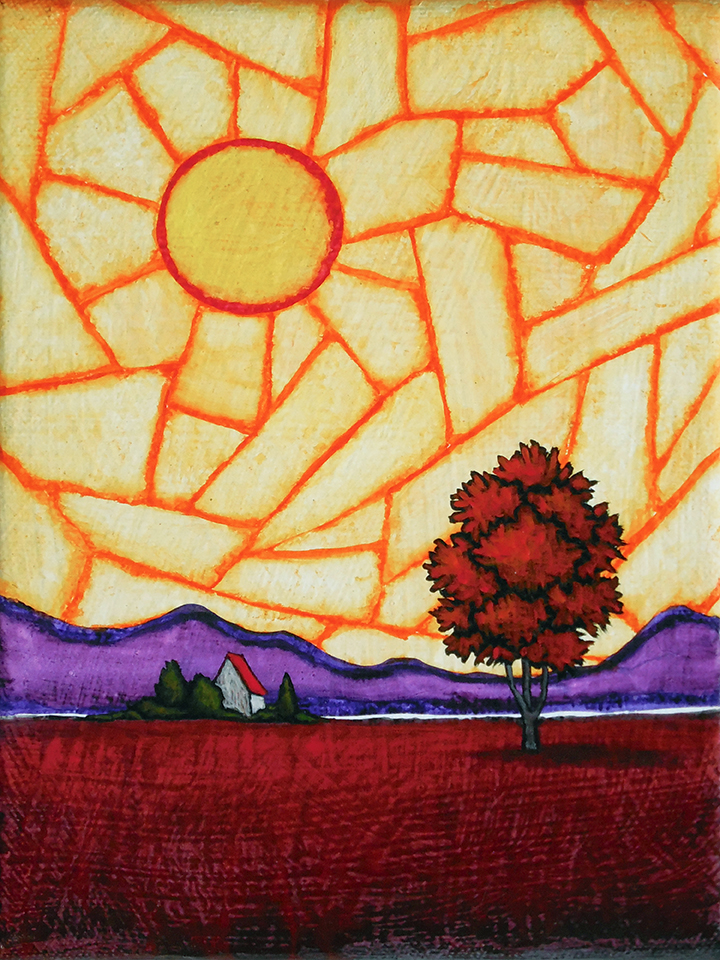
And that might well be how much of my work might be construed. The Red Tree in my work often stands apart. It is not overshadowed or lost among the many other trees in the forest. It clearly exhibits both its strength and its vulnerability.
It is free to be all it wishes to be. All it should be.
The ultimate freedom.
So, while I am sad to see the show end, I am eager to see how the remaining work makes its way into the world.
And to clearly see their strength and hear their singular voices.
As noted above, Guiding Lightends at the end of the day. There’s still a chance to get in to hear the chorus.
Here’s a classic from Joe Cocker, his cover of the Beatles’ With a Little Help From My Friends. It just seems right this morning. This his iconic Woodstock performance. The backup singers were trapped in the traffic jam heading to the festival so his band members had to take up the slack. With a little help from his friends, Cocker’s performance carries the day.
I hope my soloists carry this kind of passion with them…
Happy are they who live in the dream of their own existence, and see all things in the light of their own minds; who walk by faith and hope; to whom the guiding star of their youth still shines from afar, and into whom the spirit of the world has not entered! They have not been “hurt by the archers”, nor has the iron entered their souls. The world has no hand on them.
–William Hazlitt, Winterslow: Essays and Characters (1850)
I have used a quote once before here, back in 2012, from the British art and literary critic of the 19th century William Hazlitt. The quote made me chuckle when I came across it this morning while researching the quote from him above:
Landscape painting is the obvious resource of misanthropy.
As a painter of primarily landscapes, I am not saying that Hazlitt’s claim isn’t sometimes true. Believe me, there are days when the last thing I want to do is see or talk to another human being. Most days, actually.
But the fact is that I see the landscapes that I paint, internally created though they may be, as connecting tissue to our humanity and all that is good and decent in it. And that goodness and decency is something I will always revere and love in humans.
Part of the attraction of painting my landscapes is that I can create a world that reflects an acceptable form of humanity for me, one that creates space for our better angels. Nne that I can feel comfortable in. One that brings me happiness of some sort.
A landscape that gives me a path to follow and a light to guide me.
You can see why I was attracted to Hazlitt’s less cynical words at the top of the page. I can see them reflected in much of the work from my Guiding Lightexhibit at the West End Gallery that ends tomorrow. The first line–Happy are they who live in the dream of their own existence, and see all things in the light of their own minds– resonates deeply for me in the work of this show.
The only part of Hazlitt’s passage to which I might mildly object is the one stating that this created inner world is one into whomthe spirit of the world has not entered. As I said, I see these internal landscapes as connecting tissue to my humanity. The spirit of the world, at least the better angels of that spirit, are infused in the work.
As noted, it is a mild objection only as I understand that he is inferring that if the darker angels of our spirit were to enter such a world, happiness in this inner world might never be achieved.
For my part, the work for this show brought me such happiness as Hazlitt describes. I hope others sensed that and felt it in themselves.
All I can ask of it.
Guiding Light now hanging at the West End Gallery comes to its conclusion at the end of the day tomorrow, Thursday, November 13.
One never finishes learning about art. There are always new things to discover. Great works of art seem to look different every time one stands before them. They seem to be as inexhaustible and unpredictable as real human beings.
–Ernst Gombrich, The Story of Art (1978)
I think the passage above from art historian Ernst Gombrich (1909-2001) is an apt flourish to this reminder that my solo exhibit, Guiding Light, at the West End Gallery comes to its conclusion at the end of the day this Thursday, November 13. There are three days to arrange to see the show.
I believe Gombrich’s statement applies here because as he says, art looks different every time one stands before it. And I think when a show is hung it creates a unique atmosphere created by the dynamics of the individual pieces in relation to one another, the space, and the viewer. It makes viewing any painting in an exhibit, as well as the exhibit as a whole, a unique experience for the viewer.
Maybe I am out of place in saying this, but I felt that this show at the West End Gallery was one of those unique experiences with its own atmosphere. Each piece stands out in their individuality but is reinforced by the work surrounding it.
Like strong individual voices gathered in a choir.
Hope you get a chance to catch the show before the choir disbands and the singers go solo.
Here’s a favorite song from the Talking Heads and David Byrne performed during his American Utopia tour of 2018. This is This Must Be the Place (Naive Melody).
The less we say about it the better Make it up as we go along Feet on the ground, head in the sky It’s okay, I know nothing’s wrong, nothing
If only we try to live sincerely, it will go well with us, even though we are certain to experience real sorrow, and great disappointments, and also will probably commit great faults and do wrong things, but it certainly is true, that it is better to be high-spirited, even though one makes more mistakes, than to be narrow-minded and all too prudent. It is good to love many things, for therein lies the true strength, and whosoever loves much performs much, and can accomplish much, and what is done in love, is well done.
-Vincent van Gogh, The Letters of Vincent van Gogh to his Brother, 1872-1886
Jean-Francois Millet- The Sower 1850
There are a lot of other things I could write about, things that of concern to me in many areas, but I am going to leave them off the table this morning. Instead, I just wanted to share a few words from Vincent van Gogh and what I imagine is one of his lesser-known paintings, The Sower.
Painted in 1888, van Gogh appropriated the figure here from the famous 1850 painting of the same name from Jean-Francois Millet, which was a very influential on van Gogh. He painted several takes on the Millet painting, of which Millet painted several subsequent versions himself.
I share this image from van Gogh today because whenever I come across it, it reminds me of how influential it was on me when I first saw it years ago as a nascent painter. The simplicity and strength of the composition’s elements and the way the paint evoked feelings well beyond the subject spoke to me then and now. It felt uncontrived and sincere, a deep expression of the artist.
I can’t tell you how many times I have been reminded of this painting in my own work over the decades. Sometimes it is in the composition, the way the tree trunk slices the picture plane or the prominence of the sun above the horizon line. Sometimes it comes in recognizing the same emotional response to what I am working on that I felt in seeing his painting.
The words here reflect van Gogh’s feelings on living and painting with sincerity. This has had much the same effect on me that this painting and others of his have had on me. I am not qualified to judge the quality of my work or whether it will have a lasting legacy. That is well out of my hands. But I can attest to its sincerity and the fact that the emotions it expresses are genuine and meaningful to me.
That sense of sincerity has been my guiding star for the past thirty years. It has sustained me in my work and in my life. Like every living human, I have had my fair share of high points and an equally fair share of, as I call them, beatdowns, breakdowns and meltdowns. Clear-eyed sincerity has pulled through these thus far in my life. And I believe that applies to my work. In fact, enduring the down times with sincerity may have strengthened the work. As van Gogh wrote in another letter:
Whoever lives sincerely and encounters much trouble and disappointment without being bowed down is worth more than one who has always sailed before the wind and has only known prosperity.
I would like to think that has been the case, that adversity has been turned to strength through sincerity and resolve.
I think that must be the seed that every artist sows.
Got to go. The fields are waiting to for me. Maybe I can sow some seeds while I listen to Satchmo. Here’s Louis Armstrong and La Vie en Rose.




 Redtree Times