Feeds:
Posts
Comments

Archive for the ‘Uncategorized’ Category

Brueghel_the_Elder_-_Netherlandish Proverbs

Pieter Bruegel the Elder- Netherlandish Proverbs, 1559


I was following the pack, all swallowed in their coats
With scarves of red tied ’round their throats
To keep their little heads from falling in the snow
And I turned ’round and there you go
And Michael, you would fall and turn the white snow red
As strawberries in the summertime

White Winter Hymnal, The Fleet Foxes


I felt like hearing the song White Winter Hymnal though it is still technically not yet winter. But it is cold and there is a light covering of snow on the ground in these parts. I checked to see when I had last played it here and saw that it was in 2018 along with the post below. Since it was a favorite Bruegel painting, one that never fails to grab my attention, I decided to run it again.


I was listening to some music early this morning and came across this song, one that I hadn’t heard in a number of years. Thought it might be a good one to share if only to show the painting that adorned the album cover from which it came.

The painting is from Pieter Bruegel the Elder from 1559. It has come to be known as Netherlandish Proverbs though its original title was The Blue Cloak or The Folly of the World. It has also been known as The Topsy Turvy World which I personally like.

Like any Bruegel painting, it is a pleasure for the viewer with their gorgeous warm colors and dense compositions that make it feel like there is always something more to see. The painting certainly lives up to that feeling, containing depictions of over 120 proverbs or idioms used by the Dutch at the time.

Many are comical, pointing out the absurdity of the world, and some are still in use, such as “Banging your head against a brick wall which you can see in the bottom left-hand corner. Others have faded from usage, like Having one’s roof tiled with tarts” which indicates that one is very wealthy. Some are surprisingly scatological, such as “He who eats fire, craps sparks,” which is about the same as our current “If you mess with fire expect to get burnt.”

If you go to the Wikipedia page for the painting there is a complete list of the proverbs along with the imagery for each. I am enjoying it as I work my way through the list. Even without the list, looking closely at a Bruegel painting is always a great pleasure, as I pointed out above.

The painting was used on the cover of the Seattle based Fleet Foxes‘ self-titled 2008 first album. The song is White Winter Hymnal which works well for this time of the season. The lyrics are actually kind of nonsensical (the verse at the top is basically the whole song) but the song with its ringing harmonies is lovely and the video is interesting. The song has also been covered by the acapella group Pentatonix.

So, take some time to really look at the painting and use the list to see if what can identify what Bruegel was saying.


Read Full Post »


GC Myers- Monde Parfait

Monde Parfait— At West End Gallery

Art is not a handicraft, it is the transmission of feeling the artist has experienced.

-Leo Tolstoy, What is Art? (1897)


When I first shared the quote above, I wasn’t sure if it was accurate or even from Tolstoy. I have found the source in the six of so years since it appeared here, and it was both from Tolstoy and accurate, appearing in an 1897 book titled What is Art? The book decried the elitist nature of art at the time when it was predominantly the domain of the powerful — the rulers, the ultrawealthy, the academies of higher learning, and the church– as well as the wealthy art dealers who chose what was suitable for these elite few.

The artists who thrived at that time catered solely to these few and were often richly rewarded for their efforts. They themselves became the elite.

In the chapter that contained the sentence at the top, Tolstoy foresaw a future where art would break free from such constraints and speak to all people, from most the common person to the most powerful among us. It was a peek forward at what the 20th century soon was to deliver us as it broke free from the entrenched traditions of art.

Art would become less academic, less constrained by rules. It would become a way of expressing emotions and feelings that sometimes were stifled in prior generations. Artists would no longer cater solely to the whims of the powerful but would aim to connect with the many. It would be art that would more accurately reflect the state of all people.

As the rest of the paragraph containing the sentence above states:

But art is not a handicraft; it is the transmission of feeling the artist has experienced. And sound feeling can only be engendered in a man when he is living on all its sides the life natural and proper to mankind. And therefore security of maintenance is a condition most harmful to an artist’s true productiveness, since it removes him from the condition natural to all men,—that of struggle with nature for the maintenance of both his own life and that of others,—and thus deprives him of opportunity and possibility to experience the most important and natural feelings of man. There is no position more injurious to an artist’s productiveness than that position of complete security and luxury in which artists usually live in our society.

Art must come from human beings with common human experiences and emotions. It must be a living thing derived from the richness of life as most people know.

In the blog post from several years back where I first shared Tolstoy’s words above, without knowing the full context, I wrote the following, which I think still applies:

Craftsmanship– handicraft– definitely has a part to play but that alone cannot transport the viewer to that inner spring from which their emotions flow. Something might be beautifully crafted but unless it is constructed from the empathy, the love, the awe, the wonder and the wide assortment of feelings that define our humanity, it remains just a lovely object.  Beautiful but coolly devoid of feeling.

And there is nothing wrong with that.

But the aim of the artist, at least to my mind, should be to speak from their own emotions and experiences so that they can enmesh with the emotions of the viewer– or listener or reader, whatever their medium might be. To transmit and create a sort of communion of feeling between the artist and the recipient.

Can this be taught? I don’t know. I try to tell students to read, to look, to listen, to practice a sense of empathy in their daily lives. Widen their view and become a fuller person. I think art comes from an equal blend of one’s handicraft and their sense of humanity.

That’s just my opinion and it may be as flawed an idea as the mind that thinks it. But I can stand behind that thought and hope, in some small way, to achieve that blend in my own work.


Of course, the future that Tolstoy foresaw was already on the move. For example, by the time Tolstoy wrote What is Art? Vincent van Gogh whose life and work very much represented what Tolstoy saw ahead., had been dead for several years. His influence and that of many other artists from that era had yet to change the art world — and the world in general. It was coming though. Here’s Don McLean‘s lovely paean to Vincent van Gogh, Vincent.


Read Full Post »

Ad Marginem C 1930 Painting by Paul Klee; Ad Marginem C 1930 Art Print for sale

Paul Klee– Ad Marginem, ca 1930


First, he does not attach such intense importance to natural form as do so many realist critics, because, for him, these final forms are not the real stuff of the process of natural creation. For he places more value on the powers which do the forming than on the final forms themselves.

He is, perhaps unintentionally, a philosopher, and if he does not, with the optimists, hold this world to be the best of all possible worlds, nor to be so bad that it is unfit to serve as a model, yet he says:

‘In its present shape it is not the only possible world.’

Thus he surveys with penetrating eye the finished forms which nature places before him.

The deeper he looks, the more readily he can extend his view from the present to the past, the more deeply he is impressed by the one essential image of creation itself, as Genesis, rather than by the image of nature, the finished product.

— Paul Klee, On Modern Art


This excerpt from On Modern Art, the 1924 treatise from the great Swiss artist Paul Klee.

For me, he was a big influence not only for his distinctive works but for his attitude and his views on art that he expressed so well in his writings. His use of color also influenced me. I always think of his work in terms of the color– sometimes muted yet intense and always having a melodic harmony to it.

It always feels like music to me. Like Klee, I often equate the visual with music.

I like his idea that the world is in the process of creation, of Genesis, and that it is not a final form. It allows for visionary work, for imagining other present worlds that extend beyond our perception because, as he writes, In its present shape it is not the only possible world.

And to me, that is an exciting proposition.


This is a reworked version of a post that originally ran in 2015. I needed a little kick of Klee this morning.


Paul_Klee,_Swiss_-_Fish_Magic_ 2

Paul Klee- Fish Magic 1925


blossoms-in-the-night-paul-klee

Paul Klee,, Blossoms in the Night

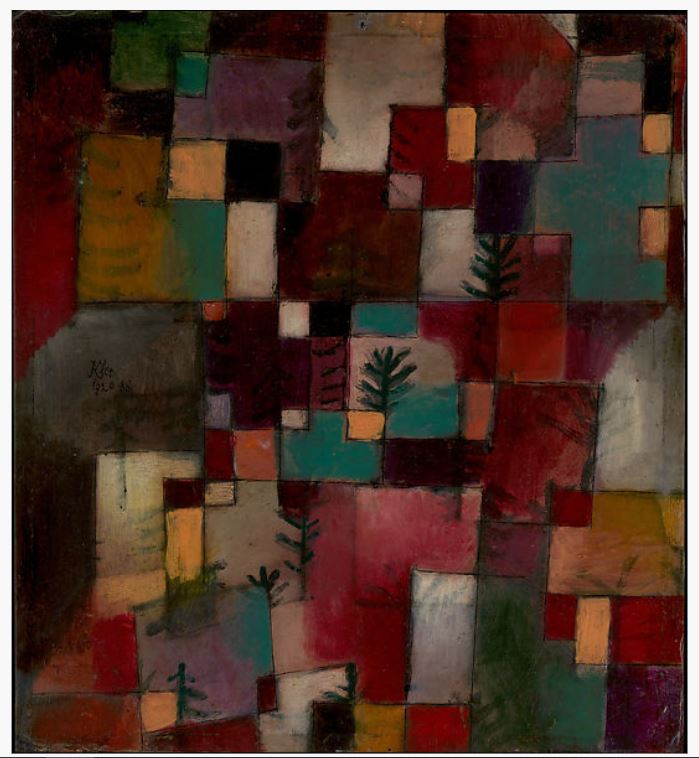
Paul Klee- Redgreen and Violets-Yellow Rhythms 1920

Paul Klee- Redgreen and Violets-Yellow Rhythms 1920

Paul Klee Bird Garden 1924

Paul Klee Bird Garden 1924

klee_southern-gardens

Southern Gardens- Paul Klee

Read Full Post »


GC Myers-- Follow the River sm

Follow the River— At Principle Gallery

Me, my thoughts are flower strewn
With ocean storm, bayberry moon
I have got to leave to find my way
Watch the road and memorize
This life that pass before my eyes
And nothing is going my way
The ocean is the river’s goal
A need to leave the water knows
We’re closer now than light years to go

–R.E.M., Find the River, 1992


Sunday morning. Cold and dark. Tired. Maybe that’s the wrong word. More like fatigued, if there is any actual difference. Just feel all out of rhythm in a lot of ways. One of those periods where everything mechanical or electronic that I touch seems to react erratically to me. Just inserting the verse above from the R.E.M. song that I am going to pay for this week’s Sunday Morning Music took about fifteen minutes as the site would freeze up and then wouldn’t format properly.

The fatigue, the frustration, the lack of rhythm– it all builds up and you feel as though you’ve strayed off your path a bit. A little disoriented and feeling somewhat lost. You look for something that gets you back on that path, some landmark or something you can follow that you know will cross your intended path somewhere down the line. Maybe a stream or river.

Something that moves, flows. Something with a rhythm. It might not be yours but maybe it will lead you to yours once again.

I’ve followed it before and found my way back. Many times. It gets harder as I age, as though the wear and tear of this process of recovering my path saps a little more each time. But even as I feel a bit more tired and achy, just knowing the drill, understanding that there is a way through, is sustaining.

So, I tell myself that today is the day I break through, the day I put my feet back on that path from which I had strayed. And maybe today really is the day in which I am not deceiving myself again.

I hope so.

I know that if it is the day, this funk will dissipate in a poof! and even the memory of it will quickly fade. One of the benefits of having experienced this before is that there’s a mechanism that washes away much of the memory of being lost. Oh, I remember but, having found the river once again, its flow has quickly carried me far downstream away from it. It remains in the rearview.

Give a listen to R.E.M. and their song Find the River from their 1992 album Automatic for the People.

Me? I have to run. I just know that that river is just ahead for me. Let yourself out, okay?


Read Full Post »

small-business-saturday 2024


Dreams come true; without that possibility, nature would not incite us to have them.

-John Updike, Self-Consciousness: Memoirs (1989)


I ran this post last year on Small Business Saturday. It’s an echo of yesterday’s post, urging people to support local businesses, craftspeople, and artists. I thought this particular post made a reasonable case for supporting local artists and businesses as well as for people pursuing their dreams. The only change has been the song at the end. Please give a read and a listen and if you’re out and about, remember to support those businesses and artists in your area.


[From 2023]

It’s another Small Business Saturday, that Saturday after Thanksgiving when people are urged to go out into their communities and shop in locally owned small businesses. It’s one of the best ways to keep your local community vibrant and alive. The money spent for the most part stays local and multiplies many times as it radiates out into the community.

It can be a huge economic engine for the small businesspeople in your local area.

But it is also something more– it is the sustaining lifeblood for a multitude of dreams. Every local small business represents the fulfillment of a dream of someone in your area. It required that someone believed in an idea or ability that they possessed and then risked something– often everything– in putting themselves out there in front of their friends and neighbors.

It can be a gigantic gamble where failure can sometimes mean financial ruin, public humiliation, and lifelong dreams being forever crushed.

But you can look at that risk as the only chance you might get at following your dreams. A chance to finally be the person you once imagined yourself being. Even the humblest small business is the realization of a dream for someone.

And anyone’s dream is a big deal, in my opinion.

I am an artist and a small businessperson, as is every working artist and artisan. We don’t like to talk about it as a business, of course, but after the making of the art it is that thing that keeps our dreams alive. Our dreams and our livelihoods depend on people dealing with us or the local shops and galleries that carry our work– all small businesses.

Small but consequential.

Every gallery I work with provides income for at least 50-80 artists and artisans. That’s 50-80 dreams fulfilled in each gallery.

And, again, that’s a big deal.

I’ve been extremely fortunate to have my dream kept alive for the past 28 or so years. And I have those dream-enablers at the galleries that represent me as well as the many of you out there who have supported my work to thank for that. As much as I might like to think I achieved anything on my own, my dream has been dependent on so many people.

Like anyone with a dream of following their passion, it has meant the world to me. I would love to see many others achieve their own unique dreams in the same way.

So, help them out if you can. I am not asking you to buy locally as a charitable act. View it as more of an investment in your neighbors and your community and an act of humanity in that you are feeding someone’s dream. Whatever you might purchase from a small local business — be it a painting, a cup of coffee, a piece of clothing or pottery, a cupcake, or any of the many things made and sold in your area–is your first dividend on that investment. It is money well spent.

And to those of you out there with a dream who have yet to find the nerve to take the leap, I urge you to follow your dreams. Sure, it might be hard. And sure, you might fall on your face. That’s a given. But keep in mind that there is always the possibility of achieving your dream only if you take that leap.

You don’t want to be one of those people who go through life saying, “What if?” At least if you fail, you have the chance to chase another dream.

Here’s a song from the late Roy Orbison. He’s backed here by an all-star band as he performs In Dreams.


Read Full Post »

Feed a Dream

GCMyers-  Boxed In  2019

Boxed In, 2019


The crowd, still shouting, gives way before us. We plough our way through. Women hold their aprons over their faces and go stumbling away. A roar of fury goes up. A wounded man is being carried off.

–Erich Maria Remarque, The Road Back (1931)


You might think these lines from the sequel to All Quiet on the Western Front by Erich Maria Remarque are describing a scene from World War I or its aftermath. Actually, it’s just a retelling of past Black Fridays at any Walmart around the country. American carnage, indeed.

It’s been many, many years since I ventured out into the throngs of bargain seekers on this Friday after Thanksgiving and I don’t plan on changing that pattern today. Hey, it might not even be as bad as it once was since there is so much more online shopping. But I am not going to find out.

If you have to tempt fate and fight the crowds, I urge you to make an art gallery one of your stops. For one reason, the art there will calm you down, put things into perspective. For another, art is a wonderful gift for someone you love. And it makes an even better gift to yourself.

The last reason is that buying art supports the truly small local businesses meaning that the money from that purchase stays predominantly in that area, recirculating and helping other local businesses many times over.

Doing so makes your local small business community stronger and more responsive to your wants and needs. Plus, it supports artists who depend on every single sale in order to maintain their sometimes tenuous livelihoods.

Not only is it a unique item that comes from their hands and hearts, but it is also something that keeps their dreams alive.

It’s a rare thing that buying art does; sustaining the dreams and souls of others while obtaining a work that feeds your own.

So, instead of battling crowds, avoid the mad rush and head to a local gallery. Feed a dream– the artist’s and your own.

Here’s a favorite composition of mine from Philip Glass, Mad Rush. It was written for the Dalai Lama‘s first North American address back in 1979. Written originally for organ– it was written on the organ at the Saint John the Divine Cathedral in NY– it was meant to be an open-ended piece that could be shortened or extended without the audience noticing to accommodate the vague timetable of the Dalai Lama’s scheduled appearance. It has been recognized over the years as an iconic piece of modern music. Glass performs it here in Montreal from 2015. I like this performance, finding it very meditative as I watch his hands on the keyboard. The antithesis to the combat of shopping.


Read Full Post »

Giving Thanks, Once Again

thanksgiving pooh


Piglet noticed that even though he had a Very Small Heart, it could hold a rather large amount of Gratitude.

― A.A. Milne, Winnie-the-Pooh


Remember that even the tiniest of hearts has an infinite amount of room for gratitude.

And love.

And compassion.

Wishing you all a peaceful and quiet Thanksgiving Day…

Read Full Post »

In One Vast Thanksgiving…

GC Myers- All the World's a Stage 2024

All the World’s a Stage – At West End Gallery


I can pass days
Stretch’d in the shade of those old cedar trees,
Watching the sunshine like a blessing fall,–
The breeze like music wandering o’er the boughs,
Each tree a natural harp,–each different leaf
A different note, blent in one vast thanksgiving.

–Letitia Elizabeth Landon (1802-1838)


Day before Thanksgiving, that single day we set aside to express our gratitude. One day doesn’t seem enough, does it?

The verse above says it all. Just lazing in the woods, taking in the sights and sounds of the beauty and grace that surrounds us always, makes that one day seem woefully insufficient. 

I guess it comes down to us– as does everything, actually– to spread our thanks more broadly throughout the year.

That’s it. That’s today’s message. Be thankful I didn’t go on and on. Now go out and spend some time with some trees.

FYI:   Letitia Elizabeth Landon was an English poet and novelist who was a great influence on the generation of writers that followed her. Elizabeth Barrett Browning, Christina Rossetti, Robert Browning, and Tennyson are noted as being influenced by her. In her time, Landon was sometimes referred to as the female Byron. Her story is interesting and tragic, but I am not going to go into here in great detail except to say that she was forgotten or overlooked for many decades due to the misinformation and rumors of immorality that were leveled at her.

Here’s a song for this morning that goes somewhat with the subject of appreciating the bou nty of nature. It’s a favorite of mine, Nature Boy. I’ve shared the story of this song and the man who wrote and originally performed it, eden ahbez, several times here in the past. Another interesting story. If you know this song it is probably from the magical version of Nat King Cole. Certainly my favorite. But today I am sharing a performance from from the Swedish a cappella group, The Real Group. I shaed it here a couple of years back and really love the way their voices blend on this gracefully simple song.


Read Full Post »

Natural Anthem sm

Natural Anthem– At Principle Gallery, Alexandria VA


To Mercy, Pity, Peace, and Love
All pray in their distress;
And to these virtues of delight
Return their thankfulness.

–William Blake, Songs of Innocence (1789–1790)


Speaking of thankfulness in this week of thanks, I might add silence or quietude to those virtues of delight that Blake listed above, though that probably falls under his definition of Peace. I know that I am always thankful when I am gifted with silence or quiet when I am in the midst of some sort of distress. It stills the waters, in a manner of speaking.

There are others that I might add, as well. Understanding and compassion for example. Again, you might classify them under Blake’s Mercy and Love, respectively.

I guess it doesn’t matter how you classify them. Receiving any of these virtues of delight are gifts of the highest order, gifts of the soul that inspire thankfulness in most of us. Unfortunately, there are some who don’t recognize these gifts when given and are stingy in offering these gifts to others. I feel bad in a way for such people. There seems to be an incompleteness to them, a void of virtues that should be filled with gratitude. As the Roman orator Cicero stated: Gratitude is not only the greatest of the virtues, but the parent of all of the others.

Anyway, that’s my spiel for this morning. Thank you for reading.

Here’s a piece of music for which I am very much thankful. It’s the first movement, Ludus: Con moto, from Tabula Rasa. a 1977 work from Estonian composer Arvo Pärt.  I picked up this album back in 1999 and listened to it over and over during my early years as a full-time painter. The feel of this music and its themes of love, empty space, and silence seemed to fit well with my work at that time. Hope it still does. This features violinist Gil Shaham along with the Gothenburg Symphony Orchestra.

Still hits me hard. And I am thankful for that…


Read Full Post »


Etty Hillesum Book CoverAs life becomes harder and more threatening, it also becomes richer, because the fewer expectations we have, the more good things of life become unexpected gifts that we accept with gratitude.

–Etty Hillesum, An Interrupted Life: The Diaries of Etty Hillesum, 1941-1943


I was looking for something to share about gratitude since this is the week of Thanksgiving. I came across the quote above from a name that I didn’t recognize, Etty Hillesum. I loved the sentiment she expressed but wondered who she was.

Turns out she was young Dutch Jewish woman born in 1914 who chronicled her spiritual growth in her diaries and letters until her murder at the hands of the Nazis in the Auschwitz concentration camp in late November of 1943. She was only 29 years old, a mere 81 years ago.

Her writings had been turned over to a friend before her internment so that they might someday be published. Though many attempts were made, it wasn’t until 1979 that they finally found their way into print as the book An Interrupted Life. In 2006, the Etty Hillesum Research Centre was founded in the Dutch city of Ghent to research and promote her writings.

As I pointed out, Etty Hillesum is new to me so I can’t speak with any authority on her writings. However, many of the passages I have read exhibit great depth. Some of my favorites thus far:

Suffering has always been with us, does it really matter in what form it comes? All that matters is how we bear it and how we fit it into our lives.

But I do believe it is possible to create, even without ever writing a word or painting a picture, by simply moulding one’s inner life. And that too is a deed.

Never give up, never escape, take everything in, and perhaps suffer, that’s not too awful either, but never, never give up.

Many of her observations, especially about how suffering plays a large role in one’s meaning of life, echo those of Viktor Frankl, a psychoanalyst and survivor of Auschwitz who wrote Man’s Search for Meaning. And that second one here, about the creation of an inner life adding to the meaning of one’s life, is something I believe all too many of us overlook in our own lives.

Inner creation is as important as any outward creation. Maybe more so.

Anyway, let’s kick off this week of being grateful with a nod of gratitude to Etty Hillesum for sharing the wisdom she uncovered in her brief stay here. Her life’s search for meaning adds to our own.

And that is indeed a great gift.

Read Full Post »

« Newer Posts - Older Posts »