Feeds:
Posts
Comments
Beseech the Moons— At Principle Gallery Saturday


And now we beseech of Thee that we may have every day some such sense of God’s mercy and of the power of God about us, as we have of the fullness of the light of heaven before us.

-Henry Ward Beecher


Henry Ward Beecher (1813-1887) was a superstar clergyman in the 19th century. Kind of the prototype celebrity preacher that set the table for later preachers like Billy Graham. He was known throughout the country, drawing crowds wherever he spoke, and was even featured on tobacco trading cards of that era. He was even the subject of a famous adultery scandal and trial that dominated frontpage news for over two years. 

He was also a social reformer and abolitionist as well as the brother of Harriet Beecher Stowe and on a local note, the brother of Thomas K. Beecher, the Elmira minister who presided over the building of historic Park Church here and was good friend of Mark Twain during his summers spent in Elmira. 

Just thought I’d throw in some info on Henry Ward Beecher. And though I don’t adhere to any particular organized religion or belief system, I thought his prayer above was a good fit for this new painting. It’s a new 15″ by 10″ painting on canvas titled Beseech the Moons that is coming with me, along with a group of other new work, to the Principle Gallery tomorrow for my Gallery Talk there.

The idea of the figure on the rooftop here pleading to the light of heaven above –or the light of the eight moons shown in the painting– so that he might every day have a sense of the beauty of the created world seems appropriate.

Or perhaps he is begging for it all to make sense? 

If I am that figure on the roof, that would more likely be my plea. Not that I am discounting the gift that is the beauty and bounty of this world that we inhabit. It’s just that, even though there is much good in this world, there is what often feels like a staggering amount of the not-so-good, and the just plain bad along with plenty that might be fairly labeled as evil.

Can whatever power your Moonships possess help me understand why, if there is indeed an omniscient being overseeing this whole shindig, such badness and evil must continue to exist? I mean. thanks for the beauty and all, Your Moonships, but can you give me an answer to this question that makes sense? 

All that being said, that might not be your take on this painting. And, as always, that is as it should be. Painting, to my way of thinking, should not be a detailed novel. It should be more like a poem, a short one like a haiku, that captures the essence and feel of something in hints and nudges, relying on the thoughts and life of the viewer to fill out its meaning and definition. 

That’s just my opinion, of course. What do I know?

What I do know is that I will be giving a GALLERY TALK tomorrow, Saturday, September 27 at the PRINCIPLE GALLERY in Alexandria, VA. The Talk begins at 1 PM and ends with the awarding of the painting below, A Place of Sanctuary, to someone in attendance. Plus a few other things, as always.

The Gallery Talk is free and open to all.  Bring your questions and I’ll do my best to answer– not like those damn moons that never respond when I yell my questions at them! 

Hope you can stop in for the talk. 


A Place of Sanctuary— You Could Win This Painting!

Purpose Bound

Purpose Bound— At Principle Gallery


I don’t think life is absurd. I think we are all here for a huge purpose. I think we shrink from the immensity of the purpose we are here for.

–Norman Mailer, Interview in American Way magazine (1995)


The way I see it, this new painting, Purpose Bound, is very much about going all in once one’s purpose and mission in this life has been revealed to them. About embracing one’s purpose and not shrinking from the responsibility or toil required.

It’s about determination and fortitude, about persisting in a world that often seems single-mindedly hellbent on keeping you from accomplishing that mission.

It’s about converting that outer resistance into a rhythm and a harmony, about finding beauty and meaning in the struggle. About obtaining some form of grace.

Though that sounds like this takes place in the province of heroes, it most often exists on a much more everyday level. Simply leading a life of purpose is an epic task. The world and the lives we lead are often filled with challenges. That is just part of the admission price for having the privilege of being alive.

We can try to run and hide from those challenges, but they will still be there waiting for us.  Or we can strap ourselves in, set our minds to the task, and run headlong into them.

And that’s what many of us do on an everyday basis. We might not even notice it in others but there are plenty of folks living heroic lives among us. They are out there quietly fulfilling their purpose and mission, taking on the many challenges being thrown at them.

Who knows, it might be you. You might not even recognize this in yourself. Sometimes, the hero’s journey or the purpose of one’s life isn’t evident until it has reached its end.

As you can tell by my words, this piece really hits the mark for me. It’s been an eye magnet here in the studio and sets off all kinds of feelings and thoughts with every look.

Purpose Bound is 14″ by 14″ on canvas and is headed with me to the Principle Gallery for this Saturday’s Gallery Talk. The Gallery Talk begins at 1 PM and includes, as you might be aware, of a drawing for one of my paintings. There are usually also a few other surprises, so I wouldn’t be surprised if that is the case on Saturday.

Hope to see you Saturday at the Principle Gallery!

The Wanderer’s Compass— Coming to the Principle Gallery


I think while appropriation has produced some interesting work … for me, the most interesting thing is to back yourself into your own corner where no one else’s answers will fit. You will somehow have to come up with your own personal solutions to this problem that you have set for yourself because no one else’s answers are applicable.

[…]

See, I think our whole society is much too problem-solving oriented. It is far more interesting to [participate in] ‘problem creation’ … You know, ask yourself an interesting enough question and your attempt to find a tailor-made solution to that question will push you to a place where, pretty soon, you’ll find yourself all by your lonesome — which I think is a more interesting place to be.

— Chuck Close, 2006 interview with Joe Fig for Inside the Painter’s Studio


I have written about late artist Chuck Close (1940-2021) a few times here before. While I was fan of his distinctive work, it was his words that really hit close to home for me. For example, his Inspiration is for amateurs, the rest of us just show up and get to work has been a credo of sorts for me for some time now. In this article which spawned that credo, Close also spoke the words above and they have the same sort of meaning.

Back yourself into your own corner where no one else’s answers will fit.

I love this and can easily identify with it. I have sometimes described it as working to a place where all your influences have faded away completely and your work becomes distinct, almost self-referential.

Painting is about problem solving. Just the process of taking paint and using it to give form and meaning in two dimensions is, at its heart, a major problem. Some artists follow the lead of those who came before them in solving the problems that come with painting. That’s the appropriation that Close mentions.

But as he also says, it is most interesting when the well-worn answers no longer solve the problem as you see it. You must depend on your own unique set of skills and intuition. That is when the work of any artist takes on a new dimension and singularity for a solution. It also creates a great sense of autonomy in the artist, one that feels freed from the constraints of the influence of the past.

I also like Close’s thoughts on problem creation versus problem solving in the creative process. Problem creation forces us into those corners where new answers emerge as solutions.

I think the painting at the top is microcosm or shorthand version of that principle. It was started at the Painting Demo I gave at the Principle Gallery in June. I had a young lady from the assembled group make the first mark on the canvas.

It was a slash in a difficult spot on the surface. Definitely a problem that somewhat backed me into a corner. But it was actually a good thing because it allowed me to demonstrate how I react to such problems and the problems that arose from my initial reactions. And in my own way.

I often think that my best work comes when I encounter a problem that stretches me out and makes me uncomfortable., forcing me to look beyond the toolbox of skills I have assembled. The creation of new problems allows us to react in different ways, to climb out of our own ruts.

To create new solutions and maybe open new avenues to follow forward– that is where growth begins.

The painting, a 20″ by 20″ canvas, from the Demo is now finished, framed, and titled The Wanderer’s Compass. It will be coming with me to the Gallery Talk this Saturday, September 27, along with a group of new work. The Talk begins at 1 PM.

Gallery Talks also fall into the province of problem creation and problem solving. A big part of my talks is Question & Answer, which by its very nature is problem creation which often makes me scramble to come up with an answer that makes sense. It’s much like painting in that way.

Of course, I can cover up all my mistakes at the Talks by giving away a painting at its end. The painting this year is A Place of Sanctuary, shown below. Hope you can make the Gallery Talk on Saturday. You might well walk away with this painting!


A Place of Sanctuary— You Could Win This Painting!


Destiny’s Way

Destiny’s Way— At West End Gallery October 2025


You must unlearn the habit of being someone else or nothing at all, of imitating the voices of others and mistaking the faces of others for your own.

When destiny comes to a man from outside, it lays him low, just as an arrow lays a deer low. When destiny comes to a man from within, from his innermost being, it makes him strong, it makes him into a god… A man who has recognized his destiny never tries to change it. The endeavor to change destiny is a childish pursuit that makes men quarrel and kill one another. All sorrow, poison, and death are alien, imposed destiny. But every true act, everything that is good and joyful and fruitful on earth, is lived destiny, destiny that has become self.

~Hermann Hesse, Letter to a Young German (1919)


This passage from Hermann Hesse says so much and may well sum up the differences that separate us as humans. So many of us accept an imposed destiny, one that doesn’t bring true joy or feed our soul. We live by imitating others, copying the words and actions which we believe are expected of us.

We follow in the direction of the outer voice rather than the inner voice.

And that way seldom, if ever, brings us to our true destiny. That way seldom finds us acting authentically or speaking with our true voices.

We become a mirror and an echo of others. We stray so far from our own path of destiny that we fail to recognize that which is truly good and joyful to us.

I love Hesse’s last sentence from this passage: But every true act, everything that is good and joyful and fruitful on earth, is lived destiny, destiny that has become self.

I love the idea of a lived destiny, one that has become enmeshed in a self that seeks to enrich this world, to find joy and share it with others so that they might find their own joy.

As Hesse points out, once you have found the less traveled road of lived destiny, you will never be tempted to find another route forward, to seek shortcuts or bypasses.

You trust the path you are on because you know that it is yours to follow.

Could I be off base here? Sure. This is the era of social media, after all, where every word and thought can be parsed, challenged, and argued.

I don’t really care though. Once you have found that path you can call your own, the one that you know is your destiny, the disembodied discouragement from others are but faint murmurs since their paths are so far away from yours. Anything said that does not seek to be fruitful or bring joy, love, or goodness to the world is only a distraction to those on their true paths.

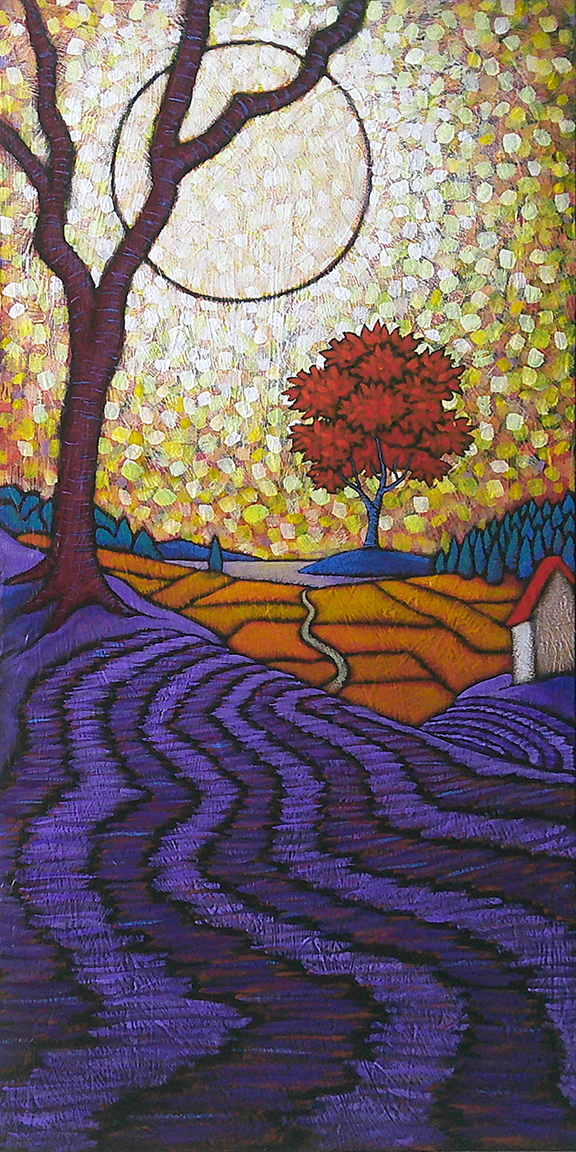
The painting at the top, a new 12″ by 36″ canvas, seemed to fit beautifully with this passage from Hesse. I call it Destiny’s Way. I guess any painting portraying my destiny would have to feature the Red Tree, right?

This painting will be included in Guiding Light, my 24tth solo exhibit at the West End Gallery which opens October 17.

Here’s I Want to Break Free from a 1986 performance from Queen. I suspect that Freddie Mercury knew a thing or two about following one’s own path.


Questions For the Moon

Questions For the Moon-At West End Gallery in October


Do not now seek the answers, which cannot be given you because you would not be able to live them. And the point is, to live everything. Live the questions now. Perhaps you will then gradually, without noticing it, live along some distant day into the answer.

~Rainer Maria Rilke, Letters to a Young Poet


Do not now seek the answers…

Such a counterintuitive and wise bit of advice that Rilke passed on to his young poet friend. History and mythology are filled with characters who stand before the void, frustrated and grieved with life, pleading for answers to come out of the nothingness before them.

Answers seldom come.

But the questions remain. These questions and concerns become ingrained to the point of almost being unnoticed in the seeker’s life and being.

And one day, if they are fortunate, they realize that that the question itself was the answer and that it was always within them, ready to reveal itself when they have lived and dealt with that question in their life and finally came to this realization.

This realization is earthshaking for some and mundane for others. For others, it is both.

The point is that there are seldom easily obtained answers to the existential questions that plague us.\

Only time and life can turn these questions into answers. And some questions are such that the answers may well be beyond our living or recognition. Those answers remain a mystery.

Maybe the ultimate question here is how well we cope with lives filled with such mystery.

That is my first take on this new small painting, 8″ by 8″ on panel, that is included in my October solo show at the West End Gallery. I call it Questions For the Moon.

I’ve been on a lot of roofs in my life, having been a chimneysweep for several years, and, more importantly, have been on the roof depicted in this painting, sending out questions whose answers I was not yet ready to recognize within myself. I know the frustration and pain in that moment of questioning as you teeter on the roof’s peak.

In that moment, the only answer is to get off the roof in one piece and move on, accepting that this might not be such a bad answer. One day further down the road, if you’re lucky and have let those questions fade onto the deep recesses of your mind, almost forgotten, the question might once more show itself as an answer that has meaning for your life as it has been lived.

And you understand in that moment that this was the only way it could have been, that it took the pain and toil of life to get to where the question could be answered.

That’s a lot to ponder for a little painting.

Here’s song in that vein from the always charming Iris Dement. This is Let the Mystery Be.


The Restless Seeker

The Restless Seeker– Coming to West End Gallery in October


He in his madness prays for storms, and dreams that storms will bring him peace”

The Sail, Mikhail Lermontov


These are the last lines of the poem The Sail from early 19th century Russian poet Mikhail Lermontov. Actually, I haven’t been able to locate a translation of the poem that translates his lines with this wording, but since Leo Tolstoy quoted these lines in this way in his The Death of Ivan Ilych it has become the accepted wording. The meaning of these lines in any translation is pretty consistent in meaning– that there are some so desperate in their search that they will head into the teeth of storm and chaos because they believe that the calm naturally accompanies the storm.

As a bit of added info, the poet Lermontov lived his life as though he was the sailor seeking calm by heading into a storm. He packed a lot into his short life, including being acclaimed as the natural heir to Pushkin’s title as the greatest Russian poet, being exiled twice, serving in the Russian army where he led a troop of Cossacks described as a gang of dirty thugs whose duty was to charge headlong into their Chechen enemy forces, and dueling twice. The second duel left him dead after a direct shot to his heart at the age of 26.

He apparently adhered to the words of the old Faron Young song– I want to live fast, love hard, die young, and leave a beautiful memory.

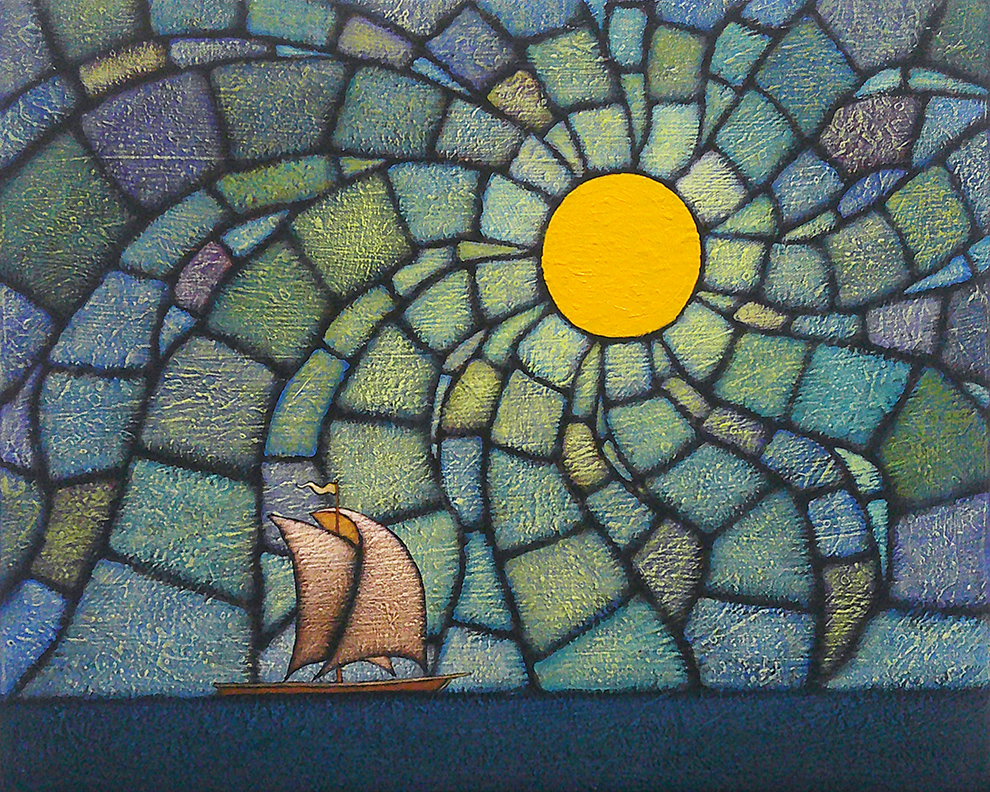
The poem itself, below, seemed to fit well with the new painting shown at the top. Titled The Restless Seeker, it is   6″ by 18″ on canvas and included in my solo exhibit, Guiding Light, at the West End Gallery that opens on October 17.

There is a stormy and otherworldly quality that comes with its chaotic sky and blood red sun/moon. Oddly enough, though it is a painting that is filled with motion, there is also a calm determination in it along with a feeling of defiant courage in the boat and its sails that I find particularly appealing. Maybe it’s the focused calm mustered by those ultimately endure the storm.

It’s a quality that we need a bit more of in these troubled times. That might be part of its appeal for me.

For this week’s Sunday Morning Music, here’s a song that has been shared here a couple of times over the years. It is The Ship Song from the always interesting Nick Cave and the Bad Seeds.


A lonely sail is flashing white
Amdist the blue mist of the sea!…
What does it seek in foreign lands?
What did it leave behind at home?..

Waves heave, wind whistles,
The mast, it bends and creaks…
Alas, it seeks not happiness
Nor happiness does it escape!

Below, a current azure bright,
Above, a golden ray of sun…
Rebellious, it seeks out a storm
As if in storms it could find peace!

–The Sail, Mikhail Lermontov


A Place of SanctuaryYou Could Win This Painting!


The whole value of solitude depends upon oneself; it may be a sanctuary or a prison, a haven of repose or a place of punishment, a heaven or a hell, as we ourselves make it.

― John Lubbock, Peace and Happiness


I promised the other day to reveal the painting that I would be the main prize awarded to someone at the Gallery Talk that I will be giving at the Principle Gallery next Saturday, September 27.

Well, here it is.

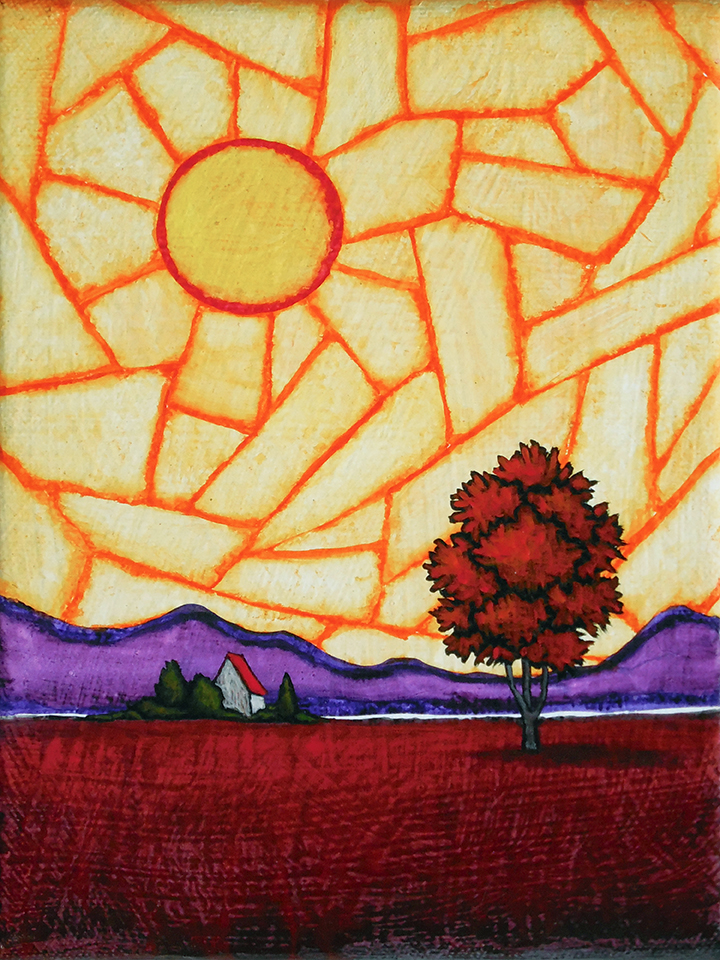
It’s titled A Place of Sanctuary and is a substantial piece at 18″ by 24″ on canvas. I believe this painting is, as I wrote earlier, a pip. I can’t fully describe what it is that makes it so, but it never fails to capture my attention when I am in its presence. Presence might be the right word, with its deep and rich colors and a large sun that feels that it might be a hypnotist’s watch mesmerizing me as I gaze at it.

Whatever it is, it transports me to a place that feels like sanctuary.

I have always maintained that the paintings given away at Gallery Talks over the years have great meaning for me, that giving it away has to involve a sense of sacrifice on my part. It has to hurt a little bit, has to make me question if I am making a mistake. This painting definitely falls into that category.

There will be a drawing for A Place of Sanctuary at the end of the Gallery Talk at the Principle Gallery which takes place next Saturday, Saturday 27, beginning at 1 PM. The Gallery Talk and the drawing for the painting is free and open to everyone. You must be present when the painting is awarded.

Hope you can make it to the Principle Gallery next Saturday. In the meantime, here’s post about this painting from a few years back:


I had never heard of John Lubbock before coming across the short quote above. He was one of those interesting 19th century British characters, a titled member (1st Baron Avebury) of a wealthy banking family who made great contributions to the advancement of the sciences and math as well as to many liberal causes. For example, it was John Lubbock who coined the terms Paleolithic and Neolithic in describing the Old and New Stone Ages, as well as helping to make archaeology a recognized scientific discipline. As a youth he was a neighbor to Charles Darwin and was heavily influenced by the older scientist, who he befriended. He also worked with Darwin as a young man and championed his evolutionary theories in his later adulthood. He was obviously a man who used his position and access to higher knowledge to add to both his own intellect and that of our collective body.

That being said, his words this morning gave me pause. I have generally viewed solitude as a sanctuary, even in the troubled times of my life. It was a place to calm myself, to gather my thoughts and clearly examine what was before me. I crave solitude so the idea that for some this same solitude could feel like a hell or a prison seemed foreign to me.

What differentiates one’s perception of such a basic thing as the solitude in being alone? How could my place of sanctuary be someone else’s chamber of horrors?

If you’re expecting me to answer, you’re going to be disappointed because I can’t really say. I might say it might have to do with our insecurity but I have as much, if not more, uncertainty and insecurity than most people. We all have unique psychological makeups and every situation, including that of solitude, is seen from a unique perspective.

This subjectiveness is also the basis for all art. What else could explain how one person can look at a painting and see an idyllic scene while another can feel uneasy or even offended by the same scene?

Now, the painting at the top, titled A Place of Sanctuary, is a piece that very much reflects this sense of finding haven in solitude. For me, it is calming and centering, a place and time that appeals to my need for sanctuary.

Someone else might see it otherwise. They might see something remote, alien and unsettling in it.

I may not understand it but that’s okay, too. So long as they feel something…

Inner Perception, Redux

Inner Perception (2011)– Coming to Principle Gallery


I have sat here for quite some time this morning trying to write about some of the new work I have been producing for my October West End Gallery show or some that is headed with me to the Principle Gallery for my Gallery Talk there next Saturday.

I know that I am more than little distracted and anxious by what is happening in this country as we descend into outright authoritarianism. It sometimes seems trivial and foolhardy to talk about art and thought when the house is burning down around you.

But I also know that part of what I do is to create work and write about things that deal with coping with life and all its travails. There is a need and a place for what this is in times like this.

I am time strapped now after sitting and ruminating here for so long. So, I am running an older post that deals a bit with an older piece, Inner Perception, shown above, that I am bringing next week to the Gallery Talk at the Principle Gallery. Every so often I like to break out and make available a vintage piece or two. This has been a personal favorite for a long time now and I felt it was time to let it find a place where it could be viewed with fresher eyes than mine.

Here the post from 2014:


This is a painting from a few years back that has toured around a bit and found its way back to me. Called Inner Perception, it has been one of my favorites right from the moment it came off my painting table. Maybe the inclusion of the the paint brush (even though it is a house painter’s brush) with red paint in the bristles makes it feel more biographical, more directly connected to my own self. Or maybe it was the self-referential Red Tree painting on the wall behind the Red Chair.

I don’t know for sure. But whatever the case, it is a piece that immediately makes me reflective, as though it is a shortcut to some sort of inner sanctum of contemplation.

Looking at it this morning, a question I was asked at a Gallery Talk I gave at the Principle Gallery a week or so ago re-emerged.

I was asked what advice I might give my fifth-grade self if I had the opportunity.

I had answered that I would tell myself to believe in my own unique voice, to believe in the validity of what I had to say to the world.

I do believe that, but I think I might add a bit to that answer, saying that I would tell my younger self to be patient and not worry about how the world perceives you. That if you believed that your work was reflecting something genuine from within, others would come to see it eventually.

I would also add to never put your work above the work of anyone else and, conversely, never put your work beneath that of anyone else. I would tell myself to always ask “Why not me?” instead of “Why me?”

This realization came to me a couple of years ago at my exhibit at the Fenimore Art Museum. When it first went up it was in a gallery next to one that held the work of the great American Impressionists along with a painting from Monet. I was greatly intimidated, worrying that my work would not stand the muster of being in such close proximity to those painters who I had so revered over the years. Surely the greatness of their work would show me to be a pretender.

But over the course of the exhibit, that feeling faded and the intimidation I had initially felt turned to a type of defiant determination. I began to ask myself that question: Why not me?

If my work was genuine, if it was true expression of my inner self and inner perceptions, was it any less valid than the work of these other painters? Did they have some greater insight of which I was not aware, something that made their work deeper and more connected to some common human theme? If, as I believe, everyone has something unique to share with the world, why would my expression of self not be able to stand along their own?

The answer to my question was in my own belief in the work and by the exhibit’s end I was no longer doubting my right to be there. So, to my fifth-grade self and to anyone who faces self-doubt about the path they have chosen, I say that if you know you have given it your all, shown your own unique self, then you must ask that question: Why not me?

Busyness

The Blue Moon Calls- At West End Gallery


Wherever I am, the world comes after me.
It offers me its busyness. It does not believe
that I do not want it. Now I understand
why the old poets of China went so far and high
into the mountains, then crept into the pale mist.

Mary Oliver, The Old Poets of China


Too busy to write much this morning but wanted to share the Mary Oliver verse above. It kind of sums up how I am viewing this too much busyness stuff. I need the cool quietude of a mountain top or some other place like the one in the painting shown here. Fortunately for me, that scene is already in my mind so it’s a short trip to get there.

Just have to get past some busyness.

Speaking of busyness, here’s a reminder to keep an eye out in the coming days for a preview of the painting that I will be giving away at my Gallery Talk that takes place next Saturday, September 27, at the Principle Gallery in Alexandria, VA. The talk begins at 1 PM and normally lasts about an hour, give or take.

The painting I have chosen is a pip, if you know what that means. Like I said, keep an eye out in the coming days and mark your calendars for next Saturday. Hope to see you there!

Now, I have to run. This damn busyness won’t leave me alone.

Where’s that mountain and that pale mist?


In the Weave of Time

In the Weave of Time– Coming to West End Gallery


Each minute bursts in the burning room,
The great globe reels in the solar fire,
Spinning the trivial and unique away.
(How all things flash! How all things flare!)
What am I now that I was then?
May memory restore again and again
The smallest color of the smallest day:
Time is the school in which we learn,
Time is the fire in which we burn.

–Delmore Schwartz, Calmly We Walk Through This April’s Day (1938)


Sometimes I begin to write about a new painting fully intending to describe what it means to me. But there are times when those intentions go out the window. Then I find myself just staring blankly at the piece.

I should say staring blankly into rather than at the painting because it’s not one of those cases where you stare straight ahead without focusing on or even knowing what is in front of your eyes. The mind is so preoccupied with something else that it commandeers your eyes.

No, this is the opposite, more like having what is front of my eyes push away all thought and empty my mind.

The eye commandeers the mind. I suppose that would be a form of involuntary meditation. Maybe that’s the best kind, one that comes without trying.

That’s kind of what happened first thing this morning. I was intending to write a bit about the new painting at the top. It’s an 18″ by 18″ canvas titled In the Weave of Time and is included in my October solo exhibit, Guiding Light, at the West End Gallery.

I pulled up the image and before I knew it, I was staring into it with an empty mind. I say empty but it was not a pure void. It had a harmony, a tone of great calmness. It had a space as well, one that placeless and timeless.

It’s hard to explain. Placeless and timeless things often are.

But frustrating as it was to find my mind empty at a time when I was desiring words and thought, I was pleased by the effect. It gave me some much-needed stillness at a moment when time and deadlines plague my thoughts.

It felt like a gift in the dark of morning.

This not what I intended to write about this painting but maybe it should have been. It certainly says more about it than the meager words I probably would have spewed.

Unfortunately, I have to return to a world filled with time and place and deadlines right now. But first, I am going to spend a few more minutes in this painting. I need it.

Here’s a favorite song, The Stable Song, from Gregory Alan Isakov. It came on while I was writing what I hadn’t intended writing and it felt right in the moment. I often have music playing while I work and much of it plays without me noticing the song or artist due my focus on the work in front of me. But whenever this song comes on, I stop and listen for a few minutes.

There’s a familiarity in it that rhymes with some memory of in the weave of time. And that’s all I could ask for this morning.