Feeds:
Posts
Comments

New Day Rising– Now at West End Gallery


Art is not a plaything, but a necessity, and its essence, form, is not a decorative adjustment, but a cup into which life can be poured and lifted to the lips and be tasted.

–Rebecca West, Black Lamb and Grey Falcon (1941)


In what is considered her masterpiece describing the history and culture of Yugoslavia, author Rebecca West wrote in Black Lamb and Grey Falcon that art and culture, especially in the form of myths and storytelling, provide both countries and individuals with a revitalizing well from which they can drink in order to survive the difficulties of life and history. Art and culture connects us with symbols, stories, and myths that changes our mere existence into one brimming with purpose and meaning. 

I know that West is writing primarily about storytelling and the myths of nations, which is evident in the passage from which the lines above are taken, which I am sharing below. But I feel that the purpose they serve, as West sees it, is very much the same for art in general. Art moves us beyond our own day-to-day existence, connecting us with our known and unknown pasts and futures. It allows us to feel as though we are part of some greater vehicle, serving both as a function of memory and desire.

Indeed, art is not a plaything. It is an elixir that invigorates the spirit and soul.

Below is the expanded passage from Rebecca West. I think there may be relevance in it for this country at this juncture in history.


Art is not a plaything, but a necessity, and its essence, form, is not a decorative adjustment, but a cup into which life can be poured and lifted to the lips and be tasted. If one’s own existence has no form, if its events do not come handily to mind and disclose their significance, we feel about ourselves as if we were reading a bad book. We can all of us judge the truth of this, for hardly any of us manage to avoid some periods when the main theme of our lives is obscured by details, when we involve ourselves with persons who are insufficiently characterized; and it is possibly true not only of individuals, but of nations. What would England be like if it had not its immense Valhalla of kings and heroes, if it had not its Elizabethan and its Victorian ages, its thousands of incidents which come up in the mind, simple as icons and as miraculous in their suggestion that what England has been it can be again, now and for ever? What would the United States be like if it had not those reservoirs of triumphant will-power, the historical facts of the War of Independence, of the giant American statesmen, and of the pioneering progress into the West, which every American citizen has at his mental command and into which he can plunge for revivification at any minute? To have a difficult history makes, perhaps, a people who are bound to be difficult in any conditions, lacking these means of refreshment.
Wherever the Wind Takes Me – At Principle Gallery


All journeys have secret destinations of which the traveler is unaware.

–Martin Buber, The Legend of the Baal-Shem (1955)


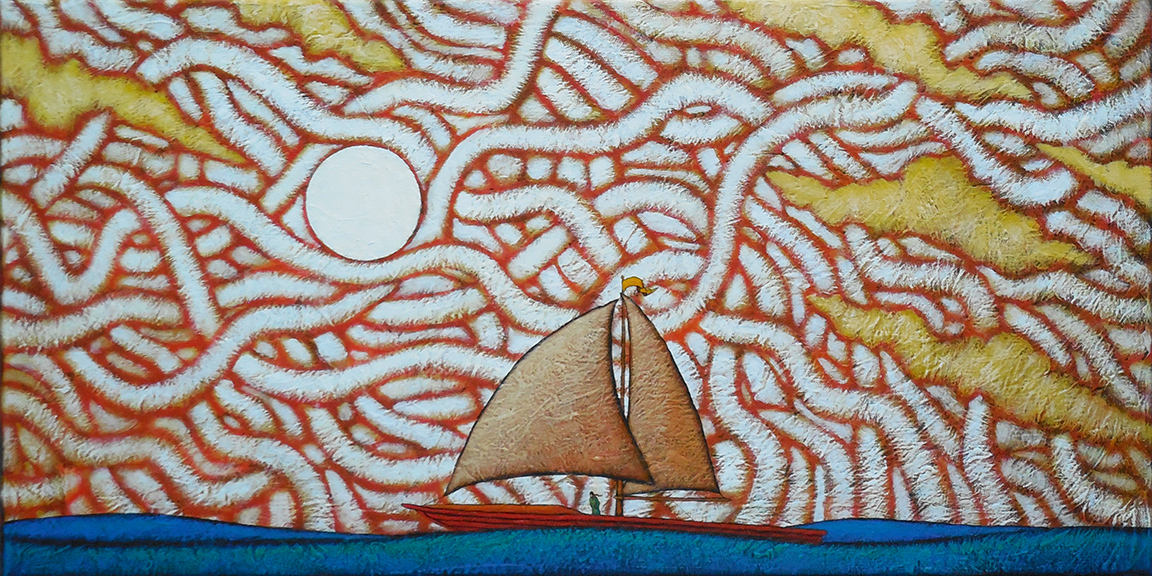
Wasn’t planning on posting anything today but a song popped into mind and I thought I would share it. Not sure that it fully lines up with the painting or the words of Martin Buber at the top, which do mesh well together. The idea of secret destinations, of arriving at a point that is unexpected, is the basis for the story of many life journeys, after all.

How many of us can say our lives ended up exactly where we thought they would be when we first set out? And for those who did arrive exactly where they intended, I don’t know whether to envy or pity them. There’s something to be said for the security of sticking precisely to your set course. On the other hand, that insinuates that will travel unchanged throughout your long journey, that your desires and values won’t be shaken up and reorganized by things encountered along the way. That you won’t at some point realize that where you thought you wanted to arrive then was not the same as it is now.

For myself, it’s pretty obvious that I never had a real plan, a true set course to any destination. And though at times it’s been hard, and that even now, though my journey is much closer to its end than its beginning, I still am not sure where it will ultimately take me, I wouldn’t have it any other way.

Here’s that song. It’s another gem from that perfect coupling of artist and composer, Dionne Warwick and Burt Bacharach. From 1966, this is Trains and Boats and Planes.


Hold On, Hold On

The Entangling– At Principle Gallery


Centuries of husbandry, decades of diligent culling, the work of numerous hearts and hands, have gone into the hackling, sorting, and spinning of this tightly twisted yarn. Furthermore, we have not even to risk the adventure alone; for the heroes of all time have gone before us; the labyrinth is thoroughly known; we have only to follow the thread of the hero-path. And where we had thought to find an abomination, we shall find a god; where we had thought to slay another, we shall slay ourselves; where we had thought to travel outward, we shall come to the center of our own existence; and where we had thought to be alone, we shall be with all the world.

–Joseph Campbell, The Hero with a Thousand Faces (1949)


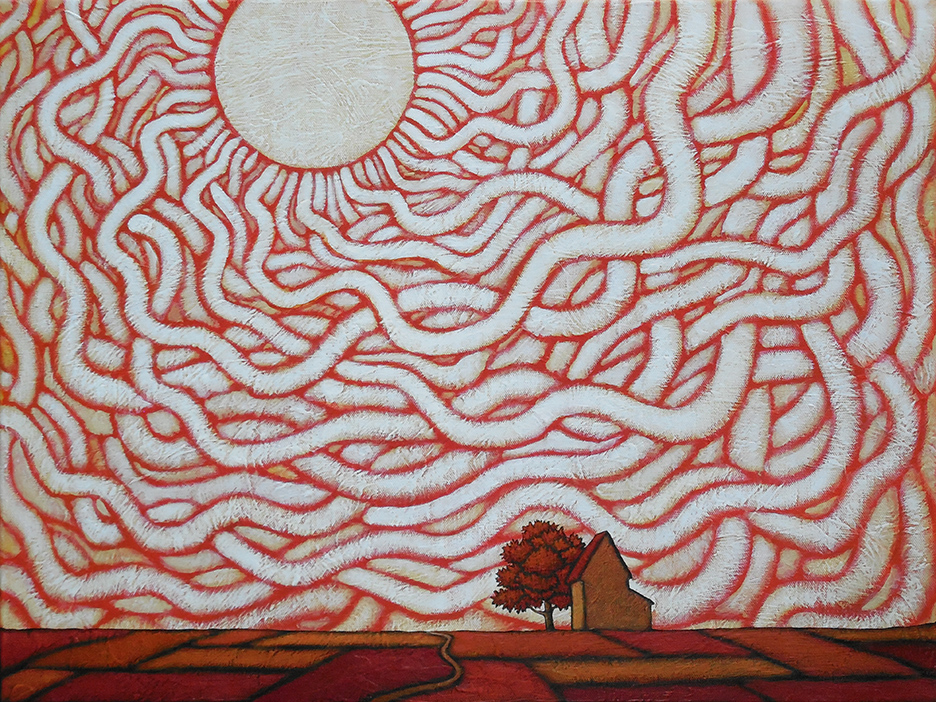
Was reading some Joseph Campbell and came across this passage and it immediately struck me as another way of looking at the Entanglement paintings from my recent Principle Gallery show.  Perhaps the twisting bands of ethereal energy as I see them are also representative of the twists and turns of the hero’s journey. It’s the story of human’s existence, one that takes them through a winding and often dark labyrinth filled with dead ends and numerous paths that seem to be leading to one’s desired destination only to be found to have led the traveler even further away.

And then when we are exhausted and filled with fear, all hope drained away, we take a turn on the twisting path and we find ourselves facing the light that gives us hope, the light that energizes and illuminates all that is behind and before us, showing us the unity of all things.

Hmm. Got to think about this a bit more.

Here’s this week’s Sunday Morning Music. Not sure it exactly fits the theme. I think it might. but it doesn’t really matter since I like this song and wanted to hear it this morning. It’s from one of my many favorites, Neko Case. This is Hold On, Hold On.


The artist must train not only his eye but also his soul, so that it can weigh colours in its own scale and thus become a determinant in artistic creation.

–Wassily Kandinsky, Concerning the Spiritual in Art (1912)


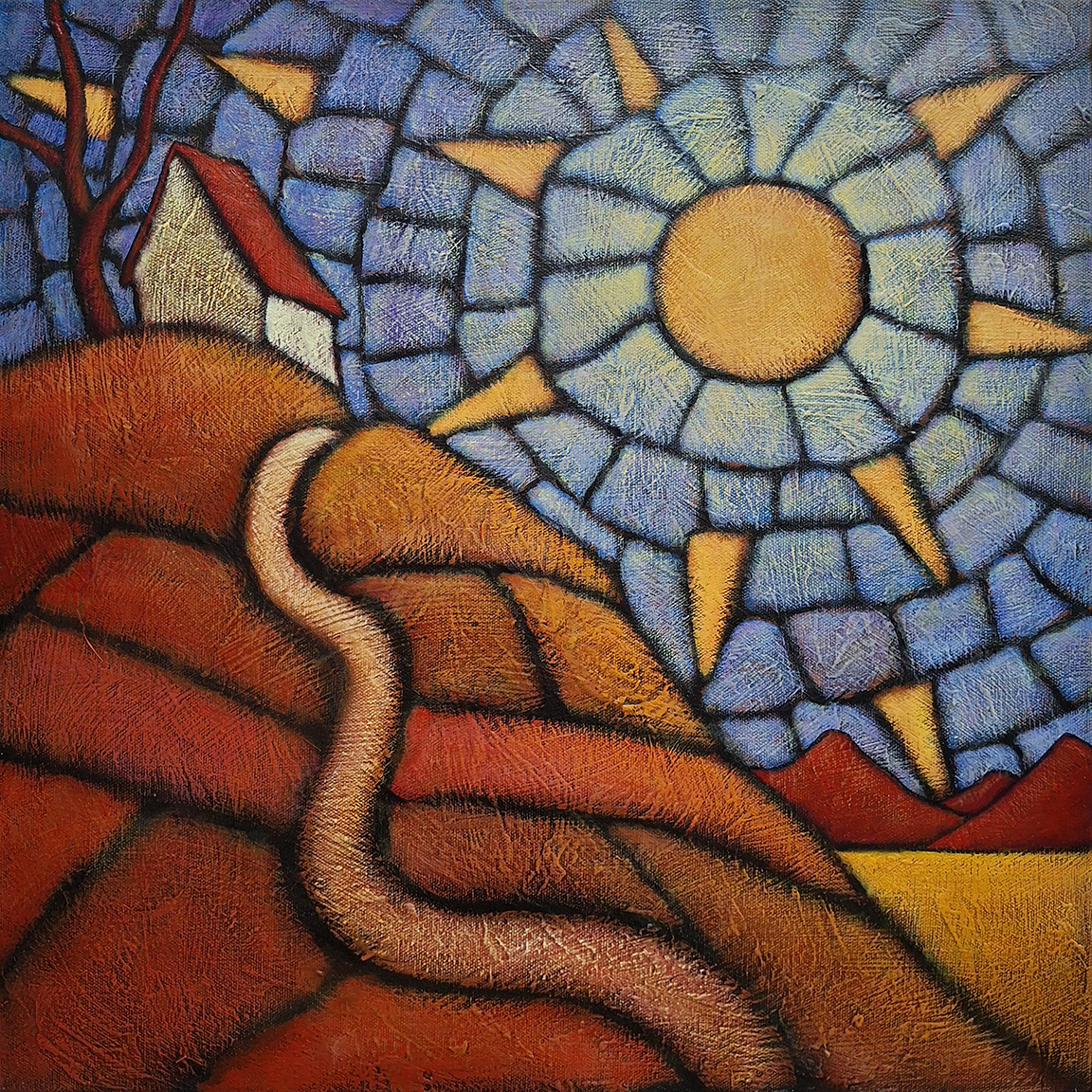
It’s been about a month since I gave a painting demonstration at the Principle Gallery. In the days after, I shared an image of the progress that had been made on the demo painting at the end of the session. I was fairly pleased with how it had emerged but could immediately see that there were changes– additions, subtractions and alterations– that needed to be made before it would truly come into form, at least to my eyes. There were a number of small adjustments and a couple of major changes.

Among the larger changes was altering the shape and color of the distant mountains in the lower right quarter. I simply wasn’t satisfied with the original. There was something in them– or not in them– that just didn’t sit right with me. 

I also changed the shape of the Red Roof house in the upper left. Again, the original just didn’t feel right to me. I depend on my ability to sense rightness in my work, and it was not meeting the mark.

I changed the angle of the roof and extended it a tiny bit, which allowed me to clean up some messiness in the sky behind it. It’s not that I mind a little messiness. The late biophysicist Max Delbruck (1906-1981) had a theory that he called the Principle of Limited Sloppiness. which stated that too much sloppiness was unacceptable in scientific research but allowing a little sloppiness sometimes revealed startling, unexpected results that could then be cleaned up. 

I guess you could say I adhere to Delbruck’s theory. A little sloppiness is fine and sometimes revelatory. However, in my work it’s a problem when the messiness is out of the rhythm of the painting and becomes a distraction, pulling focus from the whole of the painting.

Cleaning up that bit of messiness really honed the feel of the painting for me as did the fine tuning of the colors throughout. The rising road was lightened and a bit of darkness added to the left side of the hill, away from the sun, which, along with its light arrows, was brightened a bit.

It may not seem to the casual observer that the painting was greatly changed but to my eyes it emerged in a much different form., one that truly reaches that sense of rightness that I mentioned. Looking at it now here in the studio, it doesn’t feel like a hurried demo piece. It has its own feel and life now– an extension of the inner world I try to show in my work. It feels like it is truly part of that world now.

I used a Kandinsky quote at the top about an artist needing to train both their eye and their soul. I think of all the hours I have spent alone working in my studio have honed whatever skill I possess– the eye that Kandinsky mentions– as well as the sense of rightness which might well translate as the Kandinsky’s soul. I don’t really know that can express what I am trying to say but I like the idea that an artist is seeking their own soul in their work.

I am pleased I was able to share a little of what seeking looks like with the folks who made it to the demonstration a month ago. Many thanks again to everyone who made it possible.

I have yet to title this piece. A reader suggested the title of an old Cat Stevens song, Road to Find Out, as a title. That might work but I am open to suggestions. Let me know what you think.

Let’s listen to that Cat Stevens song. There’s larger image of the completed painting below. That is, if it is truly completed. Like people, art sometimes needs to change…


Shine a Light

The Blue Moon Calls– At West End Gallery


No one lights a lamp in order to hide it behind the door: the purpose of light is to create more light, to open people’s eyes, to reveal the marvels around.

-Paolo Coelho, The Witch of Portobello


Shine your light somewhere, somehow.

That’s all I have to say this morning. Trying to light my own lamp this morning.

Here’s a fitting tune from the Rolling Stones‘ classic 1972 album, Exile on Main Street. This is Shine a Light.


Summertime

Trio: Three Squares – 2002


Summertime, and the livin’ is easy
Fish are jumpin’
and the cotton is high
Oh, your daddy’s rich
and your ma is good-lookin’
So hush, little baby, don’t you cry

One of these mornings
you’re gonna rise up singing
And you’ll spread your wings
and you’ll take to the sky
But till that morning
there ain’t nothin’ can harm you
With daddy and mammy standin’ by

–Summertime, from Porgy and Bess, Dubose Heyward, George & Ira Gershwin (1934)


I am not so sure about the livin’ is easy part of summertime. Summer has often felt more like steel cage death match for me. Or a grim and gritty fever dream. You might ascertain that it is not my favorite season by a long stretch.

But that doesn’t take anything away from my appreciation of the great aria from Porgy and Bess. Like so many great songs, it’s melody and lyrics are so beautifully composed that it’s hard to find a performance that doesn’t resonate. There have been many, many great versions of this classic and there’s hardly a lemon among them. The Ella Fitzgerald version is perhaps the gold standard though that might be debatable. I am sharing a live performance by Janis Joplin from 1969 in Amsterdam.  I probably like this version because it has the grit and tone of my summers.

The image at the top is a small triptych from 2002 that hangs in my studio. It has long been a favorite and still gives me a rush when I look up at it, like I did just this moment. I see it as a link between my earliest work of the mid and late 1990’s that focused on sparsely detailed blocks of color and the subsequent work.

Here’s Janis…


Sixth Sense

Moment Revealed — At West End Gallery


We have five senses in which we glory and which we recognize and celebrate, senses that constitute the sensible world for us. But there are other senses – secret senses, sixth senses, if you will – equally vital, but unrecognized, and unlauded… unconscious, automatic.

–Oliver Sacks, The Man Who Mistook His Wife for a Hat


Maybe that’s the purpose of art, to prompt us to some sort of sixth sense, one that otherwise goes unnoticed and underutilized in our usual five-sense lives. It is something that we don’t even know that we have been needing and missing until we are awakened to it.

This sixth sense enables us to detect the many dimensions which exist between and beyond that which we observe with our five senses, adding depth and richness to our sense-limited world. 

And art does just that, serving as the activating agent for this sixth sense and beyond that, acting as the connecting link between the known and the unknown. I believe that is what is taking place when one is moved by art in any form.

It transports you into dimensions beyond the five senses. 

And that’s where the good stuff is…

Here’s a song this morning about one type of sixth sense from Irish singer/songwriter Imelda May. With a style that covers many genres of music including jazz and rockabilly, she wasn’t on my radar until just a couple of years ago. I stumbled across a video of Robert Plant and her performing a rockabilly-Big Band rave-up of Led Zep‘s Rock and Roll that I very much enjoyed. I’ll throw that on below as well.


House of Blues – At Principle Gallery


‘Cause I have all of life’s treasures and they’re fine and they’re goodThey remind me that houses are just made of woodWhat makes a house grand, oh, it ain’t the roof or the doorsIf there’s love in a house, it’s a palace for sureBut without love it ain’t nothin’ but a houseA house where nobody lives

–Tom Waits, The House Where Nobody Lives (1999)


It feels like America in the year 2025– a house without love or joy. Or happiness. Or grace, vision, or humor.

Any of those things that make a house feel lived in.

Those things that make a house a palace of love.

We instead build endless chain-link cages to fill with our hatred and bigotry.

That’s all I will say this morning.

You might not agree. Fine.

Just calling ’em like I see ’em, as the ump behind the plate would say. Just hoping your individual houses are filled with love and laughter.

Here’s the Tom Waits song that made me think this with the full lyrics below.


There’s a house on my block that’s abandoned and cold
The folks moved out of it a long time ago
And they took all their things and they never came back
It looks like it’s haunted with the windows all cracked
Everyone calls it the house
The house where nobody lives

Once it held laughterOnce it held dreams, did they throw it away, did they know what it means?Did someone’s heart breakOr did someone do somebody wrong?

Well, the paint is all cracked, it was peeled off of the woodThe papers were stacked on the porch where I stoodAnd the weeds had grown up just as high as the doorThere were birds in the chimney and an old chest of drawersLooks like no one will ever come backTo the house where nobody lives

Oh, and once it held laughterOnce it held dreams, did they throw it away, did they know what it means?Did someone’s heart breakOr did someone do somebody wrong?

So if you find someoneSomeone to have, someone to hold, don’t trade it for silverOh, don’t trade it for gold‘Cause I have all of life’s treasures and they’re fine and they’re goodThey remind me that houses are just made of woodWhat makes a house grand, oh, it ain’t the roof or the doorsIf there’s love in a house, it’s a palace for sureBut without love it ain’t nothin’ but a houseA house where nobody livesBut without loveIt ain’t nothin’ but a house, a house where nobody lives

–Tom Waits, The House Where Nobody Lives (1999)


The Entanglement— Now at Principle Gallery


The force that through the green fuse drives the flower
Drives my green age; that blasts the roots of trees
Is my destroyer.
And I am dumb to tell the crooked rose
My youth is bent by the same wintry fever.

The force that drives the water through the rocks
Drives my red blood; that dries the mouthing streams
Turns mine to wax.
And I am dumb to mouth unto my veins
How at the mountain spring the same mouth sucks.

The hand that whirls the water in the pool
Stirs the quicksand; that ropes the blowing wind
Hauls my shroud sail.
And I am dumb to tell the hanging man
How of my clay is made the hangman’s lime.

The lips of time leech to the fountain head;
Love drips and gathers, but the fallen blood
Shall calm her sores.
And I am dumb to tell a weather’s wind
How time has ticked a heaven round the stars.

And I am dumb to tell the lover’s tomb
How at my sheet goes the same crooked worm.

–Dylan Thomas (1933)


This is considered the poem that more or less brought Dylan Thomas to fame as a poet. I read it again recently and was surprised at how well it aligns with the theme of my show, Entanglement, at the Principle Gallery. It basically describes how our timed existence here on this world is simply part of the timeless driving force of the universe. How that in this place made of time, the very force allowed us for our short stay here, the life force that energizes us, ultimately destroys then leaves us to regather with its timeless source.

Not sure that it is something that is easily explained and I am not sure if I was able to adequately convey that message with this show. But since the show ends today, I felt it was worth sharing this morning along with a splendid reading from Thomas’ fellow Welshman Richard Burton. And for good measure, I added a favorite song from a favorite guitarist, Martin Simpson. Last shared here a couple of years back, it’s titled She Slips Away, and was written about the death of his mother, as she moved from time to timelessness.

As does my Entanglement show which ends today. So, if you want to see it, today is your last opportunity to see it in its entirety before it moves into the realm of the timeless.


NIghtFlare– At Principle Gallery


Where rose the mountains, there to him were friends;
Where rolled the ocean, thereon was his home;
Where a blue sky, and glowing clime, extends,
He had the passion and the power to roam.

–Lord Byron, Childe Harold’s Pilgrimage


Still a little out of it this morning. For some reason I felt like hearing some Mary Chapin Carpenter. I listened to her music quite a bit back in the 90’s but for some unknown reason it faded from my listening rotation. But every now and then, a song of hers will pop up and I am reminded of what it was in her music that I found so appealing. It’s the same now. She has a beautifully warm and personal style that I find comforting.

Don’t know if the triad of word, image, and song is perfect this morning. But it works for my aching head and that will have to be good enough.

Here’s Mary Chapin Carpenter with her Rhythm of the Blues.

PS-Today and tomorrow are the last days to see my Entanglement show at the Principle Gallery.