Feeds:
Posts
Comments

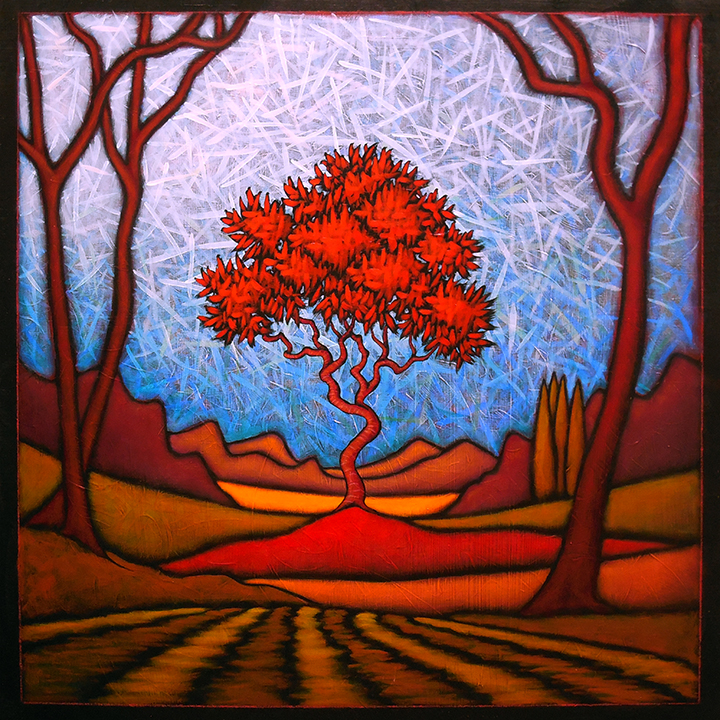
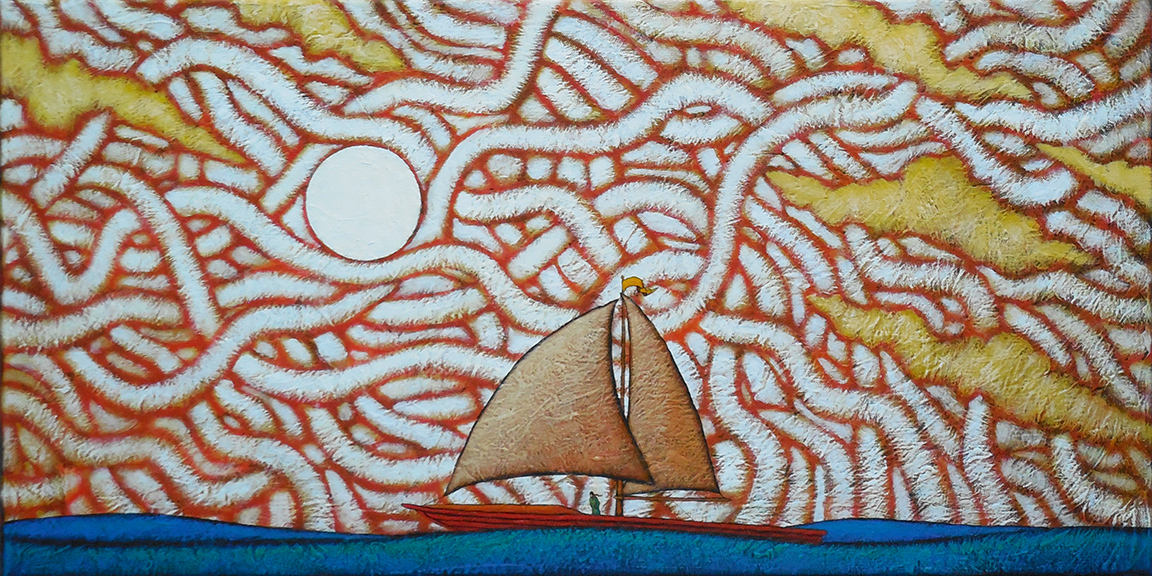
Headed Home— At Principle Gallery


If you take Greece apart, in the end you will see remaining to you an olive tree, a vineyard and a ship. Which means: with just so much you can put her back together.

-Odysseus Elytis, The Little Seafarer (1988)


Still feeling way under the weather. It’s lingered for the past 10 or 11 days and I thought it was passing a few days ago. However, it came back with a vengeance yesterday and this morning. Even so, I feel obligated to remind you that my show, Entanglement, will only be hanging for three more days at the Principle Gallery.

I also realized that I had not yet shared the painting shown above, Headed Home. For me, it represents Odysseus’ epic journey and return to Ithaca. I thought a passage from Greek writer, Odysseus Elytis, who won the 1979 Nobel Prize for Literature, was therefore appropriate. It speaks to the resiliency of people to bounce back from great loss. We need to be reminded of that.

Here’s a slideshow from the Entanglement exhibit. which closes after July 7.


fourth of july


States and Nations don’t exist as such. There are only people. Sets of people living in certain areas, having certain allegiances. Nations won’t change their national policies unless and until people change their private policies. All governments, even Hitler’s, even Stalin’s, even Mussolini’s, are representative. To-day’s national behaviour — large-scale projection of today’s individual behaviour. Or rather, to be more accurate, a large-scale projection of the individual’s secret wishes and intentions. For we should all like to behave a good deal worse than our conscience and respect for public opinion allow. One of the great attractions of patriotism — it fulfils our worst wishes. In the person of our nation we are able, vicariously, to bully and cheat. Bully and cheat, what ’s more, with a feeling that we ’re profoundly virtuous. Sweet and decorous to murder, lie, torture for the sake of the fatherland.

–Aldous Huxley, The Diary of Anthony Beavis / Eyeless in Gaza (1936)


Fourth of July 2025.

There you go– that’s my acknowledgement of the day. No parade. No blindly patriotic songs playing. No fireworks. No flag waving.

The flags above are from a big box of old damaged and dirty flags I have picked up at our local cemetery over the decades. I have hundreds of these old cheap flags. I don’t know why but I do. I think they say more than the grandest giant flag billowing over a car dealership or in some saccharine AI photo with purple  mountains majesty above the fruited plain.

Maybe that’s just me.

Okay. I am getting out of here quickly today before I say something I might regret. Here’s a song that I think says more about this country than the most chest pounding, flag waving, patriotic nonsense. It is about the hope that we maintain for a better life as well about the way that hopes are quashed. It is both sad and gloriously hopeful. What can be more American than that? This Tracy Chapman and her Fast Car for this fourth of july.


Wanderlust

To the Main Road– At Principle Gallery


I knew that I had ample room in which to wander, since science has calculated the diameter of space to be eighty-four thousand million light years, which, when one reflects that light travels at the rate of one hundred eighty-six thousand miles a second, should satisfy the wanderlust of the most inveterate roamer.

–Edgar Rice Burroughs, Pirates of Venus (1932)


Still feeling a bit off kilter and definitely not feeling celebratory in any way for the Fourth of July tomorrow. In fact, I am a little crotchety this morning. Writing that makes me wonder about the origins of the word crotchety. One of the numerous benefits of the instant information of the InterWebs– we won’t go into its equally numerous pitfalls — is that one can answer questions like this within seconds. No more finding and dragging out the dictionary or encyclopedia or whatever reference book you have stacked on your shelves. I accumulated a bunch of compendiums of knowledge, both general and odd facts, over the years that sometimes answered such queries. Not always which meant writing it on a list to be looked up the next time I went to the library. Information moved much slower then and usually by the time I got an answer I had lost interest.

FYI, crotchety is derived from the word crochet which refers to the craft and hook used in it. The term came to represent someone who was hooked by peculiar thoughts, resulting in a brusque, rude attitude towards others.

Yeah, I fall into that category this morning. Crotchety old man shaking my fist at the sky.

Anyway, the theme today is wanderlust. Maybe by the description of searching for info that should be changed to wonderlust. Is that even a word? I guess I will have to take to the InterWebs once more.

While I am doing that, here’s a tune called Wanderlust from the immortal Duke Ellington and sax legend Coleman Hawkins. This came up on my playlist earlier setting this whole fiasco in motion.

Now, either listen or get out. I got things to do. Like I said, I am crotchety this morning and wonderlust  calls…


Pity the Nation


Pity the nation whose people are sheep
And whose shepherds mislead them

Pity the nation whose leaders are liars
Whose sages are silenced
And whose bigots haunt the airwaves

Pity the nation that raises not its voice
Except to praise conquerors
And acclaim the bully as hero
And aims to rule the world
By force and by torture

Pity the nation that knows
No other language but its own
And no other culture but its own

Pity the nation whose breath is money
And sleeps the sleep of the too well fed

Pity the nation oh pity the people
who allow their rights to erode
and their freedoms to be washed away

My country, tears of thee
Sweet land of liberty!

–Pity the Nation, Lawrence Ferlinghetti (after Khalil Gibran) 2007


I leave this here today without image, comment, or music, except to point out that Ferlinghetti took inspiration in 2007 from the Kahlil Gibran poem of the same title, published posthumously after his death in 1931. Both poems clearly speak to their own times as well as this present moment. Here is the Gibran poem:


Pity the nation that is full of beliefs and empty of religion.
Pity the nation that wears a cloth it does not weave
and eats a bread it does not harvest.

Pity the nation that acclaims the bully as hero,
and that deems the glittering conqueror bountiful.

Pity a nation that despises a passion in its dream,
yet submits in its awakening.

Pity the nation that raises not its voice
save when it walks in a funeral,
boasts not except among its ruins,
and will rebel not save when its neck is laid
between the sword and the block.

Pity the nation whose statesman is a fox,
whose philosopher is a juggler,
and whose art is the art of patching and mimicking

Pity the nation that welcomes its new ruler with trumpeting,
and farewells him with hooting,
only to welcome another with trumpeting again.

Pity the nation whose sages are dumb with years
and whose strongmen are yet in the cradle.

Pity the nation divided into fragments,
each fragment deeming itself a nation.

–Kahlil Gibran, from The Garden of The Prophet (1933)


Betwixt and Between— At Principle Gallery


Don’t think. Thinking is the enemy of creativity. It’s self-conscious, and anything self-conscious is lousy. You can’t try to do things. You simply must do things. 

— Ray Bradbury


I ran a post featuring a Ray Bradbury quote the other day which reminded me of another of his quotes and a favorite blog entry from the past that employed the above quote. It’s a refinement of a quote from a 1962 essay, The Queen’s Own Evaders, in which Bradbury wrote about his time in Ireland writing the screenplay for the 1956 John Huston film, Moby Dick.

Never wanting to be a screenwriter, Bradbury adapted only his work for movies or television but made an exception when offered the chance to adapt the Melville classic. He struggled for months and months trying to adapt the novel then one day realized he was being too self-conscious, overthinking every word and element. He began anew and, at the end of an epic eight-hour writing session, finished the script.

The original quote was:

Self-consciousness is the enemy of all art, be it acting, writing, painting, or living itself, which is the greatest art of all. 

Ridding one of self-consciousness was a subject that popped up in many of his essays and interviews over the next 20 years or so as he refined the message. I well understand his view since I feel that I am least self-conscious when I am painting. My paintings are my world much like Bradbury’s world was that of Mars or the October Country or the strange, animated skin of the Illustrated Man.

Bradbury also stated over the years that an artist should not attempt to explain an artwork while it is being created. That’s how I feel about painting, as well. You do it. Then you think about it. As a result, that is why I seldom even begin to think about what the painting is about or what it might be called until it is done or at least well into its process.

Bradbury’s words on creativity are worthwhile for anyone, not just writers or artists. As he said, living is the greatest art of all. Here’s that earlier blog post, last shared here in 2018:


I came across this quote from famed sci-fi writer Ray Bradbury on an online site with quotes on creativity. This struck close to the bone for me as I have proudly not thought for years now. I have long maintained that thinking usually inhibits my work, making it less fluid and rhythmic.

It’s a hard thing to get across because just in the process of doing anything there is a certain amount of thought required, with preliminary ideas and decisions to be made. I think that the lack of thought I am talking about, as I also believe Bradbury refers, is once the process of creating begins. At that point you have to try to free yourself of the conscious and let intuition and reaction take over, those qualities that operate on an instantaneous emotional level.

I can tell instantly when I have let my conscious push its way into my work and have over-thought the whole thing. There’s a clunkiness and dullness in every aspect of it. No flow. No rhythm. No brightness or lightness. Emotionally vacant and awkward. Bradbury’s choice in using the term self-conscious is perfect because I have often been self-conscious in my life and that same uncomfortable awkwardness that comes in those instances translates well to what I see in this over-thought work.

So, what’s the answer? How do you let go of thought, to be less self-conscious?

I think Bradbury hits the nail on the head– you must simply do things. This means trusting your subconscious to find a way through, to give the controls over to instinct.

And how do you do that? I can’t speak for others but for myself it’s a matter of staying in my routine. Painting every day even when it feels like a struggle. Loading a brush with paint and making a mark even when I have no momentum or idea or at hand. Just doing things and not waiting for inspiration.

You don’t wait for inspiration– you create it.

So, stop thinking right now and just start doing things.

Wearing the Mask

Finis Terrae (Land’s End) — “Entanglement” Ends July 7,2025


Man is least himself when he talks in his own person. Give him a mask, and he will tell you the truth.

-Oscar Wilde, The Happy Prince & Other Tales


I basically believe these words from Wilde. To a point. There is a certain class of folks however who wear a mask to hide behind, to prevent them from telling truth. Usually for duplicitous reasons, to benefit themselves or to avoid responsibility. Certainly not to spare the feelings of others.

But then again, maybe wearing that mask reveals their truth, after all. It exposes their weakness and greed, their contempt for the truth as well as their lack of compassion and unwillingness to even attempt to feel empathy.

You can probably think of somebody like that. Or a whole bunch of them.

Don’t make me put a label on this group this morning. I am still reeling a bit from whatever has ailed me for the past several days and don’t want to get any more aggravated than I am feeling at the moment.

On the broader subject of Wilde’s quote, I have often wondered which is the mask I wear — my actual self or my painting? Which is more likely to tell the truth? Which is real? Or are they now one and the same? I say now because they were once two distinctly different entities, one being decidedly more truthful than the other.

I won’t say which was the more honest being.

If I did, it might well be a lie.

I do hope they’re one and the same.

And I am not just saying that. Cross my heart and hope to die.

Let me finish with song and a reminder that this is the final week to see my Entanglement exhibit at the Principle Gallery in Alexandria, as it comes down July 7. If this work is my mask, I am proud to wear it.

I think it tells truth, for both me and the work.

Here’s John Lennon and Gimme Some Truth.


Revitalization

Reunion— At Principle Gallery


“And what, you ask, does writing teach us?

First and foremost, it reminds us that we are alive and that it is gift and a privilege, not a right. We must earn life once it has been awarded us. Life asks for rewards back because it has favored us with animation.

So while our art cannot, as we wish it could, save us from wars, privation, envy, greed, old age, or death, it can revitalize us amidst it all.”

― Ray Bradbury, The October Country


Been under the weather for a few days now but wanted to at least share a song as is the custom here on Sunday Mornings, along with an image and a bit of writing. I chose the Bradbury passage because I feel in need of some revitalization. I also think we can use a reminder that art has a role to play in trying to maintain this broken democracy cannot be overstated.

I think we could all use a little revitalization about now.

A little hope.

A light at the end of the tunnel. Something to move towards.

Here’s a favorite Neil Young song, Helpless, to round out this morning.


If Only We Could

Time Patterns– At Principle Gallery


We have lived by the assumption that what was good for us would be good for the world…. We have been wrong. We must change our lives, so that it will be possible to live by the contrary assumption that what is good for the world will be good for us. And that requires that we make the effort to know the world and to learn what is good for it. We must learn to cooperate in its processes, and to yield to its limits. But even more important, we must learn to acknowledge that the creation is full of mystery; we will never entirely understand it. We must abandon arrogance and stand in awe. We must recover the sense of the majesty of creation, and the ability to be worshipful in its presence. For I do not doubt that it is only on the condition of humility and reverence before the world that our species will be able to remain in it.

— Wendell Berry, A Native Hill (1968 essay)


We must abandon arrogance and stand in awe…

If only we would do that.

Unfortunately, I don’t see us standing in humility and reverence before the world anytime soon.

That’s it. That’s all I have to say this morning. Probably said too much and could have pared it down even more.

Here’s Sierra Hull doing an only slightly bluegrass-tinged cover of the Tears For Fears song, Mad World.


The Answering Light— At Principle Gallery,


Every aspect of Nature reveals a deep mystery and touches our sense of wonder and awe. Those afraid of the universe as it really is, those who pretend to nonexistent knowledge and envision a Cosmos centered on human beings will prefer the fleeting comforts of superstition. They avoid rather than confront the world. But those with the courage to explore the weave and structure of the Cosmos, even where it differs profoundly from their wishes and prejudices, will penetrate its deepest mysteries.

— Carl Sagan, Cosmos


This is Enough Said Week on the blog. Maybe it should be a month or even a yearlong thing. As it has been in recent days, I have nothing to add here to the words of the late Mr. Sagan.

Here’s a favorite song from Daviid Bromberg, off his 1972 self-titled debut album. I won a copy of this album and about 25 other albums in a radio contest back then where the local AM station was clearing out its stock of promo albums. These were albums sent to the station by record companies with the hope that they would get airplay. David Bromberg didn’t get a lot of AM airplay. But I was glad to get the album. It’s a peach. This song has little to do with the painting or the words of Carl Sagan.

I just like it and that’s good enough for this morning. This is Suffer to Sing the Blues.


Awe

Gaining Understanding–Now at Principle Gallery, Alexandria


Awe is more than an emotion; it is a way of understanding, insight into a meaning greater than ourselves. The beginning of awe is wonder, and the beginning of wisdom is awe. Awe is an intuition for the dignity of all things, a realization that things not only are what they are but also stand, however remotely, for something supreme. Awe is a sense for transcendence, for the reference everywhere to mystery beyond all things. It enables us to perceive in the world intimations of the divine, to sense in small things the beginning of infinite significance, to sense the ultimate in the common and the simple: to feel in the rush of the passing the stillness of the eternal. What we cannot comprehend by analysis, we become aware of in awe.

― Abraham Joshua Heschel, God in Search of Man (1955)


Again, enough said.

This time the words come from Rabbi Abraham Joshua Heschel (1907-1972) who was a Jewish theologian, philosopher, author, civil rights activist, among other things. I have seen him referred to as a mystic.

Let’s just say he was a man who fit on many labels. He certainly fits here this morning.

Here’s a song that also fits well. It’s A Sense of Wonder from Van Morrison, released back in 1985.