Feeds:
Posts
Comments

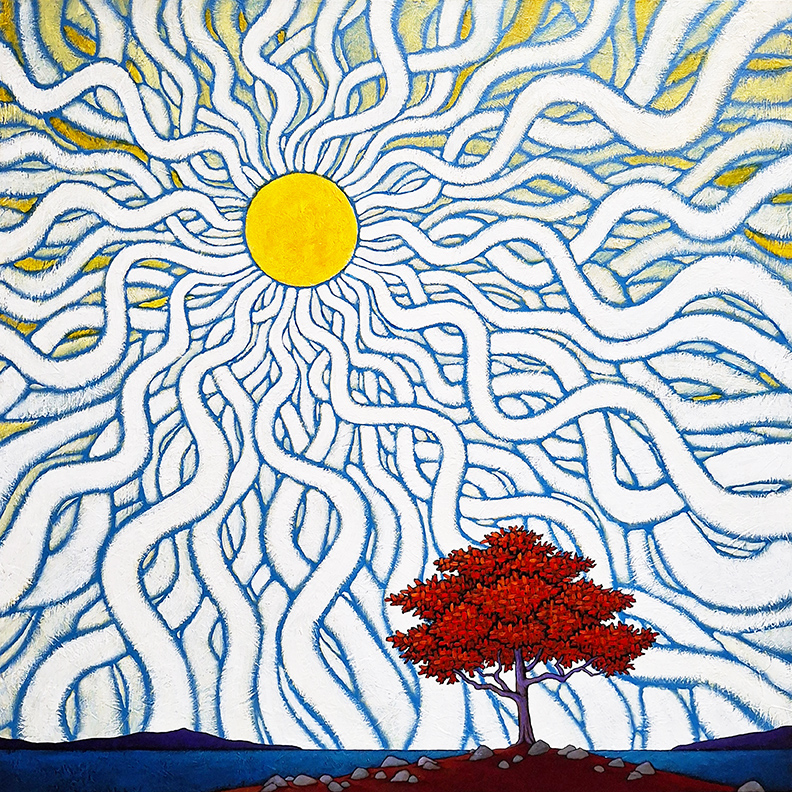
Sundancer


Sundancer— At Principle Gallery


“Significant images render insights beyond speech, beyond the kinds of meaning speech defines. And if they do not speak to you, that is because you are not ready for them, and words will only serve to make you think you have understood, thus cutting you off altogether. You don’t ask what a dance means, you enjoy it. You don’t ask what the world means, you enjoy it. You don’t ask what you mean, you enjoy yourself; or at least, so you do when you are up to snuff…

But to enjoy the world requires something more than mere good health and good spirits; for this world, as we all now surely know, is horrendous. ‘All life,’ said the Buddha, ‘is sorrowful’; and so, indeed, it is. Life consuming life: that is the essence of its being, which is forever a becoming. ‘The world,’ said the Buddha, ‘is an ever-burning fire.’ And so it is. And that is what one has to affirm, with a yea! a dance! a knowing, solemn, stately dance of the mystic bliss beyond pain that is at the heart of every mythic rite.”

-Joseph Campbell, Myths to Live By


There is always someone who better says what I have been struggling in vain to express.

Well said, Mr. Campbell. I need not add any more this morning.

It’s an enough-said-morning. Here’s Leonard Cohen and his song Dance Me to the End of Love.

Seems to fit into place.


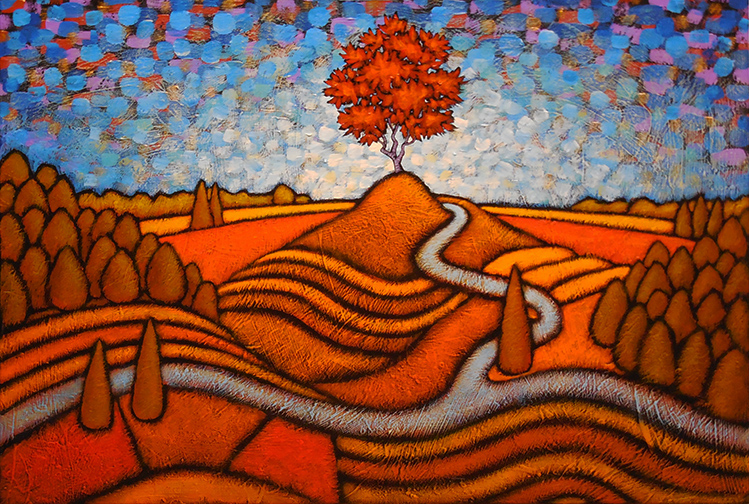
Beheld

Beheld— Now at Principle Gallery


It is very important to go out alone, to sit under a tree—not with a book, not with a companion, but by yourself—and observe the falling of a leaf, hear the lapping of the water, the fishermen’s song, watch the flight of a bird, and of your own thoughts as they chase each other across the space of your mind. If you are able to be alone and watch these things, then you will discover extraordinary riches which no government can tax, no human agency can corrupt, and which can never be destroyed.

–Jiddu Krishnamurti, The Krishnamurti Reader


Yep. Enough said.

Here’s a favorite piece of music, Fratres, from composer Arvo Pärt. The album from which this taken is titled Tabula Rasa with violinist Gil Shaham. This album played a huge role in the development of my work and I often think I don’t hear it enough now.


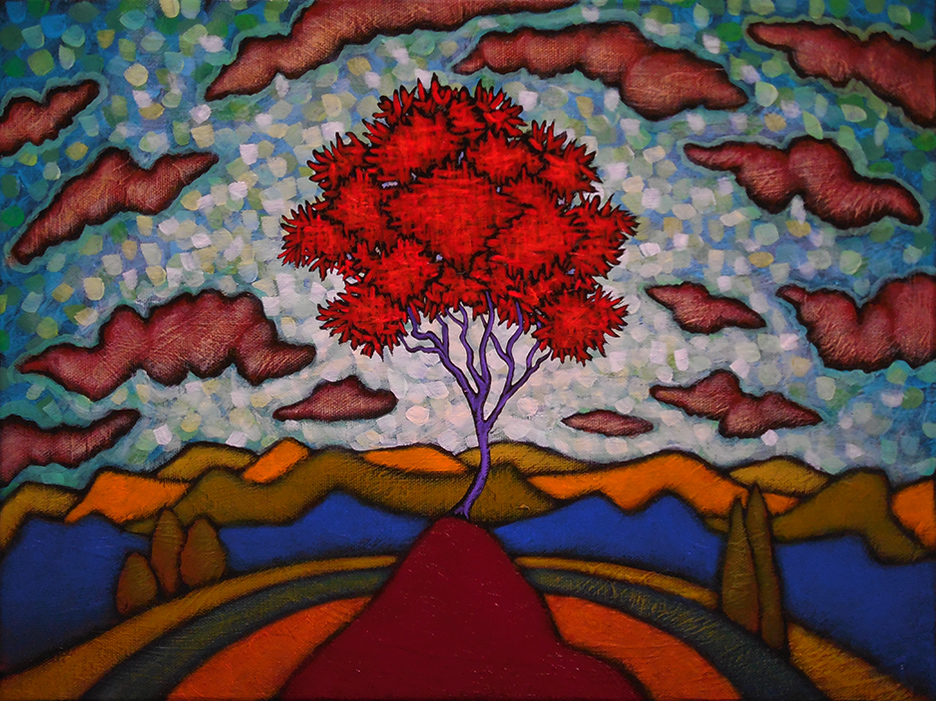
Reflecting Time

Reflecting Time— Now at Principle Gallery


I didn’t go to the moon, I went much further—for time is the longest distance between two places.

The Glass Menagerie, Tennessee Williams (1945)


I am going to be writing less in the coming days. Or weeks.

I feel like I’ve said enough to last a while. Maybe too much. But I will share some things, some words from others that I like, images from myself and others, and some music.

As always, here is a bit of Sunday Morning Music. This is The Moon from Glen Hansard and Marketa Irglová, also known as The Swell Season. You might know them best as the two lead characters in the charming movie Once. They also wrote the songs featured in the film. You might or might not also recognize Hansard from his only other acting job, as the guitarist for the band of the same name in another charming film, The Commitments. I am a fan of Hansard’s songwriting and his performances, which always feature a level of maximum effort, be it on a street corner or in a concert hall. This giving of maximum effort is something I find appealing in artists of any kind, something I try to emulate, though not always successfully.

Be that as it may, this is a lovely, haunting piece.


Becalmed

Becalmed— At Principle Gallery


Do you imagine the universe is agitated? Go into the desert at night and look out at the stars. This practice should answer the question….. The master settles her mind as the universe settles the stars in the sky. By connecting her mind with the subtle origin, she calms it. Once calmed, it naturally expands, and ultimately her mind becomes as vast and immeasurable as the night sky.

–Lao Tzu, 6th Century BC


Enough said this morning.

Here’s the great k.d. lang with the song Western Stars from her album, Shadowland.  Some albums are made to be listened to in the dark, where they create new space, in which there is nothing to distract from the lushness of the sound and the beauty of the songwriting. This is one of those. Great, great album. And a perfect performance of this Chris Isaak song.


The Passing Parade— Now at the Principle Gallery


It’s akin to style, what I’m talking about, but it isn’t style alone. It is the writer’s particular and unmistakable signature on everything he writes. It is his world and no other. This is one of the things that distinguishes one writer from another. Not talent. There’s plenty of that around. But a writer who has some special way of looking at things and who gives artistic expression to that way of looking: that writer may be around for a time.

–Raymond Carver, A Storyteller’s Shoptalk,  New York Times (1981)


I am in the midst of a deep funk, a depressive event that comes on the heels of every show or gallery talk. Every show or talk–good, bad, or indifferent. It’s just the way it is. I think it’s a blend of several things.

One is simply being worn down with the effort of both creation and promotion. The promoting part– this blog, for example– becomes difficult and depleting just before and after each event.

Another is in creating unrealistic expectations for the event. This is especially true when I have stronger than normal feelings about the work.

Some of it comes in questioning my own efforts. Did I do enough? Did I break new ground? Or the simple but deadly– Am I good enough? 

Some of it comes from second-guessing my interactions with people. In her diary, author Anaïs Nin described very much what I go through after any event:

I have never described, even in the diary, the act of self-murder which takes place after my being with people. A sense of shame for the most trivial defect, lack, slip, error, for every statement made, or for my silence, for being too gay or too serious, for not being earthy enough, or for being too passionate, for not being free, or being too impulsive, for not being myself or being too much so.

You add in the deadline for the show being met which means that an endpoint, a destination, has been reached. It seems as though it should be a time to feel free but for a short time after each event, I feel unmoored, without direction, until a new destination is put in place.

These post-show depressions usually find me questioning what I do and the choices I have made. The questions that usually satisfies and begins to put me back on course comes by asking myself if I am painting the paintings I want or need to see. Am I doing work that is mine alone?

For the answer to those questions, I am going to continue here with a blog entry that has ran a couple of times here, the last time being in early 2020. The painting at the top of the original post  has been switched out for one, The Passing Parade, from my current Entanglement exhibit at the Principle Gallerystill promoting!— which satisfies now what I wrote then. I have also added the passage at the top from the late Raymond Carver. It’s another one of those quotes about writing where one can easily substitute artist for writer. It very much ties into the idea of painting the paintings you want to see for me. Or to create the world in which you wish to live, to put it another way.

Here’s that earlier blog post:


This painting really captivates me on a personal level and reminds me of a thought that once drove me forward as a younger painter. It’s a thought that I often pass along as a bit of advice to aspiring artists:

Paint the paintings you want to see.

Sounds too simple to be of any help, doesn’t it? But that simplicity is the beauty and strength of it.

For me, I wasn’t seeing the paintings out there that satisfied an inner desire I had to see certain deep colors that were being used in a manner that was both abstract and representative. If I had seen something that fulfilled these desires, I most likely would not have went ahead as a painter. I wouldn’t have felt the need to keep pushing.

It was this simple thought that marked the change in my evolution as a painter. Before it, I was still trying to paint the paintings that I was seeing in the outer world, attempting to emulate those pieces and styles that already existed as created by other artists. But it was unsatisfying, still echoing the work of others, forever judged in comparison to these others.

But after the realization that I should simply paint what I wanted to see, my work changed, and I went from a bondage to that which existed to the freedom of what could be found in creating something new. For me, that meant finding certain colors such as the deep reds and oranges tinged with dark edges that mark this piece. It meant trying to simplify the forms of world I was portraying so that the colors and shapes collectively took on the same meditative quality that I was seeing in each of them.

In my case this seems to be the advice I needed. But I think it’s advice that works for nearly anything you might attempt.

Paint the paintings you want to see.

Write the book you want to read. Toni Morrison said this very thing at one point.

Play the music you want to hear. Make the film you want to see. Cook the food you want to eat. Make the clothes you want to wear.

Make the world in which you want to live.

Simple.

Now go do it.


It was good advice then and it still is now. Time for me to claw my way out of this hole. Paint toward the light…

The Wisdom Beyond Words– At Principle Gallery


The hero adventures out of the land we know into darkness; there he accomplishes his adventure or again is simply lost to us, imprisoned, or in danger; and his return is described as a coming back out of that yonder. Nevertheless—and here is a great key to the understanding of myth and symbol—the two kingdoms are actually one. The realm of the gods is a forgotten dimension of the world we know. And the exploration of that dimension, either willingly or unwillingly, is the whole sense of the deed of the hero.

-Joseph Campbell, The Hero With A Thousand Faces


“The realm of the gods is a forgotten dimension of the world we know.”  

This sentence from the late Joseph Campbell could well summarize what the work from my current solo show at the Principle Gallery, Entanglement, is trying to convey. It is a show about those forgotten, hidden, and unrecognized dimensions that surround us every minute of every day during our time in this physical plane.

They are dimensions made up of energy and rhythm woven into deeply entangled patterns. Some of these patterns manifest themselves in this physical plane, resulting in a template or pattern of mythic behaviors that have been manifested and recalled with reverence in the stories of every culture throughout history.

Patterns of mythic action that exist in every time and place.

Here and now.

In my eyes, this work is a representation of the psychic unity of mankind, a theory to which Joseph Campbell’s work adhered.  It basically states that all people in this world share patterns of thought and behavior. Patterns that replicate those that exist in the dimensions beyond our recognition or understanding that these paintings represent.

If you’re familiar with Campbell’s work, you know that the great myths, such as Homer’s Odyssey, are not the sole province of the hero’s journey. Most people, in every time and place, at some time in their lives recreate the hero’s journey. It may be on a smaller, more intimate scale. They surely will not see it as being mythic or heroic. But it is woven from the same cloth and in the same patterns of the great myths, those same patterns that I see in these paintings.

 I could go on and on but that’s all I want to say this morning. I have things that need to be done. 

Heroic things?

Probably not. But then again, who knows?

Here’s an all-time favorite song of mine, one that I have probably share a little more here than I should. It’s Heroes from David Bowie. The line from the song that repeats and resonates- We can be heroes, just for one day— pretty much sums up this post. 

We can be heroes…


Soul Time

In the Free World-– Now at Principle Gallery, Alexandria


Every artist dips his brush in his own soul, and paints his own nature into his pictures.

–Henry Ward Beecher, Proverbs from Plymouth Pulpit (1887)


As an artist, if you will allow to call myself that, I believe these words the famous 19th century preacher Henry Ward Beecher are true. I know that I feel closest to my work when it most reflects a feeling and tone that I recognize deep within myself. You just hope that this aspect of your nature is equally reflected outward, that people see that same aspect in you as a person.

Sometimes they do and sometimes they do not. It is not always an easy transition when trying to bring anything from the inner to the outer world. I guess the best one can do as an artist is to be sincere, to represent those aspects which truly are part of your true nature.

To try to do otherwise produces insincere work. And while it can exist and even prosper in the short term, it eventually reveals its insincerity.

I don’t know, maybe I am just spinning my wheels this morning. I often do that in the aftermath of a show opening. It’s a matter of finding something to hold on to before I fully fall into the abyss of funk that I seem to encounter after every show. In this year’s case, I am holding on to the fact that I know the work I produced is indeed sincere and represents what I believe is my true nature.

Well, most of my true nature. You know, the good parts. The aspirational. The inspirational. But in reality, even the darker aspects of my true nature show up in what I consider my best work. I think it is that tension between the dark and light aspects of an artist’s nature that produce meaningful art.

Sincere art. Art of the soul.

Okay, a little more info on Henry Ward Beecher, for those of you not familiar with the name. He was one of the biggest celebrities of the late 19th century, on an equal footing with the actors, musicians, and writers of the era. At one point, he was referred to as the Most Famous Man in America. He was even on popular trading cards and had his own sex scandal that culminated in one of the most celebrated trials of the time. He was also a great social reformer as an abolitionist and advocate for women’s suffrage. He was the brother of Harriet Beecher Stowe of Uncle Tom’s Cabin fame, as well as the brother of Thomas K. Beecher. I throw in Thomas because of his local connection to my hometown. He was the big fish in our small pond at the time, a preacher who drew huge congregations as well as a civic leader. He was a good pal of Mark Twain and buddied around with him, playing pool and such, during Twain’s many summer stays here in Elmira. Beecher also presided over Twain’s wedding to local girl Olivia Langdon.

Okay, enough extra info. Let’s have a song. Since we’re discussing the nature of the soul, here’s Soul Time from Shirley Ellis. You might know her from her fun big hits The Name Game and The Nitty Gritty. A video for The Nitty Gritty with some exuberant dancer, highlighted by the wild moves of well-known dancer/choreographer Bobby Banas, became a viral hit. Lots of fun.


Rockwell Kent– Sunglare, Alaska (1919)


Often I think that however much I draw or paint, or however well, I am not an artist as art is generally understood. The abstract is meaningless to me save as a fragment of the whole, which is life itself… It is the ultimate which concerns me, and all physical, all material things are but an expression of it… We are part and parcel of the big plan of things. We are simply instruments recording in different measure our particular portion of the infinite. And what we absorb of it makes for character, and what we give forth, for expression.

–Rockwell Kent, Wilderness: A Journal of Quiet Adventure in Alaska (1918)


I am sometimes a little hesitant in using the words of other artists in describing my own. After all, art is so subjective, both in viewing and creating, that the driving forces and subjective criteria of one can be quite different than those of another. In short, my what and why may not be the same as yours.

But I came across this passage from the journal of Rockwell Kent, an artist whose work and words I have always admired. One of the big moments in my early career was being chosen for a museum exhibition in which his work was also shown. It sure felt like a big deal then to have my name listed alongside his on the brochure for the show.

Kent kept this journal during the time in 1918 when he withdrew to an island off the coast of Alaska, along with his seven-year-old son. He was fleeing to a remote place where he could get away from marital and financial problems and a world where a World War raged and the Spanish Flu pandemic was in full, deadly force. The same world that at that time seemed to care little for the work he passionately created.

In this time, he deeply felt his own apartness from this world while at the time finding an understanding of the interconnectedness of all things. The idea that we are all part of the infinite was something which became a theme for much of his work.

I can understand that. It is basically the theme for my current show and much of my work throughout my career.

The paragraph above just slayed me when I read it. It hit on several things that I feel in my own life and work. The end of that first sentence– I am not an artist as art is generally understood— is a thought that has been with me for many years, long before stumbling across Kent’s words.

For me, I often don’t think of myself as an artist first since I didn’t come to it because of a natural and readily evident physical talent. My main impetus was instead the need to express something felt deep within, something that could not find form in any other way, something I could not easily identify or even know. That need to express the inexpressible far outweighed any innate ability that I possessed. 

I’m not sure that is the same for all artists. I don’t know, of course, and I am certain that there are plenty who have this same feeling, this sense of being both apart from the world of art even as they are seen as part of it. Perhaps as many or more than those who easily made their way to a life in art because of their natural facility and talents, those artists who feel comfortable and accepted within the world of art, never doubting their place in it. 

The latter part of this paragraph where Kent states that all physical, material things are mere expressions or physical manifestations of the infinite– the ultimate, as he calls it– echoes in what I have described as the belief system behind the work in my Entanglement series.

And that is reinforced even more in the next part: We are part and parcel of the big plan of things. We are simply instruments recording in different measure our particular portion of the infinite. 

We are all part of that one infinity and we uniquely serve purposes that we may never know or understand, hard as we may try to do so. For some like Rockwell Kent–and myself as I see it– that task or purpose is to give form to feeling so that others might somehow find some understanding of the infinite and their own unique part in it. 

Another short passage from this journal says:

These are the times in life — when nothing happens — but in quietness the soul expands. 

This sentence also struck a resonating chord with me. It wasn’t always that way. There are times in one’s life when sound and action is more welcoming than stillness and quiet, times when doing and going seem more important than simply being.

It seems that stillness creates space in which the soul can expand. 

That’s my take on Kent’s lovely words for the day. Does it make sense for anyone other than me? I can’t say. 

Just looking to expand my soul this morning with a little quietness,,,


Aftermath

Semi-Finished Demo Painting- Principle Gallery 2025

Thought I would share a recap of this past weekend at the Principle Gallery in the aftermath of my opening there on Friday evening.

The opening itself was a bit more subdued than in previous years but that was something that was anticipated by the gallery and me.  With the high temps (94° on the highway during the drive into town) and humidity along with the threat of severe thunderstorms, we knew that the crowd might be smaller. You can add to that the scheduling of the political circus/parade that was centerstage in DC this weekend, tying up traffic and both driving many people out of the area and keeping others away. And there was also my scheduled painting the following day which no doubt would keep those who wished to attend that making the decision to skip the opening. Thus, we lowered expectations accordingly. 

But the turnout was fairly good, for all of that. I was engaged in many conversations for the entire time and before I knew it, it was time to close up. Time flew by. Many thanks once more to those who made it out to the gallery on Friday. 

Then came the painting demonstration late the next morning. Due to the uncertainty of the weather, we held in the gallery as opposed to being out on the closed-off street as originally planned. The turnout was exceptional for this event with about as many people as we could comfortably fit in the space. And they were exceptional in other ways as well. 

Up to the minute it started I was unsure what I was going to do with the demo. I opted at the last second to make it a little more interactive– and a little riskier. I asked if anyone would like to make the first mark on the 20″ by 20″ canvas I had prepared first with multiple layers of gesso then a final layer of black paint. I explained that I would then work off that first mark, that it would dictate my reaction the next steps in the painting. Everything after that first mark would be an unplanned reaction.

A familiar and friendly face to me, Jesse (hope that is spelled correctly!), volunteered to make the first mark. I loaded a brush with the red oxide paint I use to compose the underpainting and handed it to her. She hesitated a bit then made a swooping and bending downward moving line. 

Now, allowing someone to make that first mark can be a risky proposition. It’s a bit like a circus highwire performer working without a net. The difference is that the circus performer rehearses their act over and over and there is only one way to go once you’re on the wire.

I immediately saw Jesse’s swooping line as a path. That was the good news. The bad news was that the mark began in the upper left quarter of the painting. I quickly realized that this first mark put some limits on where I could go compositionally. Kind of like my tightwire suddenly came apart and I was left with several narrower but shakier paths ahead. None were the optimal, easiest wire to walk.

On the other hand, being put in a tighter, more awkward spot allowed me to better show how decisions pop up during the process of painting that are often unforeseen but have to be quickly made in order to make progress.  In this case, I decided to keep the mark as a path and build a sloping hill around it, one that allowed more space for a sky to the right of it. What that sky would be was another question, another decision to be made, along with many others.

I am not going to go into every decision made or every twist and turn that the painting took here. As I told the folks there on Saturday, I was painting much faster than I would in the studio, making those decisions much quicker and putting on paint a bit sloppier and at a much faster pace. I was sometimes making instantaneous decisions.

As we got near the end of the demonstration, the piece had taken on a somewhat complete appearance and most folks there felt it was complete. The image at the top is the painting at that point. All it could very well be complete. But there were things that I can see– then and even more so back in the studio when I looked it over yesterday–that still need to be addressed along with a few changes that I would like to make but am not sure are even possible. These were mainly the result of decisions that I made before taking every possibility into consideration. Kind of like real life, right?

Overall, I was pleased to get to that point of completion while working so quickly. It still has work to be done which I will be doing in the coming days. I think you will be surprised at the transformation– if I can pull it off. Either way, I will share the change.

Time being such a precious commodity in this lifetime, the group that spent those several hours with me on Saturday were exceedingly generous with not only their time but with the good humor and kindness they offered me. In return, I hope they got a better glimpse of the thought process behind the making of a painting, at least in the way I work.

As is often the case, I believe I got more from them than they from me. Thank you to the many who were there on Saturday. I am as appreciative as can be.

Here’s a short video slideshow that shows the process. Many thanks to my friend Larry Robertson who I met along with lovely wife, Kai, many years ago at the gallery, for the photos from the demonstration.


GC Myers/ Principle Gallery Demo June 2025

Thank You!

Yesterday was a pretty long day and I find myself kind of whipped this morning so this is going to be a relatively short post. I will write more about the opening of my Entanglement show at the Principle Gallery on Friday evening and yesterday’s painting demonstration in the coming day or so. I will however take this opportunity to say Thank You! to the folks who came out to these events. I am still amazed when anyone shows up and even more so on a tension-filled weekend in the Capital district that had all the signs of being an inflection point in our history.

Throw in stifling heat and humidity along with heavy thunderstorms on Friday and I am even more amazed– and grateful– those who made their way in. And special thanks to my many friends who came to the demo yesterday and stuck with it from the beginning to end– over three hours!– and made it a good, fun time that made my drive home much brighter and easier.

And a special Thank You to Michele Marceau and her great staff at the Principle Gallery– Clint, Taylor, Owen, and Brady— who take mighty efforts to make it all possible. I cannot be more appreciative of all they do on my behalf.

And on a day of voices raised against one man’s greedy grab for ultimate power, I say Thank You to the millions who took to the streets all across this country yesterday. Leaving town, I was heartened by the number of people walking toward King Street who were carrying signs of protest of all sorts. They all seemed to me to be walking with such purpose in their strides, like they were on a mission and would not be denied. When I got home and saw some of the imagery from around the country, my heart filled.

Again, I will write more in the days ahead about the show and demonstration but for now, to those that made this a memorable weekend in different ways, please accept my heartfelt thank you.

Let’s have a little Sunday Morning Music, okay? Here’s song from British soul singer James Hunter  and his group, the James Hunter Six that might well sum up what is needed to overcome the obstacles we face in this country at the present– Whatever It Takes.