Feeds:
Posts
Comments

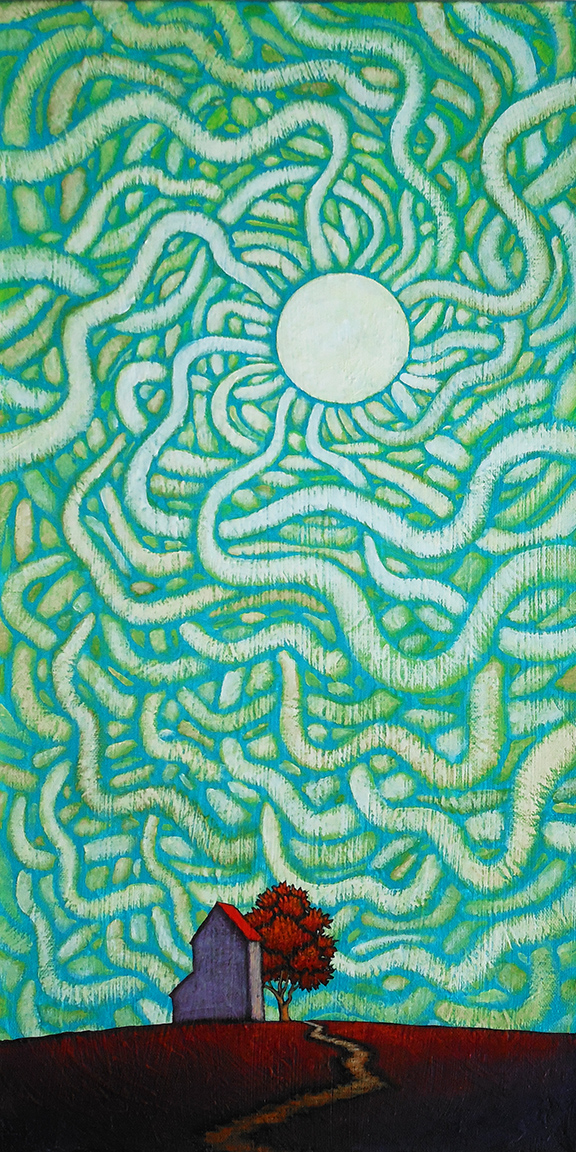
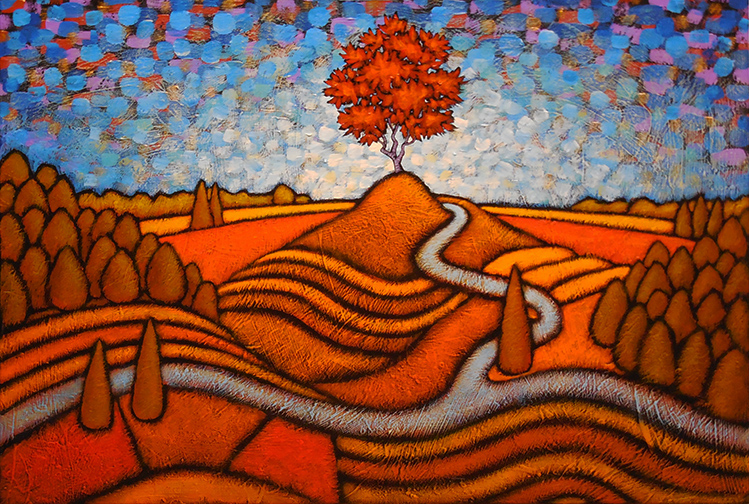
The Choice— GC Myers 2017


There is nothing in this world that does not have a decisive moment.

–Cardinal de Retz  (1613-1679)


Photographer Henri Cartier-Bresson , a favorite of mine, took that phrase from the quote above and used it to describe that moment in searching for an image when the photographer makes the creative decision to snap the photo. But I see the term at play in everything we do, everything we are. Who, what, and where we are is all the result of random moments of decision. Every day offers us new choices for moving ahead and very seldom do we ponder where these often simple and mundane decisions might ultimately lead our lives.

I think about this all the time when I consider the course my life and career has taken. Several of the galleries in which I show came about as the result of a series of random decisions– and a few moments of serendipity!– and if any of those choices leading up to the final result had differed in any way, my life as it is now might be completely different.

Even the beginning of my painting career might not have occurred if I had decided that working off a ladder on that September day twenty years ago was not a great idea. I would not have fallen and would not have found the time or inspiration to begin painting. Maybe it would have come anyway at some other point but who knows? And would that decision to follow painting at that later date yield the same results?

I see it in genealogy as well. When I look at the charts that show one’s whole ancestry laid out in an ever-widening mesh of connections all I can think is how we are all built on a huge set of random choices and pure chance. If any single one of those many thousands of connections had not been made the whole mesh that brought us here would fall away and our very existence would most likely not have occurred.

Our existence relies on so many ifs: If one ancestor had not returned from the many wars, if one ancestor had not been the lucky child that survived the many diseases that took so many children from most families in the earlier days of our country, if one ancestor had turned left instead of right and not met that person who became their other half.

It’s a delicate dance of decisive moments that leads us all to the here and now.

We can try to consider what each conscious decision we make might someday yield but there are so many decisions made on a daily that seem so inconsequential that they easily escape our notice. We often don’t realize the magnitude of a decision until much later and are either enjoying or suffering the result of a decision from our past.

Only then do we recognize it as the decisive moment.

I guess the best we can do is to use our best judgement in those decisions we truly consider and hope that who we are at our core allows us to make wise choices on those that we fail to consider fully.

I am reworking an old blog post from about 12 years ago to highlight the painting at the top from 2017, The Choice. It’s one of those pieces that jumped at me when I painted it, becoming an instant favorite of mine, but never clicked for anyone else. Over the years, as much as I liked it from the start, my appreciation for it has only grown. Maybe it’s because I see it as a representation of the choices and decisive moments that brought me to this here and now.

Or maybe not. I can’t decide…

Bulb or Light?

Quiet Revelation-Now at Principle Gallery


The problem in middle life, when the body has reached its climax of power and begins to lose it, is to identify yourself, not with the body, which is falling away, but with the consciousness of which it is a vehicle. And when you can do that, and this is something learned from my myths, What am I?  of which the bulb is a vehicle?

One of the psychological problems in growing old is the fear of death. People resist the door of death. But this body is a vehicle of consciousness, and if you can identify with the consciousness, you can watch this body go like an old car. There goes the fender, there goes the tire, one thing after another— but it’s predictable. And then, gradually, the whole thing drops off, and consciousness rejoins consciousness. It is no longer in this particular environment.

~Joseph Campbell, The Power of Myth


That is a great question: Are we the bulb that carries the light, or are we the light?

While I believe there may be an absolute answer that is deeply etched in whatever makes up and energizes the universe, the answer for our time here in this small world is determined by each of us.

We can see ourselves as being only a physical being. A body with a brain that is simply another part of it. And maybe that is all the brain is, a control module that exists to help the body maneuver and survive this world, with very little to do with our actual consciousness– that light, that lifeforce, that we carry and emit.

Or we can see ourselves as that light that is something apart from and only temporarily contained by our physical vessels. That we are that lifeforce that exists beyond our time here in this plane.

In our youth, we tend to see only the physical nature of our being- strength and beauty and the quickness of the mind. I thought that way for a while. But over the years, witnessing others struggle with disease and death while experiencing my own aging with the dings, dents, and slipping gears that accompany it, to continue the old car metaphor Campbell employed above, I definitely see things more in the latter mode, that we are the light, the consciousness, that is carried by the bulb that is our body. And someday, sooner or later, when our engine is blown and our fenders rotted off as the tow truck comes to haul us to the junkyard, our consciousness will go on. 

Cosciousness shall rejoin the greater consciousness. Our light will rejoin the greater light.

Just a thought, my own viewpoint as an old Subaru, this morning. I could go on, of course, and maybe I am remiss in not doing so. But I think I’ve said enough this morning and I’ll let you fill in the blanks like it’s some sort of philosophical Mad-Libs.

Besides, I want to get to the Sunday Morning Music for this week.

Here’s a great version of This Little Light of Mine from bluegrass legend Ralph Stanley. I had the great pleasure of seeing him perform a number of years back at Radio City Music Hall as part of the Down From the Mountain tour which featured the many singers and musicians– Alison Krauss & Union Station, Emmylou Harris, Gillian Welch, Patty Loveless, and Stanley— whose music played a large role in the film O Brother, Where Art Thou? Stanley’s performance of O Death was perhaps the most powerful moment from a memorable show.


In the Rhythm of the World– At West End Gallery


I recently came across a book of graduation speeches given by Kurt Vonnegut over the years. The speeches are witty, insightful, and bitingly to the point, much like his writing. I thought I would share one of these commencement speeches, one that includes the story behind the title of his book of speeches, If This Isn’t Nice, What Is? 

This speech from 1999 was given at Agnes Scott College, a private women’s liberal arts college in Decatur, Georgia. 26 years later, Vonnegut’s words ring true as we see ourselves vying to survive in a world that proclaims that we should adhere to Jesus’ words from the Sermon on the Mount while simultaneously prodding us to follow the Code of Hammurabi.  

Below is that speech. It’s worth a few minutes of your time. It covers a lot of ground in a short time.


Kurt Vonnegut Commencement Speech, Agnes Scott College, 1999–

I am so smart I know what is wrong with the world. Everybody asks during and after our wars, and the continuing terrorist attacks all over the globe, “What’s gone wrong?” What has gone wrong is that too many people, including high school kids and heads of state, are obeying the Code of Hammurabi, a King of Babylonia who lived nearly four thousand years ago. And you can find his code echoed in the Old Testament, too. Are you ready for this?

“An eye for an eye and a tooth for a tooth.”

A categorical imperative for all who live in obedience to the Code of Hammurabi, which includes heroes of every cowboy show and gangster show you ever saw, is this: Every injury, real or imagined, shall be avenged. Somebody’s going to be really sorry.

When Jesus Christ was nailed to a cross, he said, “Forgive them, Father, they know not what they do.” What kind of a man was that? Any real man, obeying the Code of Hammurabi, would have said, “Kill them, Dad, and all their friends and relatives, and make their deaths slow and painful.”

His greatest legacy to us, in my humble opinion, consists of only twelve words. They are the antidote to the poison of the Code of Hammurabi, a formula almost as compact as Albert Einstein’s “E = mc2.

I am a Humanist, or Freethinker, as were my parents and grandparents and great grandparents — and so not a Christian. By being a Humanist, I am honoring my mother and father, which the Bible tells us is a good thing to do.

But I say with all my American ancestors, “If what Jesus said was good, and so much of it was absolutely beautiful, what does it matter if he was God or not?”

If Christ hadn’t delivered the Sermon on the Mount, with its message of mercy and pity, I wouldn’t want to be a human being.

I would just as soon be a rattlesnake.

Revenge provokes revenge which provokes revenge which provokes revenge — forming an unbroken chain of death and destruction linking nations of today to barbarous tribes of thousands and thousands of years ago.

We may never dissuade leaders of our nation or any other nation from responding vengefully, violently, to every insult or injury. In this, the Age of Television, they will continue to find irresistible the temptation to become entertainers, to compete with movies by blowing up bridges and police stations and factories and so on…

But in our personal lives, our inner lives, at least, we can learn to live without the sick excitement, without the kick of having scores to settle with this particular person, or that bunch of people, or that particular institution or race or nation. And we can then reasonably ask forgiveness for our trespasses, since we forgive those who trespass against us. And we can teach our children and then our grandchildren to do the same — so that they, too, can never be a threat to anyone.

A woman’s reach should exceed her grasp, or what’s a heaven for?

You should know that when a husband and wife fight, it may seem to be about money or sex or power.

But what they’re really yelling at each other about is loneliness. What they’re really saying is, “You’re not enough people.”

If you determine that that really is what they’ve been yelling at each other about, tell them to become more people for each other by joining a synthetic extended family — like the Hell’s Angels, perhaps, or the American Humanist Association, with headquarters in Amherst, New York — or the nearest church.

Computers are no more your friends, and no more increasers of your brainpower, than slot machines…

Only well-informed, warm-hearted people can teach others things they’ll always remember and love. Computers and TV don’t do that.

A computer teaches a child what a computer can become.

An educated human being teaches a child what a child can become. Bad men just want your bodies. TVs and computers want your money, which is even more disgusting. It’s so much more dehumanizing!

By working so hard at becoming wise and reasonable and well-informed, you have made our little planet, our precious little moist, blue-green ball, a saner place than it was before you got here.

Most of you are preparing to enter fields unattractive to greedy persons, such as education and the healing arts. Teaching, may I say, is the noblest profession of all in a democracy.

One of the things [Uncle Alex] found objectionable about human beings was that they so rarely noticed it when they were happy. He himself did his best to acknowledge it when times were sweet. We could be drinking lemonade in the shade of an apple tree in the summertime, and Uncle Alex would interrupt the conversation to say, “If this isn’t nice, what is?”

So I hope that you will do the same for the rest of your lives. When things are going sweetly and peacefully, please pause a moment, and then say out loud, “If this isn’t nice, what is?”

That’s one favor I’ve asked of you. Now I ask for another one. I ask it not only of the graduates, but of everyone here, parents and teachers as well. I’ll want a show of hands after I ask this question.

How many of you have had a teacher at any level of your education who made you more excited to be alive, prouder to be alive, than you had previously believed possible?

Hold up your hands, please.

Now take down your hands and say the name of that teacher to someone else and tell them what that teacher did for you.

All done?

If this isn’t nice, what is?

First Peace


Well, the night is still
And I have not yet lost my will
Oh and I will keep on moving ’till
‘Till I find my way home

When I need to get home
You’re my guiding light

Guiding Light, Foy Vance


I am still building up strength and energy after being sick. I feel like I am running at about 70% or so, still getting really fatigued after much exertion or just a busy day in the studio. But my work continues, and I feel like it’s building in a way that will be at full capacity for my autumn schedule, which this year features a solo show and two Gallery Talks.

Fortunately, we switched my annual solo show at West End Gallery from July to October this year. In the shape I was in at the time, there would have been no way in which I could have mounted a July show. But we did switch and I am looking forward to that show at a different time with the added time to prepare. I especially need that additional time as my strength rebuilds.

My solo show at the West End Gallery opens Friday, October 17 and runs to November 13. This year’s show is titled Guiding Light. I was recently mulling over what to call the show and a song came on the channel I often listen to early in the morning and the song struck a chord. And its title, Guiding Light, instantly felt right. That song, which is shared below, was from singer/songwriter Foy Vance, who hails from Northern Ireland-– or Norn Iron as my good friend from Portadown, Tom, would say.

I will write more about the title and theme of the show in the coming month or so.

There will also be a Gallery Talk in the weeks following the opening. A date has not been nailed down, but it will most likely be on one of the Saturdays after the opening, either October 25, November 1 or the 8th. I am leaning toward October 25 myself, but we want to make sure it’s a clear date before announcing it. I will let you know when we make that final decision.

Before that, on Saturday, September 27, I will be returning to Alexandria to give my annual Gallery Talk at the Principle Gallery. The talk begins at 1 PM. It is usually a pretty good time and I have no doubt that this year’s edition will not be as well.

And to spice things up, I will be doing the whole talk while standing on my hands.

Well, we’ll see about that. But if anyone in attendance feels like doing handstand while we have our Gallery Talk, I will not discourage it.

That is this fall’s schedule thus far. Hope to see you somewhere down the road.

Here’s that Foy Vance song, Guiding Light. This is from a live performance in 2023 from Belfast accompanied by the Ulster Orchestra. It makes for a great way to end his show, if you watch through the end.


The Omnipresence— At West End Gallery


Shakespeare said that art is a mirror held up to nature. And that’s what it is. The nature is your nature, and all of these wonderful poetic images of mythology are referring to something in you. When your mind is simply trapped by the image out there so that you never make the reference to yourself, you have misread the image.

Joseph Campbell (with Bill Moyers), The Power of Myth (1988)


I love the passage above that Joseph Campbell spoke during his conversation with Bill Moyers for the PBS series The Power of Myth. I feel that it describes beautifully the connection between the individual and mythology and art, at least in my view. I believe that we truly connect with myth and art when we see it as personal to ourselves, as being somehow symbolic of our own experience and being.  

Our emotions and reactions.

Of course, some myths and much in art may not speak to us on this personal level. There is plenty of art out there that doesn’t speak to me. That is not to say that it is not good work. Some is masterfully crafted and has an undeniable surface. It is not a judgement of quality.  just doesn’t speak to me personally and doesn’t reflect my own experience or worldview.

And I certainly don’t expect my work to speak to everyone no matter how much I may wish that it could. 

It simply cannot be a reflection for everyone.

My work, after all, is a reflection of my life’s journey. My experiences, knowledge, understanding, and being are mine, complete with flaws and limitations. Yours is completely different, as it should be. Try as we might, no two people can have an identical existence. I believe (without evidence, of course) that even conjoined twins must have differing views and feelings of their shared experiences.

But occasionally, there is a moment of overlap, when the work reflects a truth– perhaps a personal truth or one that is universal– that speaks to another and that other person recognizes something of themself and their own world in my representation of my inner world.

That is a magical and most gratifying moment for me. The fact that someone might see a reflection of their own life and experience of the world in my representation of my own that makes me feel connected to the mythic and the universal.

For that moment, I feel that there is a meaning beyond the mere surface imagery of my work. And I think that sense of meaning is something we all crave, regardless of the field in which we toil.

Here is a song I’ve shared a couple of times over the years. It may or may not have anything to do with this post. I just felt like hearing it this morning. This is Marmalade with the very 60’s sound of their Reflections of My Life.


Night’s Dream— At Principle Gallery


“As I thought of these things, I drew aside the curtains and looked out into the darkness, and it seemed to my troubled fancy that all those little points of light filling the sky were the furnaces of innumerable divine alchemists, who labour continually, turning lead into gold, weariness into ecstasy, bodies into souls, the darkness into God; and at their perfect labour my mortality grew heavy, and I cried out, as so many dreamers and men of letters in our age have cried, for the birth of that elaborate spiritual beauty which could alone uplift souls weighted with so many dreams.

—W.B. Yeats, Rosa Alchemica (1896)


It seems like each new day sees us bearing witness to yet another outrage, often greater than that of the day before which was greater than the day before it. This downward and backward spiral goes on and on to a point not so long ago when those with darkest and most amoral souls were vilified and ostracized, not idolized and elevated before the public in the way we are currently experiencing.

Those days, though not so long ago, seem like ancient history now as the behavior of the worst of us grows at an alarming geometric pace. To those of us who wish to lead a simple, quiet, and peaceful life that sees us doing no harm to others and others doing no harm to us, these days feel like we are being beaten down with a bag of oranges, each blow hurting a bit more until we are in a state of numb submission.

The dreams and aspirations of so many that once seemed to be within reach now feel even further removed, distant like the stars in the sky. It is a time when dreams fall by the wayside. It begs the question that the poet Langston Hughes asked in his poem Harlem:

What happens to a dream deferred?

Does it dry up
like a raisin in the sun?
Or fester like a sore—
And then run?
Does it stink like rotten meat?
Or crust and sugar over—
like a syrupy sweet?

Maybe it just sags
like a heavy load.

Or does it explode?

What will happen with the dreams of so many being not only deferred, but destroyed?

I don’t know. It certainly feels that is must be sagging like heavy load for many folks at this point. Or like they are furiously treading water just trying to stay afloat.

The question remains: How does one keep their dreams alive in times such as these?

Maybe that is one purpose of the spiritual element of art in all its many forms–to lift our vision and our spirit, to inspire creative thought and action that will transcend the horror that stalks the present moment. To stave off the drying up, the festering, the stinking rot, and crusting over so that dreams may be kept alive. 

Maybe.

And if it explodes? Maybe art then provides guidance and unity through the explosion as well as a reminder of who we are and the values we hold dear.  And in the aftermath of the explosion it may serve as a template to follow in our rebuilding so that the errors that brought us to this point are not repeated. 

Well, until time and a new darkness clouds our memories once more and we begin a similar downward spiral.

My dream is that we don’t forget, that we are lifted up and dreams continue to be both dreamed and realized by many folks, not just those privileged few who dream of hoarding everything for themselves.

Here’s a little-known song from Bruce Springsteen that I am pretty sure has not been shared here before. It’s called Dream Baby Dream. I saw him perform this once during a solo show in 2005 that featured only him and his guitar, his piano, and for this song, a pump organ. It is a spare, simple song and its sound mounted throughout so that it became almost mantra.

Very powerful. A mantra for our times, perhaps.


Granuaile

Soloist– At West End Gallery


We’re creators by permission, by grace as it were. No one creates alone, of and by himself. An artist is an instrument that registers something already existent, something which belongs to the whole world, and which, if he is an artist, he is compelled to give back to the world.

Henry Miller, The Rosy Crucifixion Book I: Sexus (1949)


The words above from Henry Miller very much echo in several things I have written here in the past. An artist recreates in their own manner that which already exists, the seen and the unseen. It is created from a multitude of influences, experiences, and observations from this world.

As he says, this creation, being comprised of this world, belongs to the whole world. Art, though its message often feels targeted to us as individuals, is at its heart communal, meant to be shared.

I am not going anywhere with this statement this morning. I simply like the thought and thought it needed to be shared.

Now, here’s a song from a favorite of mine, guitarist Martin Simpson. It fits well with the painting at the top but most likely has nothing to do with Miller’s words. As it was with the Miller passage, I simply like it and wanted to share it. This is Granuaile from his 1991 album When I Was on Horseback. I believe it refers to Grace O’Malley, the head of the Irish O’Malley dynasty in the 16th century. She is often referred to as the Pirate Queen. and is known for a meeting she had late in her life with Queen Elizabeth to ask for the release of her sons who were being held captive by the English governor of Connacht.


The Answering Light— At Principle Gallery,

make a poem that does not disturb
the silence from which it came.

Wendell Berry


I run the post below every five years or so. Since I’m busy this morning (trying to not disturb the silence) and it’s been five years, thought today would be as good a time as any to replay it.

Regardless of what we do, we all need a reminder now and then to heed the silence.


I came across this poem a while ago from poet/author Wendell Berry on Maria Popova‘s wonderful site, Brain Pickings. It’s a lovely rumination that could apply to any creative endeavor or to simply being a human being.

I particularly identified with the final verse that begins with the line: Accept what comes from silence and ends with the lines above. I’ve always thought there was great wisdom and power in silence, a source of self-revelation and creative energy. Perhaps that self-revelation is why so many of us shun the silence, fearing that it might reveal our true self to be something other than what we see in the mirror.

Berry’s words very much sum up how I attempt to tap into silence with my work, to find those little words that cone out of the silence, like prayers, and to find inner spaces to paint that are sacred to me and not yet desecrated by the din of the outside world.

At the bottom is a recording of Wendell Berry reading the poem which gives it even a little more depth, hearing his words in that rural Kentucky voice. It’s fairly short so please take a moment and give a listen.


HOW TO BE A POET
(to remind myself)

Make a place to sit down.
Sit down. Be quiet.
You must depend upon
affection, reading, knowledge,
skill — more of each
than you have — inspiration,
work, growing older, patience,
for patience joins time
to eternity. Any readers
who like your poems,
doubt their judgment.

Breathe with unconditional breath
the unconditioned air.
Shun electric wire.
Communicate slowly. Live
a three-dimensioned life;
stay away from screens.
Stay away from anything
that obscures the place it is in.
There are no unsacred places;
there are only sacred places
and desecrated places.

Accept what comes from silence.
Make the best you can of it.
Of the little words that come
out of the silence, like prayers
prayed back to the one who prays,
make a poem that does not disturb
the silence from which it came.

Wendell Berry


Peaceful Journeys


Hope is like the sun, which, as we journey toward it, casts the shadow of our burden behind us.

–Samuel Smiles, Self-help, with Illustrations of Character and Conduct (1861)


I learned yesterday of the death of a friend, Stacy, this past week from cancer. I say friend but I didn’t know her well, to be honest. I didn’t know much about her life and only saw her once or twice a year at my openings or talks. When we did get to speak, it was only for few minutes at best. I am sure she probably knew me better than I her, from reading this blog and following my work over the years.

But even so, whenever I encountered her and her husband, Jeff, our eyes always met, and we would exchange a glance that said more than words. It was an acknowledgement by both of knowing one another, that we recognized and understood the common path we briefly shared.

Or maybe not so briefly. Stacy is continuing her journey now and perhaps at one time in the future– or past, however timelines for such journeys work– our paths will intersect once again, and we will then exchange that same knowing glance of recognition.

I have a constant reminder of the friendship that I shared with Stacy and Jeff here in the studio. A few years ago, they sent me the mounted photo of a red tree they had encountered, shown here on the right. They said it reminded them of me and my work. It’s a priceless treasure for me and reminds me of the friendship we share. 

I am showing the photo at the top which is from my painting demo in June at the Principle Gallery. It was the last excursion that Stacy and Jeff made in the final weeks of her illness. I was heart-broken to see Stacy’s condition but was deeply touched that despite her struggles, she wanted to be there.

That weekend was a hard one in many ways but seeing her for what I knew would be one last time made it worthwhile, giving that time a much deeper meaning.

Peaceful journeys to you, Stacy. You will be missed.

I believe that is what I will call that painting from the demo– Peaceful Journey.

For this Sunday, here is a song that I have shared a number of times here on such occasions, which takes place quite often on our journey. This is the Harry Nilsson song Don’t Forget Me as performed by Neko Case on Austin City Limits.

For Stacy and Jeff…


Bearing Outrage

GC Myers- The Angst


Actions are held to be good or bad, not on their own merits, but according to who does them, and there is almost no kind of outrage — torture, the use of hostages, forced labour, mass deportations, imprisonment without trial, forgery, assassination, the bombing of civilians — which does not change its moral colour when it is committed by ‘our’ side.

–George Orwell, Notes on Nationalism (1945)


George Orwell wrote this several years before the publication of his classic 1984 in 1949. Eighty years later, the outrages he listed are still timely. And still outrageous.

As it is with nationalism and totalitarianism, some things never change.

We can certainly add to that list. A masked secret police force with unchecked authority. A justice system stacked with rank political loyalists to protect the wealthy at all costs and punish those without the wherewithal to protect themselves. The hamstringing and intimidation of a free and independent press.

The corruption and removal of data that doesn’t fall in line with narrative of the state. And the removal of those whose task is to compile that data when they present numbers that tell a hard and uncomfortable truth and replacing them with corrupt incompetents willing to make up whatever numbers satisfy the powers that be.

And that change of moral colour applies to moral failings of all sorts as well. When it is ‘our‘ side– not mine, mind you– people now find it acceptable to turn a blind eye to the blatant lying, outright corruption, unvarnished racism and misogyny, and perhaps human trafficking and even pedophilia. All which at one time would be cause for outrage among the so-called moral majority that now worships a golden idol.

I am sorry to veer off the art track this morning, but I can’t just sit by and not at least raise my voice in protest once in a while. Surely, the outrages must seem unbearable at some point for a majority of the citizens.

As William Faulkner wrote in his 1948 novel Intruder in the Dust:

Some things you must always be unable to bear. Some things you must never stop refusing to bear. Injustice and outrage and dishonor and shame. No matter how young you are or how old you have got. Not for kudos and not for cash: your picture in the paper nor money in the bank either. Just refuse to bear them.

It seems that if we are willing as a nation to bear the current outrages set upon us, we deserve all the shame and ruin that they will eventually produce. 

Unfortunately, many refuse to remove their blinders and will glue themselves to their team even as it leads then over the cliff. As W.H. Auden wrote:

We would rather be ruined than changed
We would rather die in our dread
Than climb the cross of the moment
And let our illusions die.

 These words were written by poet W.H. Auden in the aftermath of World War II in his Pulitzer Prize winning poem The Age of Anxiety, a work that later was translated into music in the form of a highly acclaimed symphony by Leonard Bernstein and ballet by Jerome Robbins. Here is one piece, Masque, from that symphony, performed by pianist David Bar-Illan.