Feeds:
Posts
Comments

Finis Terrae (Land’s End)— Coming to Principle Gallery, June 2025


Nothing is secure but life, transition, the energizing spirit.

–Ralph Waldo Emerson, Circles (1841)


There is a lot to discuss from the 1841 Emerson essay, Circles, from which the words above are taken, much of which is applicable to the new painting above them. But that will have to wait for another day. Today we’ll focus on just this small part of his essay.

This new painting is 15″ by 30″ 0n canvas and is included in my upcoming solo show, Entanglement, opening June 15th at the Principle Gallery. I chose its title, Finis Terrae (Land’s End), because the term Land’s End, in whatever local language is spoken, is employed in a variety of locales around the world to signify the furthest point one can venture in a particular direction before reaching the sea. I saw that small rocky island with its blue house as being such a place, an endpoint, a place where one has reached the end of one realm and can only proceed by venturing into a different and unknown realm.

A transition point from one state of being into another.

I often think of those first ocean voyagers who left the Land’s End of their countries and proceeded out into the ocean without knowing where they might end up or what might lie in store for them. Theirs was a venture into the unknown and in order to survive and continue their journey, they had to make the transition from a life bound by soil and stone, forests and fields, a land with its own rhythms and cycles, to a watery life ruled by the wave and the wind, one under the unrelenting gaze of the sun and the moon.

Much of what they knew from their prior life on land now meant little in the new world in which they traveled. They lived by different rhythms now with different parameters and concerns. In order to survive, they truly underwent a transition from one state of being to another.

I see a similar kind of transition here. It’s not necessarily about departing land on a sea voyage. No, it’s a different sort of voyage, more of a spiritual quest that seeks a sense of unity with the greater powers of the universe, which is the basis for much of the work in this show. 

For some, there comes a time when they recognize–though they will never fully understand it–the endless power and chaos of the universe and realize that they and everything they see and know are products of that churning tangle of energy. They come to know that at some point they will depart this realm to rejoin with that greater power. 

They will leave this Land’s End and head out into the unknown for a reunion, a homecoming, of sorts.

A transition from one state of being to another.

And that’s what I see in this painting. It is neither sad nor happy. It just is as it is. It has a shifting sense of what it is, one that reflects back to me my own mood at any time. And I like that reflective quality. That may be the source of the vast appeal this piece holds for me. 

As with Emerson’s essay, there’s a lot more that could be said. For now, let’s leave it here with a song from English folk singer June Tabor, whose songs I have shared here in the past. This song is called, of course, Finisterre. It is a beautiful tune and concerns a departure from a port called Santander, in Land’s End, Finisterre, Spain. Wonderful atmosphere in this song. Thought it paired well with this painting.


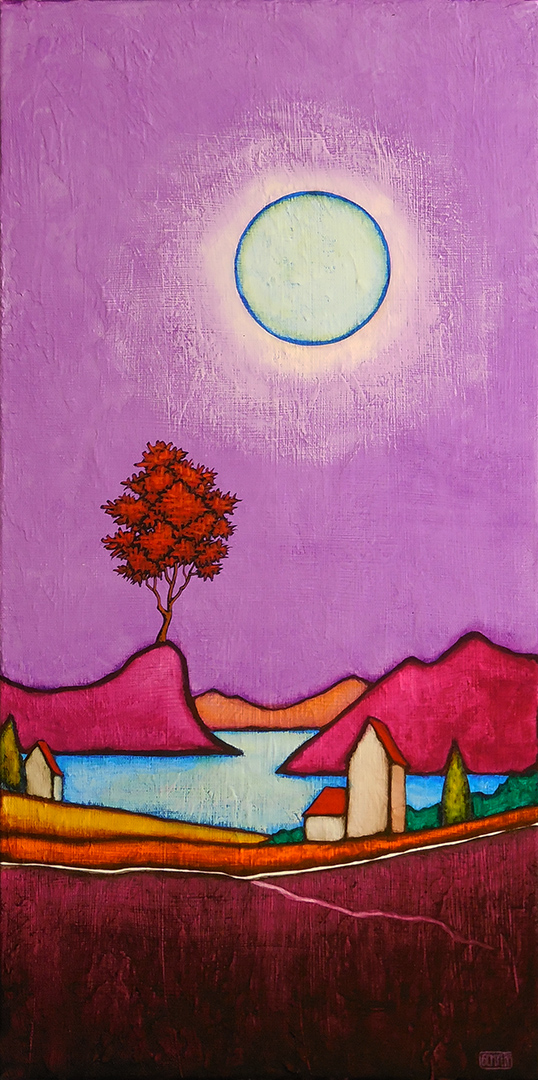
Mother’s Day, 1994


Art is the child of nature in whom we trace the features of the mothers face.

― Henry Wadsworth Longfellow


 I realize that Longfellow was referring to Art being the child of Mother Nature, that nature is written in the DNA of all art.  For myself, I also read it as being about the influence of artists’ mothers on their art. That’s probably not anywhere near Longfellow’s original intent but it works for my mother and my art. I know that my mom played a role in me becoming an artist if only for the fact that she never discouraged me from following any particular path and always gave all the encouragement she could.

This year marks 30 years since my mom passed away. Though 30 Mother’s Days have come and gone without her, it seems like it was just a year or so back in time. I wish she had lived long enough to see that things worked out okay for me and my work. There was certainly no indication that it would when she was alive.

She never saw my paintings hanging in a gallery or museum nor would she know that I would end up making art as my livelihood. She only saw my earliest work in its formative state, like the piece at the top that I gave to her on Mother’s Day in 1994, nearly a year before I began showing my work publicly. It now hangs in my studio to remind me of her.

Looking around the studio at the work assembled for my show in June, I think she would be very happy with it. I am not saying she would love the work itself. I can never really know that. But she would love the fact that I did it and that there were people out there who enjoyed it and found something in it for themselves. I know that this would be enough, that it would be a source of great pride for her.

And that makes me happy.

Maybe that’s what Longfellow was referring to with his words.

I don’t know. Just going to take some time today to remember my mom, though a day seldom goes by without some trace of her coming through to me, somewhat echoing Longfellow’s words.

I am grateful to have those memories of her. Like the song says: they can’t take those away from me.

For this Mother’s Day Sunday musical selection, here’s a recording of that classic George and Ira Gershwin tune done by Billie Holiday at a later stage of her career, in 1957. I love this performance with Ben Webster on sax and Barney Kessel on guitar. Here’s They Can’t Take That Away From Me.

This is a reworked post from 2021. Happy Mother’s Day.


The Calming Flow

The Calming Flow— Coming to Principle Gallery, June 2025


In my youth the heart of dawn was in my heart, and the songs of April were in my ears.
But my soul was sad unto death, and I knew not why. Even unto this day I know not why I was sad.
But now, though I am with eventide, my heart is still veiling dawn,
And though I am with autumn, my ears still echo the songs of spring.
But my sadness has turned into awe, and I stand in the presence of life and life’s daily miracles.

Youth and Age, Kahlil Gibran (1926)


I recently came across the opening portion above from the poem Youth and Age from poet/philosopher Kahlil Gibran (1883 –1931) and felt that it spoke deeply to both what I have been feeling in my recent work and in my own life. I suppose that makes sense since my work very much reflects the experience and feeling of my life. I 

I think that anyone who is into the autumn or winter of their life can identify with the message of these lines. The face in the mirror shows the wear of the years and the body often aches and groans but the heart and spirit still feel youthful. As Gibran puts it, my ears still echo the songs of spring.

But it is a youthfulness that comes with much more understanding and acceptance than when one was actually the age felt. I think this is put best in a passage from later in this poem:

And in my youth I would gaze upon the sun of the day and the stars of the night, saying in my secret, “How small am I, and how small a circle my dream makes.”
But today when I stand before the sun or the stars I cry, “The sun is close to me, and the stars are upon me;” for all the distances of my youth have turned into the nearness of age;
And the great aloneness which knows not what is far and what is near, nor what is small nor great, has turned into a vision that weighs not nor does it measure.

The extremes of smallness and largeness of self that one sometimes felt in their youth has mellowed with the knowledge that while we are but small and seemingly insignificant bits of whatever you want to call this swirling, chaotic mass that is our existence and the universe, we occupy a place in it.

Born of a singularity, we are of it. 

And with that knowledge, as Gibran puts it so well, my sadness has turned into awe, and I stand in the presence of life and life’s daily miracles.

I think this thought is an apt description for what I see in this new painting, The Calming Flow, an 18″ by 18″ canvas that is part of my upcoming solo exhibit, Entanglement, at the Principle Gallery. I recognize that same sense of acceptance and realization that I read in Gibran’s verse. It is one of the calmness and patience that comes with age for some.

The complete poem Youth and Age is below.


Entanglement opens Friday, June 13 at the Principle Gallery with an Opening Reception from 6-8:30 PM. I will also be giving a Painting Demonstration at the gallery on the following day, Saturday, June 14, from 11 AM until 1 PM.


In my youth the heart of dawn was in my heart, and the songs of April were in my ears.
But my soul was sad unto death, and I knew not why. Even unto this day I know not why I was sad.
But now, though I am with eventide, my heart is still veiling dawn,
And though I am with autumn, my ears still echo the songs of spring.
But my sadness has turned into awe, and I stand in the presence of life and life’s daily miracles.
The difference between my youth which was my spring, and these forty years, and they are my autumn, is the very difference that exists between flower and fruit.
A flower is forever swayed with the wind and knows not why and wherefore.
But the fruit overladen with the honey of summer, knows that it is one of life’s home-comings, as a poet when his song is sung knows sweet content,
Though life has been bitter upon his lips.
In my youth I longed for the unknown, and for the unknown I am still longing.
But in the days of my youth longing embraced necessity that knows naught of patience.
Today I long not less, but my longing is friendly with patience, and even waiting.
And I know that all this desire that moves within me is one of those laws that turns universes around one another in quiet ecstasy, in swift passion which your eyes deem stillness, and your mind a mystery.
And in my youth I loved beauty and abhorred ugliness, for beauty was to me a world separated from all other worlds.
But now that the gracious years have lifted the veil of picking-and-choosing from over my eyes, I know that all I have deemed ugly in what I see and hear, is but a blinder upon my eyes, and wool in my ears;
And that our senses, like our neighbors, hate what they do not understand.
And in my youth I loved the fragrance of flowers and their color.
Now I know that their thorns are their innocent protection, and if it were not for that innocence they would disappear forevermore.
And in my youth, of all seasons I hated winter, for I said in my aloneness, “Winter is a thief who robs the earth of her sun-woven garment, and suffers her to stand naked in the wind.”
But now I know that in winter there is re-birth and renewal, and that the wind tears the old raiment to cloak her with a new raiment woven by the spring.
And in my youth I would gaze upon the sun of the day and the stars of the night, saying in my secret, “How small am I, and how small a circle my dream makes.”
But today when I stand before the sun or the stars I cry, “The sun is close to me, and the stars are upon me;” for all the distances of my youth have turned into the nearness of age;
And the great aloneness which knows not what is far and what is near, nor what is small nor great, has turned into a vision that weighs not nor does it measure.
In my youth I was but the slave of the high tide and the ebb tide of the sea, and the prisoner of half moons and full moons.
Today I stand at this shore and I rise not nor do I go down.
Even my roots once every twenty-eight days would seek the heart of the earth.
And on the twenty-ninth day they would rise toward the throne of the sky.
And on that very day the rivers in my veins would stop for a moment, and then would run again to the sea.
Yes, in my youth I was a thing, sad and yielding, and all the seasons played with me and laughed in their hearts.
And life took a fancy to me and kissed my young lips, and slapped my cheeks.
Today I play with the seasons. And I steal a kiss from life’s lips ere she kisses my lips.
And I even hold her hands playfully that she may not strike my cheek.
In my youth I was sad indeed, and all things seemed dark and distant.
Today, all is radiant and near, and for this I would live my youth and the pain of my youth, again and yet again.

–Youth and Age, Kahlil Gibran 


The Happy Donor— Rene Magritte


I conceive of the art of painting as the science of juxtaposing colours in such a way that their actual appearance disappears and lets a poetic image emerge. . . . There are no “subjects”, no “themes” in my painting. It is a matter of imagining images whose poetry restores to what is known that which is absolutely unknown and unknowable.

–Rene Magritte, 1967, In a letter two months prior to his death


I am getting ready for my annual solo exhibit at the Principle Gallery. This year’s edition, Entanglement, my 26th such show at the Alexandria, VA gallery, opens five weeks from today on Friday, June 13th. I will also be doing a Painting Demonstration at the gallery the following Saturday, June 14, from 11AM until 1 PM. There is still a ton of work to be done so I am simply sharing a reworked post from several years back.


The quote above from Belgian Surrealist Rene Magritte reminds me of an instance where I didn’t fully get across what I was trying to communicate in response to a question while speaking to a group. It occurred at a demonstration and talk I gave before a regional arts group consisting of enthusiastic painters, some amateurs and some professional.

While I was working, a question was brought up about the importance of subject. Magritte elegantly stated in his words what I was trying to say that evening, that the purpose of what I was doing was not in the actual portrayal of the object of the painting but in the way it was expressed through color and form and contrast. To me, the subject was not important except as a vehicle for carrying emotion.

Of course, I didn’t state it with any kind of coherence or clarity. Hearing me say that the subject wasn’t important visibly angered the man who was an art teacher and an accomplished lifelong painter of realistic landscapes. He said that the subject was most important in forming your painting. I fumbled around for a bit and don’t think I ever satisfied his question or got across a bit of what I was attempting to say.

I think he was still mad when he left which still bothers me because he was right, of course. Subject is certainly important. It is the artist’s relationship that with the subject and the emotional response it elicits that allows the artist to create this poetry of the unknown, as Magritte may have put it.

While I am not interested in depicting landscapes of specific areas, I am moved by the rolls of hills and fields and the stately personae of trees that populate my work. I believe it comes through in my painting. Yes, I can capture emotion in things that may not have any emotional attachment to me through the way I am painting them, which was part of what I was saying to that man that evening, but it will never be as fully realized as those pieces which consist of things and places in which I maintain a personal relationship. It is always easier to find the poetry of the unknown in those things which we know.

But there is a caveat: The subject is often not the tree or the landscape, as much as it may seem the case. Often, it is the vague poetry made from that tree, the sky, the landscape, or whatever is chosen to paint along with things not visibly apparent that makes up the atmosphere of the painting.

That poetry is the real subject of a painting. 

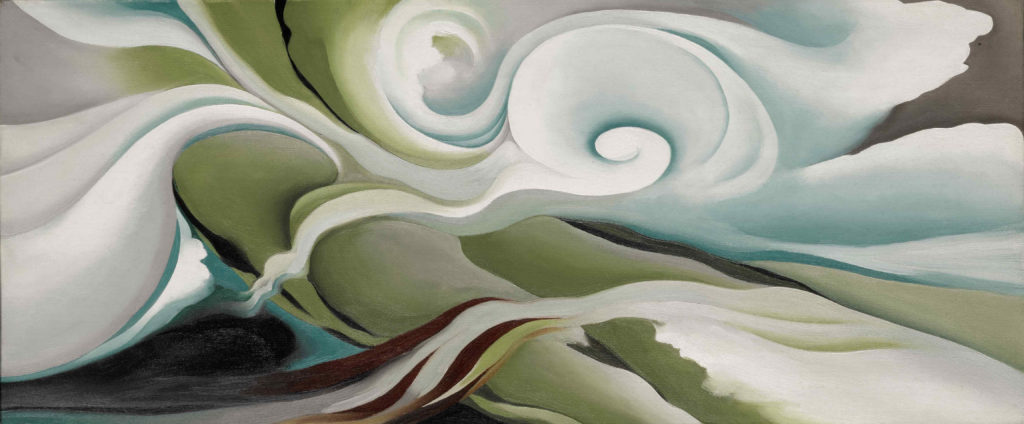
Nature Forms

Georgia O’Keeffe- Nature Forms, 1932


I found things I could say with color and shapes that I couldn’t say in any other way… things I had no words for.

–Georgia O’Keeffe


I was really struggling to write this morning. Words just weren’t coming and the more time that passed, the more began to rush. And rushing is never a good thing when writing. Or painting. Or doing much of anything that involves creativity and thought.

In the end, I fell back on a favorite Georgia O’Keeffe painting and quote. The painting reminds me of the forms and rhythms I am trying to capture in my current work– the work I couldn’t write about this morning– and the quote pretty much sums up my feelings about what I do, which explains my inability to write on the subject this morning.

I am also sharing a favorite song from the Yardbirds that accompanied this O’Keeffe painting and quote here a few years back. Featuring fine guitar work from Jeff Beck, this is Shapes of Things from 1966. It sort of fits the theme here. And even if it doesn’t, it’s still a great song.


Trip the Light Fantastic— Coming to Principle Gallery, June 2025


Come, and trip it as ye go
On the light fantastick toe…

–John Milton, L’Allegro, (1645)


Trip the light fantastic. From Milton’s 1645 poem, it originally meant to dance nimbly. But for some reason, perhaps its phrasing or the derivations of the term over the centuries, it’s a term that summons up all sorts of images in my mind. But for the purpose of the new painting shown here, nimbly dancing might well fit as a description.

Using the phrase as its title definitely came to mind as the painting took on its final form. With the lively, rhythmic spirals and bright undercolor in the sky along with the rolling undulations of the sea, there is a feeling of a dance of sorts in piece for me. Of movement and countermovement, of rhythm matching rhythm and the joy that comes when that movement seemingly becomes effortless.

As though the two rhythms have become one.

As you may know, I am not a sailor. So, I can only imagine that there are those magical moments when the sea, the winds, and the sailor feel as one. I would imagine that would be an exhilarating feeling of unbridled joy and freedom.

That’s what I see in this piece. I feel lightened and brightened by it. But that’s just me…

This painting, Trip the Light Fantastic, is 15″ by 30″ on canvas and is from my annual solo exhibit at the Principle Gallery in Alexandria, VA. This year’s exhibit, my 26th there, is titled Entanglement and opens on Friday, June 13. Much of the work in this year’s show deals thematically with the bands and tangles of energy that make up everything, including us in our human form.

Much of it entails representing that energy in the sky of these pieces in a variety of ways– as twisting knot-like ribbons without beginning or end or cacophonous bands that interweave over and under one another. There are also some, such as this painting, that employ colorful rhythmic spirals.

It all makes for a striking look in each piece, one that make me really stop and consider each. The skies are often the central figures in this work, as much as the boat or the Red Tree or the house, and it’s hard to not dwell on finding some sort of meaning in them. There’s an almost meditative, therapeutic feel in many of these pieces for myself, both in the painting and the viewing.

Does that translate to other viewers? I don’t know. And maybe that doesn’t matter in the long run. It felt like I didn’t have any choice but to paint these pieces.  In some weird way, they demanded to be painted at this point in time.

Maybe I needed them for some reason. Some purpose.

I haven’t figured out the why of this. I only have the what at this point. And maybe, like so many things, I will never get the answer I seek. Maybe I am supposed to only ask the question.

If that’s the case, so be it. I am satisfied in continuing my search without answers if every so often I get to trip the light fantastic…


Time/Breathe

As In a Dream— At West End Gallery


Humans are amphibians — half spirit and half animal…. As spirits they belong to the eternal world, but as animals they inhabit time. This means that while their spirit can be directed to an eternal object, their bodies, passions, and imaginations are in continual change, for to be in time means to change. Their nearest approach to constancy, therefore, is undulation—the repeated return to a level from which they repeatedly fall back, a series of troughs and peaks. 

–C. S. Lewis, The Screwtape Letters (1942)


Taken from C.S. Lewis‘s satirical novel, these are the words in a letter from a senior Devil, Screwtape, to his nephew, Wormwood, who is a not yet fully a Devil, only a Tempter. I like its description of humans as amphibian creatures who attempt to exist in both the world of the timeless spirit and of the timebound physical world, with their only consistent trait being that are constantly changing.

I kind of see things in the same way. I don’t know if that would have made me a Devil in Lewis’ eyes. Doesn’t really matter, I guess.

Anyway, I am still on break but felt that I still had to share a piece of Sunday Morning Music. It’s become so ingrained and obligatory that it would nag at me if I didn’t at least make this small effort. So, without further ado, here’s a bluegrass take on Pink Floyd‘s classic Time with a short foray into their Breathe Reprise at the end. This is from the Kalamazoo, Michigan-based Greensky Bluegrass. a modern bluegrass group that feels more Phish-y than Bill Monroe. I like their treatment of this song and I very much like their name. Sounds like a title for one of my paintings. Maybe it will be someday. Who knows?

Now, have to run– time is short for this amphibian….


Gaining Understanding— Coming to Principle Gallery, June 2025


“Accustom yourself every morning to look for a moment at the sky and suddenly you will be aware of the air around you, the scent of morning freshness that is bestowed on you between sleep and labor. You will find every day that the gable of every house has its own particular look, its own special lighting. Pay it some heed…you will have for the rest of the day a remnant of satisfaction and a touch of coexistence with nature. Gradually and without effort the eye trains itself to transmit many small delights.”

–Hermann Hesse, My Belief: Essays on Life and Art


I am going to take a short break from the blog to try to catch up on painting and other preparation for my June solo show, Entanglement, at the Principle Gallery. I feel like I am behind schedule but can’t tell if that is reality or just a feeling, maybe a by-product of pre-show anxiety. I just get the sense at the moment that I at least need to feel like I am caught up.

I didn’t want to leave without sharing a new painting from the Principle Gallery show. The piece at the top is one of the smaller paintings, 10″ by 10″ on wood panel, from the exhibit. I call it Gaining Understanding.

I thought the passage above, especially that first sentence, from Hermann Hesse was appropriate for this painting. It also pretty much describes my early morning walk through the woods to the studio, usually in darkness. So often I stop along the way and look through the trees at the sky. The bracing coolness of the forest air on my skin, which is still warm from sleep, is refreshing.

I find that I feel closer to some kind understanding on those days when I start them in this way. I feel sharper, more in tune with something beyond me. It has a calming effect that seems to slow time a bit.

This small painting reflects that feeling for me.

I’m going to leave it at that before taking this short break. Well, I’ll throw in a song as well. This is If I Could Only Fly from the late Blaze Foley. He’s probably not on your radar, unless you’re in Texas or have followed Outlaw Country or Americana music for a long time. Foley died in a shooting in 1989 at the age of 40, never really achieving wider notoriety. But his music lives on, providing a rich legacy, as do the many quirky stories of his life. As the late Townes Van Zandt said of Foley, “He’s only gone crazy once. Decided to stay.” The writing in this song and his enunciation reminds me greatly of the late John Prine which makes sense as Prine recorded Foley’s song Clay Pigeons for a 2006 album.

I’ll be back soon. Thanks!


Silent Eye of Night- At West End Gallery

This is thy hour O Soul, thy free flight into the wordless,
Away from books, away from art, the day erased, the lesson done,
Thee fully forth emerging, silent, gazing, pondering the themes thou lovest best,
Night, sleep, death and the stars.

–Walt Whitman, A Clear Midnight


First day of May. Suddenly the deadline for getting the work ready for my June show at the Principle Gallery seems so much closer than it did just yesterday. It was only April then and the June show seemed months off. A distant dot on the horizon. I know it’s just a matter of perception, but time feels as though it constricted greatly in the last 24 hours.

The once distant dot has transformed into a growing knot in my gut.

Of course, as I have noted here in the past, this is all expected. I’ve been through this many, many times before with my solo shows. This feeling comes with every show, without fail.

So, after nearly 70 solo shows, it doesn’t approach as a stranger to me.

What that translates to is that I am shortening my time on this blog this morning and heading right to work. I am already feeling late. In lieu of any semblance of original thinking this morning I am sharing a triad of a bit of verse from Uncle Walt, a painting of mine now at the West End Gallery, and a 1966 version from Marvin Gaye of a song written by Willie Nelson in the late 1950’s, Night Life.

Do what you will with it all– I have to go now.


The Wisdom Beyond Words– Coming to Principle Gallery, June 2025


There is in all visible things an invisible fecundity, a dimmed light, a meek namelessness, a hidden wholeness. This mysterious Unity and Integrity is Wisdom, the Mother of all, Natura naturans. There is in all things an inexhaustible sweetness and purity, a silence that is a fount of action and joy. It rises up in wordless gentleness and flows out to me from the unseen roots of all created being, welcoming me tenderly, saluting me with indescribable humility. This is at once my own being, my own nature, and the Gift of my Creator’s Thought and Art within me, speaking as Hagia Sophia, speaking as my sister, Wisdom.

— Thomas Merton, Hagia Sophia (1961)


I was looking for something to accompany the new painting shown here, The Wisdom Beyond Words, and came across this passage from Thomas Merton. It’s the opening section of his prose poem Hagia Sophia written sometime around 1961.  Though it speaks through the dogma of Catholicism, it matches very well the belief system I somewhat laid out here a week or so back. As it often is with most religions, the underlying structure and belief is very much the same idea but with symbols, stories, and representations that reflect cultural differences. 

In short, this passage captured in words what I see and sense in this painting. It could very well be used to describe the theme of my Entanglement exhibit that opens June 13 at the Principle Gallery, which I have described as being how everything is contained in small part in every other thing. Much as it is in the theory put forward by Stephen Hawking that when a star dies it collapses into itself until it is finally a single tiny point of zero radius, infinite density, and infinite curvature of spacetime at the heart of the black hole formed from the star’s collapse. A single point of immense mass and energy This was referred to as a Singularity

Hawking looked at this singularity and wondered since this was the end point of star’s death could it not also be the starting point for future new universes that might emerge if this singularity were to explode outward– the Big Bang Theory.

The underlying thought is that the universe and all that it is was once a single thing before the Big Bang created all that we know the universe to be now from that single point.

We were all part of one thing. We were that one thing.

And it’s that unity and wisdom of all things, much like that of which Merton wrote, that I sense in this painting.