No one lights a lamp in order to hide it behind the door: the purpose of light is to create more light, to open people’s eyes, to reveal the marvels around.
-Paolo Coelho, The Witch of Portobello
Shine your light somewhere, somehow.
That’s all I have to say this morning. Trying to light my own lamp this morning.
Here’s a fitting tune from the Rolling Stones‘ classic 1972 album, Exile on Main Street. This is Shine a Light.
Summertime, and the livin’ is easy Fish are jumpin’ and the cotton is high Oh, your daddy’s rich and your ma is good-lookin’ So hush, little baby, don’t you cry
One of these mornings you’re gonna rise up singing And you’ll spread your wings and you’ll take to the sky But till that morning there ain’t nothin’ can harm you With daddy and mammy standin’ by
–Summertime, from Porgy and Bess, Dubose Heyward, George & Ira Gershwin (1934)
I am not so sure about the livin’ is easy part of summertime. Summer has often felt more like steel cage death match for me. Or a grim and gritty fever dream. You might ascertain that it is not my favorite season by a long stretch.
But that doesn’t take anything away from my appreciation of the great aria from Porgy and Bess. Like so many great songs, it’s melody and lyrics are so beautifully composed that it’s hard to find a performance that doesn’t resonate. There have been many, many great versions of this classic and there’s hardly a lemon among them. The Ella Fitzgerald version is perhaps the gold standard though that might be debatable. I am sharing a live performance by Janis Joplin from 1969 in Amsterdam. I probably like this version because it has the grit and tone of my summers.
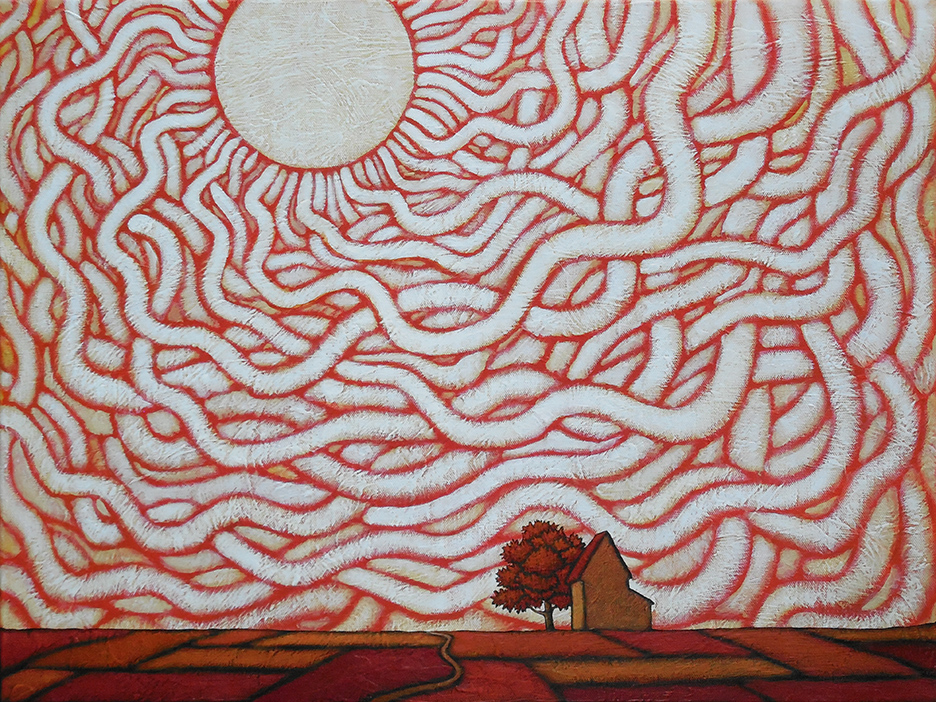
The image at the top is a small triptych from 2002 that hangs in my studio. It has long been a favorite and still gives me a rush when I look up at it, like I did just this moment. I see it as a link between my earliest work of the mid and late 1990’s that focused on sparsely detailed blocks of color and the subsequent work.
We have five senses in which we glory and which we recognize and celebrate, senses that constitute the sensible world for us. But there are other senses – secret senses, sixth senses, if you will – equally vital, but unrecognized, and unlauded… unconscious, automatic.
–Oliver Sacks, The Man Who Mistook His Wife for a Hat
Maybe that’s the purpose of art, to prompt us to some sort of sixth sense, one that otherwise goes unnoticed and underutilized in our usual five-sense lives. It is something that we don’t even know that we have been needing and missing until we are awakened to it.
This sixth sense enables us to detect the many dimensions which exist between and beyond that which we observe with our five senses, adding depth and richness to our sense-limited world.
And art does just that, serving as the activating agent for this sixth sense and beyond that, acting as the connecting link between the known and the unknown. I believe that is what is taking place when one is moved by art in any form.
It transports you into dimensions beyond the five senses.
And that’s where the good stuff is…
Here’s a song this morning about one type of sixth sense from Irish singer/songwriter Imelda May. With a style that covers many genres of music including jazz and rockabilly, she wasn’t on my radar until just a couple of years ago. I stumbled across a video of Robert Plant and her performing a rockabilly-Big Band rave-up of Led Zep‘s Rock and Roll that I very much enjoyed. I’ll throw that on below as well.
‘Cause I have all of life’s treasures and they’re fine and they’re good They remind me that houses are just made of wood What makes a house grand, oh, it ain’t the roof or the doors If there’s love in a house, it’s a palace for sure But without love it ain’t nothin’ but a house A house where nobody lives
–Tom Waits, The House Where Nobody Lives (1999)
It feels like America in the year 2025– a house without love or joy. Or happiness. Or grace, vision, or humor.
Any of those things that make a house feel lived in.
Those things that make a house a palace of love.
We instead build endless chain-link cages to fill with our hatred and bigotry.
That’s all I will say this morning.
You might not agree. Fine.
Just calling ’em like I see ’em, as the ump behind the plate would say. Just hoping your individual houses are filled with love and laughter.
Here’s the Tom Waits song that made me think this with the full lyrics below.
There’s a house on my block that’s abandoned and cold The folks moved out of it a long time ago And they took all their things and they never came back It looks like it’s haunted with the windows all cracked Everyone calls it the house The house where nobody lives
Once it held laughter Once it held dreams, did they throw it away, did they know what it means? Did someone’s heart break Or did someone do somebody wrong?
Well, the paint is all cracked, it was peeled off of the wood The papers were stacked on the porch where I stood And the weeds had grown up just as high as the door There were birds in the chimney and an old chest of drawers Looks like no one will ever come back To the house where nobody lives
Oh, and once it held laughter Once it held dreams, did they throw it away, did they know what it means? Did someone’s heart break Or did someone do somebody wrong?
So if you find someone Someone to have, someone to hold, don’t trade it for silver Oh, don’t trade it for gold ‘Cause I have all of life’s treasures and they’re fine and they’re good They remind me that houses are just made of wood What makes a house grand, oh, it ain’t the roof or the doors If there’s love in a house, it’s a palace for sure But without love it ain’t nothin’ but a house A house where nobody lives But without love It ain’t nothin’ but a house, a house where nobody lives
The force that through the green fuse drives the flower Drives my green age; that blasts the roots of trees Is my destroyer. And I am dumb to tell the crooked rose My youth is bent by the same wintry fever.
The force that drives the water through the rocks Drives my red blood; that dries the mouthing streams Turns mine to wax. And I am dumb to mouth unto my veins How at the mountain spring the same mouth sucks.
The hand that whirls the water in the pool Stirs the quicksand; that ropes the blowing wind Hauls my shroud sail. And I am dumb to tell the hanging man How of my clay is made the hangman’s lime.
The lips of time leech to the fountain head; Love drips and gathers, but the fallen blood Shall calm her sores. And I am dumb to tell a weather’s wind How time has ticked a heaven round the stars.
And I am dumb to tell the lover’s tomb How at my sheet goes the same crooked worm.
–Dylan Thomas (1933)
This is considered the poem that more or less brought Dylan Thomas to fame as a poet. I read it again recently and was surprised at how well it aligns with the theme of my show, Entanglement, at the Principle Gallery. It basically describes how our timed existence here on this world is simply part of the timeless driving force of the universe. How that in this place made of time, the very force allowed us for our short stay here, the life force that energizes us, ultimately destroys then leaves us to regather with its timeless source.
Not sure that it is something that is easily explained and I am not sure if I was able to adequately convey that message with this show. But since the show ends today, I felt it was worth sharing this morning along with a splendid reading from Thomas’ fellow Welshman Richard Burton. And for good measure, I added a favorite song from a favorite guitarist, Martin Simpson. Last shared here a couple of years back, it’s titled She Slips Away, and was written about the death of his mother, as she moved from time to timelessness.
As does my Entanglementshow which ends today. So, if you want to see it, today is your last opportunity to see it in its entirety before it moves into the realm of the timeless.
Where rose the mountains, there to him were friends; Where rolled the ocean, thereon was his home; Where a blue sky, and glowing clime, extends, He had the passion and the power to roam.
–Lord Byron, Childe Harold’s Pilgrimage
Still a little out of it this morning. For some reason I felt like hearing some Mary Chapin Carpenter. I listened to her music quite a bit back in the 90’s but for some unknown reason it faded from my listening rotation. But every now and then, a song of hers will pop up and I am reminded of what it was in her music that I found so appealing. It’s the same now. She has a beautifully warm and personal style that I find comforting.
Don’t know if the triad of word, image, and song is perfect this morning. But it works for my aching head and that will have to be good enough.
Here’s Mary Chapin Carpenter with her Rhythm of the Blues.
PS-Today and tomorrow are the last days to see my Entanglementshow at the Principle Gallery.
If you take Greece apart, in the end you will see remaining to you an olive tree, a vineyard and a ship. Which means: with just so much you can put her back together.
–-Odysseus Elytis, The Little Seafarer (1988)
Still feeling way under the weather. It’s lingered for the past 10 or 11 days and I thought it was passing a few days ago. However, it came back with a vengeance yesterday and this morning. Even so, I feel obligated to remind you that my show, Entanglement,will only be hanging for three more days at the Principle Gallery.
I also realized that I had not yet shared the painting shown above, Headed Home. For me, it represents Odysseus’ epic journey and return to Ithaca. I thought a passage from Greek writer, Odysseus Elytis, who won the 1979 Nobel Prize for Literature, was therefore appropriate. It speaks to the resiliency of people to bounce back from great loss. We need to be reminded of that.
Here’s a slideshow from the Entanglementexhibit. which closes after July 7.
States and Nations don’t exist as such. There are only people. Sets of people living in certain areas, having certain allegiances. Nations won’t change their national policies unless and until people change their private policies. All governments, even Hitler’s, even Stalin’s, even Mussolini’s, are representative. To-day’s national behaviour — large-scale projection of today’s individual behaviour. Or rather, to be more accurate, a large-scale projection of the individual’s secret wishes and intentions. For we should all like to behave a good deal worse than our conscience and respect for public opinion allow. One of the great attractions of patriotism — it fulfils our worst wishes. In the person of our nation we are able, vicariously, to bully and cheat. Bully and cheat, what ’s more, with a feeling that we ’re profoundly virtuous. Sweet and decorous to murder, lie, torture for the sake of the fatherland.
–Aldous Huxley, The Diary of Anthony Beavis / Eyeless in Gaza (1936)
Fourth of July 2025.
There you go– that’s my acknowledgement of the day. No parade. No blindly patriotic songs playing. No fireworks. No flag waving.
The flags above are from a big box of old damaged and dirty flags I have picked up at our local cemetery over the decades. I have hundreds of these old cheap flags. I don’t know why but I do. I think they say more than the grandest giant flag billowing over a car dealership or in some saccharine AI photo with purple mountains majesty above the fruited plain.
Maybe that’s just me.
Okay. I am getting out of here quickly today before I say something I might regret. Here’s a song that I think says more about this country than the most chest pounding, flag waving, patriotic nonsense. It is about the hope that we maintain for a better life as well about the way that hopes are quashed. It is both sad and gloriously hopeful. What can be more American than that? This Tracy Chapman and her Fast Carfor this fourth of july.
I knew that I had ample room in which to wander, since science has calculated the diameter of space to be eighty-four thousand million light years, which, when one reflects that light travels at the rate of one hundred eighty-six thousand miles a second, should satisfy the wanderlust of the most inveterate roamer.
–Edgar Rice Burroughs, Pirates of Venus (1932)
Still feeling a bit off kilter and definitely not feeling celebratory in any way for the Fourth of July tomorrow. In fact, I am a little crotchety this morning. Writing that makes me wonder about the origins of the word crotchety. One of the numerous benefits of the instant information of the InterWebs– we won’t go into its equally numerous pitfalls — is that one can answer questions like this within seconds. No more finding and dragging out the dictionary or encyclopedia or whatever reference book you have stacked on your shelves. I accumulated a bunch of compendiums of knowledge, both general and odd facts, over the years that sometimes answered such queries. Not always which meant writing it on a list to be looked up the next time I went to the library. Information moved much slower then and usually by the time I got an answer I had lost interest.
FYI, crotchety is derived from the word crochet which refers to the craft and hook used in it. The term came to represent someone who was hooked by peculiar thoughts, resulting in a brusque, rude attitude towards others.
Yeah, I fall into that category this morning. Crotchety old man shaking my fist at the sky.
Anyway, the theme today is wanderlust. Maybe by the description of searching for info that should be changed to wonderlust. Is that even a word? I guess I will have to take to the InterWebs once more.
While I am doing that, here’s a tune called Wanderlust from the immortal Duke Ellington and sax legend Coleman Hawkins. This came up on my playlist earlier setting this whole fiasco in motion.
Now, either listen or get out. I got things to do. Like I said, I am crotchety this morning and wonderlust calls…
Pity the nation whose people are sheep And whose shepherds mislead them
Pity the nation whose leaders are liars Whose sages are silenced And whose bigots haunt the airwaves
Pity the nation that raises not its voice Except to praise conquerors And acclaim the bully as hero And aims to rule the world By force and by torture
Pity the nation that knows No other language but its own And no other culture but its own
Pity the nation whose breath is money And sleeps the sleep of the too well fed
Pity the nation oh pity the people who allow their rights to erode and their freedoms to be washed away
My country, tears of thee
Sweet land of liberty!
–Pity the Nation, Lawrence Ferlinghetti (after Khalil Gibran) 2007
I leave this here today without image, comment, or music, except to point out that Ferlinghetti took inspiration in 2007 from the Kahlil Gibran poem of the same title, published posthumously after his death in 1931. Both poems clearly speak to their own times as well as this present moment. Here is the Gibran poem:
Pity the nation that is full of beliefs and empty of religion. Pity the nation that wears a cloth it does not weave and eats a bread it does not harvest.
Pity the nation that acclaims the bully as hero, and that deems the glittering conqueror bountiful.
Pity a nation that despises a passion in its dream, yet submits in its awakening.
Pity the nation that raises not its voice save when it walks in a funeral, boasts not except among its ruins, and will rebel not save when its neck is laid between the sword and the block.
Pity the nation whose statesman is a fox, whose philosopher is a juggler, and whose art is the art of patching and mimicking
Pity the nation that welcomes its new ruler with trumpeting, and farewells him with hooting, only to welcome another with trumpeting again.
Pity the nation whose sages are dumb with years and whose strongmen are yet in the cradle.
Pity the nation divided into fragments, each fragment deeming itself a nation.
–Kahlil Gibran, from The Garden of The Prophet (1933)




 Redtree Times