Feeds:
Posts
Comments

Toward Serenity


In Eminence— At Principle Gallery

The sole art that suits me is that which, rising from unrest, tends toward serenity.

–André Gide, journal entry, November 23, 1940


The journal entry above from Nobel Prize-winning author André Gide very much speaks to me. Though it serves many purposes for me, I tend to view my work as a means of absorbing and acknowledging the anxieties and pressures that this world often presses upon us, dampening their effects, and then moving, to use Gide’s term, toward serenity.

The darker aspects of the world are still there, an underlying presence that creates a contrasting tension, a counterpoint that serves as a starting point from which serenity and other aspects of light can build.

I am talking about the emotional tone of the work here, but it also roughly describes my actual painting process. Much of my work starts with a dark surface on which light and brightness is built.

Even my work with transparent inks that is more watercolor-ish in nature employs a process where a darker layer of ink is first applied. almost as a dark puddle on a light– usually white and prepped with layers of gesso– surface. This layer, this puddle of ink, is then little by little removed, each deduction revealing more and more light from the underlying surface.

From darkness comes light…

Let’s have a tune this morning. The song is I See a Darkness. It’s one I have played a couple of times over the years, once by Will Oldham (aka Bonnie “Prince” Billy) who wrote and originally recorded it and the other as covered by Johnny Cash, from the American Recordings period late in his life. His work from this time, when his scarred voice carried his age and emotion so eloquently, is potent stuff.

Light coming from darkness…

 I think this part of its chorus fittingly applies to today’s post and to life in general:

Oh, no, I see a darkness.
Did you know how much I love you?
Is a hope that somehow you,
Can save me from this darkness.


A Matter of Perspective— At the West End Gallery


The Moment

The moment when, after many years
of hard work and a long voyage
you stand in the centre of your room,
house, half-acre, square mile, island, country,
knowing at last how you got there,
and say, I own this,

is the same moment when the trees unloose
their soft arms from around you,
the birds take back their language,
the cliffs fissure and collapse,
the air moves back from you like a wave
and you can’t breathe.

No, they whisper. You own nothing.
You were a visitor, time after time
climbing the hill, planting the flag, proclaiming.
We never belonged to you.
You never found us.
It was always the other way round.

–Margaret Atwood


It’s hard to watch the Billionaire Boys Club pillaging day after day, discarding people at will while staking claims and planting their flags on everything in sight. Brazenly displaying the power of their ownership.

I take some solace in putting things into perspective.

For example, the top of Mount Everest is comprised of limestone, sedimentary rock that contains marine fossils. It was formed more than 450 million years ago, during the Ordovician period, at the bottom of a large body of water before shifting tectonic plates and volcanic forces pushed it upward toward the sky, to the rooftop of the world. 

The land surface of the Earth is approximately 29% with the other 71% under water. Our knowledge of the Earth’s history is known primarily from limited examination over a very short period of time of a very small amount of the 29% that is currently above water. We know little, if anything, of what rests beneath the bottom of the other 71%. We know nothing of any other creatures or civilizations might have lived and prospered during their time on this Earth, before all evidence of their existence was plunged into the depths of the seas. 

I can’t say for sure, but it seems plausible that during those intervening 450 million years some being existed who dominated and ruled over the other beings in their region, claiming all the Earth that they could see and reach as their own. 

At the other end of the spectrum, the mayfly emerges from the water each year and lives for but a day. A mere 24 hours.

That lifespan seems ludicrously short and insignificant to us humans. But to the mayfly that timespan is all they will ever know, representing everything within their purpose. For that time period the world they know belongs to them.

Their ownership of their time and space is no different than our own. No less significant or insignificant than our own. When you compare the lifetime of the mayfly with that of the human within the Earth’s timeline, the difference between them is negligible. In the eyes of the Earth’s history, we are little different than the mere mayfly.

When our civilization is long gone and buried at the bottom of some future ocean, what importance will there be in the ownership and power possessed now? For that matter, in just a few years when age or violence has claimed the lives of the tyrants and oligarchs who revel in their power now, what good will the hoarded wealth, be to them?

The real estate and all the things on this Earth they claimed as their own never really belonged to them. As the poem says in its final verse:

No, they whisper. You own nothing.
You were a visitor, time after time
climbing the hill, planting the flag, proclaiming.
We never belonged to you.
You never found us.
It was always the other way round.

In the end we own nothing here. We are but momentary visitors on the great timeline of this Earth.

You might ask how that gives me solace? After all, isn’t it simply evidence of my own insignificance? 

Well, yes, it is.

It shows us to all be little more than mayflies. And when the mayfly’s 24 hours are up, does the life of one mayfly matter anymore than that of another?  

Just thinking out loud this morning. Take it for what it worth– the ramblings of a mayfly…

An Irish Trio

Paul Henry- The Fairy Thorn (1936)


I will arise and go now, and go to Innisfree,
And a small cabin build there, of clay and wattles made;
Nine bean rows will I have there, a hive for the honey bee,
And live alone in the bee-loud glade.

And I shall have some peace there, for peace comes dropping slow,
Dropping from the veils of the morning to where the cricket sings;
There midnight’s all a glimmer, and noon a purple glow,
And evening full of the linnet’s wings.

I will arise and go now, for always night and day
I hear lake water lapping with low sounds by the shore;
While I stand on the roadway, or on the pavements grey,
I hear it in the deep heart’s core.

William Butler Yeats, The Lake Isle of Innisfree (1888)


St. Patrick’s Day 2025.  No commentary today, just a simple triad of Irish imagery, song and verse.

The painting at the top is from Paul Henry, who spent his life painting his native Ireland from 1877 until his death in 1958. He was perhaps the best-known painter in Ireland through the first half of the 20th century though many of us here in the States may not recognize the name. I didn’t know his work until a decade or so ago, but had an affinity for it instantly, seeing a familiarity between his work and my own, in the stark manner in which the landscape and tree was portrayed.

Most of Henry’s landscapes were set in the west of Ireland, in the Connemara district, an area described by Oscar Wilde as “a savage beauty.”  For many, Henry’s landscapes represent the idealized image of the Irish countryside with simple white cottages set among stark, barren hills and rolling green fields. But his greens are not that bright Kelly green so often used in depicting Ireland. No, Henry often chose blue and brown tints in his work.  He used a very distinct and deceptively cool palette in his painting which enhances the earthy coolness and solitary nature of the landscapes.

The poem, The Lake Isle of Innisfree, is from the great W.B. Yeats and may well be the most famous piece of Irish verse. It has been set to music by numerous artists, referenced in film and television, and is even printed on the Irish passport. I find it’s transcendent tone captivating, a mood much like that which I try to find in my work.

For the song, I am going with Carrickfergus from the collaborative effort between the Chieftains and Van Morrison. This may be my favorite version of this folk tune that feels like it is much older than its actual age, coming as it does from the 1960’s. That old feel may come from the fact that musical scholars have deduced that its melody is a combination of two much older Celtic folk tunes.

Whatever the case, I think it is a lovely fit this morning with the words of Yeats and the painting from Henry.

And I shall have some peace there, for peace comes dropping slow…


Pretzel Logic


Too Many Moons — At Principle Gallery

Madness is a special form of the spirit and clings to all teachings and philosophies, but even more to daily life, since life itself is full of craziness and at bottom utterly illogical. Man strives toward reason only so that he can make rules for himself. Life itself has no rules. That is its mystery and its unknown law. What you call knowledge is an attempt to impose something comprehensible on life.

–Carl Jung, Liber Novus


An attempt to impose something comprehensible on life

That sounds like a pretty tall task, given the sheer lack of logic and reason it so often displays. It also sounds like the way artists and writers often describe what they are trying to find in their work– an understanding of what is and isn’t. A revealing of the possibility of that which we cannot see and a new perspective on that which we can.

And in doing so, make their own rules while discarding others. Whatever it takes to make sense of the insensible. Using the illogical to find some sort of logic.

That makes sense in a world that seldom moves in a straight line.

Where that takes us, I don’t know. As an artist– if that is what I am– following that twisting and turning line to some sort of end is the mystery and the thrill of it.

Pretzel logic.

And like a pretzel, following its line always brings us back to where we began. Do we know any more at that point?

Who knows?

Maybe that’s the whole point, to let us know that we can’t know what we can’t know. That we must embrace the mystery.

Sounds good. But, of course, that is the result of some pretzel logic.

Okay, that was a long way around the pretzel to get to this week’s Sunday Morning Music. Here is Steely Dan and Pretzel Logic.

But, of course, you knew that, right? Can’t fool you guys…


And the River Flows— At West End Gallery

Who looks upon a river in a meditative hour, and is not reminded of the flux of all things? Throw a stone into the stream, and the circles that propagate themselves are the beautiful type of all influence.

–Ralph Waldo Emerson, Nature (1836)


Looking for some meditative space this morning. Don’t want to write, to be honest. Some mornings it feels like the self-examination that is often requires is just too much. At such time, I find myself wanting to be standing somewhere watching the river flow, my mind emptied and the gentle unceasing rhythm of the water’s motion serving as a droning mantra. 

Then I am neither happy nor sad, nor fearful or unafraid. 

Just there in that moment. Captured in the flux of all things.

And the river flows on…

Here’s song that has, for me, the feeling of that river’s rhythm. This is The Way the Whole Thing Ends from a favorite of mine, Gillian Welch. I particularly like its chorus:

Standing in the backdoor cryingNow you’re gonna need a friendThat’s the way the cornbread crumblesThat’s the way the whole thing ends


Evercool— At Principle Gallery


Patience serves as a protection against wrongs as clothes do against cold. For if you put on more clothes as the cold increases, it will have no power to hurt you. So in like manner you must grow in patience when you meet with great wrongs, and they will then be powerless to vex your mind.

–Leonardo da Vinci, Leonardo da Vinci’s Note-Books (1906)


Believe me when I say that I try to follow this advice from Leonardo d Vinci.

That’s all I am going to say this morning. Like the painting above, I want to remain evercool in my patience.

Let me add this: It don’t come easy.

Here’s a tune from Ringo to reiterate that point.

Now get out of here before I lose my patience…


Too Much Empathy?

The Universal Symbol for Empathy


Resolve to be tender with the young, compassionate with the aged, sympathetic with the striving, and tolerant of the weak and the wrong. Sometime in life you will have been all of these.

― George Washington Carver


In recent weeks, the absolutely normal and not-strange-at-all Elon Musk has waxed poet on the subject of empathy. Or to be more accurate, how empathy should be avoided at all costs since, as he put it in a February interview, “The fundamental weakness of Western civilization is empathy.

He has also referred to those who rely on government programs in any way as the “Parasite Class.” You know, the Parasite Class— poor folks on Food Stamps, old folks in nursing homes, people who have lost everything they owned to natural disasters, retirees who depend on the Social Security to which they contributed for their entire lives, farmers who depend on subsidies, veterans who depend on the healthcare and other support they were promised, and so on.

Let’s not forget to include those corporations and those billionaires who greatly profit from huge government subsidies or have built their wealth by exploiting government funded research and development.

He may be right– there may be a parasite class. It’s just might not be the same one he’s pointing at. It’s exploitation for thee, but not for me.

I’ve written a number of times over the years about the declining level of empathy in this country. There was a University of Michigan study from 2009 that spanned thirty years which measured the empathy levels of 14,000 college students over that time frame. It concluded that there was a steep decline from 1979 to 2009 in the levels of empathy among the students surveyed. They surmised that the college student of 2009 was 40% less empathetic than those in 1979. I take the results of this study with a grain of salt since I can’t vouch for its validity, accuracy, or level of bias of its methodology. But even if it is off by a factor of 50%, the results are still troubling.

I thought I’d share another post on empathy that ran a few years back during the week of Thanksgiving.  It includes a quote that has been making the rounds in recent months from a psychologist who interviewed and dealt with Nazi war criminals at Spandau Prison in the aftermath of WWII. His conclusions and opinions on empathy differ greatly from those of Musk.

As do my own. Empathy is not the great weakness of Western Civilization. No, it is unbridled greed that is our weakness. Empathy, in my opinion, might be our greatest strength. It is the thing that binds us together as a people, that makes us raise our voices and march in the streets for those other than ourselves who suffer.

Empathy is the driving force of democracy, equality, fairness, and justice.

Okay, I’m climbing off my soapbox now. Here’s that short post on empathy from a few years back:


Let’s continue this Thanksgiving week’s stream of virtues with a biggie: empathy. The ability to put yourself in someone else’s shoes or see through their eyes. To feel their emotions, to try to perceive the circumstances of their life.

As Walt Whitman put it in the immortal Song of Myself, describing his time as a hospital aide during the Civil War when he nursed severely wounded Union soldiers:

I do not ask the wounded person how he feels, I myself become the wounded person.

It seems like a simple thing, a natural reaction for most decent people. But it is, unfortunately, becoming a more and more scarce entity. It sometimes feels like there is a total absence of empathy in this world with some folks. Or maybe it’s that they have managed to lop their empathy into smaller bits, reserving it only for people who look and speak and think like themselves.

Empathy is sometimes even mocked these days, derided as a symptom of weakness or softness, something to be exploited. My persona view on this is that empathy is actually a strength, something that allows you to feel compassion with those in need while at the same time giving you the ability to understand and perhaps predict how your adversaries might act.

In this case, a lack of empathy is actually a hinderance to those with less than honorable intentions. This thought takes me back to the words of Gustav Gilbert who was the psychologist at Spandau Prison where the Nazi war crimes defendants were held in 1945:

I told you once that I was searching for the nature of evil. I think I’ve come close to defining it: a lack of empathy. It’s the one characteristic that connects all the defendants. A genuine incapacity to feel with their fellow man. Evil, I think, is the absence of empathy.

Conversely, goodness would include the presence of empathy.

Most of you out there reading this are empathetic folks. If not, you most likely wouldn’t have read this far or be following this blog. So, this is just preaching to the choir. But can you make others feel empathy or, at least, more empathetic to a wider range of others?

I would guess that this can only occur through a willingness to display your own empathy with patience and grace. Much like the words of advice at the top from George Washington Carver.

Do I know this for sure?

No. But who or what can it hurt?

It can only help in some way or another. Try it…


Sea of the Six Moons– At West End Gallery


A great wind is blowing, and that gives you either imagination or a headache.

–Catherine the Great (1762-1796), Letter to Baron Friedrich von Grimm (29 Apr 1775)


Doing a quick search this morning, I couldn’t find the entirety of the letter from Catherine the Great that contained the quote above, so I don’t know the exact context. I don’t know what was that wind to which she referred. It might have been the stirrings of the American Revolution or, more likely, the spread of the progressive ideas of the Enlightenment that she was trying to introduce to the Russian people.

Whatever the case, when the great winds of change come, one can choose to see the new possibilities that lay beyond and navigate toward this new horizon of opportunity. That’s the imagination part, I dare say.

Or one can just see one’s resistance to the winds be pummeled into acceptance. To finally let the wind blow you wherever it wants to take you and do whatever it will regardless of one’s desires. Hopeless and powerless, to end up as flotsam on the never-ending waves.

I would venture that this might be the headache. It sounds like a headache to me.

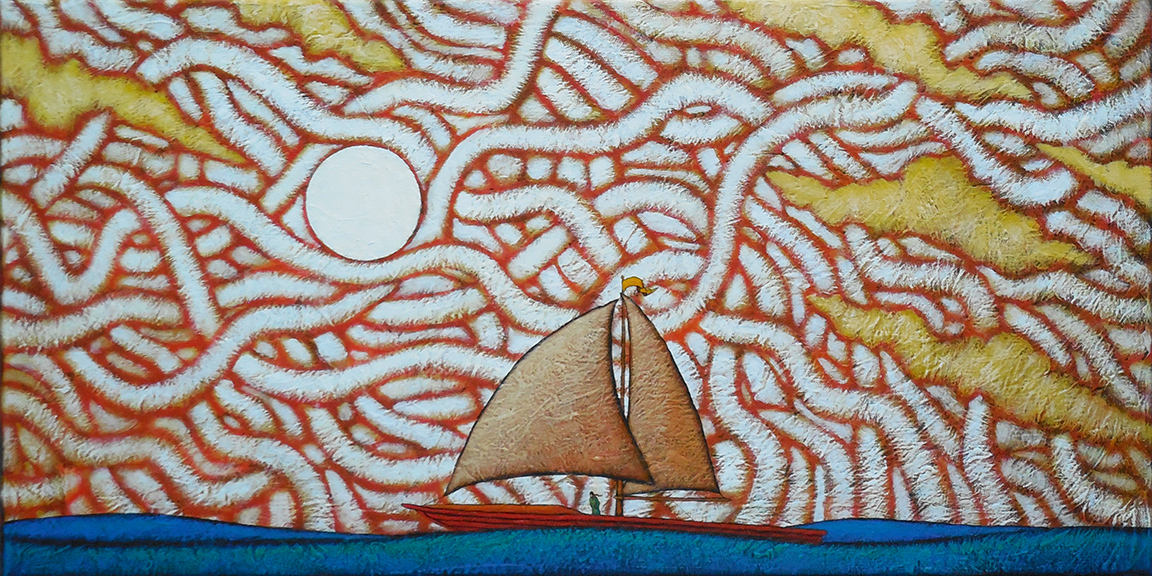
That’s all I am going to say this morning. Just liked that quote from the Empress Cathy and thought it might fit with the painting at the top. Or maybe not. Does it matter?

The painting by the way, Sea of the Six Moons, is currently hanging at the West End Gallery as part of their annual Little Gems exhibit. The show ends tomorrow, Thursday, March 13, so if you want to catch this always wonderful show, please get in today or tomorrow.

Here’s a song that may or may not fit alongside today’s painting and quote. I played it here four years back and it just hit a chord with me this morning. It’s The Dolphins from Fred Neil, who was best known for writing Everybody’s Talkin’ that was made popular by Harry Nilsson and its prominent connection to the film, Midnight Cowboy. I was going to play one of the covers of it that have been made, such as those by Linda Ronstadt, Tim Buckley, or Harry Belafonte, but I find that Neil’s original suits me best.


And then they stole our solace
(I can’t cry no more)
And then they stole our peace
(I can’t cry no more)
With countless acts of malice
(I can’t cry no more)
And hatred without cease
(I can’t cry no more)

Cry No More, Rhiannon Giddens


I have been painting intently for my annual June solo show at the Principle Gallery. The title for this year’s show, which opens June 13, is Entanglement. I am not ready to start sharing the details or work from this show yet except to say that it is providing the excitement I need to get me through the current state of this country and the world in general. I can’t completely turn off the sound and fury of the outer world nor my reactions to it. With what is taking place, to not have a reaction is unnatural.

I am not going to list or go into details of the atrocities that make me want to scream. There are too many in the firehose of horror with which we are being soaked. Just one or two of these would have people up in arms in normal times.

But these are not normal times. And unusual times require unusual effort.

I wanted to share a video and song that speaks to it in a way.

It is from one of my favorites, the talented Rhiannon Giddens, who studied opera at the Oberlin Conservatory and has become a force in Folk/ Americana/ World Music. The song, Cry No More, was written by Giddens in the aftermath of the 2015 Charleston, SC church shooting in which 9 church members were murdered. It’s probably hard to remember. There have been so many mass shootings in the years since that we barely notice anymore, to our great shame, when only 3 or 4 or 5 people are killed let alone a shooting from ten years back. 

The words at the top appear in a frame at the end of the video. These words and the lyrics of the song serve as a powerful reminder that we get what we put up with and that to be silent is to accept this status quo. 

All the tears in the world accomplish nothing unless they are followed with a powerful and unified voice.

So, cry no more.

Know your history. Know your mind. Speak up. Be loud.

I am sharing two versions of the song. The first is the original, shot in a Greensboro, NC church. It is spare and powerful with only her hand drum– an Irish bodhran— as accompaniment. The second is a zoom session from the pandemic year of 2020. More accompaniment and layered but maintaining its full power.


Miró Blues, Again

Blue II– Joan Miró

*****************

The picture should be fecund. It must bring a world to birth.

-Joan Miró

****************

The thought behind these words from Joan Miró is one that I often keep in mind. Art succeeds when it creates its own reality, when it brings a world to birth in the mind of those who behold it. The artist’s own belief in the reality of that new world is a large determinant in whether this birth takes place.

For myself, I almost always feel like I am taken to a different world, one as real as the world I inhabit in my human skin, by whatever is on the surface before me.

That is, when it works. Sometimes it is difficult to climb into that new world and that new reality that wants to be born on the surface is nothing more than a lifeless mishmash of paint blotches and lines. That is frustrating, to say the least.

But when it works, it is an easy glide into that new world with its own atmosphere and landscape, so familiar yet new and fresh in the nose and to the eye. It’s a thrill just to be in there for that time when taking on its lifeform.

Joan Miró (1893-1983) did such a thing with such ease. I am showing his Blue triptych from 1961 today. I find it interesting how intimate and alive they feel as single images on a screen where their scale fades away. These could easily be small paintings. But when you see them as they are in the two photos below, you can see their size and how it magnifies their lifeforce.

They are a world unto themselves.

Take a look for yourself. I have also included a video oDave Brubeck’s Bluette at the very bottom of the page that is played over a slideshow of Miró’s work. As Brubeck fans know, he sometimes employed Miró’s work in his own as well as on his album covers. All in all, just plain good stuff…


Didn’t feel like writing this morning and wanted to start out the week with something not troubling my mind. Something that is more about art, something that perhaps inspires or at least eases the mind. Something to make me feel fecund, to use Miró’s term. This post is from five years ago and felt good this morning, especially with the Dave Brubeck accompaniment to Miró’s paintings.


Blue I- Joan Miró


Blue III- Joan Miró