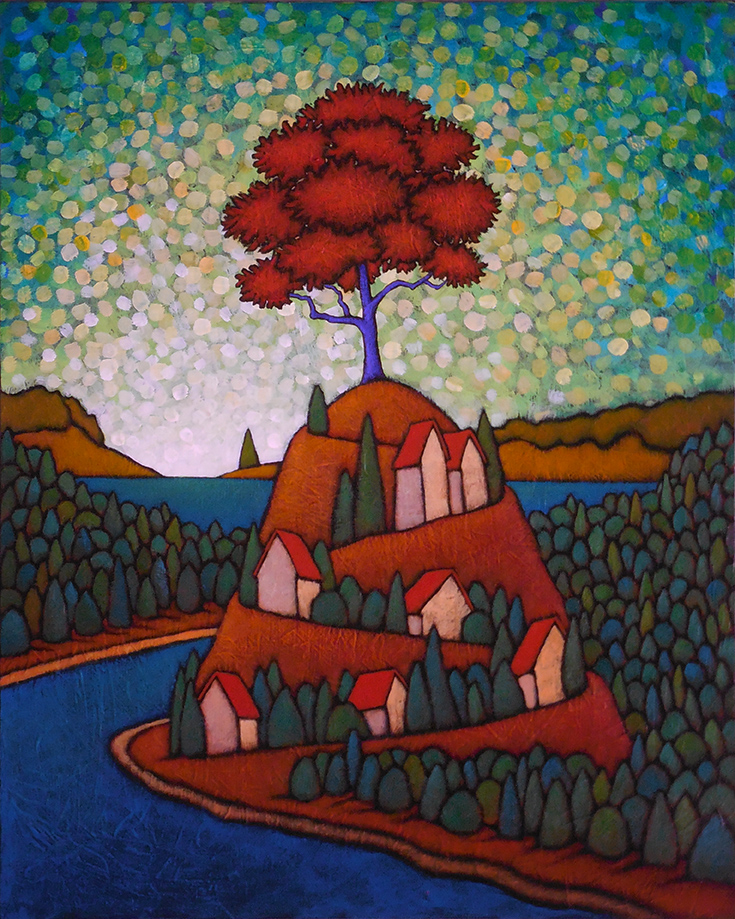
Feeds:
Posts
Comments

Balance/ Wyeth

Andrew Wyeth-That Gentleman


It’s all in how you arrange the thing… the careful balance of the design is the motion.

-Andrew Wyeth


I am running a bit late this morning but wanted to share the post below from several years ago, to feature the paintings of Andrew Wyeth but to also highlight the importance of balance in any work of art. I have lately been trying to reconcile the desire to have large fields of color within my work that will have instant visual impact with the need to also have balance and a sense of motion for the eye within the piece, even in pieces that depict stark stillness. It’s one of those esoteric conundrums in every piece of work with an answer that is only known after the fact– you don’t know what it is until you see it and even then, you don’t know how you got there. 

It’s something I can’t easily explain, if at all. But for this morning it serves as an excuse to look at some wonderful Wyeth pieces.


I recently read this quote from the late Andrew Wyeth then looked over a large group of his work, examining each piece with these words in mind. I could really see the importance of the placement of the elements in his work, how it was the characteristic that truly defined his work. It was this that gave his work a poetic feel.

His use of negative space is masterful, the empty areas taking on an important role in the overall feel of the work. Placing the central character, the focal point of the picture, in any in any other spot would change the whole piece, would make it feel less.

It would feel off balance, at least in the form that Wyeth defined it. That balance is his signature.

And I think that is true for many artists. This idea of balance and motion makes up the artist’s eye. Every artist has a slightly different way of seeing things which creates their own unique visual voice.

Myself, when I feel stuck or blocked or feel that I have painted myself into a creative dead end, I look back at older work. It is often the balance and motion with the composition that affect me the most. It serves as a reminder to not lose sight of this idea of balance, to not focus too  much on other parts of the painting that, while important, may not have as much effect on the overall impact of the piece.

Balance in the design creates motion. Good advice from Mr. Wyeth.


Andrew Wyeth– Spring Fed,1967

Eclipse


Nations, like stars, are entitled to eclipse. All is well, provided the light returns and the eclipse does not become endless night. Dawn and resurrection are synonymous. The reappearance of the light is the same as the survival of the soul.

–Victor Hugo, Les Misérables (1862)


Eclipse– At West End Gallery

Perhaps all people sometimes live through periods of eclipse, times when the light on which we depend seems to go away. Science tells us now that the light will soon return but to those who lived in the earlier ages of man, the sudden departure of light must have felt apocalyptic. I can only imagine the fearful panic and worry that must have filled them, not knowing if the light would ever return. Wondering if their lives, their futures, would be forever changed. How would they survive?

Maybe I don’t have to imagine. Maybe we are now in the time of a great eclipse.

I don’t know. But those feelings that our distant ancestors must have felt when the last bit of light they saw was obscured seem closer to the surface now, not lost in the mire of our long dormant DNA memories.

I want to believe that like the natural type of eclipse, the darkness of this cultural eclipse will soon give way to a reappearance of light. And I think it will.

The question is how long will this eclipse linger? Will our desire to see the light once more hasten its return? Or will we learn to dwell in a state of constant darkness, forgetting all that the light once gave to us?

Again, I don’t know. Not sure than anyone out there has a credible answer, one way or the other. All we can do is bide our time, lighting candles and torches against the darkness. Keeping light alive somehow.

After I finished this small painting, Eclipse, I knew that I liked it on a surface level. I liked it simplicity, forms, and colors. It seemed to work, to have a life energy. But I also felt that it was offering a message beyond its surface appeal.

This symbolic idea of an eclipse was the first thing that entered my mind at that point. I often attach symbolic meanings to my work that might only apply to my own interpretation. You might not see it that way at all. After all, we all perceive the world around us in different ways with different preferences and prejudices.

You might think that an eclipse is just an eclipse, and a cigar is just a cigar. That’s okay. We all take what we want and need from art. In this case, I see the bigger symbolism of this little piece and find myself waiting for, as Hugo put it, dawn and resurrection.

For this week’s Sunday Morning Music, here’s a song that I have shared a few times over the years. It’s alive version of Darkness on the Face of the Earth from Willie Nelson with Emmylou Harris sitting in. He wrote the song in 1962 and it was originally released that year by Hawkshaw Hawkins, who was a big country star at the time. He died in the same plane crash in 1963 that killed Patsy Cline. Nelson released the version on which this performance is based on his 1998 album, Teatro. Great album.

Eclipse is a 2″ by 4″ piece on paper that is now at the West End Gallery for their annual Little Gems show, opening February 7.


King of the Night Forest — At West End Gallery


The clearest way into the Universe is through a forest wilderness.

–John Muir, July 1890


I have mentioned that one of the things I like best about doing work for the annual Little Gems exhibit at the West End Gallery is that I get to work on new themes and directions. The smaller format is ideal for exploring new things– different color combinations, compositions, elements, etc. Over the 31 editions of  this show, some once new things have become regular visitors to my work where others have been limited to their one and only appearance.

This year’s show has one distinctly different entry– actually, two paintings of the same sort– to the body of my work. I very much enjoyed working on these and found myself looking at them constantly after they were done. If that means they will become part of my regular rotation for years to come or are simply a one-time entry for this time remains to be seen.

Some of my favorite themes had limited lifespans within the body of my work. Of course, I always reserve the right to revisit these themes in the future so they may not be really finished within the body of my work. Just paused. For example, my popular Archaeology series flourished for a year or two then moved to a place within my body of work where it shows itself every few years. And even then, it only appears in a handful of new pieces, maybe only two or three.

Sometimes, it simply depends on what I need to see in the work for myself. This work starts off as being explicitly for myself. While I might be pleased if others take to them, it doesn’t really matter to me so long as they spark some sort of excitement within me that can I carry with me into my other work.

There are two distinct pieces from this show that fall into this category. I don’t know where they fit yet or if they will become regular visitors. Or maybe they will become regulars that will never be shown outside my studio. Work for me alone.

The jury is still out on this new work. I like these new pieces a lot. They excite me, both in the process and in the way they carry their own different story and mythology. Maybe I need that new mythos right now in order to make sense of the bizarreness of what I see unfolding here recently. It leaves me feeling me more alone than ever and even more unmoored, as though the past I thought I knew and relied on was no more. 

Kind of like that feeling of which George Orwell wrote in 1984:

He felt as though he were wandering in the forests of the sea bottom, lost in a monstrous world where he himself was the monster. He was alone. The past was dead, the future was unimaginable.

Maybe I simply needed to see something different, something with its own reality, its own history and mythology. This work seems to fit that bill. Whether it remains it another question. I could see them effectively translated as much larger work– 4′ by 4′, for example. It would make for a dramatic and bold statement. But whether I go that route is unknown right now.

The first of these paintings is shown above. It is a little over 6″ by 6″ on paper and I call it King of the Night Forest. The title came from when I used to walk in the dark down to my home from my first studio that was up in the woods. I often did that walk without a flashlight or without any visible lights to guide me and found that the forest took on a whole different character in that darkness. Every sensation, every sound, every smell was magnified as I felt my way down the hill with my feet. Where I could peer deep into the forest during the day, I was now met with a deep blanket of opaque blackness.

The imagination could run wild. Maybe there were eyes watching from just beyond that wall of darkness? Maybe some being I didn’t recognize who only came out when the dimension of blackness. Maybe a whole civilization that lived in a dimension just a shade beyond our own, so near that in those dark moments when I found myself rubbing up against their dimension they could observe me. Maybe they were wondering what sort of strange beast was moving their space.

Perhaps one of those times it was the King of the Night Forest watching me slowly make my way in the blackness. 

I began these faces because they allow me to use pattern and color in their making. It really doesn’t feel much different to me than the process I often use in creating some of my landscapes that incorporate more colors, shapes, and patterns than is typical for my work. It is only the form and the narrative that emerges that is different. 

Where it goes from here, I don’t know. For now, it satisfies something with me that was in need of something new.

This painting, King of the Night Forest, and the other which I will show here in the coming days are available at the West End Gallery as part of this year’s Little Gems exhibit. The show officially opens Friday, February 7 but the work is now in the gallery and available for previews. 

I didn’t have a song in mind for this painting but right now, I feel like hearing Patti Smith and her 1978 collaboration with Bruce Springsteen, Because the Night.

Maybe it fits. If not here, maybe in the Night Forest.


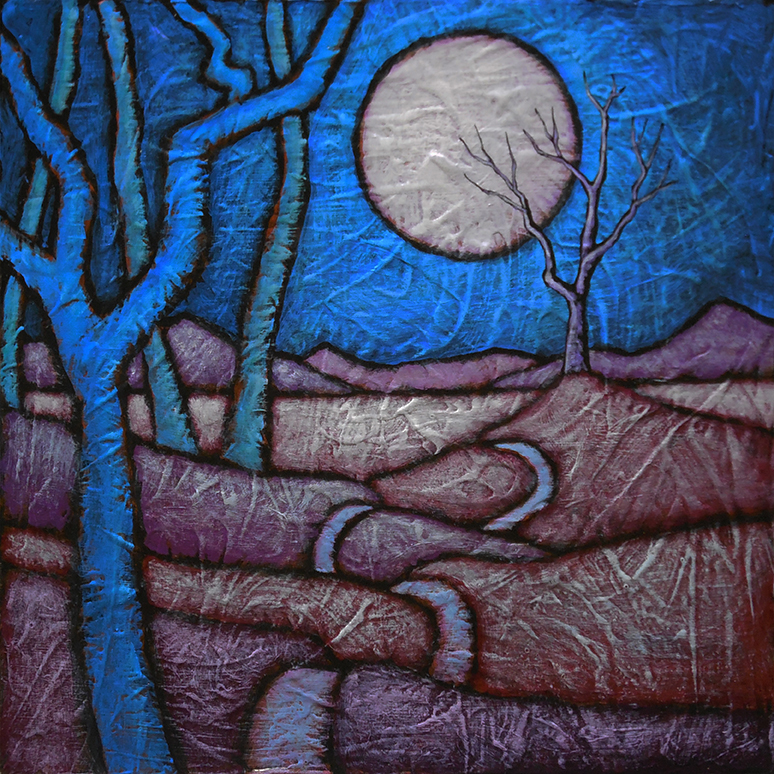
The Blue Moon Calls– At West End Gallery


Of The Empire

We will be known as a culture that feared death
and adored power, that tried to vanquish insecurity
for the few and cared little for the penury of the
many. We will be known as a culture that taught
and rewarded the amassing of things, that spoke
little if at all about the quality of life for
people (other people), for dogs, for rivers. All
the world, in our eyes, they will say, was a
commodity. And they will say that this structure
was held together politically, which it was, and
they will say also that our politics was no more
than an apparatus to accommodate the feelings of
the heart, and that the heart, in those days,
was small, and hard, and full of meanness.

–Mary Oliver, Red Bird (2008)


The question is: When the collective heart of a people has become small, and hard, and full of meanness, can a person keep their own heart from becoming the same?

Or maybe it should be: Is the condition of the collective heart, now small, and hard, and full of meanness, terminal? Can it ever be reversed so that one day in the future it will be said that we were a people whose heart was large, and soft, and filled with warmth and kindness?

Of course, only time will reveal the answers to these questions.

Time is, after all, the ultimate revelator.

On that note, here’s one of my all-time favorite songs, The Revelator, from Gillian Welch. When I worked in my first and much more rustic studio (no phone, TV, internet, or other distraction) up in the woods in the early 2000’s, this song was in heavy rotation on my playlist.

I imagine most of you know who Mary Oliver (1935-2019) was but for those of you not familiar, she was perhaps the best known and bestselling contemporary American poet in recent times. I have featured her work, including her best-known poem Wild Geese, several times in the past.


Sea of the Six Moons

Sea of the Six Moons– At West End Gallery


But the principal failing occurred in the sailing,
And the Bellman, perplexed and distressed,
Said he had hoped, at least, when the wind blew due East,
That the ship would not travel due West!

–Lewis Carroll, The Hunting of the Snark (1876)


I think the takeaway from this new small painting for me is that we sometimes find ourselves sailing on seas that don’t make sense.

The bearings that once guided our navigation have changed in ways that confuse us. The winds blow and the waves break in ways we have never seen before and don’t quite understand. Where there was one moon and recognizable constellations by which we could set a course, we find ourselves under a starless sky with six moons, some rising, some falling, some moving sideways.

And a familiar shoreline is nowhere to be found. And the only map we have is like the Bellman’s map in Lewis Carroll’s The Hunting of the Snark— a blank sheet of paper!

Lost sailors on strange seas with the only things we have at hand are ourselves, our imagination, a bit of courage, and the willpower to survive.

A dire situation, indeed. But we are still afloat and our sails intact. That is job one. We can do this.

Now that is my reading of this piece this morning at this particular moment in history. I have looked at this piece many times since I completed it a few weeks ago and saw it in more whimsical terms.  Less ominous and less fraught with peril. But either way, as a frightening allegory or as a flight of fancy, it satisfies me greatly. And that’s all I can ask of my work.

This piece is 8″ by 8′ on panel and is now at the West End Gallery in Corning. It will be included in their 31st annual Little Gems exhibit that opens February 7. The show is going up on the walls beginning today if you would like to stop in for a preview.

Here’s a song that leans heavily to the whimsical interpretation of this painting. It’s a version of a favorite Little Feat song, Sailin’ Shoes, performed by mandolinist Sam Bush, who is a big kahuna in the world of progressive bluegrass. Always good stuff and a good take on this song.

Now, to which moon do I set my course? There’s a snark out there somewhere to be found, for sure.


Winterglide— At West End Gallery


“In a room where people unanimously maintain a conspiracy of silence, one word of truth sounds like a pistol shot.”


Came out the door this morning and was met with -7°. Everything creaks differently at those temperatures, me included. I think part of my brain froze on the walk over to the studio so, instead of fumbling with that, I thought I’d share a post from 2019 that has been getting a lot of views here recently. The poem from Milosz is powerful and seems timely, especially that third stanza.

Struggle echoes and history rhymes…

I also added a song at the bottom, It Makes No Difference, from the Band. Their last living member, Garth Hudson, died yesterday at age 87. Hard to believe they are all gone.

But on the day the world ends their music will no doubt play on.


[From 2019]

I found that these intriguing words from the late Polish poet, Czeslaw Milosz that came from his acceptance speech for the Nobel Prize for Literature in 1980. But while researching this quote, I came across this poem that really spoke to me. I thought I would share this as well. It was written in Warsaw, Poland in 1944 in the midst of the Nazi’s destruction of that city.

Basically, he is saying that though the world might seem to be in chaotic and deadly turmoil, that some will see that the world as they knew it is obviously ending, there are those who will not notice. The sun is shining as it always does and the moon will rise soon after as it, too, always does. Birds sing and fish swim as they always do. People go about their days, working and playing, as they always do.

How can this be the end of the world if such things go on unaffected? How can atrocity exist side-by-side with the mundane?

But the end he may be describing may not be the actual end of the world, though for some it surely does. The world is always changing sometimes in small ways and sometimes in large swipes. Every change means the end of one world and the beginning of another. Perhaps, while he is surely pointing to an actual ending of worlds for his neighbors in WW II Warsaw, he is also referencing a symbolic ending to worlds of innocence, of worlds of gentleness, replaced with worlds of violence and treachery.

I don’t know for sure but that is how I am reading it. Take a look and decide for yourself.

**************************

A Song on the End of the World

On the day the world ends
A bee circles a clover,
A fisherman mends a glimmering net.
Happy porpoises jump in the sea,
By the rainspout young sparrows are playing
And the snake is gold-skinned as it should always be.

On the day the world ends
Women walk through the fields under their umbrellas,
A drunkard grows sleepy at the edge of a lawn,
Vegetable peddlers shout in the street
And a yellow-sailed boat comes nearer the island,
The voice of a violin lasts in the air
And leads into a starry night.

And those who expected lightning and thunder
Are disappointed.
And those who expected signs and archangels’ trumps
Do not believe it is happening now.
As long as the sun and the moon are above,
As long as the bumblebee visits a rose,
As long as rosy infants are born
No one believes it is happening now.

Only a white-haired old man, who would be a prophet
Yet is not a prophet, for he’s much too busy,
Repeats while he binds his tomatoes:
No other end of the world will there be,
No other end of the world will there be.

–Czeslaw Milosz   (1911-2004)


The Beat Goes On

The Beat Goes On— Soon at West End Gallery


The first vows exchanged by two beings of flesh and blood was at the foot of a rock that was crumbling into dust; they took as witness for their constancy a sky that is not the same for a single instant; everything changed in them and around them, and they believed their hearts free of vicissitudes. O children! always children!

–Denis Diderot, Jacques le Fataliste (1796)


This is a new piece from a group of small paintings that are headed to the West End Gallery for its annual Little Gems exhibit of small works. It was one of the first pieces I worked on for this new group. I wanted to play with color and form and silhouette.

I add silhouette because it is a big part of perception. That really becomes apparent the longer I live in the woods. Looking through the trees of the forest, especially this time of the year (winter– -4° this morning!) when the underbrush has died back, the fallen trees create strange dark silhouettes that sometimes make me stop in my tracks. There is a kind of primal response as, for a few moments, my imagination sees them as lurking dark creatures.

But all the time my brain is weighing out things and I quickly deduce from gained knowledge the reality of what I am seeing. It is too big or small or the line that would be the creature’s back is somehow not right. The primal response retreats and I am left to relish that momentary burst of imagined perception. It also makes me wonder how many reports of Bigfoots (or is it Bigfeet?) and other strange creatures have been of something far different than what those witnesses have claimed they were.

As I say, our response to silhouette is an important aspect of how we interpret things. I think that’s why I am drawn to the silhouettes of city skylines. They tell a story of growth and change. Or during wartime, of destruction and change.

We often see skylines as constants, being able to identify cities by landmark buildings. But around these few identifiable silhouettes, it is anything but constant. It is always changing as new building arise and old one come down. For example, the skylines of NYC from 1985, 2005, and 2025 are not the same.

Change is the only constancy.

That can be said for almost everything, not just skylines. The rates of change may vary but everything changes over time. Some things evolve for the better and we want them to be eternally that way. Some devolve for the worse and we can’t wait for even more change to come soon. Either way, it is our responsibility to adapt to these changes, good or bad, as they come.

Because changes will keep coming.

Like the old Sonny & Cher song from 1967 says, the beat goes on. That’s where I got the title for this Little Gem. There was also something both warm and cool in the colors that reminded me of the song’s famous bassline, suggested and played brilliantly by Carol Kaye. She was part of the famed Wrecking Crew, a group of L.A. session musicians who played on many of the hits of the 1960’s. Leon Russell and Glen Campbell, among many others, were alumni of the Wrecking Crew.

It is reported that Carol Kaye has played bass on an estimated 10,000 recordings in a career that spanned 65 years. I find that incredible. The beat truly does go on.

There’s more I could write about this Little Gem.  But I am just going to leave it here with the Sonny & Cher tune.

And the beat goes on…


Night Runner— At Principle Gallery, Alexandria, VA


What we have in life that we can count on is who we are and where we come from… For better or worse, that is what we have to sustain us in our endeavors, to buttress us in our darker moments, and to remind us of our identity. Without those things, we are adrift.

–Terry Brook, A Knight of the Word


Feeling adrift this morning, like I’ve lost sight of land and can’t exactly find my bearings. I am hoping that today doesn’t begin a long period of such a feeling for others in this country. Like forty years of drifting on empty seas or wandering aimlessly in the desert.

But as the fantasy writer Terry Brook points out above, when one is adrift in those darker moments all we can count on is who we are and all that this knowledge entails. Who we are is our strength and that must sustain us when we find ourselves adrift.

The question is: Who are we? Or should it be: Who am I?

I can’t say who we are anymore. I thought I knew but the fact remain that I don’t know.

Maybe I never did.

But I do know who I am.

I know what I value, what I respect, what I cherish.  I know my strengths and weaknesses, what I am and what I am not. And that can’t be changed because it remains the only compass bearing that I know for certain is true, the only one I trust to guide me when I am adrift.

And this morning, I feel far removed from my homeland. Adrift and in the dark with only who I am to guide me home.

Here’s a favorite song on that theme from Blind Faith with Steve Winwood‘s iconic vocals.


This Train

Going West— Thomas Hart Benton, 1926

The whole blear world
of smoke and twisted steel
around my head in a railroad
car, and my mind wandering
past the rust into futurity:
I saw the sun go down
in a carnal and primeval
world, leaving darkness
to cover my railroad train
because the other side of the
world was waiting for dawn.

Sunset, Allen Ginsberg, 1949


I have a lot to do this morning as I prep new work for the February Little Gems show at the West End Gallery so I am simply sharing a triad of image, word, and song with a train theme.

I went with a Thomas Hart Benton painting, an Allen Ginsberg poem, and a song from the great Sister Rosetta Tharpe who was a gospel giant and is also considered the godmother of rock and roll.

The Benton painting exudes the power and danger of a runaway train which seems fitting for today. A lot can change here in the next few days as we face a governmental upheaval that comes in with a bitter cold snap that will bring frigid temperatures to much of the country. Seems somewhat symbolic.

The Ginsberg verse has an ominous tone as well, evoking perhaps a trainwreck. Again, symbolism.

And The Sister Rosetta Tharpe song, This Train, offers a bit of redemption in the symbolic form of a train to glory.

There you have it on a cold and gray Sunday morning– fear and loathing along with a just a bit of hope that the train stays on the tracks.


Summerdream


I do not know whether I was then a man dreaming I was a butterfly, or whether I am now a butterfly dreaming I am a man.

–Zhuang Zhou


I love this famous anecdote above from the great Daoist philosopher Zhuang Zhou, who was born sometime in the 4th century BCE. Like most things worth thinking about, it has no answers for us, only questions. In this case, the question being how we discern what is reality and what is a dream.

I am not going to get into a philosophical argument here this morning on that question. I only mention it because it reminded me of the painting above and the feeling I take away from it.

It is an early piece of mine from thirty years ago, back in 1995, that I call Summerdream. I’ve been looking at it a lot recently as I prep it to be part of the upcoming annual Little Gems show at the West End Gallery.

It’s a small piece that has always resonated with me. I love its forms and simplicity. But more than that, it has a sense of solidity in the way it is painted with deep saturated watercolor while still giving me a dreamy, ethereal sense of floating. I like this dichotomy, its appearance of earthly solidity alongside a diaphanous airiness in its felt atmosphere.

Like Zhuang Zhou, I find myself asking which is real and which is the dream here.

I don’t know for sure. Perhaps I am actually a butterfly dreaming that I am a man wondering such a thing? Or maybe both I and my butterfly alter ego are just a tiny part of a dream dreamt by a tiny being that dwells forty dimensions of time and space from where I sit? 

Maybe or maybe not. We will most likely never know and that, in itself, might be the only correct answer. We deal with the reality in which we find ourselves at any given moment.

Right now, I am a guy sitting in the dark of a winter morning. That’s my reality right now. But later, I might look at this painting and find myself as a floating butterfly.

And that will be an acceptable reality then.

Here’s a well-worn song, from the Cranberries and the late Dolores O’Riordan, Dreams.


Summer dream is a 5″ by 7″ watercolor on paper, framed at 11″ by 14″. It will be available at the West End Gallery as part of their annual Little Gems show, which opens February 7. This painting and a group of new small paintings will arrive at the gallery later this week. The gallery is currently on a short winter break and will reopen this coming Tuesday, January 21.