Feeds:
Posts
Comments


“Oh well, bears will be bears,” said Mr. Brown.”

― Michael Bond, More About Paddington


We’ve been visited just about every night recently by a family of bears, Mom Bear and her 3 young ones. I believe they are yearlings, probably not far from the time when they will be set out on their own by Mom. The photo above was from the night before last, right around 7 PM. It was a little earlier than their usual as they normally come under the cloak of darkness to invade our bird feeder, so I was able to get a few shots of the group. This shot was taken from a window in our dining area.

We normally get visits from bears several times a year. They usually tear down and empty our suet and hummingbird feeders or destroy two hanging feeding platforms that I continuously remake from old picture frames. Our large main feeder is on a pole that is about 9 feet off the ground because over the years bears had destroyed a few of our previous feeders on the shorter post that was then in place. We wrapped the pole with stovepipe because the taller post alone didn’t dissuade the bears from climbing up to get the feeder. You can see how crunched and dented the stovepipe now is from years of their attempts to climb it.

This group has made our feeder a regular stop on their dining schedule lately, to the point that I now go out as it is getting dark to stow away our platforms and the suet. They came this night before I had chance to get out there. Mom was not really feeding this time and seemed to be just showing the gang the ropes. She was super attentive to noises up in the woods and down the driveway and would sometimes lumber off to a point higher in the yard to sit and watch over the young ones. 

We gave them quite a while to feed off the fallen seed on the ground. But when one of the little guys finally stretched up and was able to grasp one of the platforms, spilling the seed all over its head, we decided it was time to head out to disrupt their party before they destroyed the platform and crushed the suet cages.  Merely opening our backdoor caused them to scatter, Mom and one of the small ones quickly heading up into the forest and the other two setting down through the yard toward our pond in full sprint mode. They might seem to lumber around but when they need to move their speed over open ground is startling. I don’t know that many large dogs could run faster.

We were worried that they might be separated but a few hours later they were all together again and revisiting the bird feeder.

We enjoy having them around even though they tend to periodically tip over our garbage and compost bins or invade our feeders. Or when Mom leaves big piles of, uh, let’s just call them calling cards all around our yard and bird feeder. Though I admire their resilience and love seeing their natural beauty, I find myself worrying for them. They have such a hard existence that it’s easy to overlook their occasional transgressions.

After all, bears will be bears.

I also want to remind everyone that I will be doing a painting demonstration at the West End Gallery on Saturday, April 26. My demo begins at 10 AM and runs to about 12 noon. Maybe a little later than that depending on how the painting I will be working on is progressing.

Gina Pfleegor-Unbound at West End Gallery

This event is being held in conjunction with the Arts in Bloom Art Trail of Chemung and Steuben County which involves open tours of artists’ studios and events such as this in the area’s art galleries. I mentioned in the earlier announcement for the demo that painter Trish Coonrod will also be giving a demonstration of her immense talent beginning at 11 AM but failed to mention that the wonderful Gina Pfleegor will also be giving a demo beginning at 10 AM.

So, at one point you can see three painters with three distinct styles at work.  I’ll certainly be taking a break or two from my own demo to watch Trish and Gina ply their talents as I am big fans of both.

Hope you can come out to the West End Gallery to spend some time with us, maybe ask a question or just chat while I smear paint on stuff. Could be fun.


Trish Coonrod- Still LIfe with Eggs and Shot Glass, West End Gallery


Lawlessness is a self-perpetuating, ever-expanding habit.

–Dorothy Thompson, The Courage to Be Happy (1957)


Let me preface today’s blogpost by saying that I am sorry for being compelled to write this but, though I knew it could, I never truly thought such a thing would happen here.


I didn’t know much about Dorothy Thompson before a few weeks ago. She was a journalist/ radio broadcaster who died in 1961 at the age of 67. She was, to put it plainly, an asskicker and a truth-teller. She interviewed Adolf Hitler in 1931 before he came to power for the magazine Cosmopolitan and soon after wrote a book, I Saw Hitler. Published just before Hitler became German Chancellor in 1933, she warned of the grave dangers presented if he were to ever take power.

The book infuriated Hitler. As a result, she was the first American journalist expelled from Germany in 1934. Arriving in Berlin she was greeted in her hotel within hours by Gestapo agents who gave her 24 hours to leave the country. A crowd of journalists gathered at the train station the next day as she left, presenting her with bunches of American Beauty roses as a symbol of their solidarity.

She became a celebrity, on equal footing with Eleanor Roosevelt in as being the most influential woman in America according to Time Magazine in 1939, as well as a symbol for journalism’s role in fighting fascism.

She spent the 30’s on a crusade to warn the world and particularly the USA of the threat that Naziism and Fascism posed to all countries. She famously disrupted the infamous 1939 German American Bund at Madison Square Garden, heckling and laughing at the speakers until finally being escorted from the building. Her efforts against totalitarianism were tireless.

And of course, many brushed it off as hyperbole. It might be no coincidence that she was married to Sinclair Lewis from 1927 until 1942, a period in which he wrote the prescient and dystopian novel It Can’t Happen Here which outlined just how an American candidate who fomented fear and division while making empty promises of instant prosperity is elected president. He then immediately takes complete control of the government and sets up a totalitarian regime.

Sounds familiar, doesn’t it?

I came across the quote at the top from Dorothy Thompson a few weeks ago and its truth screamed at me. Looking her up made wish we had a journalist like Dorothy Thompson right now who had the guts and the brains to speak truth to the naked lawlessness we are experiencing.

If you’re not paying attention, it’s high time to get your head in the game because as Thompson said, lawlessness is self-perpetuating and ever-expanding. In short, it’s going to get much worse if something doesn’t bring an end to it soon.

As an example, the idea that due process can be thrown out the window for any reason should terrify everyone. Without due process, anyone can be whisked off the streets and dispatched to a distant or even foreign detention center (you can read that as slave labor or concentration camp) without any chance to seek legal counsel or defend oneself against the charges–if there are even charges.

Without due process, they could basically disappear anyone at any time for little to no reason and with no determined length of sentence. You are just gone. You cease to legally exist. And there is no telling when and if you might return.

And you better believe that this has been part of their plan for some time. In fact, at yesterday’s meeting with the El Salvadoran president, Trump told him that El Salvador needed to build about five more even larger prison camps as Trump was planning on starting to send native US citizens there. He used the term home-grown.

Don’t try to shrug this off and say these people being whisked away to camps here and El Salvador probably did something to deserve this kind of treatment because without due process there is no way of knowing that. Due process provides the evidence, charges, and adjudication that have been the backbone of our legal system for as long as we have existed as a country.

It feels like we are about 8 seconds from being fully into fascism here as this administration totally ignores Supreme Court orders and openly makes plans to disappear all sorts of people. Disappearing people has long been one of the go-to moves for totalitarian regimes. Think of the several thousand people disappeared in Chile under Pinochet in the early 70’s. %o years later Chile is still dealing with the repercussions from that time. Or think about Argentina in the late 70’s/ early 80’s when it is estimated that around 30 thousand people, mainly political opponents or activists who spoke out against the dictatorship that was put in place by a military junta that overthrew Juan Peron, were seized and never heard from again.

The numbers that are being thrown around here would dwarf those from Argentina.

The idea that they could sweep anyone off the street and imprison them indefinitely without charges should concern you deeply.  You might think it doesn’t affect your life but it portends an even darker future where this corrupt and lawless government may very well affect every aspect of your life. Now is the time to stop this madness. The window for action is closing fast and there may not be an opportunity in the future. And depending on how the Supreme Court responds to their orders being tossed aside, that window might already be closed.

You might be shaking your head and saying that I should calm down, that this is all hyperbole. That such a thing couldn’t happen here. Dorothy Thompson heard that all the time and look what happened then when people ignored the repeated warnings from her and others.

It can happen here and will if we don’t act now. The crisis is now at hand and there is no avoiding it.

Here’s a song off the 1983 album Voice of America from Little Steven. The song is titled Los Desparecidos (The Disappeared) and is about those who were surreptitiously taken away in Argentina at the time. I urge you to pay attention to the lyrics here and be aware that it might well apply here now.

It can and will happen here unless we stop it now. As I stated at the beginning: though I knew it could, I never truly thought such a thing would happen here…


For more on Dorothy Thompson there is a fine article online from the United States Holocaust Memorial Museum.


Icon: Peter the Scoundrel


HOW I BECAME A MADMAN

You ask me how I became a madman. It happened thus: One day, long before many gods were born, I woke from a deep sleep and found all my masks were stolen,–the seven masks I have fashioned and worn in seven lives,–I ran maskless through the crowded streets shouting, “Thieves, thieves, the cursed thieves.”

Men and women laughed at me and some ran to their houses in fear of me.

And when I reached the market place, a youth standing on a house-top cried, “He is a madman.” I looked up to behold him; the sun kissed my own naked face for the first time. For the first time the sun kissed my own naked face and my soul was inflamed with love for the sun, and I wanted my masks no more. And as if in a trance I cried, “Blessed, blessed are the thieves who stole my masks.”

Thus I became a madman.

And I have found both freedom of loneliness and the safety from being understood, for those who understand us enslave something in us.

But let me not be too proud of my safety. Even a Thief in a jail is safe from another thief.

–Kahlil Gibran, The Madman: His Parables and Poems (1918)


I was recently looking at some paintings from 8 or 9 years back from a series I call Icons. The subjects are people pulled from my ancestry that were done in a rough way like religious icon paintings. I stopped over this one at the top, Peter the Scoundrel. This one has been one of my least favorites from the series for a variety of reasons, some aesthetic, but mainly because the character it portrays, my 3rd great-grandfather, was such an enigma.

His name was Peter Bundy though it’s hard to tell if that was his real name or just one of the several aliases he assumed in his lifetime. I shared his story here back in 2016 and what a convoluted and confusing one it was. It had an abandoned family, two stints in the Union Army in our Civil War under different names one of which ended in desertion, capture and imprisonment in Andersonville, and a couple of other aliases that hid who-knows-what. My investigation into left me with the realization that the only thing I knew of him for sure was that he was buried in a small country cemetery in Caton. His stone there lists the unit of his second stint as a soldier and that he was born in Scotland. While I think he served in this unit under the name Peter Bundy, I have my doubts as to whether he was actually born in Scotland or born with the name Peter Bundy.

It was a frustrating look into his life, like trying to reveal the identity of someone behind a mask. Just when you thought you were going to see the truth of that person, you pull off the mask you see only to discover there is yet another mask beneath. And another beneath that one and maybe another beyond that. 

It made me think of the masks many of us wear throughout our lives. Peter Bundy might be an extreme case but many of us have multiple faces we wear for different situations and people, often to the point where it becomes difficult to discern which face is real and which is a mask.

It is equally difficult to fully understand the reason for the mask we wear. Sometimes it is to deceive, plain and simple. Peter Bundy, for example. Sometimes we wear masks for protection against things we fear or to fit into situations where we feel uncomfortable. Sometimes we wear a mask simply because we don’t want to be who we are or to show our real self. There are many reasons and situations, some honest and some not, that cause us to don our masks.

I often wonder if there are those who never wear a mask and think that it must be a wonderful thing to be so comfortable in your own skin. I am sure they are out there, those people who feel so self-assured and real. But then I wonder if one would even be able to know for sure if that was not just a mask in itself.

That brings me to the parable at the top from Kahlil Gibran. I came across it the other day after sharing another short piece on a scarecrow that was from the same book of Gibran’s parables. It made me think of Peter Bundy’s masks as well as the many masks I have worn. But more than that, it made me think about the liberating feeling of shedding all your masks, to live with your naked face.

To live a life of transparency.

I realized that it’s something I aspire to through my work and this blog. I also realized that shedding every mask is not an easy thing. Some fit so well, feel so comfortable and protective, that they naturally just go back into place at certain times. 

I have also found that trying to resist the temptation to wear these masks often leads one to a need for solitude and caring less, if at all, how others see you. This would be the freedom of loneliness and the safety from being understood as Gibran put it. I would quibble a bit with the use of loneliness in this translation as I seldom, if ever, feel lonely in my solitude. In fact, I often feel lonelier out in the public. That’s when I most want to pull on my mask.

I don’t know that I’ll ever be fully without a mask or two. Can any of us really make that claim? Is it even possible?

Who really knows?

Let’s finish up with a song that’s not really about masks. Well, the more I think about it, maybe it is. It is about madness of a sort. It’s some great early Rolling Stones–19th Nervous Breakdown.

Here it comes, here it comes….


Tight Rope


The Dividing Line

The first method for estimating the intelligence of a ruler is to look at the men he has around him.

–Niccolò Machiavelli, The Prince (1513)


Have truer words ever been written about those who seek power?

It takes only a glimpse at the Rogues Gallery that surround our would-be king to understand that that this country is tottering on a tightrope today. Two words immediately jump to mind that I feel best describe our current government: kakistocracy and kleptocracy.

The first, kakistocracy, is a government run by the worst, least qualified, or most unscrupulous citizens. We got that in spades, folks.

The second, kleptocracy, is a government based on virtually unlimited grand corruption. one whose ruler– the thief-in-chief— grants almost absolute immunity to those he has authorized to loot on his behalf.

We are seeing textbook examples of both. Well, they would be textbook examples in a society ruled by a government that didn’t rewrite textbooks in their own image.

It leaves us up there on a shaky tightrope with little chance of keeping the balance needed to make it across with little to save us should we fall since we’re now working without a net since they dismantled it.

It is almost as though they want us to tumble off that rope.

I could be wrong, of course. I keep saying that, but they never seem to prove me wrong. And if I am wrong and this is truly the best and brightest that have been assembled to lead this country, we are in worse shape than any of us thought.

The kakistocracy and kleptocracy we are witnessing brings to mind another word– idiocracy. I have read many times that we are living in the most stupid of times and while it is terrifying, it also gives me hope that it cannot exist for too long.

The worst and the dumbest can only hold off the best and the brightest for so long. Only one can make it to the other side of that tightrope and my money– and effort– is against the worst and the dumbest.

Stay up there, folks.

Here’s a predictable song for this week’s Sunday Morning Music. It’s the late Leon Russell and his Tight Rope. I was surprised to see that I never shared this song here in the many years I’ve been doing this blog. Well, let’s fix that today, as well.


Night Karma

Night Karma (2002)


For the keynote of the law of Karma is equilibrium, and nature is always working to restore that equilibrium whenever through man’s acts it is disturbed.

–Christmas Humphreys, Karma and Rebirth (1948)


I came across the quote above from a book on Buddhism from a Brit named Christmas Humphreys. I had never heard the name but agreed the sentiment that nature is a continuously bringing the world into equilibrium despite our best efforts to disrupt and destroy its balance. Turns out that Christmas Humphreys was a famous British barrister as well as a judge at the Old Bailey later in his career.

But the more interesting part for me was that he was, in his lifetime from 1901 to 1983, one of the highest profiled Buddhists in Britain, having founded the London Buddhist Society and authoring a large number of books on the religion. After his death his home in St. John’s Wood became a Buddhist temple.

His involvement in a number of famous trials led to him being portrayed in several films, including a recent one (it’s on the streaming service BritBox now) concerning the Ruth Ellis trial, in which he was the prosecuting barrister. Ruth Ellis was convicted of murdering her abusive lover and was subsequently the last woman executed in the UK, hanged in 1955.

I guess that’s some sort of karma, right? Probably depends on your perspective.

Humphreys was also mentioned with a line– “I went home and read my Christmas Humphreys book on Zen“– in the 1982 Van Morrison song, Cleaning Windows. I thought that make a good final addition to today’s triad alongside Humphreys’ quote and the 2002 painting at the top, Night Karma. which is one only a few pieces that remain with me from what I call my Dark Work, those pieces painted in the period of about 18 months immediately after 9/11. It’s been a longtime favorite of mine here in the studio.

Now here’s Cleaning Windows from Van Morrison.


The Scarecrow

Not a Crow in Sight– At West End Gallery


THE SCARECROW

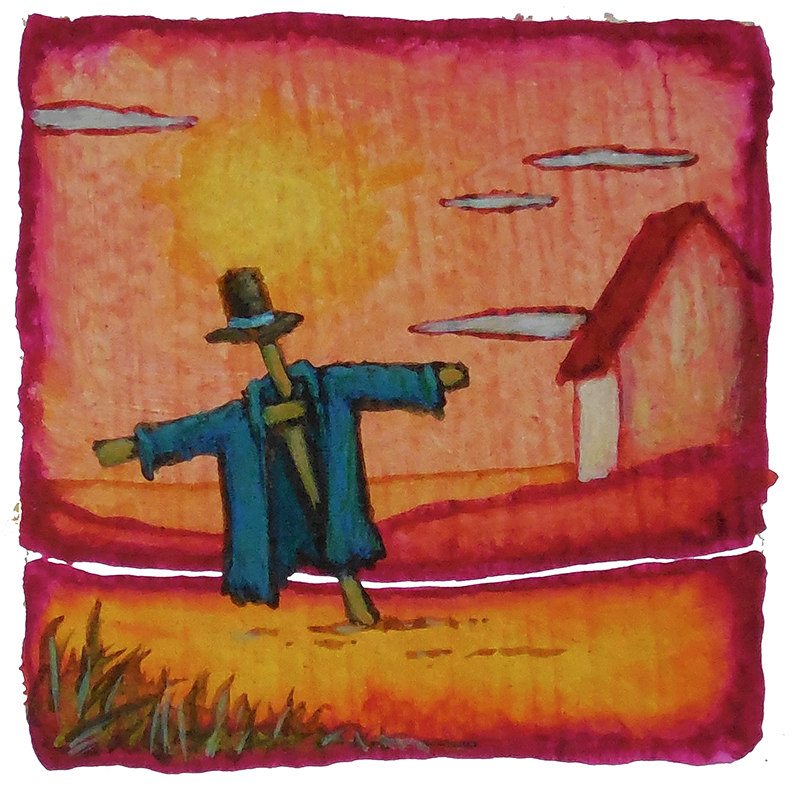
Once I said to a scarecrow, “You must be tired of standing in this lonely field.”

And he said, “The joy of scaring is a deep and lasting one, and I never tire of it.”

Said I, after a minute of thought, “It is true; for I too have known that joy.”

Said he, “Only those who are stuffed with straw can know it.”

Then I left him, not knowing whether he had complimented or belittled me.

A year passed, during which the scarecrow turned philosopher.

And when I passed by him again I saw two crows building a nest under his hat.

–Kahlil Gibran, The Madman, His Parables and Poems (1918)


Looks like the theme for today is the scarecrow even though I have already spent too much time attempting to write something altogether different.  The other and now discarded subject was just not coming together in any kind of cohesive way. But in a roundabout way it did lead me to the short parable above from Kahlil Gibran.

The answer from the scarecrow– “The joy of scaring is a deep and lasting one, and I never tire of it.” — struck my fancy.

I just stopped for a few moments after writing that to ponder what a strange phrase struck my fancy is. There may be a blog post in that phrase. Or not, which is probably for the better. Whatever strikes my fancy.

But the idea of that there can be joy in scaring is intriguing. I am not sure I ever felt scaring people was part of who or what I am. But taking joy in scaring those who richly deserve it might be within me. It probably should be within all of us just so that we keep the deserving aware of our presence and the power we possess over them.

That last sentence probably seems like pretty cryptic. Well, it probably is. Scarecrows are seldom what they seem so take it any way you wish.

Here’s a song, Scarecrow, from Beck just to round out today’s triad. Got to run– two crows are pecking around my hat…


Sea of the Six Moons– At West End Gallery


What we, thanks to Jung, call “synchronicity” (coincidence on steroids), Buddhists have long known as “the interpenetration of realities.” Whether it’s a natural law of sorts or simply evidence of mathematical inevitability (an infinite number of monkeys locked up with an infinite number of typewriters eventually producing Hamlet, not to mention Tarzan of the Apes), it seems to be as real as it is eerie.

-Tom Robbins, The Syntax of Sorcery (2012)


I came across the passage from author Tom Robbins, who died in February at the age of 92, while doing some research. One phrase from it, “the interpenetration of realities,” really jumped out at me. I am not ready to tell you what I was researching or why the phrase struck me as it did. That will be forthcoming and self-evident in the coming weeks.

But I will say that, for some reason, it reminded me of a favorite song, That’s the Way the World Goes Round, from the late John Prine. I think it has something to do with the constancy of the inevitabilities of life– the sun coming up and the sun going down, the tide coming in and the tide going out, the joy and sorrow that comes with living and dying, and so on. They all come to us at some point while this old world just keeps turning round.

That doesn’t really answer anything about the interpenetration of realities, does it? All I’ll say is that it made me wonder if the rhythms of our life cycles are modulated by other dimensions or worlds of reality that we may never know. Do they serve as a sort of unseen natural force, much like gravity, that keeps on track?

I don’t know. But rereading that just now makes me wonder if there was a little something extra in my coffee this morning.

I think I’ll just leave it there for now and share the song with the promise that I will sometime soon explain how the interpenetration of realities comes into play. Well, that is if I don’t forget…


Art is a human product, a human secretion; it is our body that sweats the beauty of our works.

–Émile Zola, Le Moment Artistique (1868)


Calvin and Hobbes from artist Bill Watterson has long been a favorite comic strip of mine. Though the strip ended its run in 1995, it is still rerun daily in newspapers around the country. The strip above was rerun yesterday and while Calvin’s sales spiel made me chuckle, it also reminded me of a blog entry from back in early 2009. It concerns the question of how long it takes to finish a painting, a question that has been asked of me many, many times at openings and gallery talks. I usually tell the story of a commission I did for a Finnish diplomat a number of years back and how the work I did on that piece became the template or rehearsal for a larger piece soon after.

The answer that I gave in 2009 still pretty much applies although I have noticed that in recent years that it is taking me longer to finish paintings. The processes I employ in my work have evolved, sometimes gaining steps that were not in place in the earlier years. I also tend to dwell on each piece a little longer now and am more apt to set them aside so that I can simply consider them before forging ahead. But there’s even a variable in that– sometimes the energy and direction of a piece is so determined that there is a danger in losing its momentum by setting it aside.

So, there is no one answer to the question. Here’s what I wrote in 2009:


I am asked this question at every opening and gallery talk:  How long does it takes to finish a painting?

Though it’s a question that I’ve answered a thousand times, I still have to stop and think about my answer.

You see, there are so many variables in my painting technique at different times that sometimes the actual process can be much longer or shorter on any given painting. Sometimes I can toil over a piece, every bit of the process requiring time and thought. There may be much time spent just looking at the piece trying to figure out where the next line or stroke goes, trying to weigh each move. Then there are times when the painting drops out effortlessly and I’ll look up after a very short time and realize that it’s almost complete. Any more moves from me and the piece would be diminished.

I often cite an example from a number of years ago. I had been working on a series of paintings, working with a particular color and compositional form. Over the course of a month, I did several very similar paintings in several different sizes from very small up to a fairly large version. Each had a very distinct and unique appearance and feel but the technique and color were done in very much the same way.

One morning at the end of this monthlong period, I got up early and was in the studio at 5 AM. I had a very large panel, 42″ by 46″ if I am not mistaken, already prepared and pulled it out.

Immediately, I started on the panel. Every move, every decision was the result of the previous versions of this painting I had executed over the past month. I was painting solely on muscle memory and not on a conscious decision-making thought process. I was painting very fast, with total focus, and I remember it as being a total whirl. The piece always seemed near to disaster. On an edge.  But having done this for a month I trusted every move and forced through potential problems.

Suddenly, it was done. I looked over at the clock and realized it had only been two hours. I hadn’t even had breakfast yet. Surely, there must be so much more to do.

But it was done. Complete.

It was fully realized and full of feeling and great rhythm. I framed the piece and a few weeks later I took it to the Principle Gallery in Alexandria, VA with a number of other new pieces. This painting found a new home within hours of arriving at the gallery.

I realized at that point that every version of that painting was a separate performance, a virtual rehearsal for that particular painting.  I had choreographed every move in advance, and it was just a matter of the having that right moment when plan and performance converged.

It had taken a mere two hours, but it was really painted over the course of hundreds of hours.

And perhaps many years of painting, listening, reading, and observing before that.

I hope you can see why I always have to think about this question…

Work in Progress 2025


If you’re a painter, you are not alone. There’s no way to be alone. You think and you care and you’re with all the people who care. You think you care and you’re with all the people who care, including the young people who don’t know they do yet. Tomlin in his late paintings knew this, Jackson always knew it: that if you meant it enough when you did it, it will mean that much.

–Franz Kline, Evergreen Review interview, 1958


Just taking a moment to announce the dates for two upcoming events at the West End Gallery in Corning.

The first is for my annual solo exhibit at the gallery. I have normally had my solo show at the West End Gallery in July. This created a short turnaround between my annual June show at the Principle Gallery and the July show at the West End which was very stressful. It has become more and more difficult as I have aged and my processes evolve. By that, I mean it simply takes longer to complete each painting. As a result, we have moved this year’s West End Gallery show– my 24th solo effort there— to the autumn.  The 2025 exhibit will open on Friday, October 17 and run until November 13. The date for the accompanying Gallery Talk will be announced later, closer to the show opening.

The second announced date is much sooner and for something I seldom do for a variety of reasons. However, after being asked for a number of years, I will be doing a painting demonstration at the West End Gallery in a little over two weeks, on Saturday, April 26. My demo begins at 10 AM and runs to about 12 noon or thereabouts.

This event is being held in conjunction with the Arts in Bloom Art Trail of Chemung and Steuben County which involves open tours of artists’ studios and events such as this in the area’s art galleries. Painter extraordinaire Trish Coonrod will also be giving a demonstration at the same time. We will both be in the Upstairs Gallery so if you’re interested it serves up a nice two-fer. A chance to witness two starkly different processes.

As I said, I seldom do these demos. However, I felt that it was important, with what looks to be a challenging year for the artists and galleries, to do all I could do to support the gallery that has been my home for 30 years now.

It’s definitely out of my comfort zone and I am more than a little self-conscious about painting in front of people. I think it’s partly because, being self-taught, I don’t necessarily paint in a traditional manner. It’s not always flashy and fast. I also worry that someone will be there only when the painting is in one of the flat and unflattering stages that almost all my paintings go through.

But despite my apprehensions, I am certain it will come off well. Things usually do okay when I am this nervous.

I know it’s early in the day, but if you’re interested, please stop in at the West End Gallery on Saturday, April 26 to watch and chat for a bit. It might be fun. No kibitzing though!

Here’s a time-lapse video from 2011 that shows the stages some of my work goes through on the way to being a painting.


The Sane Society

GC Myers- The Angst


Alienation as we find it in modern society is almost total; it pervades the relationship of man to his work, to the things he consumes, to the state, to his fellow man, and to himself. Man has created a world of man-made things as it never existed before. He has constructed a complicated social machine to administer the technical machine he built. Yet this whole creation of his stands over and above him. He does not feel himself as a creator and center, but as the servant of a Golem, which his hands have built. The more powerful and gigantic the forces are which he unleashes, the more powerless he feels himself as a human being. He confronts himself with his own forces embodied in things he has created, alienated from himself. He is owned by his own creation, and has lost ownership of himself. He has built a golden calf, and says “these are your gods who have brought you out of Egypt”

–Eric Fromm, The Sane Society, (1956)


I have written here about being a fan of psychoanalyst and humanistic philosopher Erich Fromm. Born in Germany in 1900, Fromm fled the Nazis in the early 1930’s and settled in America where he lived until his death in 1980. His 1941 book Escape From Freedom is a classic that theorizes that though we claim to desire freedom and personal independence, the vast majority of us run from responsibilities required in freedom, preferring to be ruled over. This is often cited as a leading factor in the rise of authoritarianism, then and now.

Fifteen years after Escape From Freedom, Fromm wrote The Sane Society which warned of the threat posed by the growth of both technology and capitalism that was taking place around the world, but most particularly here in the USA, in the 1950’s. As expressed in the passage at the top, Fromm saw it creating an environment in which alienation experienced by the individual is pervasive in our society. The new technologies of automation and mass-communication were purported to make our lives easier and safer, to give us more leisure time that would unite and bond us. Fromm saw it doing exactly the opposite, writing:

…Man has lost his central place, that he has been made an instrument for the purposes of economic aims, that he has been estranged from, and has lost the concrete relatedness to, his fellow men and to nature, that he has ceased to have a meaningful life. I have tried to express the same idea by elaborating on the concept of alienation and by showing psychologically what the psychological results of alienation are; that man regresses to a receptive and marketing orientation and ceases to be productive; that he loses his sense of self, becomes dependent on approval, hence tends to conform and yet to feel insecure; he is dissatisfied, bored, and anxious, and spends most of his energy in the attempt to compensate for or just to cover up this anxiety. His intelligence is excellent, his reason deteriorates and in view of his technical powers he is seriously endangering the existence of civilization, and even of the human race.

Moving nearly 70 years into the future, Fromm’s observations here seem to be spot on. I might be wrong, but the last part of this paragraph could well be describing the average person today. I wonder how Fromm would respond to the world as it is now, if he would simply view it as the normal progression of his theorized behaviors from the time in which he wrote his book. Or perhaps he would even be a bit surprised at the point of progression/regression where we find ourselves now. I am not sure that he completely foresaw the speed of change and the effects that would take place with computerization and the internet.  I have a feeling he might view AI as the Golem to which we might all soon be servants.

He does give some hope in how we might actually one day achieve a sane society, defining it as:

A sane society is that which corresponds to the needs of man — not necessarily to what he feels to be his needs, because even the most pathological aims can be felt subjectively as that which the person wants most; but to what his needs are objectively, as they can be ascertained by the study of man. It is our first task then, to ascertain what is the nature of man, and what are the needs which stem from this nature.

That entails, of course, determining what those universal needs might be. And that might be a problem, especially right now where those whose actions are subject only to what they want rule. Their subjective wants outweigh our objective needs.

Until there is a movement that can define our objective needs and how they might be reasonably achieved, we are destined to live out the scenario that Fromm saw back in 1956.

I am neither optimistic nor pessimistic on this. Well, that depends on any particular moment of any particular day. Pessimistically, I think the coming weeks and months will come at us harder and faster than many of us expect, presenting us with great challenges that may test our mettle in ways most of us have never faced. 

But optimistically, I think seeing that what is taking place might well have been foreseen 70 or more years ago indicates that it is part of a pattern of behavior. And once recognized, behaviors can be changed and futures altered.

If we have the willpower and the desire to do so.

I am hoping we do.

Good luck to us all…