Feeds:
Posts
Comments

I am giving a painting demonstration this morning at the West End Gallery in Corning. It begins at 10 AM and ends somewhere between noon and 1 PM. I realize that most folks will not be able to make it to the gallery today so I thought it might not be a bad idea to share a blog post from a number of years back, from early 2013, that gives a glimpse into how I work, though it doesn’t show the entire process from start to finish. For today’s demo, the painting I will be working on will be smaller than this and will be a simpler composition that will hopefully allow me to get further along in the process in the allotted time.

There will be other differences, of course, but you will have to be at the West End Gallery this morning to see that. The doors open at 9:45 so that attendees can claim a seat, which are limited in number, if they wish. Or they can stand and go back and forth between the artists that will be giving demos today. I will be painting on the 2nd floor of the gallery and painter Gina Pfleegor will be in the Main Gallery beginning at 10 AM. We will be joined around 11 AM by Trish Coonrod who will be working on the 2nd floor with me. And at 2 PM watercolorist Judy Soprano comes in take over and finish out the day. It should be informative, interesting, and maybe even a little bit of fun. Hope you can make it!

gc-myers-feb-2013-1

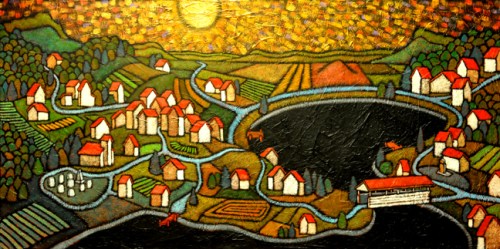
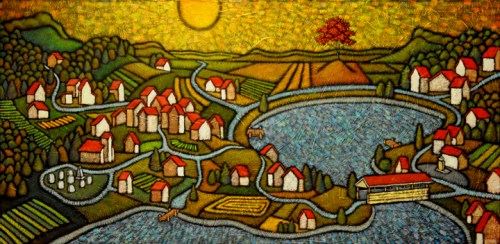
This is a new piece that I started over the weekend.  It’s a fairly large canvas, 24″ by 48″, covered with layers of gesso then blackened before I began to lay out the composition in the red oxide that I favor for the underpainting. I went into this painting with only one idea, that it have a mass of houses on a small hilltop. That is where I began making marks, building a small group of blocky structures in a soft pyramid. A little hilltop village. From there, it went off on its own, moving down the hill until a river emerged from the black. An hour or two later and the river is the end of a chain of lakes with a bridge crossing it. We’ll see where and what it is when it finally settles.

I like this part of the process, this laying out of the composition. It’s all about potential and problem-solving, keeping everything, all the elements that are introduced, in rhythm and in balance. One mark on the canvas changes the possibility for the next. Sometimes that possibility is limited by that mark, that brush of paint. There is only one thing that can be done next. But sometimes it opens up windows of potential that seemed hidden before that brushstroke hit the surface. It’s like that infinitesimal moment before the bat hits the pinata and all that is inside it is only potential. That brushstroke is the bat sometimes and when it strikes the canvas, you never know what will burst from the rich interior of the pinata, which is the surface of the canvas here. You hope the treats fall your way.

One of the things I thought about as I painted was the idea of keeping everything in balance. Balancing color and rhythm and compositional weight, among many other things, so that in the end something coherent and cohesive emerges. It’s how I view the process of my painting. Over the years, keeping this balance becomes easier, like any action that is practiced with such great regularity. So much so that we totally avoid problems and when we begin to encounter one, we always tend to go with the tried and true, those ways of doing things that are safest and most predictable in their results.

It’s actually a perfectly fine and safe way to live. But as a painter who came to it as a form of seeking, it’s the beginning of the end. And as I painted, I realized that many of my biggest jumps as an artist came because I had allowed myself at times to be knocked off balance. It’s when you are off balance that the creativity of your problem-solving skills is pushed and innovation occurs.

It brings to mind a quote from Helen Frankenthaler that I used in a blogpost called Change and Breakthrough from a few years back: “There are no rules. That is how art is born, how breakthroughs happen. Go against the rules or ignore the rules. That is what invention is about.”  

 You must be willing to go outside your comfort zone, be willing to crash and burn. Without this willingness to fail, the work becomes stagnant and lifeless, all the excitement taken from the process. And it’s that excitement in the studio that I often speak of that keeps me going, that keeps the work alive and vitalized.

It’s a simple thing but sometimes, after years of doing this, it slips your mind and the simple act of reminding yourself of the importance of willingly going off balance is all you need to rekindle the fire.

This is a lot to ponder at 5:30 in the morning. We’ll see what this brings in the near future.  Stay tuned…

gc-myers-feb-2013gc-myers-feb-2013-wipgc-myers-feb-2013-2wipgc-myers-game-of-life-small

Between the Sea and the Sun– Now at West End Gallery


Beauty is a terrible and awful thing! It is terrible because it has not been fathomed, for God sets us nothing but riddles. Here the boundaries meet and all contradictions exist side by side.

–Fyodor Dostoyevsky, The Brothers Karamazov


I’ve been thinking about contradictions lately, mainly in those contradictions that exist between our perceptions and reality. Most of us can easily see these sorts of contradictions in ourselves. Well, at least I think most of us can. Actually, for all I know, maybe most folks don’t see any difference in how they see themselves and how they really are. That would explain a lot.

But manly I have been thinking about contradiction as it occurs in art. I think the passage above from The Brothers Karamazov articulates this pretty well. Often art creates forms of beauty that challenge us with contradictions between what we know in our mind and what we perceive with our senses.

For my work, it comes in forms, colors, sizes, perspectives, omissions, and other aspects that one knows, when one really considers them, are unreal. They do not or cannot exist in reality in the way they are shown. The contradiction comes in the fact that this unreality is often perceived as a reality by the mind.

I realized this for myself a long time ago. The work always translated as reality to me, whether there were blue treeless hills, brightly colored patchwork fields, giant suns, or trees whose proportions sometimes defied perspective.

It basically straddled the boundary between reality and the totally fantastic, that area where those two contradictory terms meet and coexist. Unreality becomes reality. That area where what the mind knows (or believes) is nonsense begins to make sense.

As I have said in the past at Gallery Talks while groping to explain this, I never questioned the reality of what I painted. It always translated immediately in my mind as being reality.

It just was, despite all evidence to the contrary. The coming together of reality and unreality, which might well be used to define all art.

You know, I wasn’t planning on writing anything this morning and this thing just popped out. I hope it makes sense. Maybe it’s art because in my head it does…

Okay, I have to go get stuff around for tomorrow’s painting demo at the West End Gallery. It begins at 10 AM and goes to around 12 and maybe a little later, depending on how it is going. If it’s going well, I might keep working. If not, I might set the damn thing on fire right then and there. Just kidding– I would take it out of the gallery before setting it ablaze. Hope to see you there!

Here’s a song that caught my eye this morning. I didn’t think I had ever heard of it before, but the chorus made me think I had heard it at least once or twice. It sounded familiar. It’s a 1966 song called Painter Man from a group called The Creation. This group claimed that their music was as much visual as it was musical and sometimes had a member of the group painting while they played on stage.


Eye to the Future— At West End Gallery


You can have the other words-chance, luck, coincidence,
serendipity. I’ll take grace. I don’t know what it is exactly, but
I’ll take it.

— Mary Oliver, Sand Dabs, Five


I am getting ready for a painting demonstration I am giving on Saturday at the West End Gallery, beginning at 10 AM. This event is part of the Arts in Bloom Art Trail of Chemung and Steuben County which involves open tours of artists’ studios and events such as this in the area’s art galleries.

As I mentioned before, I seldom paint in front of people and am a little self-conscious as a result. Even more so when at one point on Saturday painters Trish Coonrod and Gina Pfleegor will also be showing off their prodigious talents. Both paint in a more traditional manner at a very high level of skill. I think of Trish’s talents as one would of a grandmaster pianist and Gina’s as that of a highly trained operatic soprano or a golden voiced chanteuse.

Me? I think of myself as a guy with an old and out of tune guitar who knows maybe three or four chords. Sings a little off key. What I lack in skill I try to make up for with the 3 E’seffort, emotion, and earnestness

I do whatever it takes to find something on that surface in front of me. It’s kind of like the line at the top from poet Mary Oliver— I’m forever looking for serendipity or, on those special days, grace to show up before me in the paint. There’s a lot of time when its appearance is an uncertainty and it can take some time to coax it out into the open. 

My hope is that it will choose to show up during the few hours I will be working on Saturday. I am still trying to decide if I should have a plan on how or what I will paint or if I should just let serendipity and grace decide for me. I am leaning toward the latter just because that path can sometime be the most exciting.

We’ll see what happens Saturday morning. I am hoping grace shows up for a brief visit.

I am sharing the rest of the Mary Oliver poem, Sand Dabs, Five, from which the line at the top was taken. I think that I could apply much of what it expresses to what I am trying to say as an artist., particularly those final lines.


Sand Dabs, Five

Mary Oliver


What men build, in the name of security, is built of straw.

*

Does the grain of sand know it is a grain of sand?

*

My dog Ben — a mouth like a tabernacle.

*

You can have the other words-chance, luck, coincidence,
serendipity. I’ll take grace. I don’t know what it is exactly, but
I’ll take it.

*

The pine cone has secrets it will never tell.

*

Myself, myself, myself, that darling hut!
How quick it will burn!

*

Death listens
to the hum and strike of my words.
His laughter spills.

*

Spring: there rises up from the earth such a blazing sweetness
it fills you, thank God, with disorder.

*

I am a performing artist; I perform admiration.
Come with me, I want my poems to say. And do the same.


The Communing

The Communing– Coming to Principle Gallery, June


In the spell of the wonderful rhythm of the finite he fetters himself at every step, and thus gives his love out in music in his most perfect lyrics of beauty. Beauty is his wooing of our heart; it can have no other purpose. It tells us everywhere that the display of power is not the ultimate meaning of creation; wherever there is a bit of colour, a note of song, a grace of form, there comes the call for our love. Hunger compels us to obey its behests, but hunger is not the last word for a man. There have been men who have deliberately defied its commands to show that the human soul is not to be led by the pressure of wants and threat of pain. In fact, to live the life of man we have to resist its demands every day, the least of us as well as the greatest. But, on the other hand, there is a beauty in the world which never insults our freedom, never raises even its little finger to make us acknowledge its sovereignty. We can absolutely ignore it and suffer no penalty in consequence. It is a call to us, but not a command. It seeks for love in us, and love can never be had by compulsion. Compulsion is not indeed the final appeal to man, but joy is. And joy is everywhere; it is in the earth’s green covering of grass; in the blue serenity of the sky; in the reckless exuberance of spring; in the severe abstinence of grey winter; in the living flesh that animates our bodily frame; in the perfect poise of the human figure, noble and upright; in living; in the exercise of all our powers; in the acquisition of knowledge; in fighting evils; in dying for gains we never can share. Joy is there everywhere; it is superfluous, unnecessary; nay, it very often contradicts the most peremptory behests of necessity. It exists to show that the bonds of law can only be explained by love; they are like body and soul. Joy is the realisation of the truth of oneness, the oneness of our soul with the world and of the world-soul with the supreme lover.

Rabindranath Tagore, Sādhanā: The Realisation of Life (1913)


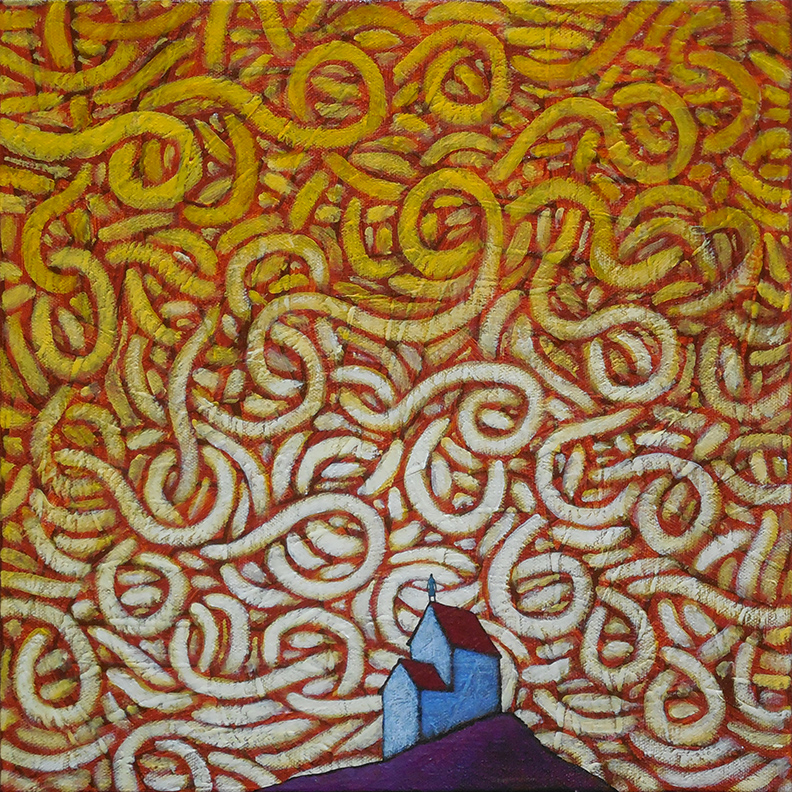
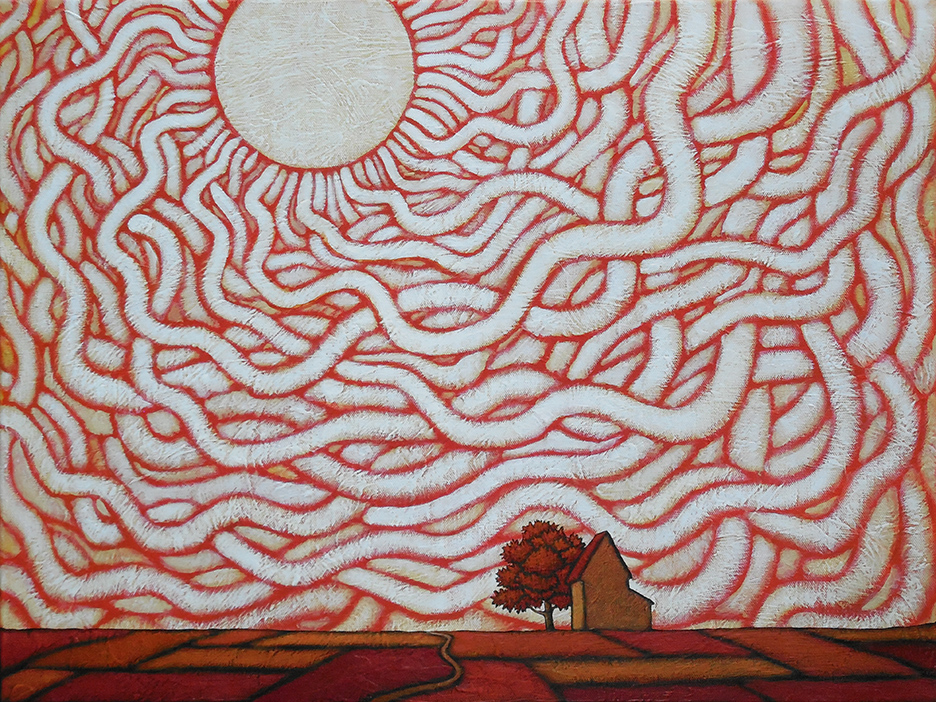
This is a new painting that is included in Entanglement, this year’s edition of my annual solo exhibit which opens June 13 at the Principle Gallery in Alexandria, VA. This painting while modest in size at 14″ by 14″ speaks volumes about the theme behind much of the work in this show, of which I gave a rough outline in a post here on Monday.

This painting is titled The Communing. and it speaks to, as the great Indian poet/philosopher Rabindranath Tagore put it in the passage above: the truth of oneness, the oneness of our soul with the world and of the world-soul with the supreme lover.

This goes back to the concept of singularity, one expounded by Stephen Hawking that theorized that the universe and all that it is was once a single thing, a single tiny point of zero radius and infinite density, before it the Big Bang exploded it and created all that we know the universe to be now.

We were all part of one thing. We were and, for that matter, still are that one thing. A oneness.

That’s what I see in this piece. I see myself as the figure on the rooftop, reaching out to the hidden knowledge of the universe that are represented here by the twists and entanglements of the bands that make up the sky. They create a sense of both mystery and interconnectedness. Of our oneness. They raise questions that can’t be answered while at the same time giving a sense of understanding.

And isn’t that the basis of all belief systems?

This was the first piece that employed these knot-like bands in the sky, and it immediately sparked something within me. It was like I needed to see them and this piece at that point. I have no idea how people will react to this painting and the ones that followed it. But, as I commented to my wife, it doesn’t matter– I needed to paint this now, if only for what I take from it.

It speaks to something needed by me now. And if it speaks or doesn’t speak to others at this time, so be it.

That’s the story of all art, right?

If you like, I’ll see you up on the roof…

Tango/ Passionata

Passionata–Now at West End Gallery. Corning


“It’s a tango.” Marco maneuvered me out among the dancers. “I love tangos.” “I can’t dance.” “You don’t have to dance. I’ll do that dancing.” Marco hooked an arm around my waist and jerked me up against his dazzling white suit. Then he said, “Pretend you are drowning.” I shut my eyes, and the music broke over me like a rainstorm. Marco’s leg slid forward against mine and my leg slid back and I seemed to be riveted against him, limb for limb, moving as he moved, without any will or knowledge of my own, and after a while I thought, “It doesn’t take two to dance, it only takes one,” and I let myself blow and bend like a tree in the wind. “What did I tell you?” Marco’s breath scorched my ear. “You’re a perfectly respectable dancer.”

-Sylvia Plath, The Bell Jar (1963)


I am busy this morning and was planning on skipping the blog today. But this song, Tango, from jazz great Diane Reeves came on and I immediately felt like it should be shared. It’s a wordless song and for Reeves the composition serves as a sculpture’s underlying armature that she fills in with her improvisational skills. I’ve heard a number of performances of this song and each has its own distinct feel. It is the same song but always unique. It almost feels new each time, and in reality, it is.

I’ve often described my painting in similar terms. There are compositions that I fall back on over and over again, but they are never really the same. There are so many varying and constantly changing factors that go into each piece that I would be hard-pressed to recreate any piece in the same way twice. The color choices change, sometimes subtly and sometimes in much more drastic ways. The textures change. My brushwork changes, often as a result of the change in my brushes as they age from use. What I see as the focus of the painting shifts, sometimes altering everything.

And to top it off, I seldom do anything exactly the same way all the time. This sometimes makes things feel exciting and new in the moment. And sometimes, it can be frustrating. Like so many things in life.

Just wish I could paint as well as Diane Reeves sings.

I have seen this song called Tango du Jour which no doubt is a nod to each performance’s uniqueness. Whatever you want to call it, it’s a tour de force. This is from a 2013 performance in Istanbul.


Entanglement

The Entanglement— Coming in June to Principle Gallery


So the universe is not quite as you thought it was. You’d better rearrange your beliefs, then. Because you certainly can’t rearrange the universe.

–Isaac Asimov, Nightfall (1941)


 I have been extraordinarily fortunate to have had solo exhibits at the Principle Gallery in Old Town Alexandria, VA every year since 2000. This year’s exhibit, my 26th solo effort there, opens Friday, June 13, and is titled Entanglement. The painting at the top is the first piece from this show that I am sharing. It is titled The Entanglement.

At my last Gallery Talk at the Principle Gallery this past September, I spoke briefly about my own belief system. I can’t remember exactly how I put it since I pretty much speak off the cuff at Gallery Talks, but I vaguely remember beckoning at my work on the walls behind me and stating that one could observe my entire belief system in those paintings. It was not of any particular religion nor was it a rejection of any other. I pointed out that we all have a belief system of some sort. Even Atheism or whatever else you might call believing in nothing is a belief system. Mine, as shown in my work, was simply how I saw the totality of the world and the universe, expressed in a way that my simple mind could comprehend and accept. 

I don’t know that I was able then to fully explain it in a way that was satisfactory to anyone but myself. Probably not. But I felt kind of freed up by just admitting to a belief system, however unformed and vague it might seem. Thought I had felt this way about the link between my work and my beliefs, saying it aloud made me look at my work in a different way. It became the impetus for this year’s exhibit.

Entanglement, the title of this exhibit, also is perhaps the most vital aspect of what I believe. Over the coming weeks, I will try to explain it a bit more, though my perception of it shifts and moves all the time.

You see, my belief system is not based on any dogma or doctrine or on any sort of demand for certainty. Human uncertainty is a given in my belief system.  I say human uncertainty because I do believe there is some sort of certainty in my belief system. But it’s more in the way of the immutable laws of physics. Well, the laws physics as an ill-educated person sees them.

And that’s where Entanglement enters the picture here. I see us as being manifestations of waves and bands of energy that have merged together to manifest and create flesh and blood beings. These beings, we humans, are temporary, existing for but a limited time on this physical plane. When that time comes to an end, their energy rejoins the bands and waves are constantly in motion around us.

We have free will in my belief system. There is no central figure overseeing and guiding our movements or choices while we in our physical form. Our freely chosen actions either create harmony or disharmony with these bands of energy. Good as we understand it might be seen as being in harmony with this energy while Evil might be seen as being in disharmony, which creates a disruption in the intricate pattern which these energy bands create.

However, it is a self-healing system, one that instantaneously begins to modulate and return itself to a state of harmony. The results of these healing actions within the system are sometimes referred to here as karma. As far as I my limited knowledge of history tells me, though there is always someone using their free will to choose disharmony, the system always comes back to a state of harmony within a reasonably short time. In short, evil seldom prevails for an extended period of time.

Much of what makes up this belief system of energy waves and bands is not inconsistent with other religions or systems of belief. Much of the underlying theology for most religions, once you strip away parochial dogma, is fairly consistent throughout the world. The Ten Commandments, after all, are generally rules which aim to create harmony and discourage disharmony. You needn’t be Christian to see that they aren’t bad rules to live by.

I am going to take a break from this for now. I get a little self-conscious talking about this, imagining someone reading this and rolling their eyes and saying, “What a nutjob!”

Not that I need to defend myself, I will say that it makes this world somewhat tolerable for me. When things are going bad for us as species, it allows me to believe that the system is already beginning to correct itself, aided by those on this physical plane who sense this disharmony and attempt to bring the world back into rhythm with their efforts.

There’s a lot more to it that I will share in the near future.  Actually, if you have read along for a while, you probably know what I believe already.

Now, getting back to this painting, The Entanglement. For me, I see this as being a scene of the harmony of which I have describing. The bands of energy move all around in patterns and directions we cannot sense and will never fully understand while we are here. It also creates a feeling of placidity in the scene as well as a sense of connection to the immense power behind it.

We are, after all, built from that energy, distinct parts of it. Our energy, our spirit, as we might call it, will forever be entangled with those ever-swirling bands of energy.

This connection and entanglement is the focus of much of the work from this year’s show. I find myself staring intently at the swirls and tangles in the skies I have painted for this show. Engrossed by its layers and shifts, I find myself sitting for a long time in front of some of these new pieces, often asking where it begins and where it ends. 

And I know there are no answers to these questions. And that’s just fine with me.

I don’t need an answer from that which I am.


The Entanglement is 18″ by 24″ on canvas and will be part of Entanglement, my annual exhibit at the Principle Gallery, opening Friday, June 13, 2025.


Easter Chick?


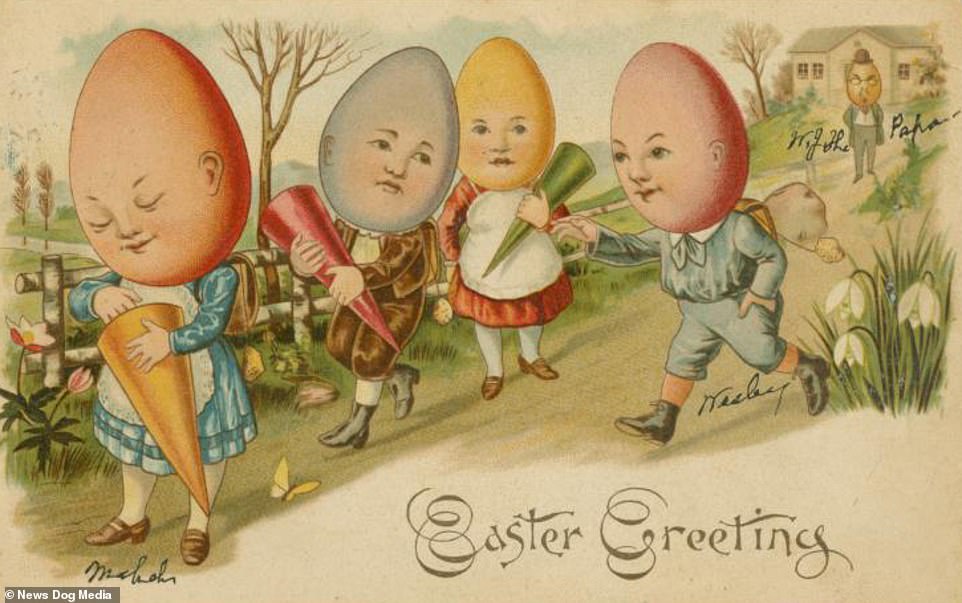
Not your typical Easter egg, I suppose. Most definitely different than the brightly colored eggs of my youth. I don’t recall any flirty topless young women on any of the Easter cards back then.

Maybe I was just looking in the wrong places.

Back then I never knew much about the origin of the egg in the Easter tradition. Never gave it much thought at all. But there is a story behind that iconic egg. Like the rabbit which has come to symbolize Easter as well, the egg stems from the pagan Easter festival which celebrated both as symbols of fertility and the emerging new life of spring. The coloring of the eggs, done in earliest times by boiling the eggs with flowers petals, also symbolized the budding colors of spring.

For the Christians part, the egg also had a part in their tradition. There is a legend that states that after the crucifixion of Jesus, Caesar summoned Mary Magdalene to appear before him, and upon hearing her claims that Jesus had been resurrected is claimed to have said, pointing at a nearby basket of eggs, “Christ has not risen, no more than that egg is red.”  At that point, the eggs supposedly turned red. Many orthodox Christians traditionally color their eggs red to symbolize this story as well as the sacrificial blood of Christ.

There’s also a pragmatic part to the story of the Easter egg. The festival of Lent, the 40 days prior to Easter that symbolize Jesus’ 40 days spent fasting in the desert, had long had a prohibition on all meats and animal by-products including milk and eggs. This created quite a surplus of eggs which would have gone to waste in those days long before modern refrigeration without their preservation by boiling.

Now, where the topless lady in that Victorian era card at the top falls into the story, I have not a clue.

The Victorians certainly had unusual tastes in their greeting cards. I’ve shared some in the past here but some of the ones below have me scratching my head. The couple below with the bunnies riding on chickens behind a sword wielding Rabbit Generals raise a lot of questions. Should we be readying for such an invasion?

Hmm.

For this Sunday Morning Music, I opted to not play an Easter song. I usually play a bit of gospel music from Sam Cooke or Mahalia Jackson. But here is a gospel-tinged song from the great Sister Rosetta Tharpe. Here’s her This Little Light of Mine.

Rockin’ good way to start your Sunday.


I am taking a short break today so if this looks familiar, it is a slightly edited replay from a couple of years back. Now get out of here or I’ll set those crazy chicken-riding rabbits loose on you…


Victorian Easter Egg 5Victorian Easter Egg 7


After all, the best part of a holiday is perhaps not so much to be resting yourself, as to see all the other fellows busy working.

–Kenneth Grahame, The Wind in the Willows (1908)


Next Saturday you can be the one to take a little break and watch some other fellows busy at work.

I am busy this morning but wanted to remind everyone that I will be doing a painting demonstration at the West End Gallery on Saturday, April 26. My demo begins at 10 AM and runs to about 12 noon. Maybe a little later than that depending on how the painting I will be working on is progressing.

As I mentioned earlier, I seldom paint in front of people and fewer people than you might think have actually seen me at work. Being self-taught with a process that is constantly shifting in one way or another makes me both self-conscious and a little protective of my process. But I thought this might the time to break out of that pattern and give folks a glimpse.

Depending on how it goes, it might be the only opportunity you’ll get! But I am determined to make it work out okay so I think it will be a bit of fun. Hope you can stop out next Saturday.

There’s a reason I mentioned being self-conscious about doing this. There will be two other extraordinary painters showing off their talents at the same time. The marvelous Gina Pfleegor will also be giving a demo beginning at 10 AM while painter extraordinaire Trish Coonrod will also be starting her demonstration beginning at 11 AM. It’s intimidating for me but for you it’sa great opportunity to see three painters with distinct styles working in one space at the same time.

And to sweeten the deal, later in the day the talented Judy Soprano will be giving a demonstration of her highly skilled watercolor technique, beginning at 2 PM.

There will be a lot going on at the West End Gallery next Saturday so put it on your calendar. Like I said, take a little break from your own work and come out to watch some other folks working hard.

I wanted to share a song about work here. I was contemplating the old Johnny Paycheck song, Take This Job and Shove It, but felt that was little too pessimistic. I like my job, after all. So, I am going with a song that isn’t specifically about working but is way more upbeat. This is Workout, from an Ed Sullivan Show appearance by the great Jackie Wilson. It kind of makes sense since I look at every painting session as a kind of a workout, a flexing oof those painting muscles.

Just don’t expect that kind of dancing next week, okay?

Go to go now– I have a painting workout waiting for me. Hope to see you next Saturday at the West End Gallery!


Hoffer/ Absolutes

Seeking Imperfection– 2001


Free men are aware of the imperfection inherent in human affairs, and they are willing to fight and die for that which is not perfect. They know that basic human problems can have no final solutions, that our freedom, justice, equality, etc. are far from absolute, and that the good life is compounded of half measures, compromises, lesser evils, and gropings toward the perfect. The rejection of approximations and the insistence on absolutes are the manifestation of a nihilism that loathes freedom, tolerance, and equity.

–Eric Hoffer, The Temper of Our Time (1967)


Several times I’ve shared the words of Eric Hoffer, the Longshoreman Philosopher as he was sometimes called who died in 1983 at the age 80. He had a way of stating complex idea in a straightforward manner. His 1951 book The True Believer, which sets out his theories on the rise of mass movements– most notably extreme political movements and cults– and the dangers they pose, is widely considered a classic of social psychology. You can read it and see many parallels to the

This particular passage spoke to me immediately when I came across it a few years back. It was something that seemed to be proving itself in real time with what we were and are experiencing here. It is a situation that might be described simply as a struggle between those who see things only in absolute terms and those who understand that there are few if any absolutes in an imperfect world such as ours.

A battle between unfounded certainty and founded uncertainty. True belief and true doubt.

Needless to say, Hoffer’s passage felt spot on for me, a creature who dwells in uncertainty. I could feel the truth in his words, particularly that last sentence: The rejection of approximations and the insistence on absolutes are the manifestation of a nihilism that loathes freedom, tolerance, and equity.

This one sentence might be the best description of the horror show we are experiencing first-hand.

Not sure why I am sharing this this morning. This passage has been sitting in my drafts file for a long time now and it just felt right this morning, a simple understanding of what we are witnessing, though I doubt any of you need to have it clarified for you.

Anyway, there it is. And here’s a song that speaks to uncertainty in equally simple terms. It’s What’s Happening?!?! by the Byrds from back in 1966, around the same time as Hoffer’s words. Nearly sixty years later and it is the same story. Nihilism then is nihilism now…


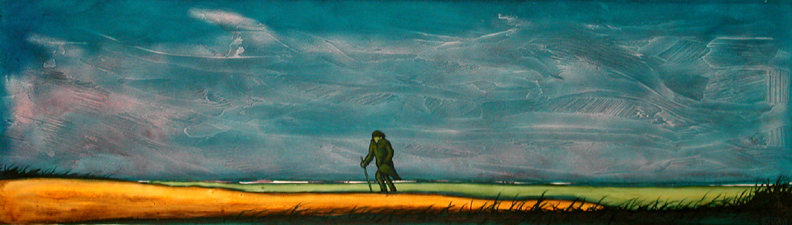
Peak of Solitude— At West End Gallery


Loneliness is the poverty of self; solitude is the richness of self.

–May Sarton, Mrs. Steven Hears the Mermaids Singing (1965)


Some of the most serious problems with our society stem from the hoarding of great wealth by the ultra-rich. Their constant need for more and more can only be fulfilled by sapping the wealth from those economically beneath them. But I’m not here to bitch about the super-wealthy today.

After all, there are problems that come with one hoarding anything. As it is with wealth, this drive to attain and hold on to more and more of anything generally causes a deprivation of something else. Everything we choose to do or attain has a cost of some sort.

We give up one thing for some other thing. If I do this, I won’t be able to do that. This might result from the cost in time, comfort, money, attention or almost any other thing. Time and money tend to be the biggest factors, or at least it seems so as I write this now. I will probably think of other examples moments after I post this.

I am a hoarder of solitude.  It is my precious in the same way the Ring of Power was for Gollum. I hold greedily onto it and am always seeking more and more. And also like Gollum, when I am without it, I am frantically seeking to regain it.

And I am willing to pay almost any price for it. I have paid for it with the relationships and time I might have with others or loss of opportunities and income for my work, among many other things. 

And the older I get, the more precious it becomes because solitude’s main currency is time, an ever-decreasing asset.

That may sound pretty sad to many of you. Maybe even a bit crazy. I get that and I can offer little if any defense or rationale to sway your opinion. Because when I am in the midst of my gathered solitude, what others think seems inconsequential. 

I think only another hoarder can understand that.

Here’s a lovely guitar version of Astrud Gilberto’s Corcovado also known as Quiet Night of Quiet Stars