Feeds:
Posts
Comments

The Happy Donor— Rene Magritte


I conceive of the art of painting as the science of juxtaposing colours in such a way that their actual appearance disappears and lets a poetic image emerge. . . . There are no “subjects”, no “themes” in my painting. It is a matter of imagining images whose poetry restores to what is known that which is absolutely unknown and unknowable.

–Rene Magritte, 1967, In a letter two months prior to his death


I am getting ready for my annual solo exhibit at the Principle Gallery. This year’s edition, Entanglement, my 26th such show at the Alexandria, VA gallery, opens five weeks from today on Friday, June 13th. I will also be doing a Painting Demonstration at the gallery the following Saturday, June 14, from 11AM until 1 PM. There is still a ton of work to be done so I am simply sharing a reworked post from several years back.


The quote above from Belgian Surrealist Rene Magritte reminds me of an instance where I didn’t fully get across what I was trying to communicate in response to a question while speaking to a group. It occurred at a demonstration and talk I gave before a regional arts group consisting of enthusiastic painters, some amateurs and some professional.

While I was working, a question was brought up about the importance of subject. Magritte elegantly stated in his words what I was trying to say that evening, that the purpose of what I was doing was not in the actual portrayal of the object of the painting but in the way it was expressed through color and form and contrast. To me, the subject was not important except as a vehicle for carrying emotion.

Of course, I didn’t state it with any kind of coherence or clarity. Hearing me say that the subject wasn’t important visibly angered the man who was an art teacher and an accomplished lifelong painter of realistic landscapes. He said that the subject was most important in forming your painting. I fumbled around for a bit and don’t think I ever satisfied his question or got across a bit of what I was attempting to say.

I think he was still mad when he left which still bothers me because he was right, of course. Subject is certainly important. It is the artist’s relationship that with the subject and the emotional response it elicits that allows the artist to create this poetry of the unknown, as Magritte may have put it.

While I am not interested in depicting landscapes of specific areas, I am moved by the rolls of hills and fields and the stately personae of trees that populate my work. I believe it comes through in my painting. Yes, I can capture emotion in things that may not have any emotional attachment to me through the way I am painting them, which was part of what I was saying to that man that evening, but it will never be as fully realized as those pieces which consist of things and places in which I maintain a personal relationship. It is always easier to find the poetry of the unknown in those things which we know.

But there is a caveat: The subject is often not the tree or the landscape, as much as it may seem the case. Often, it is the vague poetry made from that tree, the sky, the landscape, or whatever is chosen to paint along with things not visibly apparent that makes up the atmosphere of the painting.

That poetry is the real subject of a painting. 
Nature Forms

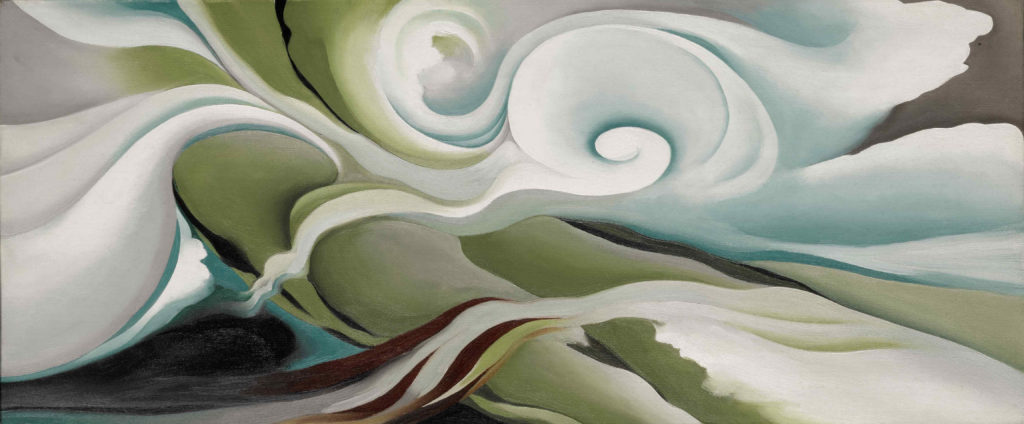
Georgia O’Keeffe- Nature Forms, 1932


I found things I could say with color and shapes that I couldn’t say in any other way… things I had no words for.

–Georgia O’Keeffe


I was really struggling to write this morning. Words just weren’t coming and the more time that passed, the more began to rush. And rushing is never a good thing when writing. Or painting. Or doing much of anything that involves creativity and thought.

In the end, I fell back on a favorite Georgia O’Keeffe painting and quote. The painting reminds me of the forms and rhythms I am trying to capture in my current work– the work I couldn’t write about this morning– and the quote pretty much sums up my feelings about what I do, which explains my inability to write on the subject this morning.

I am also sharing a favorite song from the Yardbirds that accompanied this O’Keeffe painting and quote here a few years back. Featuring fine guitar work from Jeff Beck, this is Shapes of Things from 1966. It sort of fits the theme here. And even if it doesn’t, it’s still a great song.


Trip the Light Fantastic— Coming to Principle Gallery, June 2025


Come, and trip it as ye go
On the light fantastick toe…

–John Milton, L’Allegro, (1645)


Trip the light fantastic. From Milton’s 1645 poem, it originally meant to dance nimbly. But for some reason, perhaps its phrasing or the derivations of the term over the centuries, it’s a term that summons up all sorts of images in my mind. But for the purpose of the new painting shown here, nimbly dancing might well fit as a description.

Using the phrase as its title definitely came to mind as the painting took on its final form. With the lively, rhythmic spirals and bright undercolor in the sky along with the rolling undulations of the sea, there is a feeling of a dance of sorts in piece for me. Of movement and countermovement, of rhythm matching rhythm and the joy that comes when that movement seemingly becomes effortless.

As though the two rhythms have become one.

As you may know, I am not a sailor. So, I can only imagine that there are those magical moments when the sea, the winds, and the sailor feel as one. I would imagine that would be an exhilarating feeling of unbridled joy and freedom.

That’s what I see in this piece. I feel lightened and brightened by it. But that’s just me…

This painting, Trip the Light Fantastic, is 15″ by 30″ on canvas and is from my annual solo exhibit at the Principle Gallery in Alexandria, VA. This year’s exhibit, my 26th there, is titled Entanglement and opens on Friday, June 13. Much of the work in this year’s show deals thematically with the bands and tangles of energy that make up everything, including us in our human form.

Much of it entails representing that energy in the sky of these pieces in a variety of ways– as twisting knot-like ribbons without beginning or end or cacophonous bands that interweave over and under one another. There are also some, such as this painting, that employ colorful rhythmic spirals.

It all makes for a striking look in each piece, one that make me really stop and consider each. The skies are often the central figures in this work, as much as the boat or the Red Tree or the house, and it’s hard to not dwell on finding some sort of meaning in them. There’s an almost meditative, therapeutic feel in many of these pieces for myself, both in the painting and the viewing.

Does that translate to other viewers? I don’t know. And maybe that doesn’t matter in the long run. It felt like I didn’t have any choice but to paint these pieces.  In some weird way, they demanded to be painted at this point in time.

Maybe I needed them for some reason. Some purpose.

I haven’t figured out the why of this. I only have the what at this point. And maybe, like so many things, I will never get the answer I seek. Maybe I am supposed to only ask the question.

If that’s the case, so be it. I am satisfied in continuing my search without answers if every so often I get to trip the light fantastic…


Time/Breathe

As In a Dream— At West End Gallery


Humans are amphibians — half spirit and half animal…. As spirits they belong to the eternal world, but as animals they inhabit time. This means that while their spirit can be directed to an eternal object, their bodies, passions, and imaginations are in continual change, for to be in time means to change. Their nearest approach to constancy, therefore, is undulation—the repeated return to a level from which they repeatedly fall back, a series of troughs and peaks. 

–C. S. Lewis, The Screwtape Letters (1942)


Taken from C.S. Lewis‘s satirical novel, these are the words in a letter from a senior Devil, Screwtape, to his nephew, Wormwood, who is a not yet fully a Devil, only a Tempter. I like its description of humans as amphibian creatures who attempt to exist in both the world of the timeless spirit and of the timebound physical world, with their only consistent trait being that are constantly changing.

I kind of see things in the same way. I don’t know if that would have made me a Devil in Lewis’ eyes. Doesn’t really matter, I guess.

Anyway, I am still on break but felt that I still had to share a piece of Sunday Morning Music. It’s become so ingrained and obligatory that it would nag at me if I didn’t at least make this small effort. So, without further ado, here’s a bluegrass take on Pink Floyd‘s classic Time with a short foray into their Breathe Reprise at the end. This is from the Kalamazoo, Michigan-based Greensky Bluegrass. a modern bluegrass group that feels more Phish-y than Bill Monroe. I like their treatment of this song and I very much like their name. Sounds like a title for one of my paintings. Maybe it will be someday. Who knows?

Now, have to run– time is short for this amphibian….


Gaining Understanding— Coming to Principle Gallery, June 2025


“Accustom yourself every morning to look for a moment at the sky and suddenly you will be aware of the air around you, the scent of morning freshness that is bestowed on you between sleep and labor. You will find every day that the gable of every house has its own particular look, its own special lighting. Pay it some heed…you will have for the rest of the day a remnant of satisfaction and a touch of coexistence with nature. Gradually and without effort the eye trains itself to transmit many small delights.”

–Hermann Hesse, My Belief: Essays on Life and Art


I am going to take a short break from the blog to try to catch up on painting and other preparation for my June solo show, Entanglement, at the Principle Gallery. I feel like I am behind schedule but can’t tell if that is reality or just a feeling, maybe a by-product of pre-show anxiety. I just get the sense at the moment that I at least need to feel like I am caught up.

I didn’t want to leave without sharing a new painting from the Principle Gallery show. The piece at the top is one of the smaller paintings, 10″ by 10″ on wood panel, from the exhibit. I call it Gaining Understanding.

I thought the passage above, especially that first sentence, from Hermann Hesse was appropriate for this painting. It also pretty much describes my early morning walk through the woods to the studio, usually in darkness. So often I stop along the way and look through the trees at the sky. The bracing coolness of the forest air on my skin, which is still warm from sleep, is refreshing.

I find that I feel closer to some kind understanding on those days when I start them in this way. I feel sharper, more in tune with something beyond me. It has a calming effect that seems to slow time a bit.

This small painting reflects that feeling for me.

I’m going to leave it at that before taking this short break. Well, I’ll throw in a song as well. This is If I Could Only Fly from the late Blaze Foley. He’s probably not on your radar, unless you’re in Texas or have followed Outlaw Country or Americana music for a long time. Foley died in a shooting in 1989 at the age of 40, never really achieving wider notoriety. But his music lives on, providing a rich legacy, as do the many quirky stories of his life. As the late Townes Van Zandt said of Foley, “He’s only gone crazy once. Decided to stay.” The writing in this song and his enunciation reminds me greatly of the late John Prine which makes sense as Prine recorded Foley’s song Clay Pigeons for a 2006 album.

I’ll be back soon. Thanks!


Silent Eye of Night- At West End Gallery

This is thy hour O Soul, thy free flight into the wordless,
Away from books, away from art, the day erased, the lesson done,
Thee fully forth emerging, silent, gazing, pondering the themes thou lovest best,
Night, sleep, death and the stars.

–Walt Whitman, A Clear Midnight


First day of May. Suddenly the deadline for getting the work ready for my June show at the Principle Gallery seems so much closer than it did just yesterday. It was only April then and the June show seemed months off. A distant dot on the horizon. I know it’s just a matter of perception, but time feels as though it constricted greatly in the last 24 hours.

The once distant dot has transformed into a growing knot in my gut.

Of course, as I have noted here in the past, this is all expected. I’ve been through this many, many times before with my solo shows. This feeling comes with every show, without fail.

So, after nearly 70 solo shows, it doesn’t approach as a stranger to me.

What that translates to is that I am shortening my time on this blog this morning and heading right to work. I am already feeling late. In lieu of any semblance of original thinking this morning I am sharing a triad of a bit of verse from Uncle Walt, a painting of mine now at the West End Gallery, and a 1966 version from Marvin Gaye of a song written by Willie Nelson in the late 1950’s, Night Life.

Do what you will with it all– I have to go now.


The Wisdom Beyond Words– Coming to Principle Gallery, June 2025


There is in all visible things an invisible fecundity, a dimmed light, a meek namelessness, a hidden wholeness. This mysterious Unity and Integrity is Wisdom, the Mother of all, Natura naturans. There is in all things an inexhaustible sweetness and purity, a silence that is a fount of action and joy. It rises up in wordless gentleness and flows out to me from the unseen roots of all created being, welcoming me tenderly, saluting me with indescribable humility. This is at once my own being, my own nature, and the Gift of my Creator’s Thought and Art within me, speaking as Hagia Sophia, speaking as my sister, Wisdom.

— Thomas Merton, Hagia Sophia (1961)


I was looking for something to accompany the new painting shown here, The Wisdom Beyond Words, and came across this passage from Thomas Merton. It’s the opening section of his prose poem Hagia Sophia written sometime around 1961.  Though it speaks through the dogma of Catholicism, it matches very well the belief system I somewhat laid out here a week or so back. As it often is with most religions, the underlying structure and belief is very much the same idea but with symbols, stories, and representations that reflect cultural differences. 

In short, this passage captured in words what I see and sense in this painting. It could very well be used to describe the theme of my Entanglement exhibit that opens June 13 at the Principle Gallery, which I have described as being how everything is contained in small part in every other thing. Much as it is in the theory put forward by Stephen Hawking that when a star dies it collapses into itself until it is finally a single tiny point of zero radius, infinite density, and infinite curvature of spacetime at the heart of the black hole formed from the star’s collapse. A single point of immense mass and energy This was referred to as a Singularity

Hawking looked at this singularity and wondered since this was the end point of star’s death could it not also be the starting point for future new universes that might emerge if this singularity were to explode outward– the Big Bang Theory.

The underlying thought is that the universe and all that it is was once a single thing before the Big Bang created all that we know the universe to be now from that single point.

We were all part of one thing. We were that one thing.

And it’s that unity and wisdom of all things, much like that of which Merton wrote, that I sense in this painting. 

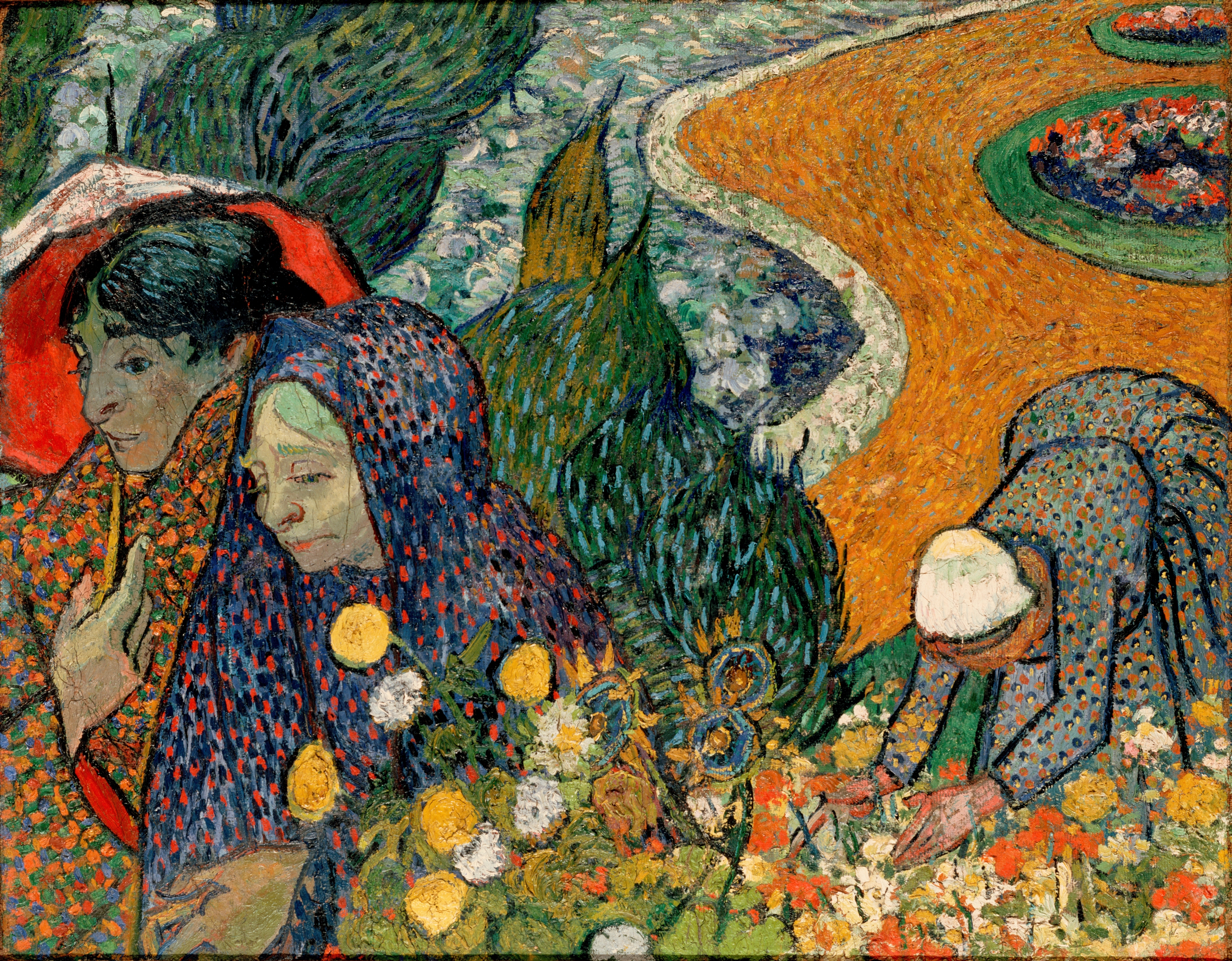
Vincent Van Gogh- Memory of the Garden at Etten (1888)


My aim in life is to make pictures and drawings, as many and as well as I can; then, at the end of my life… looking back with love and tender regret, and thinking, ‘Oh, the pictures I might have made!’ But this does not exclude making what is possible…

–Vincent Van Gogh, Letter to Theo van Gogh, 19 November 1883


Love this painting from Vincent Van Gogh with its wonderful color and the abstraction of the forms that comes from eliminating the horizon line. It was a piece that came to mind when I ran across this passage from Van Gogh. The words reminded me of something else, a thought that has been on my mind in recent times.

I was asked at my Gallery Talk at the Principle Gallery this past September [2019] if I ever had thoughts of retiring from my painting career. I think I made a bit of a joke about it, saying that I couldn’t afford to retire and would no doubt die while working away at a painting.

And that’s most likely true. I couldn’t imagine ever saying I am done as a painter.

It goes back to Van Gogh’s words above. I still see my artistic future brighter than my past, still envision important projects and better works to come. I still see my best work as being in the future, not dwelling in the distant past.

I can’t imagine that feeling ever changing. I can see myself on the day of my death, if I am capable of taking a moment to reflect on that day, will have that same regret that Van Gogh expressed: Oh, the pictures I might have made!

That being said, I must get to work. I am not retired yet and there are pictures to be made. The future is calling.


I have a few things that need to be done so I am running the post above from five years back. There are a couple of things to add to this post. The Van Gogh quote was taken from a wonderful letter to his brother, Theo, that addresses another question that has often hung with me over the years, that being whether or not I am an artist. I like Van Gogh’s answer that he would rather spend his time thinking about painting than using it to worry about labels or what he might or might not be. That’s pretty much where I have ended up after all these years, not giving a damn what label other might pin on me. I used to worry about whether I deserved to call myself an artist or even what to call whatever style my work might be. I’ll just do what I do and let others sort it out for themselves, if that’s what they want to do.

Let’s also add a song to this mashup. Here’s a song from Leonard Cohen (yay, Canada!) that I have shared a couple of times but by other artists. They were great covers from Willie Nelson and Tom Jones. I loved both but there’s often nothing like the original thing.

Okay. Got to run– the future is still calling…


Waiting For the End of the World – At Principle Gallery, June 2025


Someone called from across the water
‘Are you coming off that island soon?’
I hollered back
‘No, not yet—
I’m waiting for the end of the world.’
Then I turned back to watch the sky
As its currents and clouds
Surged and volleyed
In every way we know
And some we don’t know
And I thought to myself
With the sky racing around me
‘What a fine day it is–
Waiting for the end of the world.’


At the West End Gallery painting demo this past Saturday, someone asked when I titled my paintings, if I ever had title in mind as I worked on a piece. I said that generally it came after the painting was complete, when it was fully formed and whatever it was going to say was written on its surface. I didn’t say it quite that way, of course. 

I added to my answer and spoke about the painting at the top, a small 6″ by 12″ canvas, that is headed to the Principle Gallery for my June show there. I described that, while painting this piece, the verse above came into my head and was all I could think of as I worked. Shifting colors and words, it was a strange collaboration of thoughts for me, as I simultaneously edited and adjusted both the painting and the verse as I worked.

It made the words and the image bind one to the other in my mind.

Now, I realize the title may not seem compatible with the painting at first glance. I initially worried that the title was out of step with the theme of my upcoming show, Entanglement, which is about the unity of all energies and the idea that there is no beginning or end.

But what I see in the painting is a kind of tranquil acceptance of whatever hand fate deals in the here and now. An acceptance that allows you to recognize and appreciate the beauty of this moment and place.

A feeling of oneness with the universe, realizing that the end of the world is not the end of being. 

And that thought is completely in line with the theme of the show.

It’s a simple piece that packs a lot into a small space. But sometimes even the tiniest of things contain all that makes up this universe. As do we all.

Here’s song that I shared about five years back. It’s Push the Sky Away from a 2019 performance at the Sydney Opera House by Nick Cave, pianist Warren Ellis and the Sydney Philharmonic Orchestra. The song was originally from Nick Cave with the Bad Seeds.

Okay, that’s the end. No, not of the world– just this blog post.

But glimpsing out the window, it looks like a fine day to be waiting for the end of the world.


Thanks!


I would maintain that thanks are the highest form of thought; and gratitude is happiness doubled by wonder.

–G. K. Chesterton, A Short History of England (1917)


Many, many, many thanks to everyone who came out yesterday morning for the painting demonstration I gave at the West End Gallery. I know how precious time is so the idea that such a lovely group of people chose to spend a good portion of their Saturday watching me work blows me away. It was wonderful group that was attentive, inquisitive, gracious, and fun, with friends coming from as far away as Toronto, Syracuse and Binghamton for the event. 

I was nervous at the prospect of painting in front of a group, but these folks quickly alleviated my jitters with their easy laughter and questions.  I started the demo with a 12″ by 16″ canvas that had been prepped with multiple layers of gesso then a final layer of deep purple paint. Since I was determined to get as far into the painting as I could during the demo I painted faster than I normally would in the studio. I had decided that I would employ a blockish style in the sky that I sometimes use as it would get maximum surface coverage in the shortest time. The blocks were slapped in in multiple colors that often had a flat appearance to me at first.  That would be rectified in subsequent layers.

I had a vague idea of how I would compose the landscape below the sky but that was thrown out the window as I worked. Adjusting on the fly is often the case with my work. I opted for a simpler landscape with patchwork fields that is seen in much of my work. I asked the group if they would prefer the landscape with hills in the distance and they said yes to that. I blocked those in and then began shaping the landscape with payer of lighter colors.

I hustled along and finally decide to finish up with the prerequisite Red Tree. Of course, I had inadvertently forgot to pack the particular red that has been the staple for my red trees for the past 25 years. But as I said, art is seldom done under perfect conditions and often requires working with what is at hand. I ended up using a crimson that was a little heavier bodied and darker than I would normally use.

Without getting into all the details, the piece was more or less finished after a little before 1 PM. I was as surprised as anyone. I hadn’t anticipated getting anywhere near completion on this painting.

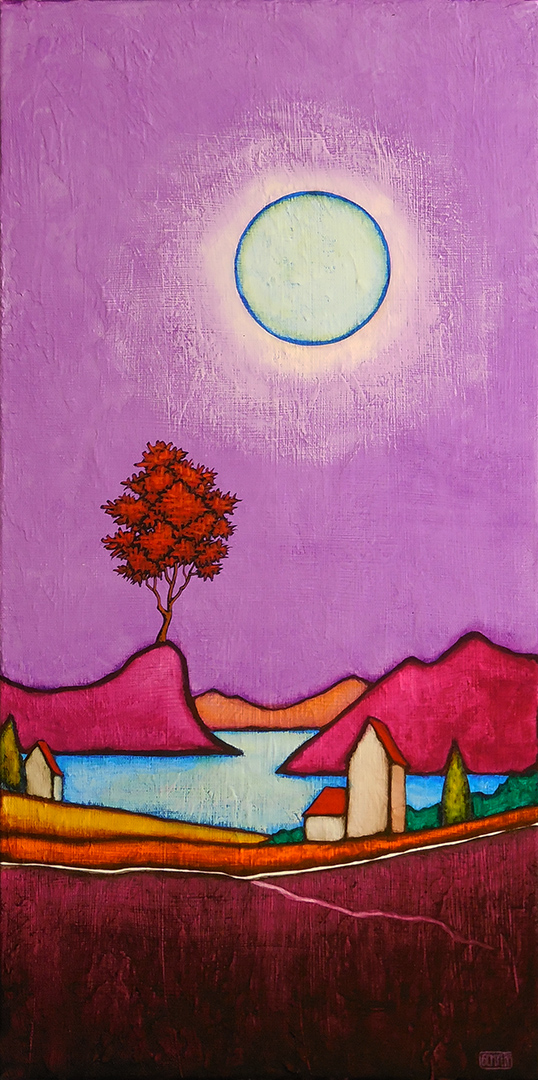
All in all, I am very pleased with the result. The image at the top shows how the demo piece turned out. Though it has a look of completion, it needs a bit of work before I would call it done. There are a number of areas in it that need to be refined and just looking at the painting now I see a number of small changes and adjustments that will be made. That includes reshaping and repainting the crown of the Red Tree which is not quite as expressive as I would like. As I said, I was hurrying a bit at the end in order to get to some form of completion.

All in all, I think the demo went well. I think it gave some insight into how this type of my work comes about and how creative decisions are made along the way in making any piece. It showed how the work seldom if ever proceeds in a straight line from beginning to end and that it is the ability to adjust and adapt that transforms a piece. 

Thank you once more for everyone that showed up yesterday. You made my task much easier and, while I can’t speak for you, you made it fun for me. And as fun is sometimes a rare commodity these days, I really appreciate that part of yesterday.

And a special Thank You to Jesse and Lin at the West End Gallery for coaxing me out of my cave for the day. Maybe we will do it again sometime in the future. Maybe with the other style, the wet work in transparent inks, that I began my career with. We’ll see…

Here’s this week’s Sunday Morning Music. It’s Bonnie Raitt’s cover of Thank You (that fits the theme here, right?) which was written by Isaac Hayes and famously recorded by the great Sam & Dave.

Thank you!